How to Convert a Corded Drill to Cordless Safely at Home
A corded drill can remain useful for years, but needing an electrical outlet and extension cord can become inconvenient when you work outdoors, in a garage, or far from available power. That naturally raises the question of whether an existing corded drill can be converted into a battery-powered tool instead of replacing it.
Learning how to convert a corded drill to cordless is less straightforward than attaching a battery where the power cord used to be. Most corded drills are designed to operate from 120-volt AC household electricity in the United States, while cordless drills normally run from much lower-voltage DC battery packs such as 12V, 18V, or 20V-class systems. The drill’s motor, switch, wiring, and electronics are therefore designed around a very different power source.
A true internal conversion is technically possible in some situations, but it often requires substantial electrical and mechanical redesign. It may also remove important electrical protections built into the original tool. For most DIY users, using a portable power station or buying a cordless drill is safer, simpler, and often cheaper.
This guide explains why the conversion is difficult, what practical options are available, how battery and inverter requirements affect the project, and when modifying the drill itself should be avoided.
How to Convert a Corded Drill to Cordless Safely
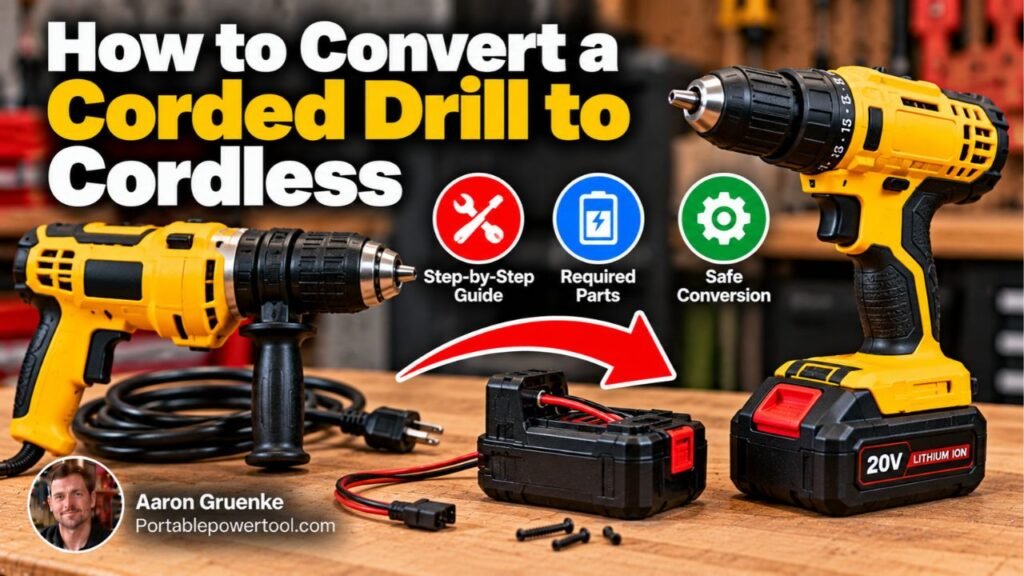
The most practical way to convert a corded drill to cordless operation is usually not to modify the drill internally. Instead, power the existing corded drill from a portable battery system that provides the same type of 120V AC power the drill was designed to use.
There are three general approaches:
- Use a portable power station with a 120V AC outlet.
- Use a properly sized battery-and-inverter system.
- Redesign the drill internally around a DC motor and cordless-tool battery system.
For most homeowners, the first option is by far the simplest.
A portable power station effectively allows the drill to remain electrically unchanged while giving you battery-powered portability. You plug the drill into the power station instead of a wall outlet.
An internal conversion is much more complicated because a typical cordless-tool battery cannot simply replace a 120V power cord.
Why You Cannot Simply Connect a Battery to a Corded Drill
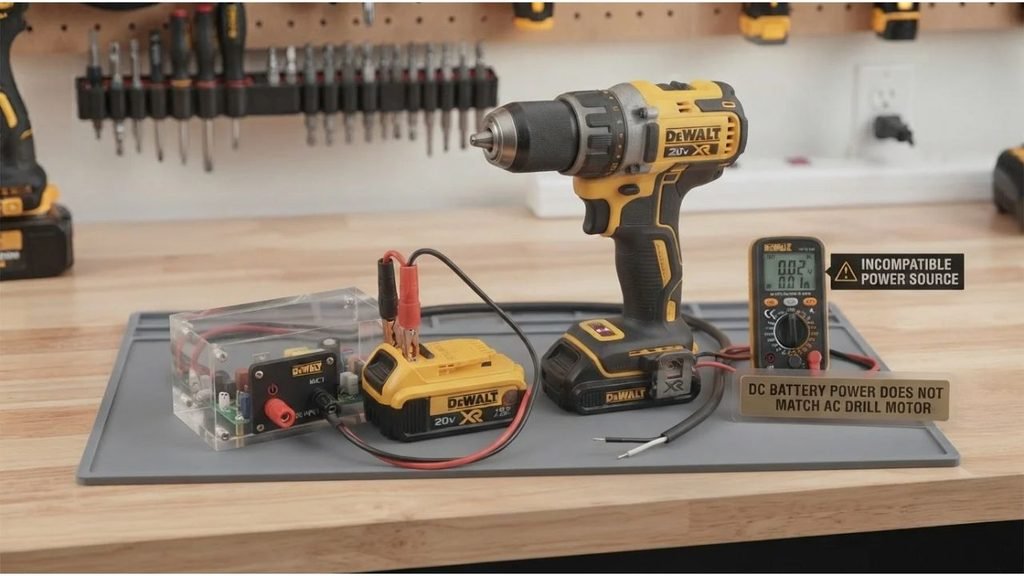
The main problem is the difference between AC voltage and DC voltage.
A typical corded drill sold in the United States is designed for approximately 120-volt alternating current (AC).
A cordless drill commonly uses a direct-current (DC) lithium-ion battery system.
Typical cordless-tool battery classes include:
- 12V
- 18V
- 20V MAX
- 24V
- 36V
- 40V and higher for some tools
Connecting an 18V or 20V battery directly to a motor designed for 120V AC will not make the drill operate normally.
Depending on the motor and electronics, it may not run at all, may produce very little torque, or could damage components.
The voltage difference is only part of the problem. AC and DC power behave differently, and switches or speed-control circuits designed for one system may not be appropriate for another.
The Easiest Option: Use a Portable Power Station
For someone who wants cordless-like portability without rebuilding the drill, a portable power station is generally the most practical solution.
A portable power station contains:
- Rechargeable batteries
- Battery-management electronics
- An inverter
- 120V AC outlets
- Charging circuitry
- Overload protection
You simply plug the corded drill into the AC outlet on the power station.
The drill continues receiving the type of electricity it was originally designed for.
Check the Drill’s Power Requirement
Look at the drill’s nameplate or manual.
You may see information such as:
- Voltage
- Amperage
- Wattage
- Frequency
A drill might be marked something similar to:
120V AC
60 Hz
6 amps
If wattage is not listed, a rough electrical calculation is:
Watts = Volts × Amps
For example, a 120V drill rated at 6 amps could theoretically draw around 720 watts under rated conditions.
However, electric motors may briefly require considerably more power when starting or when heavily loaded.
For that reason, the power station’s continuous output and surge capability should comfortably exceed the drill’s requirements.
Using a Battery and Inverter
Another method is to use a separate DC battery connected to a suitable power inverter.
The inverter converts battery DC power into approximately 120V AC electricity.
The basic concept is:
Battery → Inverter → Corded Drill
This approach can work, but it requires more attention to electrical sizing and protection than a ready-made portable power station.
The system may require:
- A suitable battery
- Proper battery protection
- An inverter
- Correctly rated cables
- Overcurrent protection
- Safe connectors
- A suitable enclosure
Because batteries can supply extremely high current during a short circuit, poorly designed wiring can overheat or start a fire.
For occasional drill use, a commercial portable power station is usually a cleaner solution.
How Large a Battery Would You Need?
Battery capacity is commonly expressed in watt-hours (Wh).
You can estimate theoretical runtime using:
Runtime = Battery watt-hours ÷ Tool watts
Suppose a drill draws an average of 500 watts while operating and the battery system contains 500 watt-hours of usable energy.
The theoretical calculation would be:
500 Wh ÷ 500 W = 1 hour
Real runtime would normally be lower because of:
- Inverter losses
- Battery-management limits
- Changing drill loads
- Battery condition
- Temperature
- Starting current
A drill also does not normally run continuously, so actual working time on a job may be much longer than continuous-runtime calculations suggest.
Can You Use an 18V or 20V Drill Battery With an Inverter?
In principle, a power-tool battery can supply an inverter designed for the correct input voltage, but this is not usually a simple plug-and-play project.
Cordless-tool battery packs often contain a battery management system, or BMS, that monitors conditions such as:
- Cell voltage
- Current
- Temperature
- Charging
- Over-discharge
Some tool batteries also communicate electronically with compatible tools and chargers.
Drawing large amounts of power through homemade adapters can exceed connector ratings or battery limits.
A consumer should not assume that a tool battery is safe for an improvised high-power inverter simply because its voltage appears compatible.
Commercial battery adapters specifically designed for power output are a safer option than exposing terminals or improvising connections.
Why Internal Conversion Is Much Harder
A true conversion would mean eliminating the cord completely and installing a battery directly onto or inside the drill.
That often requires redesigning most of the electrical system.
The Motor May Need Replacement
Many traditional corded drills use a universal motor designed to operate at high voltage.
A cordless drill normally uses a low-voltage DC motor, increasingly a brushless DC motor in newer tools.
Simply feeding a corded motor low-voltage battery power will not reproduce its original performance.
A practical internal conversion may therefore require replacing the motor entirely.
The Trigger May Not Work Correctly
A corded variable-speed trigger is designed around the original motor and AC power system.
A low-voltage DC motor may require a completely different electronic speed controller.
Brushless motors are even more complicated because they require electronic commutation through a dedicated controller.
The Gearbox Must Match the New Motor
Drill performance depends heavily on the relationship between motor speed, torque, and gearbox reduction.
Installing a different motor without considering its RPM and torque can result in a drill that:
- Spins too slowly
- Spins too quickly
- Lacks usable torque
- Overheats
- Damages the gearbox
A Battery Mount Must Be Added
Cordless drills are engineered around their battery packs.
The housing provides:
- Mechanical support
- Electrical contacts
- Battery locking
- Ventilation
- Weight balance
Adding a battery to a corded drill may make the tool awkward or unsafe to handle unless the housing is redesigned properly.
What Would a True Conversion Require?
Conceptually, a complete internal conversion could require:
- A compatible low-voltage motor
- A motor controller
- A properly rated trigger
- A cordless-tool battery
- A battery connector or mount
- Proper wiring
- Overcurrent protection
- Thermal protection
- A modified enclosure
- Mechanical adaptation between the motor and gearbox
At that point, you are effectively building a new cordless drill using parts of the old drill.
For most DIY users, the cost and effort make little practical sense.
Can You Cut Off the Cord and Attach a Battery?
No. Cutting off the power cord and connecting a cordless-tool battery directly to the existing wires is generally not a valid conversion.
The original drill may expect approximately 120V AC, while the battery supplies much lower-voltage DC power.
The result could include:
- Failure to start
- Very low power
- Overheated wiring
- Damaged switches
- Battery overload
- Electrical component failure
There can also be shock and fire hazards if the tool’s original electrical design is altered improperly.
Do not experiment with exposed mains wiring simply to see whether a battery will run the drill.
Can You Install a Higher-Voltage Battery?
Using a higher-voltage cordless battery does not solve the problem.
Even a 40V or 60V-class battery is still substantially different from a 120V AC supply.
Connecting batteries in series to increase voltage introduces additional hazards and should not be treated as a shortcut.
High-voltage battery packs can deliver dangerous currents and may exceed the safe working limits of switches, wiring, connectors, and insulation.
Portable Power Station vs. True Cordless Conversion
For most users, the comparison strongly favors keeping the drill intact.
| Option | Difficulty | Drill Modification | Portability | Best For |
| Portable power station | Low | None | Good | General DIY use |
| Battery and inverter | Moderate | None | Good | Users familiar with power systems |
| Internal motor conversion | Very high | Extensive | Excellent if successful | Advanced electronics projects |
| Buy a cordless drill | Low | None | Excellent | Frequent cordless use |
A portable power station lets you continue using a reliable corded drill without destroying its original electrical system.
Is Converting a Corded Drill Worth It?
For most people, no.
Cordless drills are designed from the beginning around batteries, motors, controllers, cooling, ergonomics, and charging systems that work together.
A conversion may require buying enough parts that the final cost approaches or exceeds the price of a basic cordless drill.
Conversion may still make sense as:
- An electronics learning project
- A hobby engineering project
- A restoration experiment
- A custom tool project
But it is usually not the most economical way to obtain a cordless drill for everyday use.
What About Old Corded Drills With Good Gearboxes?
An older corded drill may have a strong gearbox, metal housing, or high-quality chuck worth preserving.
If you enjoy fabrication and electronics, these parts could potentially become the basis of a custom low-voltage tool.
The challenge remains matching the replacement motor and controller correctly to the gearbox.
Motor shaft dimensions, mounting holes, rotation direction, RPM, torque, and cooling all have to work together.
For a valuable vintage drill, permanent modification may reduce its usefulness or collectible value. Keeping the drill original and powering it from portable AC may be a better approach.
Safety Considerations Before Modifying a Corded Drill
Corded power tools involve mains electricity, so internal modifications should not be treated like simple battery replacement.
Opening and rewiring the drill can affect:
- Insulation
- Grounding or double insulation
- Strain relief
- Overcurrent protection
- Switch ratings
- Motor cooling
- Electrical clearances
If you do not have experience working safely with mains-powered equipment, avoid internal modification.
A qualified repair technician or electrical professional is a better choice when work involves the original 120V circuitry.
Never work on the drill while it is plugged in.
Also avoid using damaged batteries, improvised exposed terminals, or unprotected high-current wiring.
Better Alternatives to Converting the Drill
If your main goal is portability, you have several simpler options.
Buy a Cordless Drill
For frequent portable drilling, this is usually the best solution.
Modern cordless drills provide strong torque, variable speed, compact size, and interchangeable battery systems.
Keep Both Corded and Cordless Drills
Corded drills still have advantages.
They can provide continuous operation without waiting for batteries to charge.
A cordless drill can handle quick jobs away from an outlet, while the corded drill remains available for longer or heavier work.
Use a Portable Power Station
This solution works particularly well if you already own several corded tools.
One power station can potentially run drills, lights, chargers, and other compatible equipment.
Use an Extension Cord
For work reasonably close to household power, a properly rated extension cord remains the cheapest and simplest solution.
Choose an extension cord appropriate for the drill’s current draw and the required distance.
Long, undersized extension cords can cause excessive voltage drop and overheating.
Common Mistakes to Avoid
Several approaches can turn a simple project into an unsafe one.
Connecting a Tool Battery Directly to 120V Drill Wiring
Voltage labels matter. A low-voltage battery cannot simply replace a 120V AC supply.
Ignoring Current Requirements
A motor can draw substantial current during startup or when the bit binds.
Power sources must handle both normal and temporary high loads.
Using an Undersized Inverter
If the inverter cannot provide enough continuous or surge power, it may shut down, overheat, or fail to start the drill.
Bypassing Battery Protection
Do not bypass battery-management electronics to obtain more current.
These protections help prevent damaging conditions such as over-discharge and excessive current.
Leaving Electrical Connections Exposed
Battery terminals and high-current wiring should never be left where metal objects can bridge the contacts.
Short circuits can produce extreme heat very quickly.
FAQs About how to convert a corded drill to cordless
Can a corded drill really be converted to cordless?
Technically, yes, but a true internal conversion usually requires replacing or redesigning major electrical components.
For most users, running the existing drill from a portable power station is much more practical.
Can I use an 18V battery on a 120V corded drill?
Not directly.
An 18V battery provides low-voltage DC power, while a typical U.S. corded drill is designed for approximately 120V AC.
An appropriate inverter system would be needed to reproduce AC power.
Will a 20V battery run a corded drill?
A 20V-class battery generally cannot directly operate a 120V corded drill as intended.
A properly engineered inverter could convert battery energy into 120V AC, but the battery, adapter, wiring, and inverter would all need to support the drill’s power demand.
Can I remove the cord and install a cordless drill battery?
Simply removing the cord and installing a battery will not normally work.
A true internal conversion would generally require a compatible motor, controller, battery system, protection circuitry, and mechanical modifications.
What size inverter is needed for a corded drill?
Check the drill’s voltage, amperage, or wattage rating.
Choose an inverter whose continuous output can handle the drill’s normal power demand and whose surge capacity can accommodate motor startup and heavy loading.
Do not size an inverter only from the drill’s average running consumption.
Is a portable power station safe for a corded drill?
It can be, provided the power station supplies suitable 120V AC output and has adequate continuous and surge capacity for the drill.
Follow both the drill and power station manufacturers’ specifications.
Is converting an old corded drill cheaper than buying a cordless one?
Usually not.
Once you include the motor, controller, battery, charger, connectors, fabrication work, and safety components, a conversion can cost more than an entry-level cordless drill.
Can I use a car battery to power a corded drill?
Not directly.
A typical car battery supplies approximately 12V DC, while a U.S. corded drill usually requires 120V AC. A correctly sized inverter and appropriate battery protection would be necessary.
Conclusion
Understanding how to convert a corded drill to cordless starts with recognizing that a corded drill and a cordless drill are built around fundamentally different electrical systems. A typical corded drill expects 120V AC power, while cordless tools use much lower-voltage DC battery packs.
For most DIY users, the safest and most practical solution is to leave the drill unchanged and operate it from a suitably rated portable power station. A battery-and-inverter setup can also work when properly engineered.
A true internal conversion usually requires replacing the motor, speed controller, trigger, wiring, battery interface, and possibly parts of the housing or gearbox. Unless the project itself is your goal, buying a purpose-built cordless drill is generally simpler, safer, and more economical.