How to Convert a Cordless Drill to Corded: Step-by-Step Guide
A cordless drill normally gets all of its power from a removable battery pack, but an aging battery, discontinued battery platform, or workshop-only setup can make a corded conversion seem attractive. Instead of repeatedly buying replacement packs, some users consider powering the drill from an external power supply.
Learning how to convert a cordless drill to corded is possible in some cases, but it is not as simple as attaching an extension cord to the battery terminals. A cordless drill motor runs on low-voltage DC power, while a household outlet in the United States supplies roughly 120-volt AC power. Connecting wall power directly to a cordless drill can destroy the tool and create a serious shock or fire hazard.
A safer conversion uses a properly rated AC-to-DC power supply between the outlet and the drill. The power supply converts household AC electricity into approximately the same DC voltage the original battery supplied. It must also be capable of delivering the relatively high current a drill can demand, particularly during startup or heavy drilling.
This guide explains how a cordless-to-corded conversion works, how to determine the correct voltage and current, the safest way to connect an external supply, what problems you may encounter, and when buying a corded drill is the better option.
How to Convert a Cordless Drill to Corded
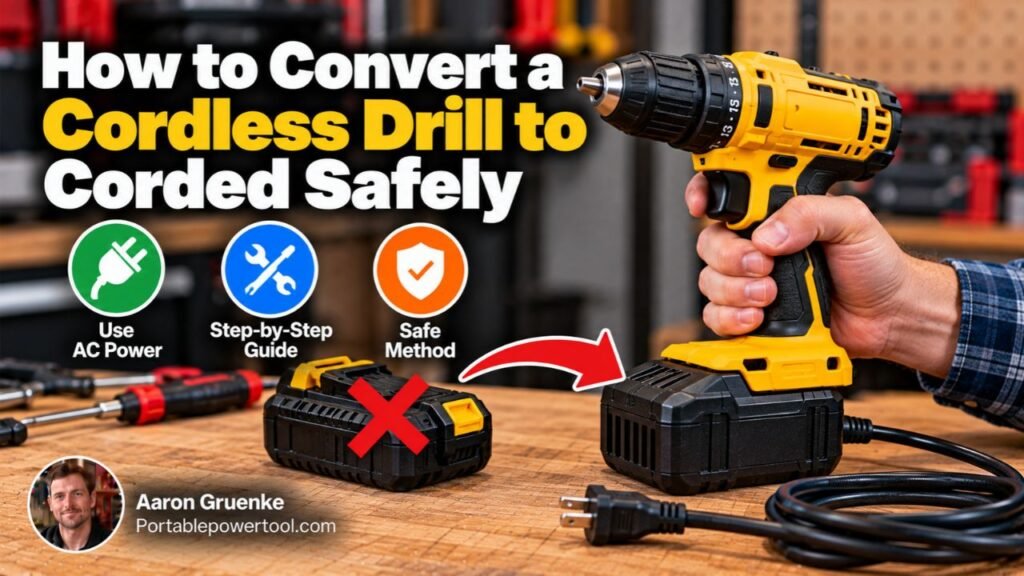
To convert a cordless drill to corded, you generally need to power the drill from a regulated DC power supply that matches the original battery’s operating voltage and can supply enough current for the motor.
The safest practical approach is usually:
- Identify the original battery voltage.
- Determine the drill’s approximate current requirements.
- Choose a sufficiently powerful regulated DC supply.
- Use an old battery shell or purpose-built battery adapter as a connector.
- Connect the power supply’s DC output to the correct positive and negative drill terminals.
- Add appropriate wiring, strain relief, and overcurrent protection.
- Test the setup under light load before normal use.
The most important rule is simple:
Never connect 120V household AC directly to a cordless drill’s battery contacts.
A cordless drill is designed for battery-level DC voltage, not line voltage.
Why a Cordless Drill Cannot Run Directly From a Wall Outlet
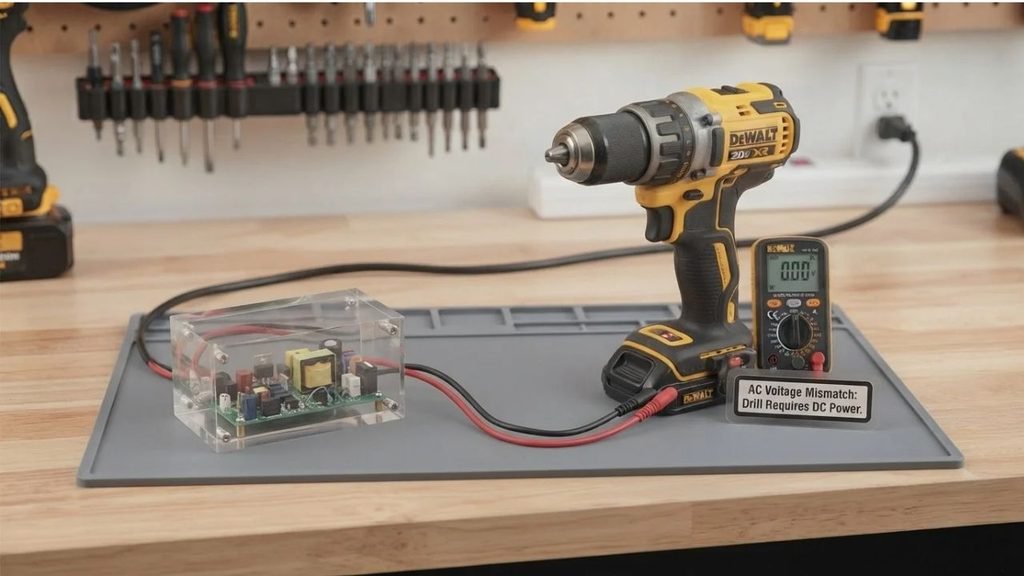
The electrical systems are fundamentally different.
A typical cordless drill may use:
- 12V DC
- 18V DC
- 20V MAX battery systems
- 24V DC
- Other low-voltage battery platforms
A standard U.S. household receptacle supplies approximately 120V AC.
The drill motor, trigger electronics, control board, and protection circuits are not designed to receive 120V AC.
You need an AC-to-DC converter, commonly called a DC power supply, to reduce and rectify the voltage before it reaches the drill.
Think of the system as:
Wall outlet → DC power supply → drill
not:
Wall outlet → drill
Check the Drill Battery Voltage First
Look at the battery pack or drill label before selecting any power supply.
You may see ratings such as:
- 12V
- 18V
- 20V MAX
- 24V
Use the manufacturer’s specifications rather than guessing.
Understanding 18V and 20V MAX
Many lithium-ion power-tool batteries marketed as 20V MAX use cells that produce approximately 20 volts when fully charged and around 18 volts nominally.
That does not mean every 18V power supply will automatically work with every 20V MAX drill.
Different tools may include electronic controls that expect specific voltage ranges or battery communication signals.
Whenever possible, verify the drill’s electrical requirements before attempting a conversion.
Voltage Is Only Half of the Problem
A common mistake is finding a power supply with the correct voltage but insufficient current capacity.
A drill motor can draw substantial current.
Under light load, it may require only a few amps. During startup, drilling, or when the motor is nearly stalled, current demand can rise sharply.
For example, a small 18V power adapter rated for:
18V, 2A
provides only:
18 × 2 = 36 watts
That is nowhere near enough for many cordless drills under useful load.
A larger supply rated for:
18V, 20A
can theoretically provide:
18 × 20 = 360 watts
That is far more realistic for a power tool, although the exact requirement depends on the drill.
How Much Current Does a Cordless Drill Need?
There is no single amperage that works for every drill.
Current demand depends on:
- Motor size
- Drill voltage
- Gear selection
- Trigger position
- Load on the bit
- Motor efficiency
- Electronic controls
- Stall conditions
A compact drill may require substantially less current than a high-torque hammer drill.
This is why small laptop adapters and inexpensive wall transformers usually do not work.
Startup Current Matters
Electric motors can draw a brief surge current when starting.
If the power supply cannot handle the surge, you may notice:
- The drill barely starts
- The power supply shuts down
- The voltage drops sharply
- The drill pulses or stalls
- The supply repeatedly resets
A suitable power supply needs enough continuous and short-term output capacity to handle real drill loads.
The Best Way to Connect the Power Supply
One of the cleanest conversion methods is using an old battery shell or purpose-built adapter.
This preserves the drill’s original battery connection and avoids permanent modification to the tool itself.
Using an Old Battery Housing
If you have a dead battery pack, its housing can sometimes be repurposed as a connector.
The general idea is to:
- Remove the battery pack from the drill.
- Open the battery housing only if it can be done safely.
- Remove or electrically isolate the old battery cells.
- Retain the battery shell and contact terminals.
- Connect the external DC supply to the appropriate positive and negative contacts.
- Provide secure cable routing and strain relief.
- Reassemble the housing.
This creates a removable adapter that slides into the drill like a normal battery.
However, modern lithium-ion packs can contain live cells and protection electronics. Damaged lithium-ion batteries can cause fire or injury.
If you are not experienced with battery packs, a commercially made battery adapter shell is generally safer than opening an old lithium-ion battery.
Do Not Work on a Live Lithium-Ion Battery Pack
A dead drill battery may still contain significant stored energy.
Do not:
- Short battery terminals
- Pierce cells
- Crush cells
- Cut directly through cell connections
- Heat the battery
- Work on swollen or damaged cells
- Assume a battery reading zero at the tool terminals is completely discharged
Battery-management electronics can disconnect cells even while energy remains inside the pack.
A safer approach is to use a compatible empty adapter housing rather than dismantling a rechargeable battery.
Choosing a DC Power Supply
The power supply is the most important component in the conversion.
Look for a supply with:
- Correct DC output voltage
- Sufficient continuous current
- Adequate surge capability
- Overcurrent protection
- Short-circuit protection
- Overtemperature protection
- Proper enclosure
- Suitable certification for mains-connected electrical equipment
Avoid exposed, poorly insulated mains wiring.
Regulated Power Supply
A regulated power supply maintains its output voltage reasonably consistently as the load changes.
That is desirable for a power tool because drill current changes constantly during operation.
Enclosed vs. Open-Frame Supplies
An enclosed consumer power supply with a proper AC cord and protected terminals is generally easier to use safely.
Some industrial switching supplies have exposed screw terminals for both AC input and DC output.
Those can work electrically, but the exposed mains side presents a much greater shock hazard and requires a proper electrical enclosure, grounding, strain relief, and other protective measures.
For a beginner, a fully enclosed power supply is the better choice.
Choosing the Correct Wire Size
The low-voltage cable between the power supply and drill may carry high current.
Thin wire can cause:
- Voltage drop
- Heat
- Reduced drill power
- Melted insulation
- Fire risk
The required wire gauge depends on:
- Maximum current
- Cable length
- Acceptable voltage drop
- Insulation temperature rating
Shorter cables generally perform better because they have lower resistance.
For a high-current drill conversion, ordinary thin speaker wire or lightweight USB-type cable is not appropriate.
Use wiring sized for the expected current and protect it from abrasion.
Why Cord Length Matters
Low-voltage systems are especially sensitive to voltage drop.
Suppose the power supply produces 18V. If several volts are lost in a long, undersized cable, the drill may receive much less voltage under load.
Symptoms can include:
- Weak torque
- Slow motor speed
- Excessive wire heating
- Trigger instability
- Power-supply shutdown
A relatively short, adequately sized DC cable usually gives better results.
If you need significant working distance, placing the power supply closer to the work area and using a properly rated AC extension cord on the mains side can be more effective than running an extremely long low-voltage cable.
Follow normal extension-cord safety practices.
Identify Positive and Negative Polarity
DC polarity matters.
The battery terminals will normally have positive and negative connections.
Reversing polarity may:
- Make a simple brushed motor rotate backward
- Damage control electronics
- Damage protection circuits
- Prevent the drill from operating
Modern drills may have more than two battery contacts.
Extra terminals can be used for:
- Temperature monitoring
- Battery identification
- Communication
- Protection circuitry
Do not assume every contact should be connected to the external power supply.
Modern Brushless Drills Can Be More Difficult to Convert
Older cordless drills with simple brushed DC motors are often easier to power externally.
Modern brushless drills can contain sophisticated electronic controllers.
The drill may communicate with the battery pack before allowing operation.
If the tool expects battery data, temperature information, or authorization signals, simply applying voltage to two contacts may not make it run.
This is one reason corded conversions are not equally practical for every drill.
A Safer Step-by-Step Conversion Method
The following approach focuses on a low-voltage external supply rather than modifying household AC wiring.
Step 1: Read the Drill and Battery Labels
Record:
- Battery voltage
- Battery chemistry
- Model number
- Battery terminal arrangement
If the battery lists watt-hours, note that information as well.
Step 2: Determine Whether the Drill Uses Battery Communication
Look at the battery interface.
A simple older drill may have only two functional power contacts.
A modern tool may have multiple terminals and electronic communication.
If battery communication is required, a basic conversion may not work.
Step 3: Select an Appropriate DC Power Supply
Choose a regulated supply with the correct output voltage and enough current for the drill.
Do not select the supply based on voltage alone.
A supply that continuously enters overload protection is too small for the application.
Step 4: Prepare a Battery Adapter
Use a properly made battery adapter whenever possible.
If using an empty battery housing, make sure no live lithium-ion cells remain in the portion being modified.
The adapter should fit securely into the drill.
Step 5: Connect the DC Output
Connect:
Power supply positive → drill positive
and:
Power supply negative → drill negative
Double-check polarity before energizing the system.
Connections should be mechanically secure and electrically insulated.
Step 6: Add Strain Relief
Do not allow the cable to hang directly from soldered terminals.
A strong pull on the cord could break the connection or create a short circuit.
Use proper strain relief where the cable enters the adapter housing.
Step 7: Protect the Circuit
A properly selected fuse or other overcurrent protection can help protect wiring if a short circuit occurs.
The power supply itself should also include appropriate protection.
Protection must be selected according to expected operating current and wire capacity rather than installed arbitrarily.
Step 8: Inspect Before Powering Up
Check for:
- Exposed conductors
- Loose terminals
- Reversed polarity
- Damaged insulation
- Pinched wires
- Improperly secured adapters
Do not operate the system until these issues are corrected.
Step 9: Test Under Light Load
Start the drill without drilling into material.
Listen for abnormal sounds.
Watch for:
- Supply shutdown
- Cable heating
- Unstable drill speed
- Burning smells
- Excessive power-supply heat
Then test gradually under a light drilling load.
Stop immediately if anything behaves abnormally.
Why a Laptop Charger Usually Will Not Work
Laptop chargers may look attractive because they often produce around 19V DC.
The problem is current.
A typical laptop adapter may provide something like:
19V × 4.7A ≈ 89 watts
A drill can demand several times that power under significant load.
The result may be:
- Power-supply shutdown
- Weak drill performance
- Repeated restarting
- Overheating
Even if the connector voltage seems close, the adapter must also tolerate the drill’s current demand.
Can You Use a Computer Power Supply?
Some hobbyists use desktop computer power supplies because they can provide substantial current.
However, a computer PSU is not automatically an ideal drill supply.
Potential issues include:
- Available rail voltage may not match the drill
- Current limits vary
- Some units require control wiring to start
- Protection circuitry may shut down during motor surges
- Wiring may require modification
A purpose-selected regulated DC power supply is generally easier to design around.
Can You Use a Car Battery?
A 12V automotive battery can theoretically power some 12V DC loads, but using one as a drill supply introduces other concerns.
Car batteries can deliver extremely high short-circuit current.
That means improper wiring can overheat dramatically or cause a fire.
Voltage compatibility is also critical.
A 12V automotive battery is not an appropriate direct substitute for an 18V drill battery.
For most users, a protected regulated power supply is a cleaner and more controllable solution.
What About Converting an 18V Drill to 120V?
You do not actually convert the drill motor to run on 120V.
Instead, you use a power supply that converts:
120V AC → approximately the drill’s required DC voltage
The drill itself continues operating at low voltage.
Rewinding or replacing the drill motor and control system to operate directly from household AC would effectively mean redesigning the tool and is not a practical DIY conversion.
Advantages of Converting a Cordless Drill to Corded
A successful conversion can provide several benefits.
No Battery Charging
The drill can run whenever AC power is available.
Useful for Old Tools
An otherwise functional drill may remain useful even if replacement batteries are unavailable or expensive.
Continuous Runtime
There is no need to stop because the battery is depleted.
Reduced Battery Replacement Cost
For a permanently bench-based tool, avoiding additional battery packs may make financial sense.
Disadvantages of a Corded Conversion
There are also important drawbacks.
You Lose Portability
The main advantage of a cordless drill disappears.
The Power Supply Can Be Bulky
A supply capable of powering a drill may be substantially larger than a normal battery charger.
Cable Resistance Reduces Performance
High-current low-voltage power does not travel efficiently through long, thin cables.
Some Modern Tools May Not Work
Battery communication and electronic controls can prevent a simple conversion.
The Conversion May Cost More Than Expected
By the time you buy:
- A high-current power supply
- Battery adapter
- Heavy cable
- Connectors
- Fuse
- Enclosure
- Strain relief
buying a basic corded drill may be cheaper.
Cordless Drill Conversion vs. Buying a Corded Drill
For most homeowners, purchasing a purpose-built corded drill is generally the simpler option.
A factory corded drill already includes:
- A motor designed for mains-powered operation
- Proper electrical insulation
- Suitable switching
- Approved cord strain relief
- Internal cooling
- Safety-tested wiring
A cordless-to-corded conversion makes the most sense when:
- You already own the necessary electrical equipment
- The drill has special value
- Replacement batteries are unavailable
- The drill will stay at a bench
- You understand low-voltage high-current DC systems
If the conversion requires buying every component from scratch, compare the total cost with a new corded drill before starting.
Common Conversion Problems
Drill Runs but Has Very Little Torque
The power supply may not provide enough current, or the DC cable may be causing excessive voltage drop.
Power Supply Shuts Off When You Pull the Trigger
The drill’s startup current may be triggering the supply’s overload protection.
A supply with more output current or better surge capability may be required.
Cable Gets Hot
Stop using the drill.
The wire may be undersized, a connection may have excessive resistance, or current may be higher than expected.
Hot wiring is a warning condition, not normal operation.
Drill Does Nothing
Possible causes include:
- Incorrect polarity
- Insufficient supply voltage
- Wrong terminals
- Battery communication requirement
- Trigger or motor fault
- Power-supply protection mode
Do not increase voltage randomly in an attempt to make the drill operate.
Drill Works Without Load but Stops While Drilling
This is a classic sign that the power supply or wiring cannot provide enough current under load.
Important Electrical Safety Considerations
A corded conversion combines household AC electricity with a high-current DC load.
Keep the two sides clearly separated.
The mains AC side should remain inside a properly designed power supply or electrical enclosure.
Do not leave exposed 120V terminals where they can be touched.
Also:
- Use a properly grounded supply when required.
- Do not use damaged extension cords.
- Keep electrical equipment away from water.
- Protect exposed DC connections against accidental short circuits.
- Use correctly sized wire.
- Use proper connectors instead of twisting wires together.
- Provide strain relief.
- Stop using equipment that smells burnt or becomes abnormally hot.
If a project requires modifying exposed household AC wiring and you are not qualified to do that safely, use a fully enclosed plug-in power supply or have a qualified person handle the mains-voltage portion.
FAQs About How to Convert a Cordless Drill to Corded
Can a Cordless Drill Be Converted to Corded?
Yes, some cordless drills can operate from an external DC power supply instead of a battery.
The supply must match the drill’s voltage and provide enough current.
Modern drills with battery communication electronics may be more difficult or impractical to convert.
Can I Plug a Cordless Drill Directly Into a Wall Outlet?
No.
A cordless drill generally requires low-voltage DC, while a U.S. wall outlet supplies approximately 120V AC.
Connecting mains electricity directly to the battery terminals can destroy the drill and create serious electrical hazards.
What Power Supply Do I Need for an 18V Cordless Drill?
You generally need a regulated DC supply close to the drill’s normal operating voltage and capable of providing substantial current.
The correct amperage depends on the specific drill.
Check the tool specifications and select a supply with enough continuous and surge capacity rather than relying on voltage alone.
Can I Use a 19V Laptop Charger for an 18V Drill?
It may have a similar voltage, but most laptop chargers cannot supply enough current for a cordless drill under meaningful load.
The charger may shut down, overheat, or provide poor drill performance.
Can I Use the Original Battery Charger to Power the Drill?
Usually no.
A battery charger is designed to charge a battery through a controlled charging process, not necessarily to supply the rapidly changing current demanded by a running motor.
Its output behavior and current limit may make it unsuitable as a direct drill power source.
Will an 18V Drill Work on 20V DC?
Do not assume that it will.
A slightly higher voltage can increase motor speed and electrical stress.
Use the voltage range specified for the tool or battery system rather than intentionally overvolting the drill.
Can I Convert a Brushless Cordless Drill to Corded?
Sometimes, but brushless drills can be more difficult because the motor controller may depend on electronics inside the battery pack.
If the drill requires battery communication, simply connecting positive and negative DC power may not work.
Is Converting a Cordless Drill to Corded Worth It?
It depends on the tool and what parts you already have.
If you already own a suitable power supply and have an obsolete drill with unavailable batteries, the conversion can be useful.
For most beginners starting from scratch, buying a purpose-built corded drill is usually simpler, safer, and potentially cheaper.
Conclusion
Learning how to convert a cordless drill to corded starts with understanding that the drill still needs low-voltage DC power. The safe approach is not to connect the drill directly to a household outlet but to use a properly rated AC-to-DC power supply that matches the battery voltage and can provide enough current.
A removable battery adapter, adequately sized wiring, secure connections, strain relief, proper polarity, and electrical protection are essential for a reliable setup. Modern brushless drills may also require battery communication that makes conversion impractical.
For an older drill used mainly at a workbench, a corded conversion can extend the tool’s useful life. For most homeowners, however, a factory-built corded drill remains the easier and safer choice when replacement batteries are no longer practical.