
Can You Use an Air Compressor to Unclog a Drain? Safety Guide
Yes, compressed air can sometimes move a soft drain blockage, but using a regular air compressor directly on household plumbing is generally not the safest or most reliable way to clear a clog. Too much pressure can damage pipe joints, loosen fittings, force dirty water out of another fixture, or turn contaminated drain water into a spray.
If you are wondering can you use an air compressor to unclog a drain, the most important factor is how the air pressure is applied. Purpose-built pneumatic drain-clearing tools are designed to deliver a controlled burst of pressure into a drain. Connecting an air hose directly to a sink, tub, toilet, or plumbing cleanout is much less predictable.
Compressed air also does not remove every type of blockage. It may move soft debris, but it is unlikely to permanently solve problems caused by tree roots, collapsed pipes, hardened grease, mineral deposits, or a damaged sewer line.
For most household clogs, a plunger, drain snake, P-trap cleaning, or another plumbing-specific method is usually safer. This guide explains when compressed air may help, why ordinary shop air can be risky, how pneumatic drain cleaners work, and when a plumber is the better option.
Can You Use an Air Compressor to Unclog a Drain Safely?
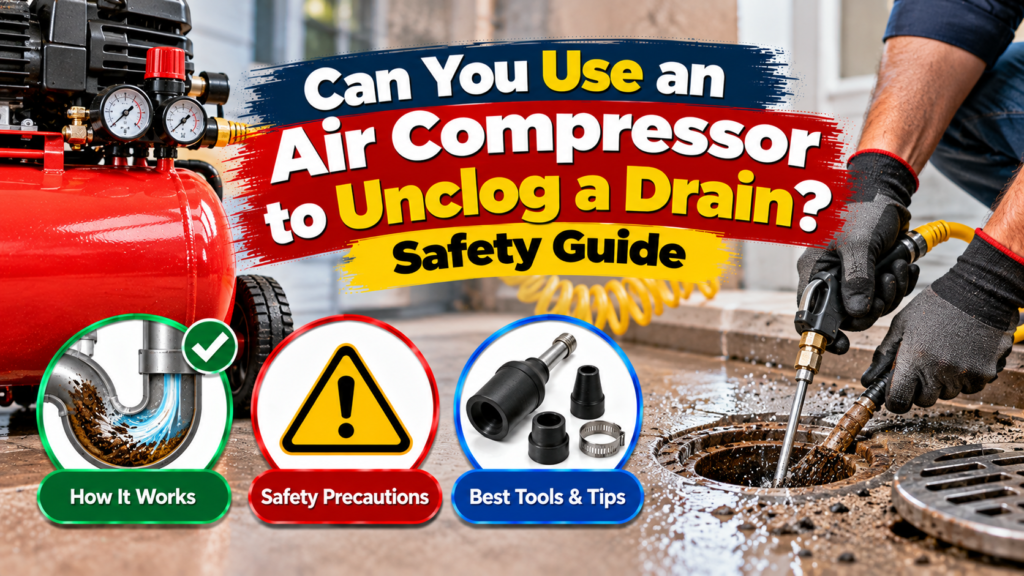
You can use an air compressor to unclog a drain only in limited situations and with the correct pressure-regulated equipment, but connecting a compressor directly to household plumbing is generally not recommended.
Household drain systems are designed primarily to carry wastewater by gravity. They are not intended to contain high-pressure compressed air.
If pressure is applied too aggressively, it can:
- Damage slip-joint connections
- Loosen old pipe fittings
- Force water through another fixture
- Blow debris back toward you
- Damage traps or seals
- Stress older plumbing
- Aerosolize contaminated drain water
A purpose-built drain-clearing attachment or pneumatic tool is a better option than improvising a connection between an air compressor and a drain.
How Compressed Air Can Clear a Drain
Compressed air works by creating a sudden pressure change inside the drain.
If the drain opening is adequately sealed, the pressure pulse travels through the pipe toward the blockage.
A soft obstruction may:
- Break apart
- Move farther down the pipe
- Become loose enough for water to carry away
- Shift enough to restore flow
This is somewhat similar to the pressure action created by a plunger, although compressed air can create a much sharper pressure pulse.
That extra force is also why compressed air can be risky.
Why a Regular Air Compressor Is Different From a Drain Cleaner
An ordinary shop compressor can produce substantially more pressure than household drain plumbing needs.
Typical air compressors may store air at pressures such as:
- 90 PSI
- 120 PSI
- 150 PSI
- 175 PSI
A drain does not need anything close to the compressor’s full tank pressure for clog-clearing attempts.
A purpose-built pneumatic drain cleaner is designed to control:
- Pressure
- Air volume
- Seal at the drain opening
- Direction of the pressure pulse
Simply pressing an air nozzle against a drain opening gives you much less control.
What Types of Clogs Might Compressed Air Move?
Compressed air is most likely to help with a relatively soft, localized obstruction.
Examples can include:
- Soap buildup
- Loose food debris
- Soft organic material
- Minor sludge
- Some hair accumulation
- Light buildup close to the fixture
However, even these clogs may respond better to a plunger or drain snake.
What Clogs Will Compressed Air Usually Not Fix?
Air pressure is not a universal drain-cleaning solution.
It is unlikely to permanently fix:
Tree Roots
Roots growing into a sewer line usually require mechanical cutting, hydro jetting, pipe repair, or replacement.
Collapsed Pipes
No amount of compressed air can restore a pipe that has physically collapsed.
Severe Grease Buildup
Hardened grease may coat a large portion of the pipe.
Blowing a small passage through it does not necessarily clean the pipe.
Mineral Deposits
Hard mineral scale is usually too solid for a short burst of air.
Solid Foreign Objects
Objects such as:
- Toys
- Jewelry
- Bottle caps
- Hygiene products
may simply become lodged more firmly or move deeper into the plumbing.
Major Sewer-Line Blockages
If several fixtures are backing up at the same time, the problem may be in the building’s main drain or sewer line.
That requires proper diagnosis rather than more air pressure.
Why High Air Pressure Can Damage Plumbing
Compressed air stores energy.
When that energy is suddenly released into a closed plumbing system, the pressure has to go somewhere.
A weak component may fail first.
Possible vulnerable points include:
- Slip-joint nuts
- Rubber couplings
- Old glued joints
- Corroded metal pipe
- Loose cleanout plugs
- Trap connections
- Fixture seals
Older plumbing deserves even more caution because fittings may already be weakened by age or corrosion.
PVC Pipes and Compressed Air
PVC drain pipe is durable for normal drainage, but that does not mean a household DWV system should be treated like a compressed-air system.
DWV means drain, waste, and vent.
DWV piping is designed mainly for gravity drainage and venting rather than storing compressed air.
The pipe itself may appear strong, but joints and fixture connections can be much more vulnerable to sudden pressure.
Avoid assuming that a pipe is safe simply because the material has a pressure rating in some other type of application.
ABS Drain Pipes
ABS plumbing presents a similar issue.
The concern is not just whether the pipe wall can tolerate pressure.
The complete plumbing system includes:
- Fittings
- Joints
- Traps
- Vents
- Fixture connections
A sudden pressure pulse may find the weakest connection.
Can Compressed Air Blow a P-Trap Apart?
It can potentially loosen or disturb a trap connection if excessive pressure is used.
Many sink P-traps are connected using slip-joint nuts and washers.
These connections are intended to contain normal wastewater flow—not high-pressure air.
If your clog appears close to the P-trap, removing and cleaning the trap is often a much more direct solution.
Why Plumbing Vents Matter
Household drains connect to a vent system that allows air to move through the plumbing.
When you force compressed air into a drain, some of that pressure may escape through:
- Another sink
- A bathtub drain
- A shower
- A vent stack
- Another connected fixture
This makes the behavior of compressed air difficult to predict.
You may intend to push a clog down the pipe but instead force dirty water upward somewhere else.
Can Dirty Water Spray Back?
Yes.
This is one of the most practical hazards.
If a drain is partially full of dirty water and you introduce compressed air, the pressure may send that water back through the opening.
Drain water can contain:
- Bacteria
- Grease
- Hair
- Soap residue
- Food waste
- Sewage contamination
Wear eye protection and avoid creating unnecessary aerosols around wastewater.
Never Use Compressed Air After Chemical Drain Cleaner
This is particularly important.
Do not use compressed air if chemical drain cleaner has recently been poured into the drain unless the chemical has been safely removed or handled according to its instructions.
Air pressure can splash corrosive chemicals back toward your:
- Eyes
- Face
- Skin
It can also spray chemicals onto nearby surfaces.
Drain-cleaning chemicals may contain strong acids or alkalis capable of causing serious chemical burns.
If chemical cleaner is present and the clog remains, tell any plumber working on the drain what product was used.
Can You Use an Air Compressor on a Kitchen Sink?
Technically, compressed air may move certain kitchen sink clogs, but it is rarely the best first choice.
Kitchen clogs commonly involve:
- Grease
- Food particles
- Soap
- Organic buildup
A better troubleshooting sequence is usually:
- Try a sink plunger.
- Clean the P-trap.
- Use a drain snake.
- Inspect farther into the branch drain if necessary.
Grease buildup often needs physical removal or thorough pipe cleaning rather than simply being pushed farther downstream.
Can You Use an Air Compressor on a Bathroom Sink?
A bathroom sink often clogs because of:
- Hair
- Toothpaste
- Soap
- Grooming products
- Sludge
These materials frequently accumulate around the stopper assembly or P-trap.
Before using pressure, remove and clean the stopper.
If the obstruction is deeper, a small hand-operated drain snake is often effective.
Can You Use Compressed Air on a Shower Drain?
A shower drain commonly clogs with hair and soap buildup.
Compressed air may move some soft material, but mechanical removal is usually more effective because hair often forms a tangled mass.
A plastic hair-removal tool or small drain snake can physically pull the clog out rather than pushing it farther into the pipe.
Can You Use an Air Compressor to Unclog a Bathtub?
The same concerns apply.
Bathtubs also have an overflow opening, which creates another route for air pressure to escape.
For plunging or pneumatic methods to work properly, the overflow usually has to be sealed temporarily.
However, because bathtub drain assemblies can be more complicated than an open sink drain, a snake through the appropriate access point is often a better solution.
Can You Use an Air Compressor to Unclog a Toilet?
Using a regular air compressor directly on a toilet is not recommended.
A toilet contains:
- Porcelain
- Internal trap passage
- Wax or other floor seal
- Drain connection
- Water
A strong pressure pulse may create a mess or stress seals and connections.
A toilet plunger or closet auger is specifically designed for this job.
A closet auger can reach through the toilet trap while reducing the risk of scratching the porcelain when used correctly.
Can Compressed Air Damage a Toilet Wax Ring?
Excessive or poorly controlled pressure could potentially stress plumbing seals or force air and water through weak points.
Because the toilet’s floor seal is essential for preventing leaks and sewer gases, there is little reason to expose it to unnecessary compressed-air pressure.
Use a toilet-specific clog-clearing method instead.
Can You Use Compressed Air on a Main Sewer Line?
A household air compressor is not an appropriate substitute for professional sewer-cleaning equipment.
A main-line blockage can involve:
- Tree roots
- Grease
- Broken pipe
- Collapsed pipe
- Foreign material
- Heavy sludge
Professional methods may include:
- Sewer auger
- Root-cutting equipment
- Hydro jetting
- Sewer camera inspection
If several fixtures are simultaneously backing up, stop treating individual drains and investigate the main drainage system.
What Is a Pneumatic Drain Cleaner?
A pneumatic drain cleaner is a tool specifically designed to clear blockages using controlled air pressure.
Some devices are manually pumped.
Others use cartridges or another pressure source.
They typically include adapters designed to seal against different drain openings.
The major advantage is control.
Instead of sending full compressor pressure into a drain, the tool delivers a controlled pressure pulse intended for drain-clearing applications.
Is a Pneumatic Drain Cleaner Safer Than an Air Compressor?
Generally, yes, when used according to its manufacturer’s instructions.
However, it can still damage weak plumbing if:
- Excessive pressure is used
- The pipe is deteriorated
- The wrong adapter is installed
- The clog is a solid obstruction
- Connected openings are not handled properly
“Purpose-built” does not mean “risk-free.”
Air Compressor vs. Plunger for Drain Clogs
For many household blockages, start with the plunger.
A plunger creates both:
- Positive pressure
- Suction
That back-and-forth action can loosen a clog instead of only pushing it deeper.
A plunger also gives you much better tactile feedback.
You can feel whether:
- The clog is moving
- Pressure is building
- Water flow is improving
It should usually be tried before more aggressive methods.
Air Compressor vs. Drain Snake
A drain snake is generally more effective for physical blockages.
A snake can:
- Break through debris
- Hook hair
- Loosen buildup
- Reach deeper into the drain
Compressed air mainly tries to move the obstruction using pressure.
A snake allows you to work directly on the clog.
For hair and many common bathroom clogs, that makes the snake the better choice.
Air Compressor vs. Drain Bladder
A drain-cleaning bladder attaches to a water hose and expands inside the pipe.
Water pressure then helps push the blockage down the line.
This differs from compressed air because water is much less compressible than air.
Drain bladders can be useful in certain drain lines, but they also require careful use.
They are not suitable for every plumbing configuration and can damage weak pipes or cause backups at connected fixtures.
Follow the bladder manufacturer’s instructions.
Air Compressor vs. Hydro Jetting
Professional hydro jetting uses high-pressure water and specialized nozzles to clean the inside of drain and sewer pipes.
It is much more sophisticated than simply forcing air through a clog.
Hydro jetting can remove:
- Grease
- Sludge
- Deposits
- Certain root growth
It also cleans pipe walls rather than merely opening a small passage.
Because professional hydro-jet equipment operates at significant pressure, it should be used only when the pipe condition and application are appropriate.
Safer Ways to Unclog a Household Drain
Before considering compressed air, try methods matched to the clog.
1. Remove Visible Debris
If hair or material is near the drain opening, remove it manually with an appropriate tool.
2. Use a Plunger
Create a good seal and use controlled plunging strokes.
For a double-bowl kitchen sink, the other drain opening may need to be sealed.
3. Clean the P-Trap
For sink clogs, place a bucket underneath and remove the P-trap if you are comfortable doing so.
Many local clogs are found there.
4. Use a Drain Snake
Feed the cable into the drain slowly and rotate it according to the snake’s instructions.
5. Use a Purpose-Built Drain-Clearing Tool
If pressure is appropriate, use equipment specifically made for plumbing.
6. Call a Plumber
Professional service is appropriate if the clog:
- Keeps returning
- Affects multiple fixtures
- Cannot be reached
- May involve a damaged pipe
- Appears to be in the main sewer line
What If You Still Want to Use an Air Compressor?
If compressed air is going to be used, avoid improvising a high-pressure connection.
At minimum, the setup should involve:
- A pressure regulator
- A purpose-built drain attachment
- Low, controlled pressure
- Eye protection
- Clear knowledge of the connected plumbing
Never use the compressor’s full tank pressure.
And never increase pressure repeatedly simply because the first attempt did not clear the clog.
If low controlled pressure does not work, switch methods.
Why More PSI Is Not Better
Higher air pressure does not necessarily increase the likelihood of safely clearing a drain.
The clog may remain in place while pressure finds another path.
That path might be:
- Loose fitting
- Nearby fixture
- Trap joint
- Damaged pipe
Compressed air can store much more energy than many people expect.
A sudden failure can be violent.
The goal should be controlled clog removal—not maximum PSI.
Should You Seal Every Other Drain Opening?
Pressure-based drain tools sometimes require connected openings to be sealed so that pressure reaches the blockage.
However, sealing multiple fixtures can also create a more closed system in which pressure has fewer safe escape paths.
This is another reason improvised compressor-based drain cleaning is risky.
If a purpose-built tool requires other openings to be sealed, follow its specific instructions.
Do not create your own fully sealed pressurized plumbing system.
What Pressure Should You Use?
There is no universal safe compressor pressure for household drains.
The plumbing system may include different:
- Pipe materials
- Joint types
- Ages
- Conditions
- Fixture seals
For that reason, giving one PSI number for every home would be misleading.
If you use a pneumatic drain-cleaning device, follow the tool manufacturer’s pressure limit and procedure.
Do not use the compressor’s maximum pressure as a target.
Can Compressed Air Clear Grease?
Sometimes it may create a temporary opening through soft grease, but it does not necessarily remove the grease coating the pipe.
The remaining grease can catch more:
- Food debris
- Soap
- Organic material
and the clog may return quickly.
Severe grease buildup may require mechanical cleaning or professional drain cleaning.
Prevent future grease clogs by avoiding pouring cooking fats and oils down the drain.
Can Compressed Air Remove Hair Clogs?
It may move a loose hair blockage, but hair often forms a tangled mass around:
- Drain stoppers
- Crossbars
- Pipe fittings
Pulling the hair out with a suitable tool is usually more reliable.
A small drain snake can often retrieve the obstruction rather than pushing it deeper.
Can Compressed Air Remove Food Clogs?
It depends on the material.
Soft food debris may shift.
Dense material may become more tightly packed.
If the clog is in a kitchen sink with a garbage disposal, first make sure the disposal itself is not jammed.
Disconnect electrical power before servicing a disposal.
Never reach into the disposal chamber with your hand.
Can an Air Compressor Make a Drain Clog Worse?
Yes.
A pressure blast can push a clog farther down the pipe.
A blockage that was originally close to the fixture and easy to reach with a small snake may become lodged deeper in the branch line.
This can make the repair more difficult.
That is one major disadvantage of trying to “blow” a clog away.
What If Water Comes Up Another Drain?
Stop applying pressure.
This indicates the plumbing fixtures are connected and the air or blockage is redirecting flow through another route.
Continuing may cause:
- Overflow
- Contaminated water release
- Plumbing damage
At that point, a mechanical drain-cleaning method is more appropriate.
What If Multiple Drains Are Clogged?
If several fixtures are draining slowly or backing up at the same time, suspect a larger problem.
Possible causes include:
- Main sewer blockage
- Branch-line obstruction
- Tree-root intrusion
- Sewer-line damage
- Septic-system problem
Do not keep blasting individual drains with compressed air.
A sewer camera inspection or professional drain service may be needed.
Signs You Should Call a Plumber
Professional help is a good idea when:
- Several drains are blocked.
- Sewage is backing up.
- Water returns through another fixture.
- The clog repeatedly comes back.
- You hear frequent gurgling in multiple drains.
- There is a sewer odor.
- A drain snake cannot reach the blockage.
- You suspect tree roots.
- The plumbing is old or fragile.
- Chemical drain cleaner is trapped in the pipe.
These symptoms often indicate a problem beyond a simple fixture clog.
Common Mistakes When Using Pressure to Clear Drains
Using Full Compressor Pressure
Household drain lines should not be treated like pneumatic equipment.
Connecting an Air Hose Directly to the Pipe
An improvised connection can create uncontrolled pressure.
Using Air After Chemical Cleaner
This can spray caustic liquid back toward you.
Assuming More Pressure Will Clear a Tougher Clog
A solid obstruction may not move at all.
Ignoring Other Connected Fixtures
Pressure may push water into another sink, tub, or shower.
Continuing After a Pipe Starts Leaking
Stop immediately and repair the plumbing.
Using Air on a Main Sewer Blockage
A small shop compressor is not a substitute for sewer-cleaning equipment.
How to Prevent Future Drain Clogs
Prevention is easier than clearing a severe blockage.
Kitchen
Avoid putting these materials into the drain:
- Cooking grease
- Fats
- Large food scraps
- Coffee grounds
- Fibrous waste
Bathroom
Use drain screens to catch:
- Hair
- Soap debris
- Grooming material
Clean the stopper periodically.
General Plumbing
Do not flush materials that are not intended for the sewer system.
Recurring clogs should be investigated instead of repeatedly forced open.
FAQs About Can You Use an Air Compressor to Unclog a Drain
Is it safe to use compressed air to unclog a drain?
It can be risky.
Low, controlled pressure delivered through a purpose-built drain-clearing tool may work in some situations, but directly connecting an ordinary air compressor to household plumbing can damage fittings or cause contaminated water to spray from another opening.
How much air pressure should I use to unclog a drain?
There is no universal safe PSI for household drains.
Use the pressure specified by a purpose-built pneumatic drain-cleaning tool rather than guessing or using full compressor pressure.
Can compressed air damage PVC drain pipes?
Excessive pressure can damage plumbing connections even if the PVC pipe itself appears strong.
Household DWV systems are not intended to operate as compressed-air pressure vessels.
Can I use compressed air on a clogged toilet?
A regular air compressor is not recommended.
Use a toilet plunger or closet auger instead.
Can I use compressed air after using drain cleaner?
Do not do so casually.
Compressed air can splash corrosive drain chemicals back toward you. If chemical cleaner is still in the pipe, avoid pressure-based methods unless the chemical manufacturer’s procedure specifically allows them.
Is a drain snake better than compressed air?
For many household clogs, yes.
A drain snake works directly on the obstruction and can retrieve hair or break through buildup without pressurizing the entire plumbing system.
Can compressed air clear a grease clog?
It may temporarily move soft grease, but it usually does not clean grease from the pipe walls.
Mechanical cleaning or professional drain cleaning may provide a longer-lasting result.
Why did compressed air make water come out of another drain?
Your plumbing fixtures are connected.
The pressure traveled through the drain system and escaped through another fixture instead of clearing the blockage. Stop using pressure and switch to another drain-cleaning method.
Conclusion
So, can you use an air compressor to unclog a drain? Technically, compressed air can move some soft and localized blockages, but using an ordinary shop compressor directly on household plumbing is usually not the best approach.
The main problem is control. Household drains contain traps, vents, slip joints, seals, and interconnected fixtures that were designed for gravity wastewater flow rather than high-pressure compressed air. Excessive pressure can turn a simple clog into a leaking fitting, damaged pipe, or contaminated-water cleanup.
For most household clogs, the better first choices are a plunger, drain snake, stopper cleaning, or P-trap removal. If you specifically want to use air pressure, choose a purpose-built pneumatic drain cleaner and follow its pressure limits rather than improvising with full compressor pressure.
Compressed air is also the wrong solution for tree roots, collapsed pipes, major grease buildup, recurring main-line blockages, or multiple backed-up fixtures. Those situations usually require mechanical cleaning, hydro jetting, camera inspection, or professional plumbing service.
The practical verdict is that an air compressor should be considered a limited and carefully controlled option—not a universal drain-unclogging tool. Using the right plumbing tool for the type and location of the blockage is generally safer, more effective, and less likely to damage your drainage system.