
What Size Air Compressor for Framing Nailer? Complete Guide
A pneumatic framing nailer does not require an enormous air compressor, but choosing the right compressor makes a noticeable difference in how smoothly the nail gun works. A compressor that is too small may fire a few nails normally and then struggle to maintain pressure during rapid nailing. An oversized compressor works perfectly well but may be unnecessarily expensive, heavy, and difficult to move around a jobsite.
For most DIY projects and light-to-moderate framing work, a 6-gallon pancake compressor delivering roughly 2–3 SCFM at 90 PSI is usually enough to operate one typical framing nailer. Professional crews working quickly, running multiple nail guns, or using air tools continuously may benefit from a larger compressor with greater airflow and tank capacity.
If you are trying to determine what size air compressor for framing nailer use is appropriate, do not judge the compressor only by its gallon rating. The most important specifications are SCFM/CFM, operating PSI, tank capacity, and recovery rate. A small compressor with adequate airflow can run a framing nail gun successfully, while a larger tank with a weak pump may recover too slowly.
This guide also answers related questions such as what size air compressor for framing nail gun, how big air compressor for framing nailer, and is a 6 gallon air compressor enough for framing nailer work.
What Size Air Compressor for Framing Nailer?
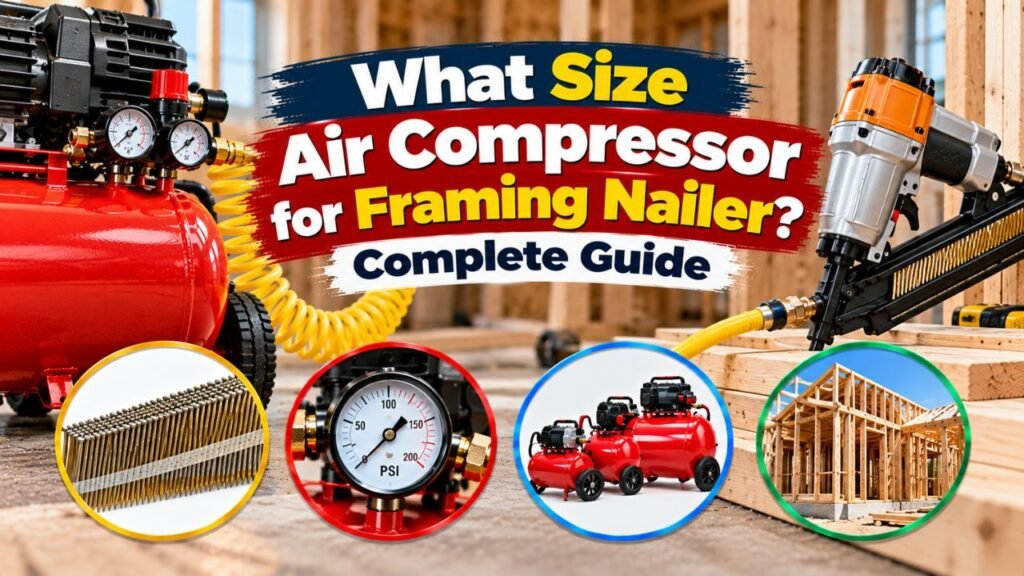
For one typical pneumatic framing nailer, a good general-purpose compressor is:
- Tank size: 4–6 gallons or larger
- Airflow: Around 2–3 SCFM at 90 PSI or more
- Maximum pressure: Usually at least 120 PSI
- Regulated working pressure: Commonly around 70–120 PSI, depending on the nailer
- Compressor type: Portable pancake, hot-dog, or larger portable compressor
A 6-gallon compressor is one of the most popular choices because it provides enough stored air for intermittent framing while remaining portable.
However, always check the nail gun manufacturer’s actual pressure and air-consumption requirements.
Some nailers use more air than others, and how quickly you fire nails has a major effect on compressor demand.
Quick Air Compressor Size Guide for Framing Nail Guns
| Framing Work | Recommended Tank Size | Suggested Airflow | Best For |
| Occasional DIY framing | 4–6 gallons | 2+ SCFM at 90 PSI | Small projects |
| General framing with one nailer | 6 gallons | 2–3+ SCFM at 90 PSI | Most homeowners |
| Frequent framing | 8–15 gallons | 3–5+ SCFM at 90 PSI | Serious DIY/pro use |
| Fast production framing | 15–30+ gallons | Higher CFM | Continuous work |
| Two framing nailers | 15–30+ gallons | Combined tool CFM plus reserve | Small crews |
| Multiple pneumatic tools | 20–60+ gallons | Based on combined demand | Shop/jobsite use |
These are practical ranges rather than universal requirements.
The nailer’s specifications should determine the final compressor choice.
Why Framing Nailers Do Not Need Huge Compressors
A framing nailer uses compressed air differently from high-consumption pneumatic tools such as:
- Air sanders
- Die grinders
- Spray guns
- Impact tools used continuously
A framing nailer consumes a short burst of air each time you pull the trigger.
Between nails, the compressor has time to recover.
This intermittent air demand is why a relatively small compressor can successfully operate a powerful framing nail gun.
A grinder might require a steady stream of compressed air for minutes at a time.
A framing nailer uses air for a fraction of a second.
That distinction is important when sizing the compressor.
What CFM Does a Framing Nailer Need?
CFM, or cubic feet per minute, measures how much air the compressor can deliver.
Compressor manufacturers often list SCFM, or standard cubic feet per minute, at a specific pressure such as 90 PSI.
Many framing nailers have relatively low average air-consumption requirements compared with continuous pneumatic tools.
For one framing nailer, a compressor rated around 2–3 SCFM at 90 PSI is generally a practical starting point.
More airflow gives you additional recovery capacity.
A compressor rated around 3–4 SCFM at 90 PSI can usually recover faster than a unit producing only 2 SCFM.
Why You Want Some CFM Reserve
Do not choose a compressor that barely matches the nailer’s theoretical requirement.
Having additional airflow capacity helps when:
- Firing nails rapidly
- Working for long periods
- Using long air hoses
- Operating in cold conditions
- Connecting another pneumatic tool
- Compressor performance declines slightly under real-world conditions
A useful approach is to choose a compressor with roughly 25–50% more airflow than the nailer’s stated average requirement when practical.
That provides useful operating headroom.
What PSI Does a Framing Nailer Need?
PSI, or pounds per square inch, measures air pressure.
Many pneumatic framing nailers operate somewhere around 70–120 PSI, although the exact range depends on the model.
The compressor should be capable of producing pressure above the nailer’s required operating pressure.
A compressor with:
- 120 PSI maximum
- 150 PSI maximum
- 165 PSI maximum
can all potentially run a nailer that requires 90 PSI.
The important part is setting the compressor’s regulated output pressure correctly.
Do not simply connect the nailer and operate at the compressor’s maximum tank pressure.
PSI and CFM Are Not the Same Thing
This is a common source of confusion.
PSI tells you how much pressure is available.
CFM tells you how much airflow the compressor can deliver.
A compressor can produce 150 PSI but still have insufficient airflow for a demanding air tool.
For framing nailers, you generally need both:
- Enough PSI to drive the nail properly
- Enough CFM to keep supplying repeated shots
For example, a compressor capable of 150 PSI but only producing very low airflow may take a long time to recover after rapid firing.
Why Tank Size Matters
The tank stores compressed air.
Every time you fire the nailer, a small amount of stored air leaves the tank.
A larger tank provides a bigger air reserve before the compressor motor needs to restore pressure.
Small Tank
Advantages:
- Lightweight
- Easy to carry
- Easier to fit in a vehicle
- Good for occasional nail firing
Disadvantages:
- Motor cycles more frequently
- Pressure drops faster during rapid firing
Large Tank
Advantages:
- More stored air
- Longer periods between compressor cycles
- Better for sustained production
- Better for multiple nailers
Disadvantages:
- Heavier
- Less portable
- More expensive
- Takes up more room
Tank size affects convenience and runtime, but the compressor pump still needs enough airflow to replenish the tank.
Is a 6 Gallon Air Compressor Enough for Framing Nailer?
Yes, a 6 gallon air compressor is usually enough for one framing nailer.
This is one of the most practical compressor sizes for:
- Home framing projects
- Building sheds
- Installing wall framing
- Deck construction
- Fence construction
- Remodeling
- Occasional professional work
A typical 6-gallon pancake compressor often provides enough pressure and airflow for a single framing nail gun.
The main limitation appears during very fast continuous firing.
If you drive nails faster than the compressor can recover, tank pressure will gradually drop.
The compressor will then run continuously until it catches up.
For most one-person framing work, pauses for positioning lumber, measuring, cutting, and moving around the project give the compressor plenty of recovery time.
When a 6-Gallon Compressor May Feel Too Small
A 6-gallon compressor may become limiting if you are:
- Bump-firing nails continuously
- Running two nailers at once
- Working with a multi-person framing crew
- Using very long restrictive hoses
- Operating other pneumatic tools simultaneously
- Framing professionally for long periods
In these situations, a compressor with a larger tank and higher SCFM rating can improve productivity.
A 10-, 15-, 20-, or 30-gallon compressor may make more sense depending on the workload.
Is a 3 Gallon Air Compressor Enough for a Framing Nailer?
Sometimes.
A 3-gallon compressor can operate many framing nailers if it provides the required PSI and enough airflow.
However, the small tank means:
- More frequent cycling
- Faster pressure drops
- Less reserve air
- More waiting during rapid firing
For occasional DIY use, a good 3-gallon compressor may be workable.
For frequent framing, a 6-gallon or larger compressor is generally more comfortable.
Is a 2 Gallon Air Compressor Enough?
A 2-gallon compressor may run a framing nailer one shot at a time, provided its pressure and airflow ratings meet the tool’s requirements.
However, it has very little stored-air reserve.
It is better suited to:
- Brad nailers
- Pin nailers
- Small finish nailers
than continuous framing work.
A 4- or 6-gallon compressor is usually a more practical choice for a framing nail gun.
Is a 10 Gallon Air Compressor Good for Framing?
Yes.
A 10-gallon compressor gives you more air storage than a pancake-style 6-gallon unit while remaining reasonably portable in many designs.
It can be a good choice for:
- Frequent framing
- Faster firing
- Roofing nailers
- Finish nailers
- General pneumatic tools
Pay attention to the compressor’s SCFM rating rather than selecting it based only on its 10-gallon tank.
What Size Air Compressor for Professional Framing?
Professional framing puts much greater demand on the compressor because productivity matters.
A homeowner may drive a few nails and then stop to:
- Measure
- Cut lumber
- Position boards
- Check alignment
A framing crew may have one or more workers firing nails repeatedly.
For high-production work, a compressor with:
- Higher SCFM output
- Larger storage capacity
- Fast recovery
- Multiple air outlets
is more appropriate.
A 15- to 30-gallon portable compressor can offer useful capacity for higher-volume work, while larger jobsite systems may be needed for several pneumatic nailers.
The actual choice should be based on the combined air consumption of all connected tools.
What Size Air Compressor for Two Framing Nailers?
If two framing nailers will operate simultaneously, calculate their combined air demand.
For example, if each nailer requires approximately 2 SCFM during the expected working cycle, the compressor should provide more than their combined requirement.
Rather than choosing exactly 4 SCFM, allowing additional reserve is better.
A compressor capable of around 5–6 SCFM at the required pressure or more may provide more comfortable operation, depending on how rapidly both nailers are used.
A larger tank, perhaps 15–30 gallons or more, can also reduce excessive cycling.
For professional crews, manufacturer-specific nailer consumption should be used for accurate sizing.
How Big Air Compressor for Framing Nailer Depends on Firing Speed
Air consumption is not fixed in actual use.
A nailer firing:
- 5 nails per minute
places much less demand on a compressor than the same nailer firing:
- 30 nails per minute
That means two people using identical framing nailers can have completely different experiences with the same compressor.
Slow Intermittent Framing
A small 4–6 gallon compressor may work extremely well.
Fast Production Framing
Higher CFM and a larger tank become more valuable.
The faster you work, the more compressor recovery performance matters.
Compressor Recovery Rate Matters
The recovery rate describes how quickly the compressor can rebuild tank pressure after air has been used.
Consider two 6-gallon compressors.
Both may have:
- 6-gallon tanks
- 150 PSI maximum pressure
But one may deliver:
- 2.6 SCFM at 90 PSI
while another provides considerably more.
The higher-output compressor can recover sooner after repeated nail firing.
This is why gallon capacity alone does not tell you which compressor performs better.
What Happens If the Compressor Is Too Small?
An undersized compressor generally does not mean the nailer immediately becomes unusable.
Instead, you may notice:
- Compressor running frequently
- Pressure dropping during rapid firing
- Nails not being driven completely
- Increased waiting for pressure recovery
- Less consistent nail depth
The nailer may work perfectly for several shots and then gradually lose driving force.
If this happens, stop firing briefly and allow the compressor to recover.
If the problem happens constantly, a larger or higher-CFM compressor may be needed.
Will Too Large an Air Compressor Hurt a Framing Nailer?
No, provided you regulate the output pressure correctly.
You can operate a framing nailer from a large compressor because the compressor’s regulator controls the pressure going to the tool.
For example, a 60-gallon compressor may store air at 150 PSI while the outlet regulator supplies the nailer at 90 PSI.
The tank size does not force excessive pressure into the tool.
The regulator setting does.
Never exceed the nailer’s maximum operating pressure.
How to Set the Air Pressure for a Framing Nailer
Start within the pressure range specified by the nailer manufacturer.
A practical procedure is:
- Connect the air hose.
- Set the regulator near the lower end of the nailer’s recommended range.
- Test-fire into scrap lumber of the same type and thickness.
- Check nail depth.
- Increase pressure gradually if needed.
- Stop when nails are being driven correctly.
Do not immediately raise pressure to the maximum.
Many nailers also have a depth-of-drive adjustment.
Use that feature when appropriate instead of relying entirely on extra air pressure.
Air Hose Size for a Framing Nailer
The hose also affects performance.
For many framing nailer setups, a 1/4-inch air hose is sufficient because nail guns do not require continuous high airflow.
A 3/8-inch hose may be useful when:
- Hose runs are long
- Multiple tools share the system
- Higher airflow tools are also used
- Pressure drop becomes noticeable
Choose a hose with a pressure rating safely above the compressor’s operating pressure.
Use good-quality fittings that do not excessively restrict airflow.
Does Air Hose Length Matter?
Yes.
Pressure loss increases as compressed air travels through a hose, especially when the hose is:
- Very long
- Narrow
- Kinked
- Equipped with restrictive fittings
A typical short jobsite hose causes little trouble for a framing nailer.
Very long hose runs can reduce available pressure and airflow.
If the nailer works correctly near the compressor but struggles at the end of a very long hose, the air-delivery system may be contributing to the problem.
Pancake vs. Hot-Dog Compressor for Framing Nailer
Both can work.
Pancake Compressor
Pancake compressors typically have a round, flat tank.
Benefits include:
- Stable design
- Compact footprint
- Easy transport
- Common 6-gallon capacity
They are extremely popular for nail guns.
Hot-Dog Compressor
A hot-dog compressor uses a horizontal cylindrical tank.
Benefits may include:
- Narrower shape
- Easy rolling on wheeled models
- Multiple capacity options
Either design can operate a framing nailer if the pressure and airflow specifications are sufficient.
Oil-Free vs. Oil-Lubricated Compressor for Framing
Both types can run framing nailers.
Oil-Free Compressor
Advantages include:
- Low maintenance
- Easy transport
- No pump-oil changes
- Common among portable pancake compressors
Potential disadvantages include:
- Often louder
- Some designs may have shorter heavy-duty service life than larger oil-lubricated pumps
Oil-Lubricated Compressor
Advantages may include:
- Quieter operation
- Good durability for frequent use
- Smooth-running pump
Disadvantages include:
- Oil maintenance
- More concern about transport orientation
- Often heavier
For typical portable framing work, an oil-free 6-gallon pancake compressor is a practical choice.
Should You Buy a 150 PSI Compressor for a Framing Nailer?
A 150 PSI maximum tank pressure is common and provides plenty of pressure reserve for most framing nailers.
However, do not confuse maximum tank pressure with actual tool requirements.
A framing nailer may only need around 70–120 PSI.
The benefit of higher tank pressure is that the compressor can store more compressed air in a given tank volume.
The regulator then reduces that pressure before it reaches the nailer.
SCFM at 40 PSI vs. 90 PSI
Compressor specifications may list airflow at:
- 40 PSI
- 90 PSI
For nailers, the 90 PSI rating is generally more useful for comparison because framing nailers commonly operate around that pressure range.
A compressor always appears to provide more airflow at lower pressure.
When comparing compressors for framing, compare the same SCFM pressure rating.
Do not compare one compressor’s CFM at 40 PSI with another compressor’s CFM at 90 PSI.
What Size Generator Is Needed for a Framing Nailer Compressor?
The nailer itself does not use electricity, but the compressor does.
If you are working on a jobsite without utility power, the generator must handle the compressor motor’s:
- Running watts
- Startup surge
Air compressor motors can draw significantly more current during startup than while running normally.
Check the compressor’s electrical specifications and size the generator accordingly.
Do not estimate generator capacity from the air tank size alone.
How to Connect a Framing Nailer to an Air Compressor
The setup is usually simple.
- Place the compressor on a stable surface.
- Connect the air hose to the compressor outlet.
- Attach the other end to the framing nailer.
- Turn on the compressor.
- Allow the tank to reach operating pressure.
- Set the regulated outlet pressure.
- Load the correct nails.
- Test-fire into scrap material.
- Adjust pressure or nail depth if necessary.
Wear eye protection and follow the nailer’s operating instructions.
Framing nailers can cause serious puncture injuries, so keep your hands away from the firing path.
Safety Tips When Using a Framing Nail Gun and Compressor
Do Not Exceed Maximum Tool Pressure
Too much air pressure can damage the nailer and increase stress on internal components.
Disconnect Air Before Servicing the Nailer
Remove the air hose before:
- Clearing a jam
- Adjusting internal components
- Performing maintenance
Use the Correct Fasteners
Use nails approved for the framing nailer.
Incorrect nail angle, length, or collation can cause jams or unreliable firing.
Wear Eye Protection
Nails, fragments, and wood chips can be ejected unexpectedly.
Keep Hands Out of the Firing Area
Never hold lumber close to where the nail will exit.
Long framing nails can deflect after entering wood.
Common Mistakes When Choosing a Compressor for a Framing Nailer
Looking Only at Gallons
Tank size is useful, but SCFM and PSI determine whether the compressor can actually keep up.
Buying Based Only on Maximum PSI
A compressor advertising 200 PSI is not automatically better for nailers than one rated at 150 PSI.
Compare airflow and recovery too.
Ignoring the Nailer Specifications
Different framing nailers have different air requirements.
Check the manual.
Choosing No Airflow Reserve
A compressor that barely meets the minimum specification may struggle during rapid work.
Extra SCFM gives you flexibility.
Buying an Oversized Compressor for Occasional DIY Work
A 60-gallon stationary compressor will easily run a framing nailer, but it may be unnecessary if framing is your primary use.
A portable 6-gallon unit is far easier to move around a project.
FAQs About What Size Air Compressor for Framing Nailer
What size air compressor for framing nail gun use?
For one typical pneumatic framing nail gun, a 4–6 gallon compressor delivering around 2–3 SCFM at 90 PSI or more is usually a practical choice.
Always confirm the specific nailer’s requirements.
How big air compressor for framing nailer work do I really need?
For ordinary DIY and one-person framing, a 6-gallon portable compressor is usually large enough.
Faster professional framing or multiple nail guns can justify a 15–30 gallon or larger compressor with higher SCFM output.
Is a 6 gallon air compressor enough for framing nailer use?
Yes. A 6-gallon compressor is generally enough for one framing nailer, especially for intermittent DIY or construction work.
It may need more frequent recovery periods during rapid bump-firing.
Can a pancake compressor run a framing nailer?
Yes.
A typical 6-gallon pancake compressor with adequate SCFM and PSI is commonly used with pneumatic framing nailers.
Will a 3-gallon compressor run a framing nail gun?
It may, provided it meets the nailer’s pressure and airflow requirements.
However, the smaller tank means more frequent compressor cycling and less capacity for rapid firing.
How many CFM do I need for a framing nailer?
Many setups work well with approximately 2–3 SCFM at 90 PSI for one nailer, but the nailer’s manufacturer should provide the actual air-consumption requirement.
Choosing extra airflow capacity improves recovery.
What PSI should a framing nailer run at?
Many framing nailers operate somewhere around 70–120 PSI.
Use the pressure range listed by the manufacturer and adjust within that range to achieve proper nail depth.
Can one air compressor run two framing nailers?
Yes, if the compressor provides enough airflow for both tools and has adequate stored-air capacity.
Add the expected air demand of both nailers and choose a compressor with additional CFM reserve.
Conclusion
For most homeowners and one-person framing projects, the practical answer to what size air compressor for framing nailer use is a 6-gallon portable compressor producing roughly 2–3 SCFM at 90 PSI or better. That combination normally provides enough pressure and stored air to operate one framing nail gun effectively while remaining small enough to carry around a home or jobsite.
A smaller 2- or 3-gallon compressor may still operate a framing nailer, but its limited air reserve means more frequent cycling and slower recovery during rapid nailing. Moving up to a 10-, 15-, or 30-gallon compressor becomes worthwhile when framing frequently, firing nails at production speed, or operating more than one nailer.
The most important takeaway is not to choose by gallons alone. Check the nailer’s required PSI and air consumption, compare that with the compressor’s SCFM at 90 PSI, and leave some extra airflow capacity for recovery. For the common question is a 6 gallon air compressor enough for framing nailer work, the answer is yes for most single-nailer DIY and light-to-moderate framing jobs, while higher-production work benefits from a larger, higher-CFM compressor.