
How to Keep Moisture Out of Air Compressor: Practical Guide
Moisture is a normal problem in compressed-air systems because every air compressor pulls humidity from the surrounding atmosphere. When that air is compressed and later cools, some of the water vapor changes into liquid condensation. That water can collect inside the receiver tank, travel through air lines, reach pneumatic tools, and cause problems with painting or other moisture-sensitive work.
If you want to know how to keep moisture out of air compressor systems, the most effective approach is to remove moisture at several points instead of relying on one device. Regularly drain the receiver tank, cool the compressed air before filtering it, install a properly sized moisture separator, and use an air dryer when especially dry air is required.
You usually cannot prevent all atmospheric moisture from entering the compressor in the first place. The practical goal is to condense, separate, drain, and dry the moisture before it reaches your tools or application.
The right setup depends on what you use the compressor for. A homeowner inflating tires may only need regular tank drainage and a basic separator, while an automotive painter or professional shop may need an aftercooler, multiple filters, and a refrigerated or desiccant dryer.
How to Keep Moisture Out of Air Compressor Systems
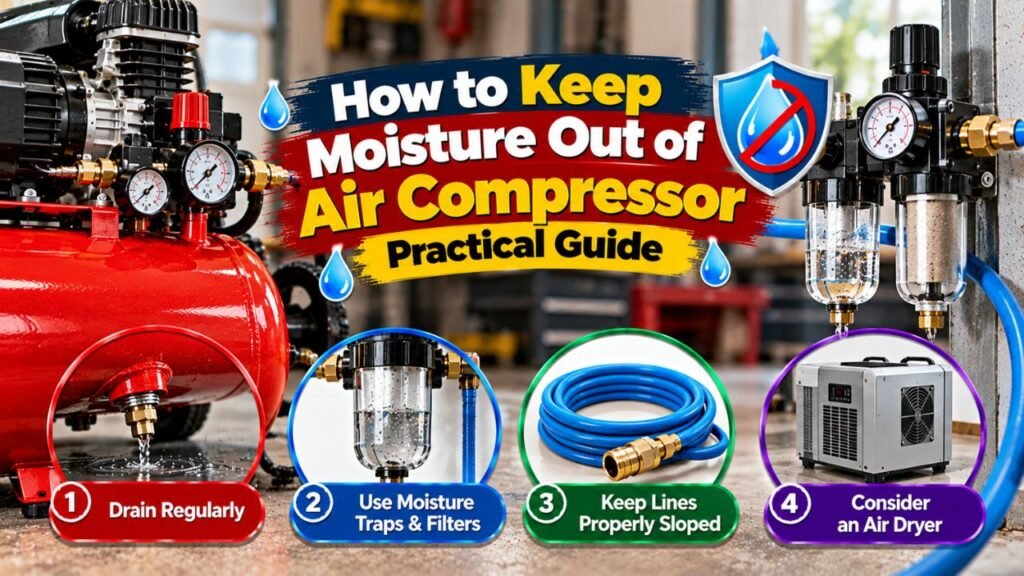
The best way to keep moisture out of an air compressor system is to control condensation from the tank all the way to the point where compressed air is used.
A practical moisture-control setup usually includes:
- Drain the air-compressor tank regularly.
- Install a moisture separator downstream of the compressor.
- Allow hot compressed air to cool before the separator.
- Use properly designed air piping with drain points.
- Install an automatic tank drain if manual draining is frequently forgotten.
- Add an air dryer when very dry compressed air is required.
- Maintain filters, separators, and drains regularly.
The important principle is that water vapor must usually cool and condense before a basic separator can remove it effectively.
Simply installing a small filter directly beside the hot compressor outlet may not remove as much moisture as expected.
Why Does an Air Compressor Make Water?
An air compressor does not actually create water. It concentrates moisture that was already present in the surrounding air.
Atmospheric air contains water vapor. The amount varies with humidity and temperature.
When the compressor takes in air:
- Atmospheric air enters the compressor pump.
- The pump compresses the air.
- Compression raises the air temperature.
- Hot compressed air enters the receiver tank and air lines.
- The air begins to cool.
- Its ability to hold water vapor decreases.
- Water condenses into liquid droplets.
The more humid the intake air and the more air the compressor processes, the more condensate the system can produce.
This is why air compressors often collect much more water during hot, humid summer weather.
Drain the Compressor Tank Regularly
The simplest step for controlling moisture is also one of the most important: drain the receiver tank.
Liquid water naturally settles at the bottom of the tank as compressed air cools.
If it remains there, it can contribute to:
- Internal tank corrosion
- Rusty condensate
- Water entering air lines
- Reduced usable tank volume
- Clogged drain valves
How often you should drain the tank depends on compressor use and humidity.
A compressor used heavily every day may need drainage daily or even more frequently depending on manufacturer instructions and operating conditions.
A lightly used home compressor may collect much less water.
Follow the maintenance interval specified by the compressor manufacturer.
Install an Automatic Tank Drain
An automatic drain valve can be useful if the compressor is used frequently or if manual drainage is easy to forget.
Automatic drains release accumulated condensate without requiring someone to manually open the drain each time.
Common designs include:
- Electronic timer drains
- Float-operated drains
- Zero-loss drains
Why an automatic drain helps
It can reduce the time water remains in the bottom of the receiver.
This is particularly useful for:
- Commercial workshops
- Auto repair shops
- Large stationary compressors
- Compressors that operate throughout the day
Automatic drains still require inspection and maintenance. A clogged or failed drain can allow water to accumulate even though the system appears automated.
Use a Moisture Separator
A moisture separator, sometimes called a water separator, helps remove liquid water from compressed air before it reaches your tools.
The separator typically causes air to spin or change direction so heavier water droplets separate from the airflow and collect in a bowl.
A separator is useful for:
- Air tools
- Impact wrenches
- Nailers
- General shop air
- Blow guns
- Light painting applications
However, a standard separator primarily removes liquid water droplets, not all water vapor.
That distinction is important.
If hot compressed air has not yet cooled enough for moisture to condense, much of the water may pass straight through the separator as vapor.
Don’t Put the Only Water Separator Right at the Compressor Outlet
This is a common mistake.
Air leaving the compressor pump or tank can still be hot.
Hot air can hold more water vapor than cooler air.
If a moisture separator is placed extremely close to the hot compressor and the air has not cooled, much of the moisture may remain in vapor form.
Later, as the air travels through the hose and cools, that vapor condenses downstream—after it has already passed the separator.
A better setup allows the air to cool before it reaches the main moisture separator.
Depending on the system, this can be accomplished with:
- Adequate metal piping
- An aftercooler
- A properly designed air-line system
- Distance between compressor and separator
The goal is to condense moisture before trying to separate it.
Use an Aftercooler
An aftercooler cools compressed air after it leaves the compressor pump.
Cooling causes water vapor to condense into liquid, making it easier to remove with a separator.
An aftercooler can significantly improve moisture control in systems that:
- Run frequently
- Produce large volumes of compressed air
- Operate in humid climates
- Supply paint equipment
- Feed professional pneumatic tools
Some compressors have built-in cooling arrangements. Others can use an external aftercooler.
A properly designed aftercooler is often paired with a water separator and drain.
Use Metal Air Lines to Help Cool Compressed Air
For permanent shop systems, metal piping can help the compressed air release heat.
Materials commonly used for compressed-air piping include appropriately rated systems such as:
- Copper
- Aluminum compressed-air piping
- Properly rated steel piping
As hot compressed air travels through the pipe, it cools.
Moisture then condenses and can be collected at strategically placed drain points.
Never assume ordinary piping material is safe for compressed air. Use pipe and fittings rated for the system’s pressure and intended application.
Some common plastic piping materials are not appropriate for compressed-air service because failure can create dangerous fragments.
Design Air Lines So Water Can Drain Away
A good air-line layout does more than transport compressed air.
It also helps manage condensate.
Permanent piping can be designed with a slight slope toward dedicated drain points so liquid water naturally moves to locations where it can be removed.
Use drip legs
A drip leg is a vertical section of piping installed at a low point where condensate can collect.
The bottom has a drain valve.
This prevents some water from continuing through the main air line toward your tools.
Take tool-air connections from above the main line
In a properly designed shop system, branch lines may be taken from the top of the main distribution pipe.
Because liquid water tends to remain at the bottom of the pipe, a top-fed branch can reduce the amount of liquid entering the tool line.
Exact piping design should follow accepted compressed-air practices and equipment requirements.
Install an Air Dryer for Better Moisture Removal
If you need significantly drier compressed air, use an air dryer.
A simple water separator cannot remove all moisture vapor.
Air dryers are designed to lower the amount of moisture remaining in compressed air.
The two common types for workshops are refrigerated and desiccant dryers.
Refrigerated Air Dryers
A refrigerated air dryer cools compressed air so moisture condenses, separates the liquid, and then sends the drier air downstream.
These dryers are commonly used in:
- Automotive shops
- Manufacturing
- General industrial compressed-air systems
- Larger home workshops
They provide much drier air than a basic separator and are suitable for many normal shop applications.
They are often a practical choice when a compressor supplies several tools throughout the day.
Desiccant Air Dryers
A desiccant dryer uses a moisture-absorbing material to remove water vapor from compressed air.
Desiccant systems can produce very dry air.
They are useful for applications such as:
- High-quality spray painting
- Instrument air
- Moisture-sensitive equipment
- Certain industrial processes
The desiccant eventually becomes saturated and must be regenerated or replaced, depending on the dryer design.
A small disposable desiccant filter can work near a spray gun for limited use, but it is not the same as a properly sized central dryer system.
Use a Coalescing Filter When Appropriate
A coalescing filter removes very fine liquid aerosols and contaminants that may pass through a basic separator.
Depending on the application, it can help remove:
- Fine water droplets
- Oil aerosols from oil-lubricated compressor systems
- Very small particles
Coalescing filters are often used as part of a multi-stage compressed-air treatment system.
A typical professional arrangement might include:
Compressor → aftercooler → water separator → receiver → particulate filter → coalescing filter → dryer → point-of-use filtration
The exact order varies depending on equipment and dryer design, so follow the manufacturers’ installation requirements.
Keep the Compressor in a Cool, Dry Location
You cannot eliminate humidity from outside air, but compressor location can influence how much moisture enters the system.
If practical, operate the compressor in an environment that is:
- Dry
- Well ventilated
- Protected from rain
- Away from excessive steam
- Away from unusually humid indoor processes
Placing a compressor in an extremely damp room means it continually draws moisture-rich air into the pump.
However, never restrict the compressor’s cooling airflow just to reduce humidity.
Adequate ventilation is essential for motor and pump cooling.
Keep the Intake Filter Clean
A clean air-intake filter helps the compressor operate efficiently.
The intake filter does not normally remove water vapor, but a clogged filter can make the compressor work harder and run hotter.
Excessive heat can reduce efficiency and increase compressor operating time.
Inspect or replace the intake filter according to the manufacturer schedule.
Do not attempt to install random moisture-absorbing material in the compressor intake unless the system was specifically designed for it.
Avoid Running a Compressor Longer Than Necessary
The more atmospheric air your compressor processes, the more moisture it can potentially bring into the system.
Air leaks can therefore indirectly increase condensation.
If the compressor has leaks at:
- Fittings
- Hoses
- Couplers
- Regulators
- Drain valves
the motor may cycle more frequently than necessary.
Repairing air leaks reduces:
- Compressor run time
- Energy consumption
- Heat generation
- Amount of humid air processed
This will not eliminate moisture, but it can reduce unnecessary condensate production.
Keep the Compressor Cool
Compressed air becomes hot, and an overheated compressor can create additional operating problems.
Maintain good airflow around:
- Motor
- Pump
- Cooling fins
- Belt guard
- Ventilation openings
Do not place objects against the compressor’s ventilation areas.
A cooler, efficiently operating compressor makes it easier for the downstream moisture-control system to function predictably.
How to Keep Moisture Out of an Air Compressor Tank
You cannot realistically keep all moisture from ever entering a receiver tank because humid compressed air naturally condenses as it cools.
Instead, focus on preventing water accumulation.
The best practices are:
- Drain condensate regularly.
- Install an automatic drain if appropriate.
- Keep the drain valve functional.
- Inspect rusty or contaminated drain water.
- Reduce unnecessary compressor cycling.
- Maintain downstream moisture controls.
The receiver tank itself can actually help separate moisture because compressed air cools while stored inside it.
The important thing is to remove the liquid that collects afterward.
How to Stop Water From Reaching Air Tools
If your tools are getting wet air even though you drain the tank, improve downstream filtration.
A good basic setup might include:
- Compressor tank
- Cooling distance or aftercooler
- Moisture separator
- Main air line
- Point-of-use filter or separator
- Tool
High-demand or moisture-sensitive work may require a dryer between the compressor and point-of-use equipment.
For pneumatic tools
Some pneumatic tools require lubrication, so completely dry air may need to be followed by a tool lubricator where the manufacturer calls for one.
Do not confuse tool lubrication with moisture contamination.
How to Stop Water in an Air Compressor for Painting
Painting requires more moisture control than many ordinary air-tool applications.
Even a small amount of water can affect certain finishes.
For painting, consider a system with:
- Tank drainage
- Aftercooling or adequate cooling distance
- Water separator
- Coalescing filtration where appropriate
- Refrigerated or desiccant dryer
- Final point-of-use filter near the spray gun
The correct setup depends on:
- Paint type
- Spray equipment
- Humidity
- Compressor output
- Finish quality required
For professional automotive refinishing, a properly engineered dry-air system is generally worth the investment.
Why Is There Still Water After Installing a Moisture Separator?
Several problems can explain this.
The air is too hot
The moisture may still be vapor when it passes through the separator.
It condenses farther downstream.
The separator is undersized
A separator designed for low airflow may become ineffective when air velocity is too high.
The bowl is full
A separator cannot work correctly if accumulated condensate is not drained.
The system lacks cooling distance
Longer properly designed piping or an aftercooler may be needed.
Humidity is extremely high
Basic separators have limits.
A dryer may be necessary for demanding conditions.
Should You Use More Than One Moisture Separator?
Sometimes.
A shop system can benefit from staged moisture removal.
For example:
- A primary separator near the cooled compressor air
- Additional drainage along the main piping
- A point-of-use filter near a moisture-sensitive tool
However, simply installing many small separators does not replace a proper dryer when truly dry air is required.
Each filter also introduces some pressure drop, so components should be properly sized.
Does an Oil-Free Compressor Have Less Moisture?
No.
Oil-free refers to pump lubrication, not moisture.
An oil-free compressor can produce just as much condensation as an oil-lubricated unit operating under similar atmospheric conditions.
Humidity, air volume, temperature, and cooling determine how much water forms.
You must drain and treat air from both types.
Does a Bigger Tank Reduce Moisture?
Not necessarily, but a larger receiver may allow compressed air more time to cool.
Cooling can cause more water to condense inside the tank, where it can then be drained.
That can help prevent some moisture from traveling farther downstream.
However, a larger tank does not remove moisture automatically.
If the tank is not drained, the collected water simply remains inside.
Can You Prevent Condensation Completely?
Usually, no.
If a compressor draws humid atmospheric air and then compresses and cools it, condensation is a natural result.
The realistic goal is to control where condensation occurs and remove it effectively.
A well-designed system encourages moisture to condense in places equipped with:
- Separators
- Receiver drains
- Drip legs
- Automatic drains
- Air dryers
Trying to prevent condensation altogether is much less practical than managing it correctly.
Common Moisture-Control Mistakes
Never Draining the Tank
This allows liquid water to sit against the bottom of the receiver and can promote internal corrosion.
Installing a Separator Too Close to Hot Air
A separator cannot remove water that is still present mainly as vapor.
Give compressed air a chance to cool.
Assuming an Oil-Free Compressor Produces Dry Air
Oil-free does not mean moisture-free.
Using Only a Small Filter for Spray Painting
A basic filter may not provide air dry enough for high-quality finishing.
Ignoring Air-Line Design
Low spots without drains can collect large amounts of water.
Forgetting to Drain Filter Bowls
A separator bowl full of water cannot continue doing its job effectively.
Ignoring Air Leaks
Leaks force the compressor to process more humid atmospheric air than necessary.
Signs Your Compressor System Has Too Much Moisture
Watch for:
- Water spraying from an air hose
- Rust-colored condensate
- Water in filter bowls
- Corrosion inside pneumatic tools
- Paint defects
- Moisture at hose couplers
- Nailers or air tools behaving poorly
- Excessive water when draining the receiver
Some water in a compressor tank is normal.
Repeated water reaching the tools indicates that the moisture-control setup needs improvement.
A Simple Moisture-Control Setup for Home Garages
Many home users do not need an industrial dryer.
For tire inflation, nailers, occasional impact tools, and basic DIY work, a practical system can include:
- Regular receiver drainage
- Adequate hose or piping distance for cooling
- Properly sized water separator
- Point-of-use filter where necessary
This setup may be sufficient for ordinary garage work.
Painting or other moisture-sensitive applications may require better drying.
A Better Setup for a Busy Workshop
A shop that uses compressed air throughout the day may benefit from:
- Compressor
- Aftercooler
- Primary moisture separator
- Receiver tank with automatic drain
- Properly sloped distribution piping
- Drip legs
- Particulate/coalescing filtration as required
- Refrigerated air dryer
- Point-of-use treatment
This setup controls water at several stages instead of expecting one filter to handle everything.
Maintenance Tips for Keeping Compressed Air Dry
Moisture-control equipment only works when maintained.
Regularly:
- Drain the receiver.
- Check automatic drains.
- Empty separator bowls.
- Replace filter elements when required.
- Inspect air lines for low-point water accumulation.
- Service dryers according to manufacturer instructions.
- Replace saturated desiccant.
- Check for air leaks.
- Keep compressor cooling surfaces clean.
If water suddenly increases despite similar weather and use, inspect the system for failed drains or saturated filters.
FAQs About How to Keep Moisture Out of Air Compressor
How do I prevent water from building up in my air compressor tank?
You cannot prevent all condensation, but you can prevent water from accumulating by draining the receiver regularly or installing a properly maintained automatic drain.
What is the best way to remove moisture from compressed air?
For general use, combine tank drainage, proper cooling, and a moisture separator.
For significantly drier air, add a refrigerated or desiccant dryer.
Will a water separator remove all moisture?
No.
A standard separator mainly removes condensed liquid droplets.
Water vapor can pass through and later condense downstream.
Why does my air compressor have so much water in it?
High humidity, warm weather, long compressor run times, and high air demand can all increase condensate production.
Large amounts of water do not necessarily mean the compressor is defective.
How can I stop water coming through my air hose?
Drain the tank, allow compressed air to cool, install a properly sized water separator, and consider a dryer or point-of-use filter if water still reaches the hose.
Where should I install a moisture separator?
A separator generally works better after compressed air has had a chance to cool enough for water vapor to condense.
Follow the separator and compressor manufacturer’s installation instructions for distance and placement.
Do I need an air dryer for a home compressor?
Not always.
A tank drain and moisture separator may be adequate for tire inflation, nailers, and general DIY work.
Painting and other moisture-sensitive tasks can benefit from a dryer.
Does an oil-free air compressor still make water?
Yes.
Oil-free refers to pump lubrication. It does not prevent atmospheric moisture from condensing inside the tank or air lines.
Conclusion
The practical answer to how to keep moisture out of air compressor systems is not to expect one filter to eliminate all water. Moisture enters with atmospheric air, and some condensation is unavoidable whenever compressed air cools. The most effective strategy is therefore to control that moisture in stages.
Start by draining the receiver tank regularly so water cannot remain against the steel tank. Allow hot compressed air to cool, then use a properly sized moisture separator to remove condensed liquid. For permanent shop systems, properly designed piping, drip legs, and automatic drains can improve moisture control significantly. If the air must be very dry for painting, instruments, or other sensitive applications, add a refrigerated or desiccant dryer.
The same approach answers how to keep moisture out of air compressor tank, how to prevent moisture in air compressor, how to stop moisture in air compressor, and how to stop water in air compressor systems: you cannot realistically stop humid air from entering, but you can efficiently condense, separate, drain, and dry the moisture before it causes rust, tool damage, or problems at the point of use.