
How to Unclog a Drain With an Air Compressor Safely
A clogged sink, tub, or floor drain can sometimes be cleared by using compressed air to push a soft blockage through the pipe. The method can work well on certain clogs caused by soap residue, loose debris, or minor buildup, but it also carries risks if too much pressure is used.
You can sometimes unclog a drain with an air compressor, but you should use very low, controlled pressure and only on a plumbing system that is in good condition. High-pressure air can damage traps, fittings, seals, or older pipes and may force dirty water back through another drain.
Understanding how to unclog a drain with an air compressor is mainly about controlling pressure and sealing the correct openings. Unlike a drain snake, compressed air does not physically grab or break apart a clog. Instead, it creates a short pressure pulse that may dislodge a blockage and move it farther down the drain line.
This technique is best treated as a limited DIY option rather than a universal solution. It may help with a minor sink or floor-drain clog, but it is a poor choice for severe blockages, damaged plumbing, septic-system problems, or clogs deep in a main sewer line.
This guide explains when compressed air can help, what equipment you need, how to use it safely, which drains to avoid, and what to do if the clog does not clear.
How to Unclog a Drain With an Air Compressor
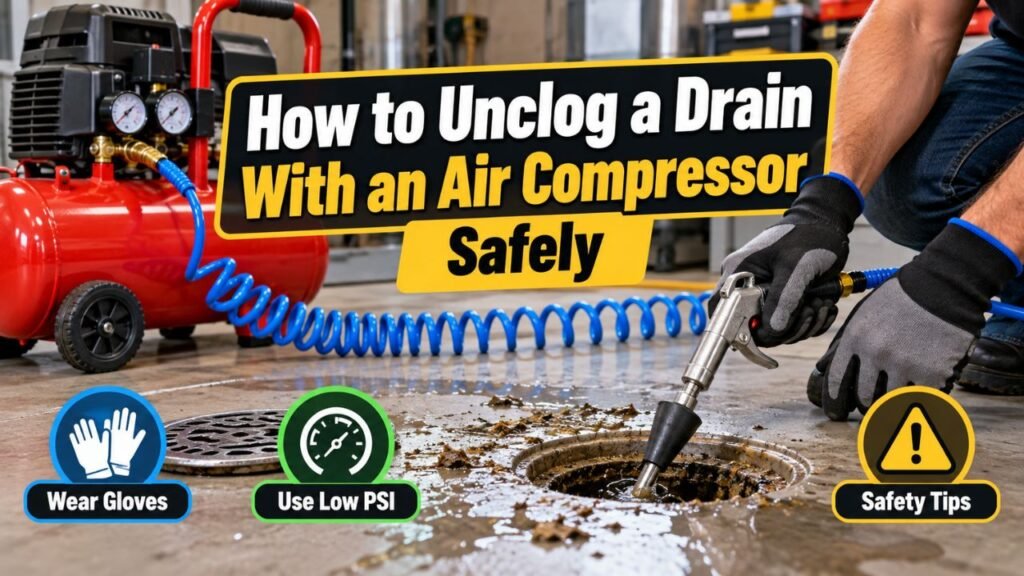
To unclog a drain with an air compressor, reduce the compressor’s output to low pressure, remove standing water if possible, seal nearby drain openings, connect an appropriate rubber drain adapter to the clogged drain, and apply short bursts of air rather than continuous pressure.
A basic process is:
- Identify the type of drain and likely clog.
- Remove as much standing water as practical.
- Check the visible plumbing for damage or loose fittings.
- Seal nearby drains and overflow openings.
- Set the regulator to a low pressure.
- Fit a rubber drain-cleaning adapter over the clogged drain.
- Apply a short burst of compressed air.
- Wait and listen for movement.
- Test the drain with a small amount of water.
- Repeat cautiously only if needed.
If the pipe begins leaking, a fitting moves, or the drain does not improve after a few controlled attempts, stop and use another method.
How Compressed Air Clears a Drain
Compressed air creates a pressure wave inside the plumbing.
That pressure can push against a clog and sometimes move it farther through the pipe.
It works best when the blockage is:
- Soft
- Loose
- Relatively close to the drain
- Not completely hardened
- Not caused by a solid object
Typical examples include buildup from:
- Soap
- Hair mixed with soap
- Light grease
- Loose food particles
- Sludge
A hard object lodged inside the pipe may not respond well to air pressure.
What Pressure Should You Use?
This is one of the most important parts of the process.
Do not send full compressor pressure into household plumbing.
Many shop compressors can produce 90 to 150 PSI or more, while household drainage systems are not designed to be pressurized like an air hose.
Start with very low pressure.
For a household drain, a controlled range around 10 to 20 PSI is a much safer starting point than typical air-tool pressure.
Even at low pressure, use only brief pulses.
You should never assume that a plumbing system can safely tolerate 50, 90, or 120 PSI simply because the compressor can produce it.
Why High Pressure Is Dangerous
Too much air pressure can cause damage in several ways.
It Can Blow Apart Slip-Joint Fittings
Many sink traps use threaded slip nuts and plastic washers.
These fittings are designed to drain water, not contain high internal air pressure.
A strong pressure burst can loosen or separate them.
It Can Damage Old Plumbing
Older pipes may already have:
- Corrosion
- Cracks
- Weak joints
- Brittle plastic
- Deteriorated seals
Pressure can turn a hidden weakness into a leak.
It Can Force Wastewater Back Through Another Drain
Drain lines are connected.
If you pressurize one branch, the air and dirty water may escape through another:
- Sink
- Tub
- Shower
- Floor drain
- Dishwasher connection
That is why nearby openings sometimes need to be sealed.
It Can Damage a Trap or Seal
A sink or tub trap normally holds water to block sewer gas.
Excessive pressure can disturb water seals or damage components around the drain connection.
What You Need
A basic setup may include:
- Air compressor with an adjustable regulator
- Air hose
- Rubber drain-cleaning adapter
- Towels
- Bucket
- Safety glasses
- Rubber gloves
- Drain stopper or plugs
- Wet/dry vacuum if available
A purpose-built rubber drain bladder or pneumatic drain tool is better than trying to hold a bare air nozzle directly against the drain opening.
Do Not Put a Blow Gun Directly Into the Drain
A standard shop air blow gun is not a good drain-cleaning adapter.
It can create a concentrated jet and may not seal the drain properly.
That makes pressure harder to control and increases the chance of:
- Splashing contaminated water
- Sudden pressure release
- Damaging drain parts
- Sending debris toward your face
Use a proper rubber attachment that spreads pressure more evenly.
Step 1: Identify the Type of Clog
Before using compressed air, determine whether you are dealing with a local fixture clog or a larger plumbing problem.
Local Clog
A local clog usually affects one drain.
For example:
- Kitchen sink drains slowly
- Bathroom sink backs up
- One tub is clogged
Compressed air may be worth trying if the blockage is minor.
Main Drain Problem
A larger problem may be present if:
- Multiple drains are backing up
- Toilets and tubs are affected together
- Water rises in a shower when another fixture drains
- Floor drains overflow
- Sewage odor is present
Do not rely on compressed air for a suspected main sewer clog.
A drain snake, hydro-jetting equipment, or professional plumber is more appropriate.
Step 2: Remove Standing Water
If possible, remove standing water from the sink or tub before applying air.
Use:
- Cup
- Sponge
- Wet/dry vacuum
Less water around the drain means less contaminated liquid can spray if pressure escapes.
You do not need the pipe to be completely dry.
Step 3: Inspect the Plumbing
Look underneath the sink or around accessible piping.
Check for:
- Loose trap nuts
- Cracked PVC
- Corroded metal pipe
- Existing leaks
- Damaged connections
If anything already looks weak, avoid pressurizing the line.
Fix the plumbing first or use a mechanical drain-cleaning method.
Step 4: Seal Nearby Openings
Air will escape through the easiest available path.
For a bathroom sink, seal the overflow opening before applying pressure.
For a double kitchen sink, seal the second drain.
Depending on the plumbing layout, you may also need to seal:
- Adjacent basin
- Dishwasher connection
- Other nearby drain openings
A wet cloth, stopper, or rubber plug can work for some openings.
The seal does not need to withstand high pressure because you should be using low pressure.
Step 5: Reduce Compressor Pressure
Turn the compressor regulator down before connecting to the drain adapter.
Do not rely on trigger control alone.
Set the output pressure low at the regulator.
A conservative starting point is around 10 PSI.
If the plumbing is sound and the clog does not move, you may increase pressure slightly, but stay cautious.
The goal is a short pressure pulse, not sustained force.
Step 6: Attach the Drain Adapter
Fit the rubber drain-cleaning attachment securely over or into the drain opening according to its instructions.
The adapter should:
- Seal reasonably well
- Stay centered
- Avoid damaging the drain trim
- Keep the air hose under control
Do not permanently wedge the attachment into the pipe.
You should be able to remove it immediately if something goes wrong.
Step 7: Apply a Short Burst of Air
Use a brief pulse, typically around a second or less.
Then stop.
Listen for:
- Gurgling
- Water movement
- Air escaping
- Clog shifting
Do not hold continuous compressor pressure against the drain.
A short pulse lets you evaluate what happened before adding more force.
Step 8: Test the Drain
After one or two brief pulses, remove the adapter and run a small amount of water.
If the water drains normally, the clog may have cleared.
If it drains better but still slowly, another cautious pulse may help.
If there is no improvement, repeated pressure may not solve the problem.
Switch to another cleaning method.
Can You Use an Air Compressor on a Kitchen Sink?
Sometimes.
Kitchen sink clogs often contain:
- Grease
- Food particles
- Soap residue
Compressed air may move a soft blockage, but thick grease can be difficult to clear because air may simply create a small channel through it.
For grease-heavy clogs, a drain snake or trap cleaning may provide a more complete repair.
Double-Bowl Kitchen Sinks
If your sink has two bowls, seal the open drain in the second bowl before applying compressed air.
Otherwise, the pressure may simply escape through that opening.
Be prepared for dirty water to rise in the other basin if the seal is not tight.
Can You Unclog a Bathroom Sink With Compressed Air?
Yes, a minor bathroom sink clog may respond to compressed air.
However, bathroom sink clogs often contain:
- Hair
- Soap
- Toothpaste residue
- Grooming debris
These materials can form a dense mass near the stopper or P-trap.
Before using compressed air, it is often easier to remove and clean:
- Pop-up stopper
- Drain flange area
- P-trap
If the blockage is physically accessible, removing it is better than pushing it deeper into the plumbing.
Can You Use Compressed Air on a Bathtub Drain?
Possibly, but tub drains require extra care because of the overflow opening.
You need to seal the overflow opening so pressure does not escape.
Hair is one of the most common tub-drain blockages.
A plastic drain-cleaning strip or small drain snake is often more effective because it can physically pull hair out rather than push it deeper.
Can You Use an Air Compressor on a Shower Drain?
A small shower drain clog may respond to low-pressure air.
However, shower clogs are frequently caused by hair and soap buildup.
Mechanical removal is often the better first choice.
Remove the drain cover and inspect for visible debris before attempting pressure.
Can You Use an Air Compressor on a Toilet?
It is generally not a good DIY approach.
A toilet has a ceramic trapway and complex internal passage.
Applying compressed air can:
- Splash contaminated water
- Damage seals
- Force waste into other plumbing
- Create excessive pressure
- Potentially damage the toilet
Use a toilet plunger or closet auger instead.
For a severe toilet or sewer-line blockage, call a plumber.
Can You Use Compressed Air on PVC Drain Pipes?
Use extreme caution.
PVC drainage pipe is durable under normal drainage conditions, but it is not intended to carry high compressed-air pressure.
Older PVC can become brittle, and joints may already be weak.
Never connect full shop-air pressure to a PVC drainage system.
If you decide to use compressed air, keep pressure very low and use only short bursts.
Can You Use Compressed Air on Cast Iron Drains?
Cast iron is strong, but age and corrosion matter.
An older cast-iron drain may have:
- Internal scaling
- Corroded joints
- Cracked fittings
- Deteriorated seals
Compressed air can move loose debris but may also expose an existing weakness.
For older plumbing, mechanical cleaning is often more predictable.
Can Compressed Air Make a Clog Worse?
Yes.
Compressed air may push a blockage farther into the plumbing.
A clog that was originally close to the fixture can end up deeper in the branch line, where it becomes more difficult to reach.
This is especially possible with:
- Hair masses
- Solid objects
- Grease plugs
- Foreign materials
That is one reason mechanical removal is often better when the blockage can be reached directly.
Air Compressor vs. Drain Snake
Both can clear clogs, but they work differently.
| Method | Best For | Main Advantage | Main Limitation |
| Compressed air | Soft minor clogs | Fast and simple | Can push clog deeper |
| Hand snake | Hair and physical blockages | Breaks or retrieves clog | Requires access |
| Powered auger | Deeper stubborn clogs | Greater reach | Can damage pipes if misused |
| Plunger | Near-fixture soft clogs | Very safe and simple | Limited reach |
| Hydro jet | Heavy buildup and grease | Cleans pipe walls | Professional equipment often needed |
For many household clogs, a plunger or snake should be tried before compressed air.
Air Compressor vs. Drain Bladder
A drain bladder usually connects to a garden hose and expands inside the pipe.
Water pressure then pushes against the clog.
This is different from compressed air.
A drain bladder can be effective in some lines, but it also creates pressure and should be used carefully.
Do not use it in fragile, poorly supported, or questionable plumbing.
Why a Wet/Dry Vacuum Can Be Safer
A wet/dry shop vacuum can sometimes remove a clog by suction instead of pushing it deeper.
It may work well for:
- Hair
- Loose debris
- Standing water
- Small objects near the drain
If you can create a good seal around the drain opening, suction may pull the clog toward you.
That can be preferable to forcing it farther down the line.
Avoid Mixing Compressed Air With Chemical Drain Cleaner
Do not apply compressed air to a drain that contains strong chemical drain cleaner.
Pressurizing the pipe can spray corrosive chemicals back toward you.
This can cause serious:
- Eye injury
- Skin burns
- Respiratory irritation
If chemical cleaner has already been used, follow the product’s instructions and avoid methods that can create splashing.
Tell a plumber if chemicals are present in the drain.
What if the Drain Is Completely Blocked?
A completely blocked line can build pressure quickly because air has nowhere to escape.
That increases the risk of:
- Pipe separation
- Leaks
- Blowback
- Splashing
If the line is completely blocked, a drain snake is generally safer and more effective.
Do not keep increasing compressor pressure in an attempt to force the obstruction through.
Signs You Should Stop Using Compressed Air
Stop immediately if you notice:
- Pipe movement
- Leaking joints
- Water spraying from another fixture
- Strong sewer odor
- Cracking sounds
- Drain fittings shifting
- Pressure building with no drainage
- Repeated clogging after temporary clearing
These signs suggest that the problem needs mechanical cleaning or professional inspection.
What if the Clog Keeps Coming Back?
A recurring clog usually means the underlying buildup has not been fully removed.
Possible causes include:
- Grease lining the pipe
- Hair accumulation
- Partially blocked branch line
- Improper pipe slope
- Damaged drain pipe
- Tree roots in a sewer line
- Main-line obstruction
Compressed air may temporarily open a path without actually cleaning the pipe.
A drain camera inspection may be useful for repeated or unexplained blockages.
When to Call a Plumber
Professional help is appropriate if:
- Multiple fixtures back up.
- Sewage comes through another drain.
- The clog returns frequently.
- A drain snake cannot reach the blockage.
- The plumbing is old or damaged.
- You suspect a main sewer clog.
- You hear unusual pipe noises.
- There is a leak after pressurizing.
- The drain is completely blocked.
- You are unsure whether the pipe can tolerate pressure.
Main sewer problems should not be treated by sending high-pressure shop air into household plumbing.
How to Prevent Future Drain Clogs
Prevention is easier than repeatedly clearing blockages.
Kitchen Drains
Avoid sending large amounts of:
- Cooking grease
- Fat
- Coffee grounds
- Food scraps
down the drain.
Use a sink strainer.
Bathroom Drains
Use a hair catcher in:
- Showers
- Tubs
- Bathroom sinks
Clean it regularly.
Maintain P-Traps
If a sink repeatedly clogs close to the fixture, periodically cleaning the removable P-trap may help.
Address Slow Drains Early
A slow drain is often easier to clean than a completely blocked one.
Do not wait until water stops moving entirely.
Common Mistakes When Using an Air Compressor on a Drain
Using Full Compressor Pressure
This is the biggest mistake.
Household drains are not designed for 90-150 PSI shop air.
Applying Continuous Air
Use short pulses instead of maintaining pressure.
Forgetting to Seal Overflow Openings
Air may escape through the overflow instead of reaching the clog.
Ignoring Nearby Drains
Pressure can move through connected plumbing and create messy blowback.
Using Air After Chemical Drain Cleaner
This can spray corrosive chemicals.
Trying to Clear a Main Sewer Line
A compressor is not a substitute for proper sewer-cleaning equipment.
Assuming More Pressure Means Better Results
If low pressure does not work, increasing pressure can damage plumbing without clearing the clog.
FAQs About How to Unclog a Drain With an Air Compressor
Can you use an air compressor to unclog a drain?
Yes, low-pressure compressed air can sometimes clear a soft, localized blockage.
It should be used cautiously because excessive pressure can damage pipes, fittings, and seals.
How much PSI should I use to unclog a drain?
Start very low, around 10 PSI, and use only brief bursts.
Avoid normal air-tool pressures such as 90 PSI.
The safest limit depends on the condition and design of the plumbing system.
Can compressed air damage PVC drain pipes?
Yes, particularly if excessive pressure is used.
PVC drain systems are intended for gravity drainage, not high-pressure compressed air.
Older or poorly glued joints may be especially vulnerable.
Can I use a compressor to unclog a kitchen sink?
A minor kitchen sink clog may respond to low-pressure compressed air.
Seal the second basin on a double sink and avoid using air if chemical drain cleaner is present.
Can compressed air clear hair from a drain?
It may move a hair clog, but it often does not remove it.
A drain snake or hair-removal tool is usually better because it pulls the blockage out instead of pushing it deeper.
Can I use compressed air after pouring drain cleaner down the sink?
No.
Pressurizing a drain containing corrosive chemicals can cause dangerous splashback.
Use the chemical product according to its instructions and avoid compressed air.
Why did water come out of another sink when I used compressed air?
The drains are connected, and the pressure found another route through the plumbing.
This indicates that air pressure is traveling through the branch system rather than acting only on the clog.
Stop and reassess before adding more pressure.
What should I do if compressed air does not clear the drain?
Use a plunger, remove and clean the P-trap, try an appropriate drain snake, or call a plumber.
Do not continue increasing air pressure.
Conclusion
The practical verdict on how to unclog a drain with an air compressor is that compressed air can work for a minor, soft, localized blockage, but it should be used as a controlled low-pressure method rather than a high-force solution.
Start with very low regulated pressure, seal nearby openings, use a proper rubber drain adapter, and apply only short bursts. Never connect full shop-air pressure to household plumbing, especially older PVC, corroded metal pipe, or questionable fittings. If the clog does not move after a few careful attempts, increasing the pressure is more likely to damage the plumbing than solve the problem.
For hair, solid objects, severe grease buildup, recurring clogs, or a suspected main sewer blockage, a plunger, drain snake, auger, or professional cleaning method is usually a better choice. Compressed air is most useful when the plumbing is sound and the clog is simple—not when the system is already damaged or completely blocked.