
How to Remove Water From Air Compressor Lines and Prevent It
Water inside compressed-air lines is a common problem in home garages, workshops, auto shops, and industrial air systems. You may notice water spraying from a blow gun, droplets coming from an impact wrench, moisture collecting inside filters, or even water reaching a paint gun. In most cases, the compressor is not malfunctioning. The moisture starts as water vapor already present in the surrounding air.
The best way to remove water from air compressor lines is to drain the receiver tank and low points, cool the compressed air before moisture-sensitive equipment, install an effective water separator or dryer, and make sure the piping is arranged so condensate can collect and drain instead of traveling to your tools.
Learning how to remove water from air compressor lines is only part of the solution. If you keep removing water without controlling why it is forming and where it collects, the problem will return. A good compressed-air system manages moisture from the compressor outlet all the way to the point where the air is actually used.
The amount of moisture you need to remove also depends on the job. A small amount of condensate may be manageable when operating an impact wrench, while spray painting, sandblasting, instrumentation, or other moisture-sensitive work may require much drier air.
This guide explains where the water comes from, how to get it out of existing air lines, how to keep water out of air compressor lines, and which moisture-control equipment makes sense for different types of users.
How to Remove Water From Air Compressor Lines
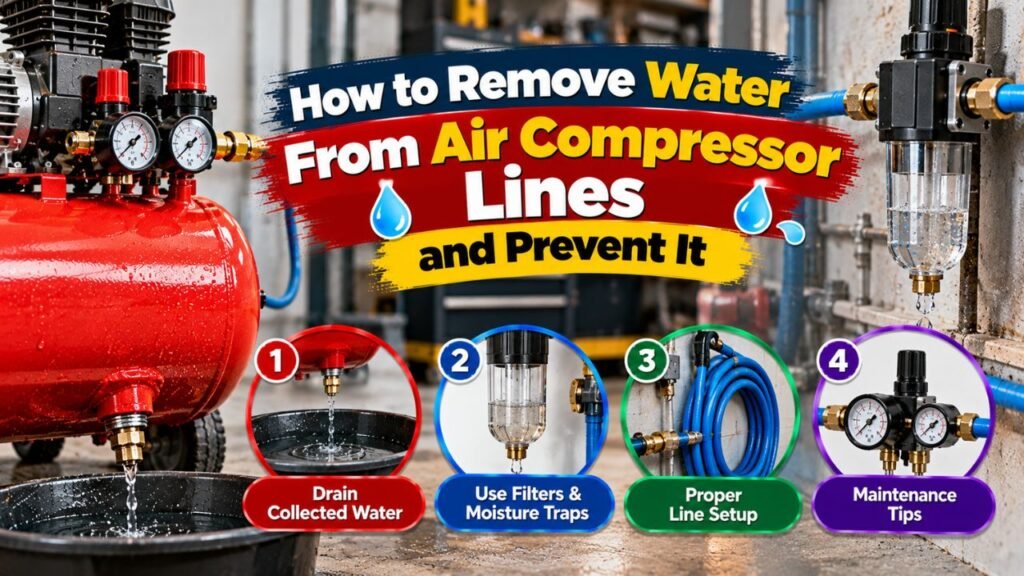
To remove water from air compressor lines, start by shutting down and safely depressurizing the system as required, drain the compressor receiver, empty moisture separators and low-point drains, and inspect the piping for places where condensate can collect. Then add or improve moisture separation and drying equipment if water continues reaching your tools.
A practical moisture-removal process is:
- Drain condensate from the compressor tank.
- Drain low points in the compressed-air piping.
- Empty water separators and filter bowls.
- Check automatic drains for proper operation.
- Allow hot compressed air to cool before the main separator when possible.
- Install a properly sized moisture separator.
- Add an air dryer if the application requires drier air.
- Correct poor piping layouts that carry condensate toward tools.
- Drain or maintain the system regularly.
If you simply install a small filter at the tool while the rest of the system contains substantial condensate, you may still have moisture problems.
Why Does Water Get Into Air Compressor Lines?
Atmospheric air contains water vapor.
The compressor pulls that humid air into the pump along with everything else in the surrounding atmosphere.
As air is compressed, its temperature rises significantly. The hot compressed air can initially hold much of its moisture as vapor.
Once the air travels through the receiver tank and piping, it begins to cool.
As it cools, some of the water vapor condenses into liquid water.
That liquid can then collect in:
- Air receiver tanks
- Horizontal piping
- Vertical drops
- Filter bowls
- Hose reels
- Pneumatic tools
- Low spots in the system
The more humid the intake air and the more air the compressor processes, the more moisture the system must handle.
Why Water Often Appears Far From the Compressor
A common mistake is assuming that all condensation happens inside the air tank.
It does not.
Compressed air leaving the compressor can still be quite hot. As that air travels through cooler piping, additional moisture condenses.
This means you can drain the receiver tank and still find water farther downstream.
In fact, longer metal air lines can cool compressed air enough that substantial condensation forms in the piping itself.
That is why a good system includes both cooling and drainage downstream of the compressor.
Drain the Air Compressor Tank First
Before trying to remove water from the lines, make sure the receiver tank is being drained properly.
The tank is usually the first major place where condensate accumulates.
If the receiver contains a large amount of water, compressed air can carry additional moisture downstream.
Depending on the system, the receiver may use:
- Manual drain valve
- Ball valve
- Timed automatic drain
- Float drain
- Zero-loss drain
For a home compressor, draining after substantial use or according to the manufacturer’s schedule is usually appropriate.
A heavily used commercial compressor often benefits from an automatic drain.
Drain Low Points in the Air Lines
Liquid water naturally moves toward low areas.
If your piping has low spots with no drain, condensate can remain trapped there.
Eventually, airflow can pick it up and carry it toward your tools.
A well-designed system provides drip legs or low-point drains where water can collect.
These drains should be checked regularly.
If you repeatedly find water at one location, that may indicate the piping is unintentionally sloping toward that point.
What Is a Drip Leg?
A drip leg is a vertical section of pipe extending downward from the compressed-air line.
Liquid water falls into this lower section instead of continuing toward the tool outlet.
A drain valve at the bottom allows the condensate to be removed.
Drip legs are especially useful:
- Near long pipe runs
- At low points
- Before equipment
- At the bottom of vertical drops
They work best when the overall piping system is designed to direct condensate toward them.
Install a Moisture Separator
A moisture separator, sometimes called a water separator, removes liquid water droplets from compressed air.
The air is directed through an internal structure that causes droplets to separate from the airflow and collect in a bowl.
The water can then be drained manually or automatically.
Moisture separators are useful, but their effectiveness depends on the air being cool enough for moisture to have condensed into liquid.
A separator cannot efficiently remove water that is still present only as vapor.
That is why installation location matters.
Where Should a Water Separator Be Installed?
Installing a separator immediately at the hot compressor outlet may not provide the best moisture removal.
At that point, much of the moisture may still be vapor.
Allowing the air to cool first gives water vapor time to condense.
A common arrangement is:
Compressor → Aftercooling or piping → Receiver/condensate drain → Moisture separator → Dryer if required → Distribution system
The exact layout depends on compressor and system design.
For small garage systems, placing the main separator some distance downstream from the compressor can improve performance because the piping gives the air time to cool.
Use an Aftercooler
An aftercooler removes heat from compressed air after it leaves the compression stage.
Cooling the air intentionally causes more water vapor to condense before it reaches the rest of the system.
The newly formed liquid can then be removed by a separator.
Aftercoolers are especially useful in systems with:
- High compressor output
- Continuous operation
- High ambient humidity
- Painting
- Sandblasting
- Commercial pneumatic equipment
Many larger compressor packages include an aftercooler from the factory.
Use a Refrigerated Air Dryer for Better Moisture Control
If separators alone are not keeping the air dry enough, a refrigerated compressed-air dryer is a major upgrade.
A refrigerated dryer cools the compressed air so additional water vapor condenses.
The liquid is removed, and the air is then delivered downstream with a lower moisture content.
Refrigerated dryers are commonly used in:
- Auto shops
- Manufacturing
- Painting systems
- CNC equipment
- General industrial compressed air
They provide much better moisture control than relying only on a receiver and basic separator.
Use a Desiccant Dryer When Very Dry Air Is Required
A desiccant dryer removes water vapor using moisture-absorbing material.
It can produce much drier compressed air than a basic mechanical separator.
Desiccant dryers are useful for:
- Instrument air
- Very sensitive painting applications
- Cold-weather air lines
- Laboratory applications
- Processes requiring low dew points
For ordinary home air tools, a full industrial desiccant system may be unnecessary.
A small point-of-use desiccant dryer can sometimes be useful for painting or other sensitive tasks.
Water Separator vs. Air Dryer
These devices solve different parts of the moisture problem.
| Equipment | Primary Function | Removes Liquid Water? | Removes Water Vapor? |
| Tank drain | Removes accumulated condensate | Yes | No |
| Moisture separator | Separates liquid droplets | Yes | Very limited |
| Aftercooler | Cools air so vapor condenses | Indirectly | Converts some vapor to liquid |
| Refrigerated dryer | Cools and removes condensate | Yes | Yes, substantially |
| Desiccant dryer | Adsorbs water vapor | Yes with proper prefiltration | Yes, very effectively |
A separator and dryer are therefore not interchangeable.
How to Keep Water Out of Air Compressor Lines
If you are wondering how to keep water out of air compressor lines, the goal is not to prevent atmospheric moisture from entering the compressor completely. That is generally impossible in a normal open-air intake system.
Instead, the goal is to remove moisture before it reaches critical equipment.
The most effective approach combines:
- Regular tank drainage
- Proper cooling
- Correct pipe slope
- Drip legs
- Moisture separators
- Automatic drains
- Air dryers where necessary
Keeping the system cool enough for moisture to condense in controlled locations is often more effective than simply adding more filters.
Use Proper Air Line Piping
The way compressed-air piping is installed can either help or worsen moisture problems.
A good system allows condensate to move toward drains rather than tools.
Slope the Main Line
Horizontal main lines are commonly installed with a slight slope so liquid flows toward a drain point.
The exact arrangement depends on the system design.
The important idea is to avoid random low spots that trap water.
Take Tool Drops From the Top of the Main Line
One useful piping technique is to take branch lines upward from the top of the main pipe before routing them down toward tools.
Why?
Liquid water tends to travel along the bottom of the main line.
A branch taken directly from the bottom can collect more condensate.
A top takeoff reduces the chance that liquid water enters the tool branch.
Add a Drip Leg Below Each Drop
At the bottom of a vertical drop, extend the pipe below the tool connection.
The extra section becomes a collection point for water.
Install a drain at the bottom.
The tool connection can then be positioned above the condensate collection point.
Avoid Low Spots in Flexible Hoses
A long hose lying on the floor can create low areas where water collects.
When airflow increases, that stored water can suddenly be pushed toward the tool.
If practical:
- Route hoses neatly.
- Drain hose reels when needed.
- Avoid leaving large loops filled with condensate.
- Use point-of-use filtration for sensitive equipment.
Hose management will not replace a dryer, but it can prevent obvious water pockets.
Keep the Compressor Intake in a Good Location
A compressor draws whatever air surrounds its intake.
Placing it in an extremely humid location increases the moisture load.
When practical, keep the compressor in:
- A well-ventilated area
- A relatively dry space
- An area away from steam or water spray
Do not restrict the compressor’s cooling airflow in an attempt to isolate it from humidity.
Cooling is essential for compressor reliability.
Drain Filter Bowls Regularly
A water separator is only useful if collected condensate can leave the bowl.
Some filters have manual drains.
Others use automatic drains.
If the bowl fills completely, water may be carried downstream again.
Inspect filters regularly and make sure:
- Bowl is not cracked
- Drain works
- Float mechanism is free
- Automatic drain is not clogged
Follow the manufacturer’s pressure and maintenance instructions before servicing the bowl.
Check Automatic Drains
Automatic drains reduce maintenance but are not maintenance-free.
They can become blocked by:
- Rust
- Scale
- Oil residue
- Dirt
- Debris
If the system unexpectedly starts sending water downstream, check every automatic drain before assuming you need a larger dryer.
Use a Point-of-Use Filter for Air Tools
A point-of-use moisture separator installed close to a tool provides an additional line of defense.
This can help with:
- Impact wrenches
- Air ratchets
- Nail guns
- General pneumatic equipment
For ordinary shop tools, a main-line separator combined with a point-of-use filter may provide adequate moisture control.
For painting, additional drying is usually advisable.
How to Keep Water Out of Paint Gun Air Lines
Painting requires much cleaner and drier compressed air than many ordinary pneumatic tools.
Water reaching the spray gun can affect the finish.
A better painting setup may include:
- Proper receiver drainage
- Air cooling
- Main moisture separator
- Refrigerated dryer or suitable drying system
- Fine filtration
- Point-of-use moisture control near the spray area
Do not mount every moisture-control component directly against the hot compressor outlet and expect maximum performance.
Cooling before separation is important.
Why Water Still Reaches Your Tools After Installing a Separator
Several problems may be responsible.
The Air Is Too Hot
If moisture remains as vapor when it passes through the separator, it can condense farther downstream.
Moving the separator farther from the compressor or adding an aftercooler can help.
The Separator Is Too Small
A separator must handle the system’s airflow.
Exceeding its rated capacity can reduce performance.
The Drain Is Full or Clogged
Collected water needs somewhere to go.
More Condensation Forms After the Separator
Even properly separated air can cool further inside long downstream piping.
If the temperature drops enough, additional condensation can form.
A dryer addresses this problem more effectively.
Piping Contains Old Water
Existing lines may already contain substantial condensate.
The system may need to be fully drained after new moisture-control equipment is installed.
Does a Larger Air Tank Reduce Water in the Lines?
A larger receiver can help because compressed air spends more time cooling inside the tank, allowing some moisture to condense and be drained there.
However, a larger tank does not eliminate moisture.
Water can still condense in downstream piping as the air continues to cool.
Tank size should primarily be selected for compressed-air system performance, not as the only moisture-control strategy.
Does an Oil-Free Compressor Produce Less Water?
No.
Oil-free refers to compressor lubrication, not atmospheric moisture.
An oil-free compressor can produce just as much condensate as an oil-lubricated compressor under similar:
- Humidity
- Temperature
- Airflow
- Operating conditions
Moisture control is necessary for both.
Why Is There More Water in Summer?
Warm summer air can contain a large amount of water vapor, particularly in humid regions.
A compressor processing large volumes of humid air therefore brings a substantial amount of moisture into the system.
When that compressed air later cools, more liquid water can form.
You may consequently need to:
- Drain more frequently
- Check separators more often
- Use additional drying equipment
during humid weather.
Can PVC Pipe Be Used for Compressed Air Lines?
Standard PVC water pipe is generally not a good choice for compressed-air distribution.
Compressed gas stores considerable energy, and certain plastics can fail dangerously when damaged or degraded.
Use piping specifically rated and approved for compressed-air service.
Common systems may use:
- Copper
- Black iron
- Galvanized steel where appropriate
- Aluminum compressed-air piping
- Approved engineered polymer air piping
Follow applicable codes and manufacturer requirements.
How to Remove Existing Water From a Compressed-Air System
If your lines already contain significant water, clean up the existing condensate before evaluating new equipment.
A general process is:
- Turn the compressor off.
- Isolate electrical power where required.
- Depressurize the system safely.
- Drain the receiver.
- Open low-point drains.
- Drain filter bowls.
- Drain hose reels and long hose sections if needed.
- Check automatic drains.
- Correct obvious low spots or poor piping.
- Repressurize and test the system.
- Check whether water continues to form downstream.
Never disassemble fittings or remove threaded components from a pressurized compressed-air system.
How Often Should Air Lines Be Drained?
There is no universal schedule.
A home garage may need only periodic manual draining, while a high-use shop in humid weather may collect condensate every day.
Check the system frequently at first.
If a drip leg contains water every day, daily drainage or an automatic drain makes sense.
The amount of condensate coming out tells you whether your current schedule is adequate.
Can You Blow Water Out of Air Compressor Lines?
Airflow can push liquid water toward an open drain or outlet, but simply blowing the lines does not address why the moisture is there.
The safer and more effective approach is to provide deliberate low-point drains and proper system isolation.
Do not open fittings or hoses unexpectedly while the system is fully pressurized.
Follow the compressor and piping manufacturer’s safe depressurization procedures.
Can You Use a Household Water Filter for Compressed Air?
No.
Components installed in compressed-air systems must be rated for:
- Compressed gas
- System pressure
- Temperature
- Airflow
A filter designed only for household water plumbing may not be suitable or safe for compressed air.
Use dedicated compressed-air equipment.
How to Choose a Moisture Separator
When selecting a separator, consider:
- Maximum pressure rating
- Maximum airflow
- Connection size
- Drain type
- Bowl construction
- Temperature range
The separator should have enough airflow capacity that it does not create an excessive pressure drop.
Larger is not automatically better, but undersizing can cause poor performance.
How to Choose an Air Dryer
The correct dryer depends on how dry the air needs to be.
Consider:
- Compressor CFM
- Maximum pressure
- Inlet temperature
- Ambient temperature
- Required pressure dew point
- Application
For general shop use, a refrigerated dryer often provides a practical balance of performance and cost.
For extremely dry air, a desiccant dryer may be appropriate.
Common Mistakes When Trying to Keep Compressor Lines Dry
Only Draining the Tank
Condensation can also form downstream.
Drain piping low points and filters.
Installing a Separator Directly Against the Hot Compressor
Hot air may still contain much of its moisture as vapor.
Cooling before separation improves liquid-water removal.
Assuming a Filter Is the Same as a Dryer
A particulate or water separator cannot remove all water vapor.
Ignoring Pipe Slope
Poor piping can create permanent water traps.
Taking Tool Lines From the Bottom of the Main
This can send collected condensate directly toward the tool.
Never Servicing Automatic Drains
A clogged drain can make an otherwise good moisture-control system ineffective.
Buying an Undersized Dryer
Dryer performance depends on airflow, temperature, and pressure.
Ignoring Humidity
A system that works well in dry winter weather may struggle during a humid summer.
FAQs About How to Remove Water From Air Compressor Lines
What is the easiest way to remove water from air compressor lines?
Start by draining the compressor tank, low points, drip legs, and filter bowls.
If water keeps returning, install a moisture separator after the air has had time to cool and consider an air dryer for more demanding applications.
How do you keep water out of air compressor lines?
Use proper drainage, cool the compressed air, slope piping correctly, install drip legs and separators, and use a refrigerated or desiccant dryer when necessary.
You cannot stop humidity from entering the compressor completely, but you can remove the moisture before it reaches your tools.
Why do I keep getting water in my air compressor lines?
The compressed air is probably cooling after leaving the compressor, causing water vapor to condense in the piping.
High humidity, poor drainage, hot compressor discharge air, and inadequate drying equipment can make the problem worse.
Where should I put a water separator on an air compressor?
A separator generally works better after the air has cooled enough for water vapor to become liquid.
Avoid assuming the hottest point immediately at the compressor outlet is automatically the best location.
Follow the separator and compressor manufacturers’ installation requirements.
Will a water separator remove all moisture?
No.
A mechanical separator primarily removes liquid droplets.
Water vapor can remain in the air and condense later. A refrigerated or desiccant dryer is needed when much drier air is required.
Do I need an air dryer for my home compressor?
Not always.
For tire inflation and many ordinary pneumatic tools, tank draining and a good moisture separator may be sufficient.
Painting and moisture-sensitive applications can benefit significantly from an air dryer.
Why does water come out of my air hose even though I drain the tank?
The compressed air may be cooling and condensing after it leaves the receiver.
Water can form inside downstream piping and hoses even when the tank itself has been drained.
Does an oil-free compressor need a water separator?
Yes, if moisture control is important for the application.
Oil-free compressors still compress humid atmospheric air and therefore still produce condensate.
Conclusion
The practical solution for how to remove water from air compressor lines is not simply to empty the hose whenever water appears. Start by draining the compressor receiver and every low point in the piping, then make sure the compressed air has enough opportunity to cool so liquid moisture can be captured by a properly sized separator. If the application needs reliably dry air, add a refrigerated or desiccant dryer rather than expecting a basic filter to remove water vapor.
For how to keep water out of air compressor lines, good system design is just as important as the equipment you install. Properly sloped compressed-air piping, top-mounted branch takeoffs, drip legs, working automatic drains, regular tank drainage, and correctly positioned moisture separators prevent much of the condensate from reaching your tools.
For ordinary garage air tools, good drainage and separation may be all you need. For painting, commercial air systems, or moisture-sensitive equipment, cooling and dedicated drying become much more important. The best long-term approach is therefore to control moisture throughout the complete compressed-air system—from the receiver tank to the final tool—instead of trying to remove it only after water begins spraying from the hose.