
How Big Air Compressor for Nail Gun: Size & CFM Guide
A pneumatic nail gun does not usually need a huge air compressor. Unlike air sanders, grinders, or spray guns that consume air continuously, most nail guns use a short burst of compressed air each time you pull the trigger. That makes even relatively small compressors suitable for many framing, finish, roofing, and trim jobs.
For most nail guns, a 2- to 6-gallon air compressor delivering about 2–3 CFM at 90 PSI is enough for one user. A 6-gallon pancake compressor is one of the most practical choices for general nail-gun work.
If you are wondering how big air compressor for nail gun use needs to be, tank size is only part of the answer. You also need to check the nailer’s required PSI (pounds per square inch) and CFM (cubic feet per minute). A small compressor can operate a nail gun successfully as long as it provides enough pressure and can recover quickly enough for your firing rate.
The right compressor also depends on the type of nailer. A brad nailer uses very little air, while a framing or roofing nailer may require faster recovery during rapid work. Running two nail guns at once requires substantially more airflow than operating a single tool.
This guide explains what size air compressor for nail gun use is best, how PSI and CFM affect performance, which tank sizes work for different nailers, and what type of compressor makes the most sense for home, construction, and professional use.
How Big Air Compressor for Nail Gun Use Do You Need?
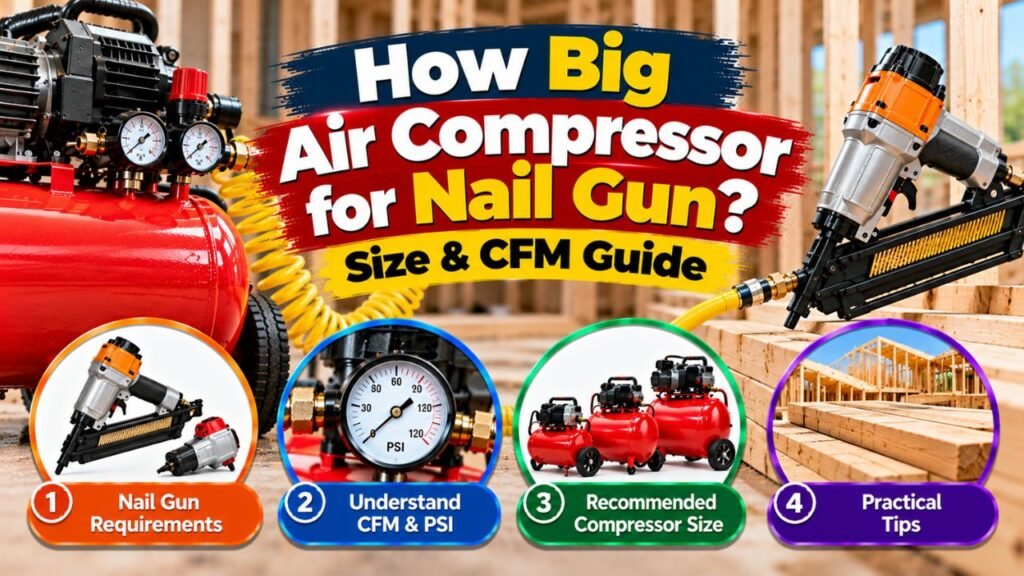
For one pneumatic nail gun, a 2- to 6-gallon compressor is sufficient for most jobs.
A practical general recommendation is:
- Brad nailer: 1–3 gallons
- Finish nailer: 2–6 gallons
- Framing nailer: 4–6 gallons or larger
- Roofing nailer: 4–6 gallons or larger
- Flooring nailer: 4–6 gallons or larger
- Multiple nail guns: 8 gallons or larger, with sufficient CFM
A compressor capable of delivering approximately 2–3 CFM at 90 PSI will operate many common nail guns comfortably.
The nail gun’s actual air requirement should always be checked because tool specifications vary.
What Size Air Compressor for Nail Gun Work Is Best?
For most homeowners and contractors using one nail gun, a 6-gallon pancake compressor offers one of the best combinations of portability, tank capacity, recovery speed, and price.
A 6-gallon unit is typically large enough for:
- Framing nailers
- Brad nailers
- Finish nailers
- Roofing nailers
- Pin nailers
- Staplers
- Some flooring nailers
Smaller compressors can also work, particularly with trim nailers.
The main difference is how often the compressor needs to restart.
Why Nail Guns Need Less Air Than Many Air Tools
A pneumatic nail gun does not use compressed air continuously.
It consumes a short burst of air when driving each fastener.
Compare that with an air grinder or sander, which may require continuous airflow for several minutes.
Because nailers use air intermittently, the compressor has time to refill the tank between shots.
This is why a small portable compressor can often power a framing nailer even though the nailer requires relatively high pressure.
PSI vs CFM: Which Matters More?
Both matter, but they describe different things.
PSI
PSI measures air pressure.
Most pneumatic nail guns operate somewhere around 70–120 PSI, although the exact range varies by tool.
Your compressor must be capable of producing at least the pressure required by the nailer.
CFM
CFM measures how much air the compressor can deliver over time.
CFM becomes especially important when:
- Firing nails rapidly
- Using larger nailers
- Running multiple tools
- Working continuously
A compressor may reach 150 PSI but still have poor airflow.
That is why maximum PSI alone should not determine compressor size.
How Much CFM Does a Nail Gun Need?
Most nail guns require relatively low airflow.
Typical requirements often fall roughly within these ranges:
| Nail Gun Type | Approximate Air Demand |
| Pin nailer | 0.3–1 CFM |
| Brad nailer | 0.3–1.5 CFM |
| Finish nailer | 0.5–2 CFM |
| Framing nailer | 1.5–2.5 CFM |
| Roofing nailer | 1.5–2.5 CFM |
| Flooring nailer | 1.5–2.5+ CFM |
These are broad estimates. Always check the tool manufacturer’s specifications.
A useful rule is to choose a compressor that delivers more CFM than the nail gun requires.
Having some reserve capacity prevents the compressor from struggling during rapid firing.
What Type of Air Compressor for Nail Gun Is Best?
The best type depends on how and where you plan to use it.
For most people, a portable oil-free pancake or hot-dog compressor is the most practical choice.
Pancake Air Compressor
A pancake compressor has a short, round tank.
Advantages include:
- Compact footprint
- Easy transportation
- Stable design
- Usually oil-free
- Common 6-gallon capacity
- Good for nail guns
This is one of the most popular compressor types for construction and DIY nailer use.
Hot-Dog Air Compressor
A hot-dog compressor has a horizontal cylindrical tank.
It can also work very well with nail guns.
Typical advantages include:
- Portable size
- Simple design
- Good tank capacity
- Easy storage
Models commonly range from a few gallons to 10 gallons or more.
Twin-Stack Compressor
Twin-stack compressors use two smaller tanks stacked together.
They often provide:
- Greater air reserve
- Good durability
- Faster recovery
- Contractor-oriented performance
These can be excellent for framing crews or more demanding use.
Larger Stationary Compressor
A large stationary compressor is unnecessary if nail guns are the only pneumatic tools you use.
However, it may make sense in a workshop that also operates:
- Impact wrenches
- Air grinders
- Sanders
- Spray guns
- Die grinders
- Other continuous-air tools
Is a 1-Gallon Air Compressor Enough for a Nail Gun?
A 1-gallon compressor can operate many small nail guns.
It is especially suitable for:
- Brad nailers
- Pin nailers
- Small finish nailers
The disadvantage is limited air storage.
The compressor may restart frequently if you fire nails rapidly.
For occasional trim or hobby work, this may not be a problem.
For framing or roofing, a larger compressor is generally more convenient.
Is a 2-Gallon Air Compressor Enough for a Nail Gun?
Yes, a 2-gallon compressor can run many pneumatic nail guns.
It works particularly well for:
- Brad nailers
- Finish nailers
- Trim work
- Small woodworking jobs
A 2-gallon compressor may also operate a framing nailer, but it will cycle more frequently during rapid firing.
The compressor’s CFM rating matters more than tank size alone.
Is a 3-Gallon Air Compressor Enough for a Nail Gun?
Yes.
A 3-gallon compressor provides enough stored air for many nail-gun applications.
It can typically handle:
- Brad nailers
- Finish nailers
- Pin nailers
- Staplers
- Light framing nailer use
For occasional construction work, a good 3-gallon compressor may be completely adequate.
Heavy framing or roofing is usually more comfortable with a 4- to 6-gallon model.
Is a 6-Gallon Air Compressor Enough for a Nail Gun?
Yes. A 6-gallon compressor is enough for nearly all common single-user pneumatic nail-gun applications.
It is one of the most versatile sizes for:
- Framing nailers
- Roofing nailers
- Brad nailers
- Finish nailers
- Flooring nailers
- Pneumatic staplers
A typical 6-gallon pancake compressor also remains portable enough to move around a house or jobsite.
For one person using one nail gun, it is often the best overall size.
What Size Air Compressor for Brad Nailer?
Brad nailers are among the easiest pneumatic tools to power.
A 1- to 3-gallon compressor is usually enough.
Brad nailers use small 18-gauge fasteners and require relatively little air per shot.
They are commonly used for:
- Trim
- Cabinet work
- Decorative molding
- Crafts
- Light woodworking
A small portable compressor is ideal for this type of work.
What Size Air Compressor for Finish Nailer?
A finish nailer generally works well with a 2- to 6-gallon compressor.
Finish nailers commonly use:
- 15-gauge nails
- 16-gauge nails
They require slightly more air than small brad or pin nailers but still have modest airflow demands.
A compact compressor is usually sufficient for:
- Baseboards
- Crown molding
- Door trim
- Window casing
- Cabinet installation
What Size Air Compressor for Framing Nailer?
For a framing nailer, a 4- to 6-gallon compressor is a practical minimum for general single-user work.
Look for roughly 2–3 CFM at 90 PSI or better, depending on the nailer’s specifications.
A framing nailer drives large nails into materials such as:
- Studs
- Joists
- Rafters
- Sheathing
- Deck framing
It uses more air per shot than a small trim nailer.
A smaller compressor may still drive the nails, but frequent rapid firing can cause pressure to fall faster than the pump recovers.
What Size Air Compressor for Roofing Nailer?
A roofing nailer typically works well with a 4- to 6-gallon compressor for one user.
Roofing work presents a special challenge because the nailer may be fired very quickly.
Even though each individual shot uses little air, rapid repeated firing increases average CFM demand.
For professional roofing crews using multiple nailers, a larger contractor compressor with greater CFM capacity is usually more suitable.
What Size Air Compressor for Flooring Nailer?
A 4- to 6-gallon compressor is generally a good starting point for a pneumatic flooring nailer.
Flooring nailers may use:
- Cleats
- Staples
- Flooring fasteners
The firing rate is normally moderate, so a portable compressor can keep up well.
Check the tool’s operating pressure because flooring nailers vary by manufacturer.
What Size Compressor for a Pin Nailer?
Pin nailers require very little air.
A 1-gallon compressor can often operate one easily.
Because pin nailers fire tiny 23-gauge fasteners, their air demand is typically among the lowest of pneumatic fastening tools.
This makes them convenient for small portable compressor setups.
Can a Small Air Compressor Run a Nail Gun?
Yes.
Small compressors are very well suited to pneumatic nail guns because nailers consume air intermittently rather than continuously.
Even a 1- or 2-gallon compressor can run many nailers.
The trade-off is compressor cycling.
A small tank empties quickly, so the pump turns on more frequently.
If the pump can maintain the nailer’s required CFM and PSI, the tool will continue operating.
Does Tank Size Matter for a Nail Gun?
Yes, but not as much as many people assume.
Tank size determines how much compressed air is stored.
A larger tank provides:
- More shots before the compressor starts
- Less frequent cycling
- Better support for rapid firing
- More stable pressure during short bursts
However, the tank does not create air.
Once the stored air is depleted, the compressor pump’s CFM output determines whether the system can keep up.
A large tank connected to a weak pump may simply take longer to refill.
Is a Bigger Tank Always Better?
Not necessarily.
A larger tank also means:
- More weight
- More storage space
- Reduced portability
- Longer initial fill time
If you are installing trim throughout a home, carrying a 20-gallon compressor between rooms would be inconvenient.
A 2- to 6-gallon portable unit is often far more practical.
How Much PSI Does a Nail Gun Need?
Many pneumatic nailers operate in approximately the 70–120 PSI range.
However, do not automatically set every nail gun to 120 PSI.
Start within the manufacturer’s recommended range and adjust pressure according to:
- Fastener length
- Material hardness
- Nail depth
- Tool requirements
Too little pressure may leave nails sticking above the surface.
Too much pressure may drive fasteners too deeply or place unnecessary stress on the tool.
Many nail guns also include a mechanical depth-of-drive adjustment.
Why Maximum Compressor PSI Can Be Misleading
A compressor may advertise:
150 PSI maximum
That does not mean your nailer should receive 150 PSI.
Maximum tank pressure refers to how much pressure the compressor stores in the receiver.
The air regulator reduces that pressure before it reaches the tool.
For example:
Tank pressure: 150 PSI
Regulated tool pressure: 90 PSI
Always set outlet pressure according to the nail gun’s requirements.
What Happens If the Compressor Is Too Small?
A compressor that is slightly undersized may still operate the nailer but struggle during fast work.
Possible symptoms include:
- Nails not being driven fully
- Pressure dropping quickly
- Compressor running constantly
- Long pauses waiting for recovery
- Reduced firing speed
The nail gun itself may be fine; the compressor simply cannot replenish air quickly enough.
Can You Run Two Nail Guns From One Compressor?
Yes, but the compressor needs enough airflow for both users.
For two nail guns, add their expected CFM requirements and include a safety margin.
For example, if each framing nailer effectively requires about 2 CFM during your work pattern, the compressor should provide more than 4 CFM at the required pressure.
Professional crews may benefit from:
- Larger twin-stack compressors
- Contractor compressors
- 8- to 20-gallon portable units
- Higher-CFM systems
Tank size alone is not enough. Pump output becomes especially important with multiple users.
How Much Extra CFM Should You Have?
A reasonable approach is to choose a compressor with approximately 25–50% more CFM capacity than the expected tool demand when possible.
The extra capacity helps compensate for:
- Rapid firing
- Air leaks
- Pressure losses
- Future tools
- Compressor wear
You do not need an enormous reserve for occasional nailer use, but operating at the compressor’s absolute limit all day can be frustrating.
What Size Air Hose for Nail Gun?
A 1/4-inch air hose is sufficient for most nail guns.
Common hose diameters include:
- 1/4 inch
- 3/8 inch
A 1/4-inch lightweight hose is popular for nailers because it is:
- Easy to move
- Lightweight
- Flexible
- Adequate for low-CFM tools
For long hose runs, multiple tools, or higher airflow, a 3/8-inch hose may reduce pressure drop.
Does Hose Length Matter?
Yes.
Long air hoses create pressure loss because air encounters resistance as it travels through the hose.
A 25- or 50-foot hose is usually practical for nailer work.
Extremely long or narrow hoses may reduce pressure at the tool, especially during rapid firing.
If nails are suddenly not driving fully at the far end of a long hose, pressure drop may be part of the problem.
Oil-Free vs Oil-Lubricated Compressor for Nail Guns
Both types can run nail guns.
Oil-Free Compressor
Advantages include:
- Lower routine maintenance
- No pump oil changes
- Easy portability
- Common in pancake compressors
For most homeowners and light contractors, an oil-free portable compressor is the simplest choice.
Oil-Lubricated Compressor
Advantages may include:
- Quieter operation on some models
- Long pump life
- Good performance for frequent use
However, these compressors require:
- Oil-level checks
- Oil changes
- More maintenance
For nail guns alone, an oil-lubricated compressor is usually not necessary.
Corded vs Cordless Air Compressor for Nail Guns
Traditional portable compressors plug into a 120V household outlet.
Battery-powered compressors are also available.
Corded Compressor
Good for:
- Long work sessions
- Framing
- Workshops
- Jobsites with electricity
Battery-Powered Compressor
Good for:
- Remote locations
- Punch-list work
- Small trim jobs
- Areas without convenient outlets
Battery compressors offer excellent portability but may have lower capacity and limited runtime compared with corded models.
Air Compressor vs Cordless Nail Gun
Pneumatic nailers are not the only option.
Modern cordless nail guns use:
- Battery-powered mechanisms
- Gas-assisted systems
- Flywheel or spring systems
A cordless nailer eliminates the:
- Compressor
- Air hose
- Electrical cord to compressor
However, pneumatic nailers remain popular because they are often:
- Lightweight
- Powerful
- Fast
- Simple
- Reliable
If you already own several pneumatic tools, buying a compressor usually makes sense.
How to Connect a Nail Gun to an Air Compressor
The basic setup is simple.
- Turn the compressor on.
- Allow the tank to fill.
- Connect an appropriate air hose.
- Connect the hose to the nail gun.
- Set the regulator to the nailer’s recommended pressure.
- Test the nailer on scrap material.
- Adjust pressure or depth control as needed.
Never exceed the nail gun manufacturer’s maximum working pressure.
Should You Use an Air Regulator?
Yes.
The compressor’s tank pressure may be considerably higher than the pressure the nail gun requires.
An air regulator lets you reduce and control outlet pressure.
For example, the tank might contain 150 PSI while the nail gun receives only 90 PSI.
This gives the tool consistent pressure without exposing it to excessive air pressure.
Do Nail Guns Need an Air Filter?
A basic moisture filter can help protect pneumatic tools.
Compressed air can contain:
- Water
- Rust particles
- Dirt
- Compressor contamination
A filter or moisture separator can reduce the amount reaching the nail gun.
For ordinary construction nailers, a simple compressor-side filter can be beneficial.
Do Pneumatic Nail Guns Need Oil?
Some do, while others are specifically designed as oil-free nailers.
If the nailer requires lubrication, manufacturers often recommend adding a few drops of pneumatic tool oil into the air inlet periodically.
Do not add oil to an oil-free nailer unless the manufacturer instructs you to.
Always check the manual.
Best Compressor Size for Different Nail Gun Users
DIY Homeowner
A 2- to 6-gallon compressor is usually ideal.
It can handle most home projects while remaining easy to store.
Finish Carpenter
A lightweight 2- to 6-gallon portable compressor works well for brad and finish nailers.
Framing Contractor
A 6-gallon or larger high-CFM contractor compressor provides better recovery for rapid firing.
Roofing Crew
A larger portable compressor with enough CFM for multiple roofing nailers is preferable.
Workshop User
If the shop also runs demanding pneumatic tools, a 20-gallon or larger compressor may make more sense than sizing the system around nail guns alone.
Common Mistakes When Choosing a Nail Gun Compressor
Looking Only at Tank Size
CFM is just as important.
Ignoring the Nailer’s PSI Range
Make sure the compressor can supply the required working pressure.
Choosing Based Only on Maximum PSI
A 200-PSI compressor is not automatically better than a 150-PSI unit if it has poor airflow.
Buying an Oversized Compressor
A huge stationary compressor is unnecessary if you only use a brad nailer occasionally.
Forgetting Multiple-Tool Demand
Two nail guns firing simultaneously require substantially more airflow.
Using an Undersized Hose
A very small or excessively long hose can cause pressure loss.
FAQs About How Big Air Compressor for Nail Gun
What Size Air Compressor for Nail Gun Use Is Best?
For most single-user applications, a 2- to 6-gallon compressor producing roughly 2–3 CFM at 90 PSI is a good choice.
A 6-gallon pancake compressor is especially versatile.
How Big of Air Compressor for Nail Gun Work Do I Need?
The compressor does not need to be very large.
Small trim nailers may work with a 1- or 2-gallon compressor, while framing and roofing nailers are more comfortable with 4–6 gallons or more.
What Type of Air Compressor for Nail Gun Use Is Recommended?
A portable oil-free pancake compressor is one of the most practical options for general nail-gun use.
Twin-stack and larger contractor compressors are useful for heavier or multi-user work.
Can a 3-Gallon Air Compressor Run a Nail Gun?
Yes.
A 3-gallon compressor can run most brad, finish, and pin nailers and can often operate a framing nailer for moderate use.
Is a 6-Gallon Air Compressor Enough for Framing?
Yes, for one framing nailer in most situations.
Make sure the compressor provides enough CFM at the nailer’s operating pressure.
Does a Nail Gun Need a 20-Gallon Compressor?
No, not normally.
A 20-gallon compressor is much larger than necessary for a single nail gun. It makes sense primarily if you also use higher-CFM pneumatic tools.
How Many CFM Does a Framing Nailer Need?
Many framing nailers have relatively modest average air requirements, commonly around the low single-digit CFM range.
Check the exact manufacturer’s specification because firing rate significantly affects actual air demand.
Can One Compressor Run Two Nail Guns?
Yes, if the compressor has enough CFM for the combined demand.
For two professional users firing rapidly, a larger high-CFM contractor compressor is preferable to a small pancake unit.
Conclusion
The practical answer to how big air compressor for nail gun use should be is that most pneumatic nailers need much less compressor capacity than continuous-use air tools. For one person using a brad, finish, framing, roofing, or flooring nailer, a 2- to 6-gallon compressor with roughly 2–3 CFM at 90 PSI will handle most jobs, with a 6-gallon pancake compressor offering an excellent balance of capacity and portability.
Smaller 1- to 3-gallon compressors are perfectly reasonable for brad nailers, pin nailers, and light finish work. Framing and roofing nailers benefit from a 4- to 6-gallon tank and faster pump recovery, particularly when fast repetitive firing is required. If two or more people will use nail guns simultaneously, focus more heavily on the compressor’s combined CFM capacity and consider a larger contractor-style unit.
When deciding what size air compressor for nail gun work you need, do not choose based on tank gallons alone. Match the compressor’s CFM and regulated PSI to the nailer’s requirements first, then choose a tank size that provides the portability and runtime you want. For most homeowners and single-tool users, there is little reason to buy a large stationary compressor solely for operating a nail gun.