
Is a 150 PSI Air Compressor Good? Uses, CFM, Pros and Limits
A compressor with a 150 PSI maximum pressure is a solid choice for many home garages, workshops, tire jobs, nailers, impact tools, and other pneumatic tasks. The higher pressure gives the tank more stored air, but it does not automatically mean the compressor has high airflow or can run demanding tools continuously.
The number on the tank is only one part of compressor performance. A small 6-gallon unit and a large 60-gallon shop compressor can both be rated for 150 PSI while delivering very different amounts of air.
For most pneumatic tools, CFM at 90 PSI is a more useful specification than maximum tank pressure. If a tool consumes 10 CFM but the compressor produces only 4 CFM, a 150 PSI rating will not make up for the missing airflow.
For anyone asking is 150 psi air compressor good, the answer is yes for many common jobs, provided the compressor has enough CFM and tank capacity for the tools you plan to use. Higher maximum pressure mainly increases stored-air reserve and gives the regulator more pressure to work with.
Safety also matters. In U.S. workplaces covered by OSHA rules, compressed air used for cleaning is generally required to be reduced below 30 PSI at the cleaning nozzle under specified conditions, along with suitable chip guarding and personal protective equipment. A 150 PSI tank rating does not mean every tool or air nozzle should receive 150 PSI.
The sections below explain what 150 PSI actually means, how it compares with 125 and 175 PSI, which tools it can run, how much CFM you need, and when a higher-pressure compressor is worth paying for.
What Does 150 PSI Mean on an Air Compressor?
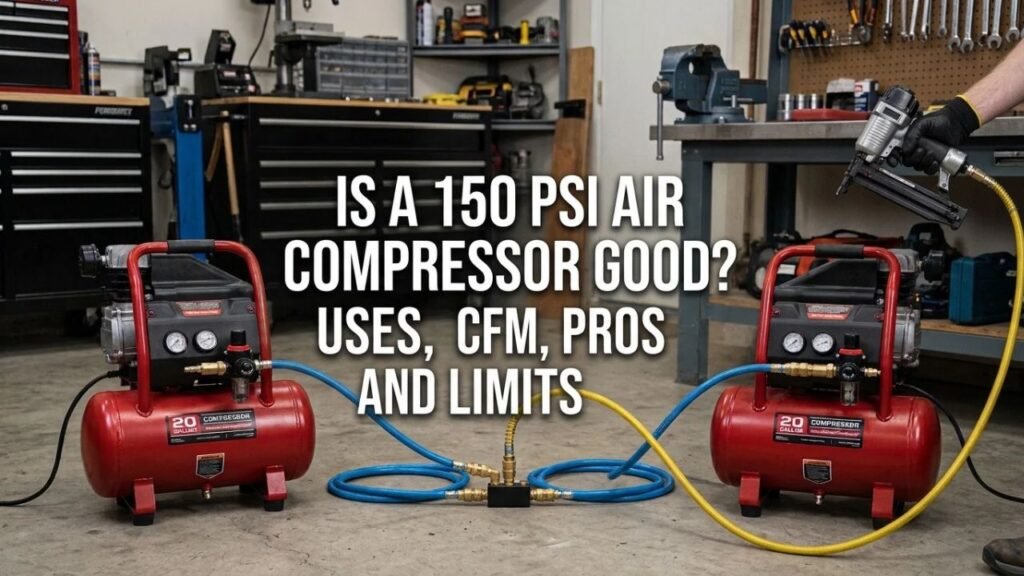
A 150 PSI rating usually refers to the compressor’s maximum tank pressure or maximum operating pressure.
It does not mean the compressor constantly sends 150 PSI through the air hose.
Tank Pressure
The compressor pump fills the receiver until the pressure switch reaches its cut-out setting.
For example, a compressor may:
- Start around 120 PSI
- Stop around 150 PSI
Those numbers vary by model.
As you use air, tank pressure falls. Once it reaches the cut-in point, the motor starts again and refills the receiver.
Regulated Outlet Pressure
Most compressors have a regulator between the tank and tool connection.
If the tank contains 150 PSI, you can still set the outlet to:
- 30 PSI
- 60 PSI
- 90 PSI
- 100 PSI
- Another pressure within the equipment limits
A pneumatic impact wrench rated for 90 PSI should normally receive the pressure specified by its manufacturer rather than the full 150 PSI stored in the tank.
PSI Does Not Tell You Airflow
Two compressors can both reach 150 PSI while one fills pneumatic tools much faster than the other.
That difference comes largely from CFM, or cubic feet per minute.
A small compressor might deliver:
2.6 CFM at 90 PSI
while a larger shop model might deliver:
11.5 CFM at 90 PSI
Both could have 150 PSI tanks.
The larger machine can support far more continuous air demand.
Key Takeaway: A 150 PSI rating tells you how much pressure the system can store, not how much air the pump can deliver each minute.
Is 150 PSI Enough for Air Tools?
Yes, 150 PSI maximum tank pressure is enough for the operating-pressure needs of most common pneumatic tools.
Many air tools are designed to run around 90 PSI at the tool, though the exact requirement comes from the tool manufacturer.
Impact Wrench
An impact wrench commonly operates around 90 PSI.
A 150 PSI compressor therefore has plenty of pressure reserve.
The bigger question is CFM.
A small 150 PSI portable compressor may operate an impact wrench for short bursts but run out of stored air during repeated lug-nut removal.
A larger compressor with higher CFM will recover faster.
Air Ratchet
Air ratchets commonly need moderate pressure but can consume air continuously while the trigger is held.
A 150 PSI tank is adequate for pressure.
Check the ratchet’s CFM rating and compare it with the compressor’s output at the same working pressure.
Nail Guns
Framing, roofing, finish, and brad nailers generally use air in short bursts.
This makes them a good match for many small 150 PSI compressors.
The tank has time to recover between shots, so sustained CFM is less demanding than with grinders or sanders.
Tire Inflation
A 150 PSI compressor is more than sufficient for most passenger-car and light-truck tire inflation.
The regulator and inflator should be used to control pressure accurately.
Never inflate a tire to the compressor’s maximum rating. Use the tire and vehicle manufacturer’s specified inflation pressure.
Spray Guns
Spray painting depends heavily on airflow.
A spray gun may operate at fairly modest pressure but consume a large amount of CFM.
For example, an HVLP spray gun can need far more airflow than a small portable 150 PSI compressor produces.
A higher maximum tank pressure cannot compensate for insufficient continuous airflow.
Air Sanders and Grinders
DA sanders and pneumatic grinders are among the harder tools for small compressors to run.
They can consume large amounts of air continuously.
A 150 PSI rating is enough from a pressure standpoint, but a small tank and low-CFM pump may cause pressure to fall quickly.
Key Takeaway: 150 PSI provides enough pressure for most pneumatic tools, but continuous tools such as sanders, grinders, and spray guns need strong CFM output as well.
Is 150 PSI Better Than 125 PSI?
A 150 PSI compressor can store more compressed air in the same tank volume than a 125 PSI compressor.
That can give you longer tool use between pump cycles.
More Stored Air
Take two compressors with identical 20-gallon tanks.
If one stores air at a higher pressure, more air mass can be packed into that same receiver volume.
After the regulator reduces both systems to 90 PSI tool pressure, the 150 PSI tank has a larger pressure reserve.
This can mean:
- Longer bursts between cycles
- Fewer rapid motor starts
- More reserve for intermittent tools
It Does Not Mean More Pump CFM
This is the main limitation.
A 125 PSI compressor producing 10 CFM at 90 PSI will usually support a demanding air tool better than a 150 PSI compressor producing only 4 CFM at 90 PSI.
Higher tank pressure and greater pump output are separate specifications.
Higher Pressure Can Mean Longer Fill Time
The compressor has to work longer to raise the tank from a lower pressure to 150 PSI than it would to stop at 125 PSI.
The pump also works against greater pressure near the end of the fill cycle.
The compressor should be designed from the factory for that operating range.
Do not adjust a 125 PSI compressor to 150 PSI unless the manufacturer specifically permits it.
Key Takeaway: 150 PSI gives more stored-air reserve than 125 PSI in a similar-size tank, but CFM still determines sustained tool performance.
150 PSI vs 175 PSI Air Compressor
A 175 PSI compressor stores air at an even higher pressure, but that does not automatically make it the better purchase.
Advantages of 175 PSI
A higher maximum pressure can provide:
- More stored air in the same tank size
- Longer periods before pressure drops
- More reserve for short high-demand jobs
- Greater pressure margin in large shop systems
Large two-stage stationary compressors often use higher tank pressures.
Advantages of 150 PSI
A 150 PSI machine is already sufficient for most home-garage tools.
It may also cost less and be available in smaller portable formats.
If your tools operate at 90 PSI, a 150 PSI compressor already provides a large pressure difference for the regulator to work with.
When 175 PSI Is Worth Considering
Higher-pressure storage may make sense if you:
- Run a busy repair shop
- Have several users on one air system
- Need large reserve capacity
- Use a large stationary two-stage compressor
- Have long air piping
- Have equipment specifically designed around higher system pressure
For ordinary tire inflation, nailers, occasional impact-wrench work, and home maintenance, 150 PSI is generally plenty.
Key Takeaway: A 175 PSI system stores more air, but 150 PSI already covers the pressure needs of most household, garage, and automotive pneumatic tools.
How Much CFM Should a Good 150 PSI Compressor Have?
The answer depends on the tool.
Match the compressor’s CFM at the tool’s operating pressure rather than comparing maximum-pressure numbers.
Light-Demand Tools
For nailers and tire inflation, a compressor around 2–4 CFM at 90 PSI can handle many normal jobs.
The tool uses air intermittently, giving the tank time to recover.
Medium-Demand Tools
Impact wrenches, ratchets, and some air hammers may work better with roughly 4–6 CFM or more, depending on the exact tool and how long it runs.
Short impact-wrench bursts are much easier on a compressor than continuous trigger use.
High-Demand Tools
Continuous pneumatic equipment can need far more airflow.
Examples include:
- DA sander
- Die grinder
- Large spray gun
- Sandblaster
- Air polisher
Some of these tools need 8, 10, 12, 15 CFM, or more.
Read the air-consumption rating of the exact tool.
Give Yourself Some CFM Margin
A compressor operating at its absolute output limit whenever a tool runs will spend a lot of time pumping.
Choosing a unit with output above your normal tool demand gives the system more room to recover.
For example, if a tool needs 6 CFM at 90 PSI, a compressor rated just over 6 CFM may technically match it, but a larger-output machine will handle long sessions more comfortably.
Key Takeaway: Choose a 150 PSI compressor by its CFM at your tool’s working pressure. Maximum PSI cannot replace missing airflow.
Does Tank Size Matter on a 150 PSI Compressor?
Yes.
Tank size affects stored-air volume and how long you can use air before the pump has to replace it.
Small Tanks: 1–6 Gallons
These are convenient for:
- Brad nailers
- Finish nailers
- Tire inflation
- Blow guns
- Small staplers
- Light intermittent use
A 6-gallon, 150 PSI compressor can be very useful despite its small tank.
It is less suited to continuous sanding or painting.
Medium Tanks: 10–30 Gallons
These offer more reserve for:
- Automotive work
- Impact wrenches
- Air ratchets
- Light painting
- General garage use
They also tend to cycle less rapidly during intermittent tool use.
Large Tanks: 60 Gallons and Up
Large stationary compressors are better suited to:
- Frequent automotive work
- High-CFM air tools
- Shop air systems
- Longer tool sessions
- Multiple pneumatic tools
A 60-gallon tank does not create CFM, but large compressors are commonly paired with larger pumps and motors that provide substantially greater airflow.
Key Takeaway: Small tanks suit intermittent work, while larger receivers provide more reserve. For long-running tools, pump CFM still matters more than tank capacity alone.
Is a 150 PSI Compressor Good for Automotive Work?
Yes, it can be an excellent garage compressor if the CFM and tank size fit the job.
Tire Inflation
150 PSI provides more pressure than required for normal passenger tires.
Use a regulated inflator with a reliable gauge and inflate to the vehicle manufacturer’s recommended tire pressure.
Impact Wrenches
A 150 PSI compressor can operate an impact wrench after the regulator is set to the tool’s specified pressure.
For repeated tire-service work, a larger tank and stronger CFM rating will reduce waiting for the compressor to recover.
Air Ratchets and Blow Guns
These tools work well with many medium-size compressors.
Air consumption changes with trigger time, so a small compressor may cycle frequently during long use.
Painting Cars
Automotive spray painting puts much more emphasis on CFM.
A compressor can reach 150 PSI and still be too small for a full-size spray gun.
Check the gun’s CFM specification and choose a compressor that can sustain the required airflow.
Moisture control also becomes important for painting, so a water separator or air dryer may be needed.
Key Takeaway: A 150 PSI compressor works well for tire service and many automotive tools. Painting and continuous pneumatic tools require enough CFM, tank volume, and moisture control.
Is 150 PSI Too Much for Air Tools?
The tank can safely hold 150 PSI if the compressor was designed and rated for it, but that does not mean the connected tool should receive the same pressure.
Use the regulator.
Check Maximum Tool Pressure
Many air tools are designed around approximately 90 PSI.
Sending 150 PSI directly into a tool rated for 90 PSI can:
- Overspeed the tool
- Increase wear
- Damage seals
- Damage internal parts
- Create a hose or fitting hazard
OSHA requires pneumatic hoses, fittings, and related equipment in covered workplaces to stay within the manufacturer’s safe operating pressure.
Use the Regulator Correctly
Tank pressure might read:
145 PSI
while regulated outlet pressure reads:
90 PSI
That is normal.
The regulator reduces the pressure supplied to the tool while retaining higher-pressure air in the tank.
Hose and Fittings Need Suitable Ratings
Check the ratings of:
- Air hose
- Couplers
- Regulators
- Filters
- Moisture separators
- Fittings
Every component exposed to full tank pressure needs to be rated for that pressure.
Key Takeaway: 150 PSI in the receiver is normal for a compressor designed for it, but regulate the outlet to the pressure specified for each tool.
Is a 150 PSI Compressor Good for Cleaning?
It provides plenty of stored pressure, but using the full 150 PSI for blowing dust or debris is not appropriate.
In U.S. workplaces covered by OSHA standards, compressed air used for cleaning generally must be reduced below 30 PSI under the required static conditions, with chip guarding and personal protective equipment.
Compressed air should never be directed at a person’s skin or clothing.
Even much lower pressures can send chips, dust, and debris into the eyes or skin.
Use a safety blow gun designed for cleaning and follow the applicable workplace and equipment rules.
What Should You Look for Besides 150 PSI?
If you are choosing a compressor, several specifications deserve more attention than the maximum-pressure number.
CFM at 90 PSI
This is one of the best numbers for comparing compressors used with typical pneumatic tools.
Match it to your highest-demand equipment.
Tank Capacity
More gallons provide more stored air.
Tank size is especially useful for tools used in short bursts.
Duty Cycle
Duty cycle describes how long the pump is designed to run before it needs cooling time.
A compressor intended for occasional DIY jobs may not tolerate the same continuous workload as a shop-rated machine.
Motor and Electrical Requirements
Check:
- Voltage
- Amperage
- Phase
- Breaker requirement
Large compressors may require 240V dedicated circuits.
Noise Level
If the compressor runs inside a garage or residential workspace, noise can make a major difference in day-to-day use.
Some quieter designs trade pump speed for reduced sound.
Pump Type
Common options include:
- Oil-free
- Oil-lubricated
- Single-stage
- Two-stage
Each has different maintenance, noise, pressure, and usage characteristics.
Key Takeaway: Judge a compressor by CFM, tank size, duty cycle, electrical requirements, noise, and pump design rather than maximum PSI alone.
Conclusion
For is 150 psi air compressor good, yes—a 150 PSI compressor offers more than enough pressure for most garage, household, construction, and automotive air-tool jobs.
The higher pressure gives the tank a useful stored-air reserve, especially compared with otherwise similar lower-pressure compressors. It can work very well for nailers, tire inflation, impact wrenches, ratchets, and other intermittent tools.
Do not judge the compressor from PSI alone. Check its CFM at 90 PSI, tank capacity, duty cycle, and the airflow demand of your tools. A small 150 PSI unit can still struggle with a DA sander or full-size spray gun if the pump cannot supply enough air.
Use the regulator to keep tool pressure within the manufacturer’s rating. If you need continuous high-CFM performance, choose a larger pump rather than buying based only on the highest PSI number printed on the tank.
FAQs About 150 PSI Air Compressors
Is 150 PSI Enough for an Impact Wrench?
Yes. Most impact wrenches operate at a working pressure well below 150 PSI, commonly around 90 PSI.
The compressor also needs enough CFM to support the wrench. Small portable units may work for short bursts but require recovery time during repeated use.
Is 150 PSI Good for Tires?
Yes. A 150 PSI compressor has more than enough pressure for ordinary passenger-car and light-truck tire inflation.
Always inflate the tire to the vehicle manufacturer’s recommended pressure rather than using the compressor’s maximum pressure.
Is 150 PSI Good for a Nail Gun?
Yes. Nail guns normally require far less than 150 PSI at the tool.
They also consume air intermittently, making them a good match for many small portable compressors. Set the regulator to the pressure range specified by the nail-gun manufacturer.
Is 150 PSI Better Than 125 PSI?
A 150 PSI compressor can store more compressed air in the same tank volume, giving a larger reserve.
It is not automatically stronger. A 125 PSI compressor with much higher CFM can outperform a 150 PSI unit with a small pump during continuous tool use.
Is 150 PSI Enough for Spray Painting?
The pressure is enough, but airflow may not be.
Spray guns can consume substantial CFM for long periods. Check the spray gun’s air requirement and compare it with the compressor’s CFM rating at the relevant pressure.
Can I Run a 90 PSI Tool From a 150 PSI Compressor?
Yes.
Set the compressor regulator so the tool receives the pressure specified by its manufacturer. The tank can remain at 150 PSI while the regulated outlet supplies 90 PSI.
Is 150 PSI Too High for an Air Compressor?
No, not if the compressor, receiver, safety valve, piping, and fittings were designed for that pressure.
Do not increase the pressure setting of a lower-rated compressor to 150 PSI. Every pressure-containing component has to remain within its approved limit.
Which Is More Important, PSI or CFM?
For most air-tool selection, CFM at the required working pressure tells you more about sustained performance.
PSI tells you pressure. CFM tells you how much air the compressor can deliver. A good setup needs enough of both.