
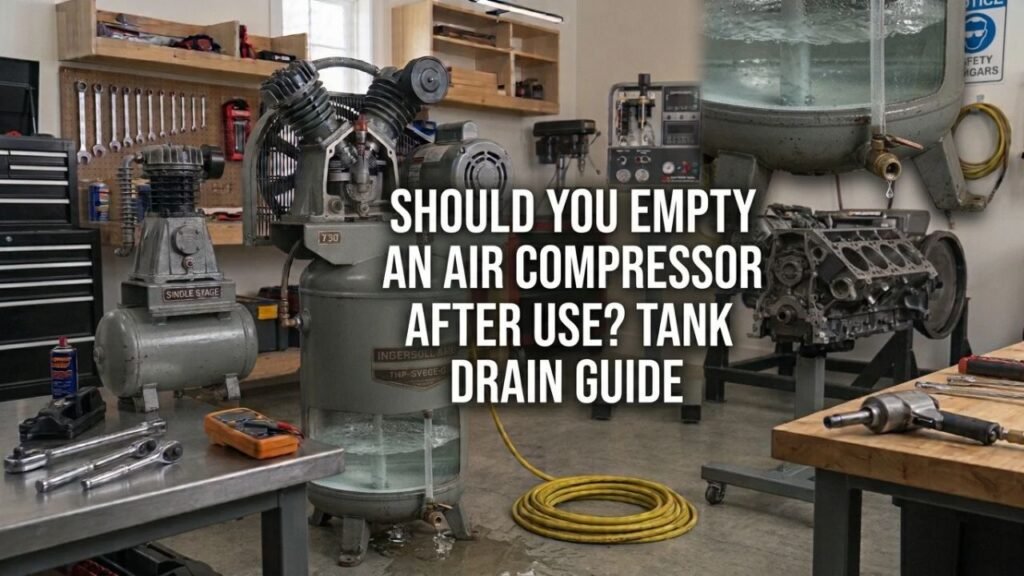
Should You Empty an Air Compressor After Use? Tank Drain Guide
For most portable tank-style air compressors, you should drain the tank regularly after use so condensed water does not remain inside. Many manufacturers recommend draining daily or after each use. You generally reduce tank pressure first, open the drain according to the manual, let the water and remaining air escape, then close the valve before the next startup.
Draining the tank and simply releasing air are not exactly the same task. The main maintenance goal is removing condensed water that settles at the lowest point of the receiver. Letting air out through a hose or safety valve can leave that water behind.
DEWALT instructs owners of several portable compressors to drain the tank daily or after each use because trapped water can lead to rust and thinning of the steel receiver. California Air Tools gives similar guidance for models with manually drained tanks.
OSHA also requires workplace air receivers to have a drain for accumulated oil and water and says receivers must be drained frequently enough to prevent excessive liquid buildup.
If you are asking should you empty an air compressor after use, the best general rule is to follow the manufacturer’s drain schedule and never leave accumulated water sitting in a steel tank. Portable compressors that see occasional use are commonly drained at the end of the work session.
You do not always need to treat every compressor the same way. Some commercial systems use automatic drains, and stationary industrial receivers can remain pressurized during normal service. Small tankless inflators have no receiver tank to drain at all.
Should You Drain an Air Compressor After Every Use?
For many portable compressors, yes.
Manufacturers often call for draining:
- After each use
- At the end of the day
- Daily during regular operation
- More frequently in humid conditions
The exact schedule is printed in the compressor’s operator manual.
Why Manufacturers Recommend Frequent Draining
Atmospheric air contains water vapor.
When the compressor pulls air in and compresses it, the air becomes hot. As that compressed air later cools inside the receiver, part of its moisture condenses into liquid water.
That water settles at the bottom of the tank.
If it remains there repeatedly, the inside surface of a steel receiver can corrode.
DEWALT specifically warns that failing to drain condensed water can cause rust and thinning of the tank wall.
OSHA Also Requires Moisture Removal From Receivers
For covered workplace air receivers, OSHA requires a drain at the lowest point and says accumulated oil and water must be removed often enough to prevent excessive liquid buildup.
That regulation does not create one universal home-maintenance schedule, but it reinforces the mechanical reason compressor tanks have drains.
Humid Conditions Can Create More Water
You may get much more condensate when operating:
- During humid weather
- In a damp garage
- For long periods
- With frequent compressor cycling
- During high-air-demand jobs
A compressor that runs for several hours may collect more water than one used for a few nail-gun shots.
Key Takeaway: Many portable compressors should be drained after each use or daily because removing condensate reduces internal corrosion risk.
Does Emptying the Compressor Mean Releasing All the Air?
Not always.
There are two separate things you may be doing:
- Removing condensed water
- Releasing stored air pressure
The manufacturer’s shutdown procedure determines how much pressure should remain while you open the drain.
Some Compressors Are Drained With Low Pressure Remaining
A little remaining pressure can help push water out of the tank.
For example, one DEWALT manual instructs the user to reduce tank pressure and fully open the drain when the gauge reaches about 10 PSI.
A RIDGID manual for another compressor instructs the operator to vent the receiver until pressure falls below 20 PSI before opening its drain valve.
Those different values show why you should not apply one pressure number to every compressor.
Do Not Open an Unknown Drain at Full Tank Pressure
A fully charged compressor may hold 120, 150, 175 PSI, or more.
Opening or removing the wrong component under high pressure can cause:
- Rapid air discharge
- Flying moisture and debris
- Hose or fitting movement
- Eye injury
- Damage to the drain valve
Follow the exact depressurization procedure in the manual.
Draining Through the Safety Valve Is Not the Same
The pressure-relief valve is primarily a safety device.
Pulling it may release air from the tank, but the valve is usually not located at the lowest point where water collects.
The drain valve exists specifically so moisture can leave the bottom of the receiver.
Do not use the relief valve as your regular tank-draining method unless your manual specifically directs you to do so.
Key Takeaway: Draining moisture and releasing all stored pressure are separate steps; reduce pressure to the level specified by your compressor manufacturer before opening the drain.
Why Does Water Build Up Inside an Air Compressor?
Moisture comes from the surrounding atmosphere.
The compressor does not create water chemically. It pulls moisture-containing air into the pump.
Compression Heats the Air
During compression, air temperature rises.
The hot compressed air enters the tank carrying water vapor.
Cooling Causes Condensation
As the air cools, it cannot retain the same amount of moisture as vapor.
Liquid water forms and collects inside the receiver.
The process is similar to moisture forming on a cold surface, though it occurs inside a pressurized system.
The Tank Acts as a Moisture Collection Point
The receiver provides time and surface area for hot compressed air to cool.
That makes the bottom of the tank a natural location for water accumulation.
This is why tank drains are installed near the lowest point.
OSHA’s air-receiver rule specifically requires drainage provisions for accumulated water and oil.
Key Takeaway: Water enters the compressor as moisture in atmospheric air and condenses into liquid as hot compressed air cools inside the receiver.
What Happens if You Do Not Drain an Air Compressor?
Skipping one drain does not normally destroy a tank instantly.
Repeatedly leaving water inside is the concern.
Internal Tank Rust
Steel exposed to moisture can corrode.
The difficult part is that most corrosion occurs on the inside where you cannot easily inspect it.
DEWALT warns that trapped condensate can rust and weaken steel air tanks.
Tank Wall Can Become Thinner
Long-term corrosion removes metal.
A receiver is designed to contain compressed air at substantial pressure, so wall thickness matters.
Do not continue operating a tank known to have serious corrosion, deep pitting, or leakage.
Water Can Reach Air Tools
Moisture can travel out through the air line.
That can cause problems with:
- Pneumatic tools
- Spray painting
- Air-operated controls
- Metal fittings
- Lubrication
Painting is especially sensitive because moisture can affect the finish.
More Moisture Reaches Hoses and Piping
A poorly drained receiver can send more liquid downstream.
A moisture separator can remove some water from the air line, but it does not replace tank draining.
A Rusted Receiver Should Not Be Welded as a DIY Repair
Manufacturers commonly warn against welding, drilling, or modifying damaged air tanks.
If a receiver leaks because of corrosion, replace the tank or compressor according to the manufacturer’s instructions.
Key Takeaway: Repeated moisture buildup can corrode the receiver, contaminate downstream air, and eventually weaken the tank.
How to Empty an Air Compressor After Use
The exact valve design and pressure limit vary, so read the manual for your model first.
A common portable-compressor procedure looks like this.
1. Finish Using the Air Tool
Release the tool trigger and disconnect it only as directed by the manufacturer’s shutdown procedure.
Keep control of the hose when disconnecting quick couplers because trapped air can cause movement.
2. Switch the Compressor Off
Move the compressor switch to OFF.
Do not depend on the pressure switch alone to prevent automatic startup during draining or service.
3. Unplug an Electric Compressor
Disconnect it from the electrical supply if the manual requires this before draining.
For engine-driven compressors, shut down the engine according to its procedure.
4. Reduce Tank Pressure
Bleed pressure using the method specified for your model.
Some manufacturers instruct you to pull the relief-valve ring until tank pressure reaches a low level.
Others specify another procedure.
Check the pressure gauge.
5. Position the Drain at the Lowest Point
Portable tanks sometimes need to be tilted slightly so liquid reaches the drain opening.
RIDGID instructs users of certain models to position the tank so moisture flows toward the drain and into a suitable container.
Do not tip a heavy compressor unsafely.
6. Open the Drain Valve
Depending on the model, the drain may be:
- Quarter-turn ball valve
- Petcock
- Screw-style valve
- Automatic drain
Open it gradually as instructed.
Keep your face and hands away from the discharge path.
7. Let Water and Air Escape
You may see:
- Clear water
- Dirty water
- Rust-colored water
- Oily condensate
Some lubricated compressors can introduce small amounts of oil into condensate.
Collect and dispose of contaminated liquid according to applicable local rules.
8. Leave the Tank Fully Drained as Directed
Allow remaining condensate to leave.
For many portable compressors, the tank ends up at or near zero pressure when the procedure is finished.
9. Close the Drain Before the Next Startup
A compressor will not build tank pressure normally if the drain remains open.
Make closing the valve part of your pre-start check.
Key Takeaway: Turn the compressor off, reduce pressure according to its manual, position the drain correctly, remove all condensate, and close the valve before the next startup.
Should You Leave an Air Compressor Pressurized Overnight?
For a portable home compressor that is finished for the day, draining and depressurizing according to its manual is the simpler maintenance habit.
There is little advantage to keeping a small portable unit fully pressurized if you are not going to use it.
Pressure Alone Is Not the Main Moisture Problem
The bigger concern is leaving condensed water in the tank.
A dry receiver holding air and a receiver containing standing water are not the same maintenance situation.
Still, many portable-compressor manuals call for regular draining, which naturally reduces or removes stored pressure.
Leaving Pressure Can Hide Small Leaks
If a compressor loses substantial pressure overnight while everything is shut off, the system may have a leak at:
- Drain valve
- Coupler
- Hose
- Check valve
- Regulator
- Fitting
Draining after use eliminates the need to keep the portable unit pressurized while it sits.
Stationary Systems Are Different
A commercial shop compressor may remain pressurized as part of a permanently installed air system.
These systems may use:
- Automatic tank drains
- Timed drains
- Moisture separators
- Dryers
- Hard piping
They are managed differently from a small portable pancake compressor.
Key Takeaway: For small portable compressors, draining after use is a sound habit; permanently installed systems may stay pressurized and rely on scheduled or automatic moisture removal.
Should You Empty the Tank for Long-Term Storage?
Yes, unless your manufacturer’s instructions state otherwise.
Before storing a portable compressor for an extended period:
- Turn it off
- Disconnect power
- Drain moisture
- Release stored pressure as directed
- Close the drain after draining if instructed
- Clean the exterior
- Store it in a dry location
- Check pump oil on lubricated models
Do not store a steel receiver with standing water inside.
Choose a Dry Storage Area
A dry garage or workshop is better than an area exposed to rain or heavy condensation.
Protect the compressor from:
- Water
- Corrosive chemicals
- Extreme dirt
- Physical impacts
Inspect Before Returning It to Service
After long storage, check:
- Tank condition
- Drain valve
- Power cord
- Hose
- Safety valve
- Gauges
- Oil level where applicable
- Air filter
Do not operate a receiver that shows signs of leakage or structural damage.
Should You Drain an Oil-Free Air Compressor?
Yes.
Oil-free describes how the compressor pump is lubricated or constructed.
It does not mean moisture cannot form inside the receiver.
An oil-free compressor still pulls humid atmospheric air into the tank.
That air can still cool and create condensation.
So a 6-gallon oil-free pancake compressor can need tank draining just like an oil-lubricated model.
The difference is mainly that oil-free pumps do not require routine compressor-oil changes.
Should You Drain an Oil-Lubricated Air Compressor?
Yes.
Oil-lubricated compressors also collect condensation.
Their tank discharge may contain a mixture of:
- Water
- Oil residue
- Rust particles
Avoid dumping oily condensate where it can enter soil, storm drains, or waterways.
Follow local disposal requirements if the condensate contains compressor lubricant.
Do Tankless Air Compressors Need to Be Drained?
A true tankless compressor has no receiver tank holding stored compressed air.
There is therefore no air receiver to drain after use.
Portable tire inflators are a common example.
You should still:
- Disconnect them from power
- Release pressure from attached hoses if required
- Store the hose properly
- Follow any moisture-maintenance instructions supplied by the manufacturer
Do not confuse a tiny receiver tank with a tankless design.
What About Air Compressors With Automatic Drains?
Some compressors handle condensate automatically.
California Air Tools, for example, sells models with automatic drain systems that periodically open to discharge water. One current system opens briefly at startup and after extended pump operation.
Automatic Drains Still Need Inspection
An automatic drain can become:
- Blocked
- Dirty
- Clogged with rust
- Disconnected
- Mechanically stuck
Check that it actually discharges condensate.
Some automatic systems also include a manual bypass or cleanout.
Follow the Automatic-Drain Manual
Do not manually open a drain at high pressure simply because another compressor’s procedure says it is acceptable.
Automatic drain designs can have different service rules.
Key Takeaway: Automatic drains reduce manual work, but they still require inspection and service so water does not silently accumulate in the receiver.
How Often Should You Drain an Air Compressor?
Use the manufacturer’s schedule.
For portable compressors, common guidance is:
- Daily
- After each use
- More often during heavy use
DEWALT documentation for several portable compressors explicitly says daily or after each use.
RIDGID instructs users of certain compressors to drain the receiver daily to reduce tank corrosion and moisture in supplied air.
OSHA does not give one universal number of hours between drains. Its rule says workplace receivers must be drained frequently enough to prevent excessive liquid accumulation.
Drain More Often if You See Lots of Water
Heavy condensate can indicate:
- Humid weather
- Long compressor run time
- Frequent cycling
- Hot operating conditions followed by cooling
If significant water comes out every time you drain, do not extend the interval.
Do You Need to Drain a Compressor if You Only Used It for a Few Minutes?
A short use may produce very little condensate, especially in dry conditions.
Still, if the manufacturer’s instructions say to drain after use, follow them.
Draining takes little time and prevents moisture from sitting in the receiver between occasional jobs.
This matters for a compressor used only once every few weeks because any water that formed may otherwise stay inside until the next use.
Common Mistakes When Emptying an Air Compressor
Opening the Drain at Full Pressure
Follow the manual’s pressure limit before opening the valve.
Full tank pressure can eject air and debris aggressively.
Only Releasing Air Through the Hose
That may reduce tank pressure without removing the water sitting at the tank’s lowest point.
Use the drain valve.
Using the Safety Valve as the Main Drain
The safety valve protects against pressure problems.
It is not normally positioned to remove bottom-of-tank condensate.
Forgetting to Drain in Humid Weather
More atmospheric humidity can mean more condensate.
Check the tank more frequently during humid conditions.
Leaving the Drain Open Before Startup
The compressor may run without building normal pressure.
Check the valve before starting.
Trying to Repair a Rusted Tank
Do not weld, drill, patch, or alter a corroded pressure vessel unless an approved professional repair procedure specifically applies.
Portable compressor manufacturers commonly instruct owners to replace a leaking receiver rather than modifying it.
Key Takeaway: Use the dedicated drain, reduce pressure first, remove the liquid rather than just the air, and never attempt an unsafe repair on a corroded receiver.
Conclusion
Should you empty an air compressor after use? For most portable tank-style compressors, draining the receiver after use or at the manufacturer’s recommended daily interval is a good maintenance practice. The main purpose is removing condensed water rather than simply getting rid of compressed air.
Follow your compressor’s shutdown procedure because drain-pressure instructions vary between models. One manufacturer may call for draining near 10 PSI, while another specifies a different pressure threshold. Do not open or remove pressurized components based on a generic procedure.
For long-term storage, leave the receiver drained and free of accumulated moisture as directed by the manufacturer. Frequent draining, leak inspection, and replacement of damaged tanks reduce the chance that hidden internal corrosion becomes a larger problem later.
FAQs About Emptying an Air Compressor After Use
Do I Have to Empty My Air Compressor Every Time I Use It?
Many portable-compressor manufacturers recommend draining the receiver daily or after each use. Check your model’s manual for its exact interval. The main goal is removing condensed water from the tank.
Is It Bad to Leave Air in an Air Compressor Overnight?
A portable compressor can physically hold air overnight, but there is usually little reason to leave it fully pressurized after the work is finished. More importantly, do not leave condensate sitting inside the receiver if the manual calls for draining after use.
Should I Leave the Air Compressor Drain Valve Open Overnight?
Follow the manufacturer’s storage instructions. Some owners leave a drained tank vented during storage, while other manuals instruct users to close the drain after emptying. The correct practice depends on the valve and compressor design.
How Much Pressure Should Be in the Tank When I Drain It?
Use your model’s instructions. Some DEWALT procedures call for fully opening the drain around 10 PSI, while certain RIDGID procedures call for reducing pressure below 20 PSI before opening the drain. Do not assume one number applies to every compressor.
Why Does Water Come Out of My Air Compressor Tank?
Atmospheric air contains moisture. Compression heats the air, and water vapor later condenses as the air cools inside the receiver. The liquid collects at the bottom of the tank and exits through the drain.
Should I Drain an Oil-Free Compressor After Use?
Yes, if the manufacturer calls for it. Oil-free refers to the pump’s lubrication design and does not prevent moisture from condensing inside the receiver tank.
Can I Drain an Air Compressor Through the Safety Valve?
The safety valve can release pressure, but it is not normally the main tank drain and may not remove water collected at the bottom. Use the designated drain valve and follow the manual.
What Happens if I Never Drain My Air Compressor?
Water can remain in the receiver and promote internal corrosion. Over time, corrosion can weaken a steel tank and send more moisture into hoses and pneumatic tools. Regular draining removes that condensate before it builds up.