
Where to Put Air Compressor in Garage: Best Location and Setup
The best place for an air compressor in a garage is on a level, solid floor in a clean, dry, well-ventilated area with open space around the motor and pump. Keep it near the proper electrical supply, away from vehicle traffic and flammable vapors, and leave easy access to the drain, gauges, air filter, and service parts.
Do not push a compressor tightly into a corner simply to save floor space. Compressors generate substantial heat, and blocked cooling airflow can raise operating temperature, shorten component life, and trigger thermal overload protection.
Noise deserves some thought too. NIOSH uses 85 dBA over an eight-hour workday as its recommended occupational noise exposure limit. Many shop compressors can approach or exceed that sound level, so moving the machine away from the main workbench can make a garage much more comfortable.
For where to put air compressor in garage, a spot along a wall or in a back corner can work well if the manufacturer’s ventilation clearance is maintained. Some stationary compressor manuals call for about 18 inches of space from walls or other airflow obstructions, but the exact clearance for your model should control the installation.
The compressor should also remain accessible. OSHA rules for covered workplace air receivers require drains, gauges, safety devices, handholes, and related service points to remain accessible rather than being buried or placed where maintenance cannot be performed.
A good garage layout balances airflow, electrical supply, noise, drainage, hose routing, dust exposure, and protection from vehicles. The sections below show where different compressor types fit best and which locations should be avoided.
Where to Put Air Compressor in Garage for the Best Setup
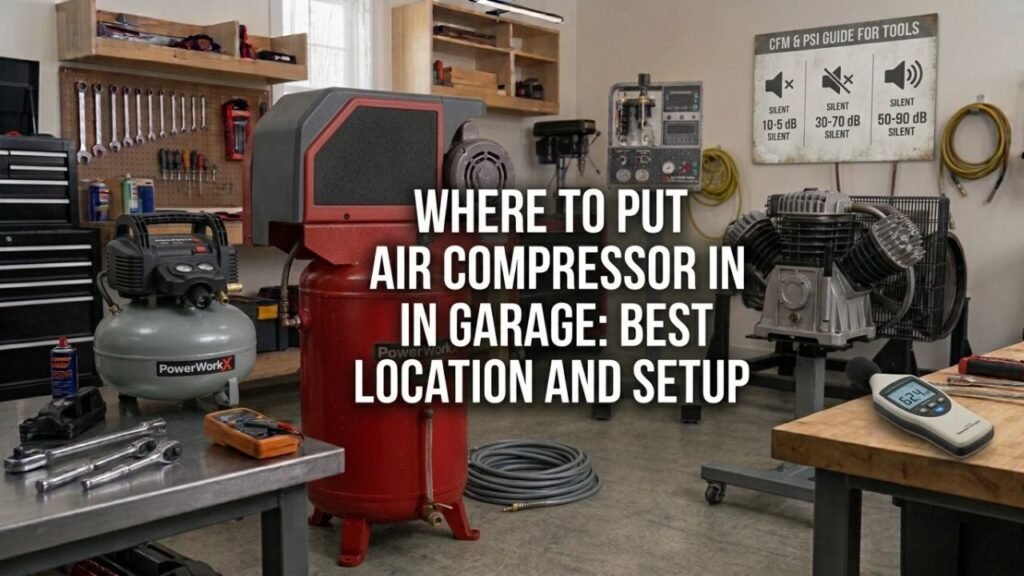
For most home garages, an open area along a wall works well.
Choose a place that keeps the compressor out of your normal walking and vehicle path without trapping it in a tight enclosure.
Leave Cooling Space Around the Compressor
Air compressors generate heat at the:
- Motor
- Pump
- Cylinder head
- Discharge tube
- Aftercooler, if equipped
Cooling air must move around these parts.
Do not block:
- Motor cooling vents
- Pump flywheel
- Fan openings
- Air intake
- Belt guard ventilation
- Cabinet cooling openings
Some stationary compressors specify around 18 inches of open clearance from a wall. Other machines may call for more or less.
Use the distance in your owner’s manual rather than applying one number to every compressor.
Keep the Compressor on a Level Surface
A concrete garage floor is normally a good base.
A level surface reduces unwanted vibration and keeps lubricated compressor pumps at the oil level expected by the manufacturer.
Large stationary vertical compressors may need to be anchored according to their installation instructions.
Do not place a large receiver on an unstable wooden platform, plastic shelf, or light workbench.
Protect It From Vehicles
Place the compressor far enough from parking areas that:
- A bumper cannot strike the tank.
- A tire cannot run over a hose or electrical cord.
- Doors do not hit gauges or piping.
- You can service the drain without crawling under a vehicle.
A protective barrier may make sense for a stationary unit placed close to a parking bay.
Keep Service Areas Accessible
You should be able to reach:
- Tank drain
- Pressure switch
- Safety valve
- Air filter
- Oil sight glass or dipstick
- Belt guard
- Pressure gauges
- Electrical disconnect
- Outlet valve
Do not install the compressor so tightly between cabinets that routine service becomes difficult.
Key Takeaway: A good garage location has solid flooring, open cooling space, protection from vehicles, and clear access to drains, gauges, filters, and maintenance parts.
How Far Should an Air Compressor Be From the Wall?
There is no universal clearance for every compressor.
The owner’s manual is the primary source for the required distance.
Around 18 Inches Is Common on Some Stationary Models
Some 60-gallon stationary compressor instructions call for at least 18 inches of space between the compressor and a wall or obstruction.
That distance provides room for cooling airflow around the pump and motor.
Your model may use a different requirement.
More Space Makes Maintenance Easier
Even if the cooling requirement is fairly small, extra room can make it much easier to:
- Replace the intake filter
- Check oil
- Remove the belt guard
- Reach mounting hardware
- Clean dust
- Inspect piping
Think about future maintenance before pushing the tank into its final position.
Do Not Block the Compressor Intake
The intake filter needs unrestricted access to clean air.
Placing the intake several inches from a solid wall or surrounding it with stored boxes can restrict airflow.
A dirty or obstructed intake can reduce pump output and increase compressor run time.
Key Takeaway: Follow the manufacturer’s wall-clearance number, with about 18 inches being common on some stationary models, and leave extra service room when space permits.
Should You Put the Air Compressor Near the Garage Door?
A spot near the garage door can work well for some users.
It gives quick access to the driveway for tire inflation and outdoor air-tool jobs.
Advantages of a Garage-Door Location
This location can make it easier to:
- Inflate vehicle tires
- Reach outdoor projects
- Run an air hose into the driveway
- Move portable compressors outside
- Reduce hose length to parked vehicles
Fresh-air circulation may also be better when the door is open.
Protect the Compressor From Rain
Do not place an electric compressor where rain can blow directly onto it.
Water and electrical equipment are a bad combination.
The compressor should stay dry even when the garage door is open during bad weather.
Watch for Dust and Outdoor Debris
An open garage door can bring in:
- Road dust
- Leaves
- Sand
- Pollen
- Vehicle exhaust
The compressor intake should pull reasonably clean air.
If the front of your garage becomes very dusty, a position deeper inside may be better.
Do Not Block the Door Track
Make sure the compressor, piping, hoses, and electrical conduit do not interfere with:
- Garage door tracks
- Safety sensors
- Springs
- Door opener
- Manual release
- Vehicle clearance
Key Takeaway: Near the garage door is convenient for tire and driveway work, but keep the compressor dry, clean, and clear of the door mechanism and vehicle path.
Is a Back Corner of the Garage a Good Location?
A rear corner is popular because it keeps the compressor away from the main workspace.
It can be a good choice if you avoid trapping heat.
Corners Can Amplify Noise
Hard walls and a concrete floor reflect compressor sound.
A machine placed tightly against two walls may seem louder because sound reflects back into the garage.
Moving it slightly away from both surfaces can improve airflow and reduce some reflected noise.
Keep the Corner Ventilated
A corner packed with shelving and storage can trap heat.
Do not surround the compressor with:
- Cardboard boxes
- Lumber
- Plastic bins
- Rags
- Paint supplies
- Dust-covered materials
Keep the cooling path open.
Leave a Route to the Drain
You should still be able to drain the receiver easily.
A tank that is difficult to reach often gets drained less frequently.
Condensation left inside a steel tank contributes to internal corrosion.
Key Takeaway: A rear corner saves working space and keeps noise farther away, but only use it if airflow, service clearance, and tank-drain access remain open.
Should the Air Compressor Be Near the Electrical Panel?
For a large electric compressor, placing it reasonably close to the correct electrical supply can simplify installation.
Long electrical runs can create voltage drop if the circuit is not sized correctly.
Large Compressors May Need a Dedicated Circuit
Stationary compressors may require:
- 120-volt dedicated circuit
- 240-volt circuit
- Hardwired disconnect
- Specific breaker size
- Specific wire gauge
Use the compressor nameplate and installation manual.
Electrical work for a large hardwired compressor should comply with applicable codes.
Avoid Long, Undersized Extension Cords
Portable compressors can have starting-current demands far above their normal running load.
A long, small-gauge extension cord can cause voltage drop, which may lead to:
- Hard starting
- Motor humming
- Thermal overload trips
- Hot wiring
- Reduced motor life
When more reach is needed, it is often better to use a longer air hose while keeping the compressor close to a proper outlet.
Keep Electrical Connections Dry
Do not put plugs, receptacles, or disconnects where tank drainage or condensation can spray onto them.
Plan the drain direction before selecting the electrical location.
Key Takeaway: Keep the compressor reasonably close to a correctly sized electrical supply, avoid weak extension-cord setups, and keep electrical components away from water and condensate.
Where Not to Put an Air Compressor in a Garage
Several locations create avoidable heat, dust, fire, or maintenance problems.
Do Not Put It in a Sealed Cabinet
A sealed cabinet traps compressor heat.
The motor and pump may start recycling their own hot exhaust air.
This can cause:
- Higher operating temperature
- Longer cooling periods
- Thermal overload trips
- Faster oil deterioration on lubricated models
- Shorter component life
A noise enclosure needs planned ventilation and enough airflow for the compressor.
Avoid Paint and Solvent Storage Areas
Keep the compressor away from areas where flammable vapors may collect.
Garage chemicals may include:
- Gasoline
- Paint thinner
- Solvents
- Aerosol products
- Fuel containers
- Parts-cleaning chemicals
Electric motors, pressure switches, and other electrical components can create sparks during normal operation.
Do not treat an ordinary shop compressor as explosion-proof equipment.
Avoid Heavy Dust
Do not place the compressor directly beside:
- Wood sander
- Table saw dust outlet
- Grinding station
- Sandblasting area
- Drywall sanding area
The intake filter can catch some particles, but excessive airborne dust loads the filter quickly and may contaminate cooling surfaces.
Avoid Damp Areas
Keep the compressor away from:
- Floor drains that flood
- Leaking walls
- Roof leaks
- Wash areas
- Standing water
The garage should be dry enough to protect the motor, switch, wiring, and tank.
Do Not Block the Tank Drain
A compressor installed behind permanent cabinets or close against a wall may leave no room to operate the drain valve.
The drain must stay accessible.
Key Takeaway: Avoid sealed cabinets, flammable-vapor areas, heavy dust, wet locations, and any position that blocks cooling air or routine maintenance.
Can You Put an Air Compressor in a Closet in the Garage?
You can build a dedicated compressor closet, but it needs ventilation and service access.
Do not simply place the compressor in an ordinary closed storage closet.
Heat Has to Escape
Compressors convert much of their electrical input into heat.
A small enclosed room can heat up rapidly while the compressor is running.
Provide a path for:
- Cooler incoming air
- Hot outgoing air
Position vents so hot discharge air does not flow directly back into the compressor intake.
Sound Control Can Help
A ventilated compressor closet can reduce the noise reaching the main garage.
Sound-absorbing wall materials may help, but they must not:
- Block cooling
- Touch hot components
- Interfere with belts
- Restrict service access
Do not line the space with loose material that can be drawn into the compressor.
Make the Door Large Enough for Service
Plan for future jobs such as:
- Belt replacement
- Pump servicing
- Motor repair
- Filter replacement
- Tank inspection
A compressor that barely fits through the opening can become difficult to maintain.
Key Takeaway: A compressor closet can reduce garage noise, but it needs planned intake and exhaust ventilation, safe materials, and enough room for maintenance.
How to Reduce Air Compressor Noise in the Garage
Location can make as much difference as the compressor itself.
Move It Away From the Workbench
If possible, place the compressor on the opposite side of the garage from your main work area.
Air hose is much easier to extend than your ears are to move away from the noise.
Use Vibration Isolation
Some compressors can use manufacturer-approved rubber isolation pads or mounts.
These reduce vibration transferred into the concrete floor or building structure.
Do not place a large stationary compressor on thick soft foam. The unit still needs stable support.
Check for Loose Parts
Rattling can make a normal compressor sound much worse.
With the machine powered off and depressurized, inspect:
- Belt guard
- Wheel hardware
- Handle
- Motor mounts
- Pump mounts
- Piping brackets
- Tank feet
Repair loose or damaged parts rather than accepting the added noise.
Avoid Mounting It Against a Shared Wall
In an attached garage, a compressor next to a bedroom, office, or living-room wall may transmit noise and vibration into the house.
If possible, choose an exterior wall or another location farther from occupied rooms.
Key Takeaway: Put the compressor away from your main workstation and shared living-space walls, then control vibration and rattling at the source.
Where Should a Portable Air Compressor Sit?
Portable units give you more flexibility than stationary machines.
Floor Placement Is Usually Best
A garage floor gives a portable compressor a stable base.
Place it where:
- Air can circulate.
- Hose connections are accessible.
- It cannot roll into a vehicle.
- Water cannot reach the electrical parts.
Many portable compressors have rubber feet designed for floor use.
Be Careful With Shelves and Workbenches
A running compressor vibrates.
A shelf must be able to support the full weight and resist vibration without letting the unit move.
There is also a risk of the compressor falling.
For that reason, the floor is usually the safer place unless the manufacturer specifically approves another mounting arrangement.
Store It Separately From Its Operating Location
A portable compressor can be stored under a bench or against a wall when switched off.
Pull it into an open operating position before use if the storage area does not provide the required cooling clearance.
Where Should a 60- or 80-Gallon Compressor Go?
Large vertical compressors need more planning.
These units are normally stationary once installed.
Use a Solid Concrete Base
Follow the manufacturer’s anchoring instructions.
Some stationary compressors need mounting to a solid, level concrete surface.
Use approved vibration pads or isolation methods if specified.
Do not guess at anchor-bolt tightening or rigidly distort the tank feet.
Leave Full Maintenance Clearance
Large compressors may need access around several sides for:
- Belt service
- Oil changes
- Pump repair
- Motor service
- Tank drainage
- Air-filter replacement
Leave more space than the bare minimum if the garage allows it.
Plan Permanent Air Piping
A large compressor is a good candidate for fixed garage air distribution.
You can run approved compressed-air piping to:
- Workbench
- Tire-inflation point
- Tool station
- Spray area
- Garage door
This allows the compressor to stay in a quieter corner while tools remain easy to connect.
Key Takeaway: Large stationary compressors belong on a solid level base with anchoring, ventilation, electrical supply, drain access, and enough surrounding room for major service work.
How to Plan the Air Hose and Piping From the Compressor
Location affects how easy the entire garage air system is to use.
Keep the Compressor Out of the Center of the Garage
You should not have to step over hoses at the compressor every time you cross the garage.
A wall-mounted distribution line can carry air to work areas while the compressor remains out of the way.
Add Multiple Air Drops
For a larger garage, consider separate outlets near:
- Workbench
- Vehicle bay
- Garage door
- Tire station
- Paint area
This reduces the need for very long loose hoses.
Plan Moisture Control
Hot compressed air creates condensation as it cools.
A fixed system can use:
- Cooling pipe
- Drip legs
- Water separator
- Filter
- Dryer where needed
Keep the tank drain and line drains accessible.
Use Compressed-Air-Rated Materials
Not every pipe that holds household water is approved for compressed air.
Use a piping system specifically rated for compressed-air service and installed according to its specifications.
Should You Put the Compressor Outside the Garage?
Moving a compressor outside can reduce indoor noise, but an exposed outdoor location creates other problems.
Weather Protection Is Required
Most shop compressors are not designed to sit in:
- Rain
- Snow
- Direct weather
- Standing water
Outdoor installations need a manufacturer-approved or purpose-built protected enclosure.
Temperature Can Affect Starting
Cold temperatures can make oil thicker in lubricated compressors and increase starting load.
Extreme heat can also raise operating temperature.
Check the compressor’s allowed ambient-temperature range.
Air Intake Quality Still Matters
Do not put the compressor intake near:
- Vehicle exhaust
- Generator exhaust
- Dryer vents
- Dusty driveway areas
- Chemical fumes
The compressor draws whatever air surrounds it.
OSHA guidance for compressed-air operations also reflects the basic principle that compressor intakes should be located where fumes, exhaust gases, and contaminants are minimized.
Key Takeaway: An outdoor location can reduce garage noise, but only use it when the compressor is protected from weather, temperature extremes, fumes, and contamination.
A Simple Garage Placement Checklist
Before committing to a spot, make sure you can answer yes to these questions:
- Is the floor level and strong enough?
- Is there enough cooling clearance?
- Can the intake breathe clean air?
- Is the electrical supply suitable?
- Can I reach the tank drain easily?
- Can I remove the belt guard or service panels?
- Is the compressor protected from vehicles?
- Is it away from gasoline and solvent vapors?
- Is the location dry?
- Can the hose reach my normal work areas?
- Will compressor noise disturb nearby living rooms or bedrooms?
- Can I expand the air-line system later?
If several answers are no, move the compressor before building permanent piping or electrical connections.
Conclusion
For where to put air compressor in garage, choose a level, dry, well-ventilated area along a wall or in a protected corner where the machine has enough cooling clearance and remains accessible for service.
Keep it reasonably close to the proper electrical supply and farther away from your main workbench if noise is a concern. Protect the tank from vehicle impacts, keep the intake away from heavy dust and exhaust fumes, and never crowd the compressor with boxes or flammable materials.
A portable compressor can usually sit directly on a stable garage floor and move as needed. A 60- or 80-gallon stationary compressor deserves a permanent location with a solid concrete base, approved anchoring, fixed electrical supply, accessible drainage, and planned air piping.
The exact clearance and mounting requirements come from your compressor manual. Once those requirements are met, choose the spot that gives you the cleanest airflow, simplest maintenance access, safest vehicle clearance, and shortest practical route to your air outlets.
FAQs About Air Compressor Placement in a Garage
Can I Put My Air Compressor Against the Wall?
Do not press it tightly against the wall unless the manufacturer specifically allows that position.
Many stationary compressors need open space around the pump and motor for cooling. Some manuals call for around 18 inches of wall clearance.
Can I Put an Air Compressor in the Corner of My Garage?
Yes, if the corner has enough airflow and service space.
Leave room around cooling vents, the intake filter, tank drain, belt guard, and electrical components. A very tight corner can trap heat and reflect more noise into the garage.
Can I Keep an Air Compressor Under a Workbench?
Storage under a bench may be fine for a portable unit when it is switched off.
During operation, make sure the space meets the compressor’s cooling-clearance requirements. A tightly enclosed bench cavity can trap heat.
Should an Air Compressor Be Bolted to the Garage Floor?
Many large stationary compressors need to be anchored to a level concrete floor according to the manufacturer’s instructions.
Small portable compressors usually use rubber feet and are not permanently bolted down. Check the manual for your model.
Can I Put an Air Compressor Next to a Water Heater?
It is better to choose another spot if the area contains combustion appliances, fuel lines, stored chemicals, or limited ventilation.
Keep the compressor away from flammable vapors and do not block access or ventilation required by the water heater.
Can I Put an Air Compressor Outside My Garage?
Only if the installation protects the compressor from rain, moisture, temperature extremes, dust, and contaminated intake air.
Many normal portable and shop compressors are intended for dry indoor locations.
How Much Space Should I Leave Around an Air Compressor?
Use the clearance listed by the manufacturer.
Some stationary models specify at least about 18 inches between the compressor and a wall or airflow obstruction, but other models may require a different distance.