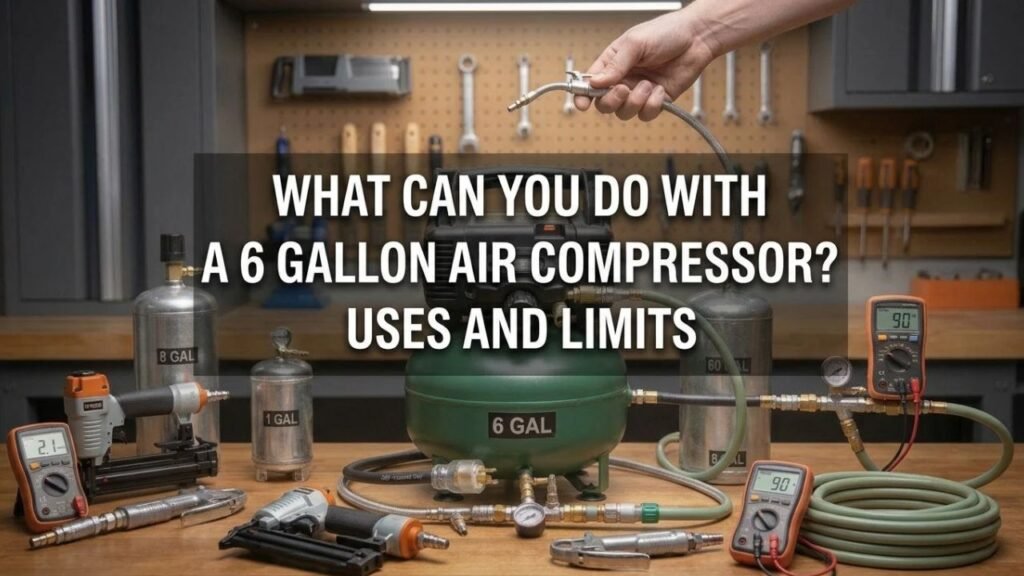
What Can You Do With a 6 Gallon Air Compressor? Uses and Limits
A 6-gallon air compressor is best for inflation, brad and finish nailers, staplers, blow guns, and other tools that use air in short bursts. It can also run some impact wrenches and light-duty pneumatic tools intermittently, but it usually cannot keep up with high-CFM tools such as air sanders, grinders, or continuous spray equipment.
This size is especially common in pancake-style compressors because the tank remains portable while storing enough air for many household, trim, and light automotive jobs.
Most 6-gallon portable compressors deliver only a few SCFM at 90 PSI, so tank size alone does not tell you what the machine can run. The compressor’s airflow rating matters much more once a tool needs air continuously.
If you are asking what can you do with a 6 gallon air compressor, think short-duty tools first. Nail guns, tire inflators, air nozzles, and staplers work especially well because they use relatively small bursts of compressed air.
For what is a 6 gallon air compressor good for, portability is one of its main strengths. A compact 6-gallon unit can move between a garage, driveway, workshop, and jobsite much more easily than a large stationary compressor.
As for what can you use a 6 gallon air compressor for, the answer depends on both PSI and SCFM. A tool may operate at 90 PSI, but the compressor still needs enough airflow at that pressure to keep it working for the required amount of time.
What Does a 6-Gallon Air Compressor Actually Mean?
The 6-gallon number refers to receiver-tank capacity.
It does not tell you the compressor’s continuous airflow.
The Tank Stores Compressed Air
A 6-gallon receiver gives the pump a small reserve of air.
When you use a pneumatic tool:
- Air leaves the tank.
- Tank pressure begins dropping.
- The compressor reaches its cut-in pressure.
- The motor starts.
- The pump begins replacing the used air.
If the tool consumes air faster than the pump can replace it, pressure continues falling even while the compressor is running.
Tank Size Is Not CFM
A larger tank gives you more stored air before pressure falls.
It does not make the compressor pump stronger.
A 6-gallon compressor producing 2.6 SCFM at 90 PSI will not suddenly produce 8 SCFM simply because its tank is full.
PSI and SCFM Have Different Jobs
PSI tells you pressure.
SCFM tells you airflow.
For tool compatibility, check:
- Required PSI
- Required SCFM
- Tool duty pattern
- Compressor duty cycle
Key Takeaway: Six gallons describes stored-air capacity; SCFM at the tool’s working pressure determines how well the compressor can sustain pneumatic equipment.
What Is a 6 Gallon Air Compressor Good For?
A 6-gallon unit works best with tools that consume air intermittently.
Tire Inflation
This is one of the easiest jobs for a small compressor.
You can inflate:
- Car tires
- Light-truck tires
- Bicycle tires
- Lawn-equipment tires
- Utility-trailer tires
A 6-gallon tank gives you enough stored air to make inflation convenient without carrying a large shop compressor.
Brad Nailers
Brad nailers use a small pulse of air for each fastener.
A 6-gallon compressor can usually handle them easily.
Typical projects include:
- Trim
- Crafts
- Cabinet work
- Furniture assembly
- Decorative molding
Finish Nailers
Finish nailers also work well because they do not consume air continuously.
You can use them for:
- Baseboards
- Door casing
- Window trim
- Crown molding
- Cabinet installation
Staplers
Pneumatic staplers are another good match.
They work well for:
- Light upholstery
- Sheathing tasks
- Crafts
- Certain trim projects
Blow Guns
A blow nozzle can be used for short cleaning bursts.
Useful jobs include:
- Blowing debris from a workbench
- Cleaning tools
- Removing dust from inaccessible areas
Compressed air should never be directed at skin or used carelessly around people. For workplace cleaning in the U.S., OSHA places restrictions on compressed-air cleaning above 30 PSI unless proper guarding and personal protection are used.
Key Takeaway: Inflation, nailers, staplers, and short blow-gun use are among the strongest applications for a 6-gallon compressor because they consume air in short bursts.
Can a 6-Gallon Air Compressor Run a Nail Gun?
Yes. Nail guns are one of the best matches for this compressor size.
Brad Nailer
A 6-gallon compressor can comfortably support most brad nailers.
Because each shot uses little air, the compressor has plenty of recovery time during normal trim work.
Finish Nailer
Finish nailers also work well.
A typical trim job rarely involves continuous rapid firing for long periods.
Framing Nailer
A 6-gallon compressor can run many framing nailers too.
The limitation appears when firing very quickly.
During rapid framing work, tank pressure may fall enough for the compressor to cycle frequently.
Roofing Nailer
Roofing nailers can work with a 6-gallon compressor, but roofing crews often fire fast enough to demand much more sustained airflow.
One nailer may work acceptably.
Multiple roofers sharing the compressor would likely overwhelm a small unit.
Key Takeaway: A 6-gallon compressor handles brad and finish nailers very well and can run framing or roofing nailers if firing rate stays within the compressor’s recovery ability.
Can a 6-Gallon Air Compressor Fill Car Tires?
Yes.
Tire inflation is an ideal job for this size.
Passenger Cars
A 6-gallon compressor has more than enough capability for normal car-tire inflation.
SUVs and Light Trucks
It can handle larger tires too, though inflation takes longer.
Completely Flat Tires
Filling from near zero pressure requires more total air than simply topping up a tire.
The compressor may cycle several times during the process.
Use an Accurate Gauge
Do not inflate based only on compressor tank pressure.
Use:
- Tire inflator gauge
- Separate tire-pressure gauge
Inflate to the vehicle manufacturer’s recommended cold pressure.
That specification is usually found on the driver’s door placard.
Can a 6-Gallon Air Compressor Run an Impact Wrench?
Yes, but usually for intermittent use.
Impact Wrenches Use Air in Bursts
An impact wrench can consume substantial airflow while the trigger is held.
A 6-gallon tank gives it a short reserve.
This can work well for:
- Removing a few lug nuts
- Occasional automotive repairs
- Short fastener-removal jobs
Continuous Use Is Different
If you hold the trigger for long periods, pressure drops quickly.
The compressor may not recover fast enough.
Check Tool SCFM
Suppose the impact wrench calls for 5 SCFM at 90 PSI while your compressor provides only 2.6 SCFM at 90 PSI.
The tool may still operate from stored tank air.
It just cannot run continuously at full performance.
Larger Impact Wrenches Need More Air
A 1/2-inch impact may be practical intermittently.
A large 3/4-inch or 1-inch pneumatic impact often demands far more airflow.
Key Takeaway: A 6-gallon compressor can run many impact wrenches for short bursts, but it usually cannot sustain high-torque pneumatic impacts continuously.
Can a 6-Gallon Air Compressor Run an Air Ratchet?
Usually, but expect the compressor to cycle frequently.
Air ratchets need more continuous airflow than nailers.
Short Fastener Work
A small ratchet can work for:
- Running bolts out
- Light assembly
- Automotive repairs
Long Trigger Time
Holding the trigger continuously can drain the receiver quickly.
Once pressure falls, torque and speed may drop.
Break Fasteners Loose First
Air ratchets are not always intended to break heavily seized bolts loose.
Use a breaker bar or impact wrench when appropriate, then use the ratchet to spin the fastener out.
Can a 6-Gallon Air Compressor Run an Air Hammer?
It may run an air hammer for short periods, but this is not one of the best pairings.
Air Hammers Consume Substantial Flow
Unlike a nail gun, an air hammer uses air continuously while the trigger is held.
Short Bursts May Work
For brief jobs such as:
- Light chipping
- Small exhaust work
- Breaking loose a component
you may get useful operation.
Expect Frequent Recovery
Long use can force the compressor to run almost constantly.
If the air hammer needs more SCFM than the compressor produces, performance declines as tank pressure falls.
Can a 6-Gallon Compressor Run an Air Sander?
Usually not well.
Air sanders are among the most demanding pneumatic tools.
Sanders Need Continuous Air
A pneumatic random orbital sander may consume roughly 8–15 CFM or more depending on the model.
That is far above the output of many 6-gallon compressors.
It May Run Briefly
A full receiver can make the tool spin for a short period.
Then:
- Pressure drops
- Sander speed falls
- Compressor runs continuously
- Sanding performance becomes inconsistent
Electric Sanders Make More Sense
For a small-compressor shop, an electric random orbital sander is usually much more practical.
Save the compressor for:
- Nailers
- Inflation
- Blow gun
- Short-duty automotive tools
Key Takeaway: A 6-gallon compressor may spin an air sander briefly but normally lacks the sustained CFM needed for productive continuous sanding.
Can a 6-Gallon Compressor Run an Air Grinder?
Usually only for very short bursts.
Die Grinders Consume a Lot of Air
Many pneumatic grinders need continuous airflow while operating.
A 6-gallon compressor may not replace the air quickly enough.
Tool Speed Falls as Pressure Drops
This can lead to:
- Slow cutting
- Frequent pauses
- Long compressor recovery time
Electric or Cordless Is Often Better
For occasional grinding in a small garage, electric or battery-powered grinders avoid the airflow limitation.
Can a 6-Gallon Air Compressor Run a Paint Sprayer?
Sometimes, but sprayer airflow determines the answer.
Small Detail Guns
Some low-consumption touch-up guns may work reasonably well.
Full-Size Spray Guns
Many HVLP guns require considerably more CFM than a 6-gallon compressor can sustain.
The compressor may:
- Run continuously
- Lose pressure
- Produce inconsistent atomization
Intermittent Small Projects
A small spray gun may work for:
- Touch-ups
- Small parts
- Crafts
- Limited refinishing
Large Automotive Painting Is Different
Painting a complete vehicle requires steady airflow and good moisture control.
A small 6-gallon compressor is normally a poor choice.
Key Takeaway: A 6-gallon compressor can work with selected low-air-consumption spray equipment, but most full-size spray guns require more sustained airflow.
Can a 6-Gallon Air Compressor Run a Framing Nailer?
Yes, for one nailer in many situations.
Framing Nailers Use Intermittent Air
Each shot consumes a small volume.
During ordinary framing, the tank can recover between firing bursts.
Fast Bump-Firing Uses More Air
If nails are fired rapidly, pressure falls faster.
This can make the compressor cycle more frequently.
One Tool Is Better Than Several
A 6-gallon compressor is not intended to support a crew of several framers simultaneously.
For one user, it can be a practical portable setup.
Can a 6-Gallon Air Compressor Run a Roofing Nailer?
Yes, with limitations.
A roofing nailer fires very quickly, so air demand can become substantial even though each individual shot uses little air.
For occasional roofing or repair work, a 6-gallon unit can be useful.
For sustained professional roofing, a larger compressor with greater SCFM may reduce recovery delays.
Can a 6-Gallon Compressor Be Used for Blowing Out Sprinklers?
This is generally not an ideal size for full irrigation-system winterization.
Sprinkler Systems Need Volume
Winterizing irrigation requires enough airflow to push water out of long underground lines.
A 6-gallon tank empties quickly.
Compressor May Cycle Repeatedly
Small zones may be possible, but large systems can require far more air volume.
Pressure Must Be Controlled
Too much pressure can damage:
- Irrigation valves
- Fittings
- Sprinkler heads
Use the irrigation-system manufacturer’s pressure limits.
A larger compressor or professional winterization service may be more appropriate.
Can a 6-Gallon Air Compressor Blow Out Water Lines?
For short household or workshop lines, sometimes.
Small Lines Need Less Volume
A compact compressor can clear:
- Short hoses
- Small equipment lines
- Selected plumbing sections
RV Winterization Can Be Possible
An RV blowout plug and regulated low pressure are commonly used to clear water lines.
Follow the RV manufacturer’s pressure limit.
Do not connect full tank pressure directly to plumbing.
Can a 6-Gallon Compressor Run a Plasma Cutter?
This depends heavily on the plasma cutter.
Small Plasma Cutters May Need Moderate Airflow
Some compact units can operate from modest compressed-air supplies.
Others need much more sustained air.
Air Quality Matters
Plasma cutting works better with:
- Dry air
- Clean air
- Stable pressure
Moisture can affect consumable life and cut quality.
Compare the Exact Specifications
Check the cutter’s:
- Required CFM
- Required PSI
against the compressor’s output at that same pressure.
Do not judge compatibility from tank gallons.
Can a 6-Gallon Compressor Run a Pneumatic Grease Gun?
Usually, yes.
Air-powered grease guns generally do not require the same continuous airflow as sanders and grinders.
This makes a 6-gallon compressor suitable for many:
- Automotive
- Farm
- Equipment-maintenance
greasing jobs.
Check the grease gun’s inlet pressure specification and regulate accordingly.
Can a 6-Gallon Compressor Run a Rivet Gun?
Many pneumatic riveters work well with small compressors because their air consumption is intermittent.
Suitable jobs can include:
- Sheet metal
- Fabrication
- Automotive repair
- DIY projects
Airflow requirements vary, so check the exact tool.
Can a 6-Gallon Compressor Run a Pneumatic Caulking Gun?
Often, yes.
These tools generally use modest airflow.
Set the regulator carefully because too much pressure can dispense material too quickly.
What Tools Are Best for a 6-Gallon Air Compressor?
The strongest matches are tools with low or intermittent air consumption.
Excellent Matches
- Brad nailer
- Finish nailer
- Stapler
- Tire inflator
- Blow gun
- Pneumatic riveter
- Pneumatic grease gun
Usually Good With Moderate Use
- Framing nailer
- Roofing nailer
- Small impact wrench
- Air ratchet
- Small touch-up spray gun
Poor Matches for Continuous Use
- Random orbital air sander
- Die grinder
- Cutoff tool
- Large impact wrench
- Sandblaster
- Full-size HVLP spray gun
- Continuous air hammer use
Key Takeaway: A 6-gallon compressor excels with intermittent tools and struggles with pneumatic equipment that consumes high airflow continuously.
How Much CFM Does a 6-Gallon Air Compressor Produce?
Tank capacity does not determine CFM, so there is no single number.
Many portable 6-gallon pancake compressors fall somewhere around:
2–3 SCFM at 90 PSI
Some produce more.
Check the Nameplate or Specification
Look for a rating such as:
- 2.6 SCFM at 90 PSI
- 3.0 SCFM at 90 PSI
This figure is more useful than:
- Peak horsepower
- Maximum tank PSI
- Tank gallons
Compare at the Same Pressure
If your tool needs:
4.5 CFM at 90 PSI
and the compressor produces:
2.6 SCFM at 90 PSI
the compressor cannot sustain that tool indefinitely.
It may still run it intermittently from stored air.
Is 6 Gallons Enough for an Impact Wrench?
For occasional lug-nut work, often yes.
The tank gives you a useful reserve for a short trigger pull.
After several fasteners, the compressor may need to recover.
For constant automotive repair using multiple pneumatic tools, a larger compressor is more practical.
Is a 6-Gallon Compressor Good for Home Use?
Yes.
This is one of the best sizes for a homeowner who values portability.
Common Home Jobs
You can use it for:
- Inflating tires
- Installing trim
- Building furniture
- Blowing debris
- Running nailers
- Light garage work
- Small repair projects
Easy to Store
A pancake unit takes up much less space than:
- 20-gallon compressor
- 30-gallon compressor
- 60-gallon stationary machine
Easier to Carry
Many 6-gallon models are designed with a top handle.
This makes them practical for moving around a house or jobsite.
Key Takeaway: A 6-gallon compressor is a strong homeowner size because it covers common inflation, nailing, cleaning, and light repair tasks without requiring permanent installation.
Is a 6-Gallon Air Compressor Good for Automotive Work?
For light automotive use, yes.
Good Automotive Jobs
It can handle:
- Tire inflation
- Blowing debris
- Pneumatic grease gun
- Small impact wrench in bursts
- Some air ratchet work
Poor Automotive Jobs
It is usually too small for sustained use of:
- DA sander
- Die grinder
- Large impact
- Air polisher
- Full vehicle spray gun
If pneumatic tools are a major part of your garage work, look at SCFM first and consider a larger receiver and pump.
Is a 6-Gallon Compressor Good for Woodworking?
Yes, particularly for assembly and trim.
Strong Woodworking Uses
- Brad nailing
- Finish nailing
- Stapling
- Blow-off cleaning
Less Useful for Pneumatic Sanding
Air sanders consume too much continuous airflow for most small pancake compressors.
Electric sanders pair much better with this shop setup.
How Long Can a 6-Gallon Air Compressor Run?
The answer depends on its duty cycle.
Some Portable Compressors Need Rest Periods
Duty cycle describes how much of a given time period the compressor can safely spend running.
A lower-duty-cycle compressor may need cooling breaks.
High Air Demand Creates Long Runtime
If the connected tool consumes more air than the pump produces, the compressor may run continuously.
That can cause:
- High temperature
- Faster wear
- Thermal shutdown
Do Not Judge by Tank Size
A larger tank can delay motor startup but does not reduce total pumping work over a long job.
Check the compressor manual for operating limits.
How Long Does a 6-Gallon Tank Last Before the Compressor Restarts?
It depends on:
- Tank starting pressure
- Cut-in pressure
- Tool CFM
- Regulated pressure
- Hose losses
A nail gun may allow many shots before noticeable pressure loss.
An air sander may drain the useful reserve in a short time.
This is why two tools connected to the same 6-gallon compressor can have completely different user experiences.
How to Tell if Your Air Tool Will Work With a 6-Gallon Compressor
Use a simple comparison.
Step 1: Find Tool PSI
For example:
90 PSI
Step 2: Find Tool Air Consumption
Suppose it requires:
4 SCFM at 90 PSI
Step 3: Find Compressor Output
Suppose your compressor provides:
2.6 SCFM at 90 PSI
Step 4: Compare the Numbers
The compressor produces less air than the tool consumes.
That means:
- Short intermittent use may work.
- Continuous operation will not be sustained.
Step 5: Consider Duty Pattern
This matters greatly.
A nail gun needing a high instantaneous airflow for a fraction of a second can still work well.
An air grinder consuming 4 CFM continuously presents a much bigger problem.
Key Takeaway: Match SCFM at the same PSI and consider how long the tool uses air; intermittent tools can work even when their momentary demand exceeds pump output.
Can You Make a 6-Gallon Compressor More Capable With a Bigger Tank?
A larger auxiliary tank gives you more stored air, but not more pump CFM.
Bigger Tank Gives Longer Bursts
You may be able to operate a high-demand tool longer before pressure drops.
Recovery Takes Longer
Once both tanks are depleted, the same small compressor pump must refill all that storage.
Continuous Performance Does Not Change
If the pump produces 2.6 SCFM and the tool consumes 10 CFM, adding another tank does not close that long-term airflow gap.
Use a larger compressor when sustained CFM is required.
Advantages of a 6-Gallon Air Compressor
This size remains popular for good reasons.
Portable
It can move between jobs without machinery.
Compact
Storage space is modest.
Good for Nailers
This is one of its strongest roles.
Good for Inflation
Tire and recreational inflation tasks are easy.
Common Electrical Requirements
Many portable models are designed for standard household electrical service, though the exact circuit requirements still need to be checked.
Affordable
A small compressor gives access to pneumatic tools without the expense of a large shop system.
Key Takeaway: Portability, compact storage, easy inflation, and excellent nailer compatibility make the 6-gallon class attractive for home and jobsite use.
Limitations of a 6-Gallon Air Compressor
Its compact size comes with real restrictions.
Low Continuous CFM
This is the main limitation.
Frequent Cycling
High-demand tools make the motor start and run often.
Small Air Reserve
Six gallons empties quickly with continuous air use.
High-CFM Tools Perform Poorly
Sanders, grinders, and large spray equipment often need a larger compressor.
Noise Can Be Noticeable
Portable pancake compressors often use high-speed pumps.
Some models are much louder than larger low-RPM shop compressors.
Key Takeaway: A 6-gallon compressor is limited primarily by low sustained airflow and a small reserve, not by its ability to produce useful pressure.
What Size Air Compressor Should You Get Instead for Bigger Tools?
If a 6-gallon unit cannot meet your needs, choose the next compressor based on SCFM.
Impact Wrenches
A larger portable or 20–30 gallon compressor may provide better recovery for repeated impact use.
Air Sanders
Look for a compressor capable of exceeding the sander’s sustained SCFM requirement.
This often pushes buyers toward much larger shop compressors.
Spray Guns
Match the compressor to the gun’s stated CFM at operating pressure.
Full-size spray equipment can require significantly more airflow than a pancake compressor provides.
Die Grinders
Again, use the continuous CFM rating.
Do not choose solely by tank gallons.
Common Mistakes With a 6-Gallon Air Compressor
Small compressors are often asked to do jobs they were not sized for.
Looking Only at Maximum PSI
A 150 PSI maximum does not mean the compressor can run every 90 PSI air tool.
Ignoring SCFM
This is the most common compatibility mistake.
Running High-CFM Tools Continuously
The compressor may overheat or spend nearly all its time running.
Using Long, Undersized Extension Cords
Voltage drop can make the motor harder to start and increase heating.
Follow the manufacturer’s electrical instructions.
Forgetting to Drain the Tank
Condensation accumulates inside the receiver.
Drain it according to the compressor instructions.
Using Air to Clean Skin or Clothing
Compressed air can cause serious injury.
Keep the nozzle away from your body and follow proper pressure and guarding requirements.
Key Takeaway: Check SCFM, respect duty cycle, use proper electrical supply, drain moisture, and handle compressed air safely rather than relying on maximum PSI alone.
Conclusion
For what can you do with a 6 gallon air compressor, the best jobs are tire inflation, brad and finish nailing, stapling, short blow-gun work, pneumatic riveting, and other applications that use compressed air intermittently.
For what is a 6 gallon air compressor good for, portability is a major reason to choose one. It provides enough stored air for many home, trim, woodworking, and light automotive jobs without taking up the space of a large stationary machine.
For what can you use a 6 gallon air compressor for, some higher-demand tools such as impact wrenches and air ratchets can work in short bursts. Continuous tools such as pneumatic sanders, grinders, sandblasters, and many spray guns usually need much more airflow.
Check the compressor’s SCFM rating at the tool’s required PSI before buying or connecting a pneumatic tool. If the tool consumes more air than the pump supplies, the 6-gallon tank can only delay the pressure drop—it cannot make up for insufficient continuous airflow.
FAQs About 6-Gallon Air Compressors
Is a 6-gallon air compressor big enough for a nail gun?
Yes. Brad, finish, and many framing nailers work well because they use compressed air in short bursts rather than continuously.
Can a 6-gallon air compressor run an impact wrench?
Yes, for intermittent use in many cases. A small tank can support short impact bursts, but repeated heavy use may cause pressure to drop faster than the pump can recover.
Can a 6-gallon air compressor run an air sander?
Usually not for productive continuous sanding. Pneumatic sanders often require far more sustained CFM than a typical 6-gallon compressor can produce.
Is a 6-gallon air compressor good for tires?
Yes. It is a very practical size for inflating and topping up passenger-car, SUV, light-truck, trailer, and lawn-equipment tires.
Can a 6-gallon compressor run a paint sprayer?
It can run some low-consumption detail guns, but many full-size spray guns need more continuous airflow than a typical 6-gallon unit provides.
Is a 6-gallon air compressor good for home use?
Yes. It works especially well for inflation, trim nailers, staplers, light cleaning, furniture projects, and occasional garage work.
Does a bigger tank make a 6-gallon compressor produce more CFM?
No. Additional tank capacity provides more stored air, but the compressor pump’s SCFM output remains unchanged.
How do I know if my air tool will work with a 6-gallon compressor?
Compare the tool’s required SCFM at its operating PSI with the compressor’s SCFM rating at the same pressure. Also consider how continuously the tool consumes air.