
What Does the Gallon Mean in an Air Compressor? Tank Size Guide
The gallon rating on an air compressor tells you the physical capacity of its air-storage tank. A 6-gallon compressor has a tank with about six gallons of internal volume, while a 60-gallon model has a much larger reservoir. Gallons do not directly tell you the compressor’s airflow, pressure, horsepower, or ability to run a specific air tool.
A larger tank stores a bigger reserve of compressed air. That reserve lets an air tool draw air for longer before tank pressure falls enough for the compressor pump to start or before pressure becomes too low for the tool.
Tank size matters most when air demand changes rapidly or a tool consumes air in bursts. Nail guns, for example, can work well with relatively small tanks because each shot uses a short burst of air. Sanders, grinders, spray guns, and other continuous-use tools place much greater demand on the pump and usually benefit from higher airflow plus additional storage.
For what does the gallon mean in an air compressor, think of gallons as storage capacity, CFM or SCFM as air-delivery rate, and PSI as air pressure. Campbell Hausfeld defines air-tank capacity as the volume stored in the tank and available for immediate use, while SCFM describes the air volume delivered by the compressor.
This is why buying the largest tank you can find does not guarantee good air-tool performance. Ingersoll Rand recommends sizing a compressor around required CFM and PSI first, since two compressors with similar tank or motor specifications can deliver very different airflow.
The sections below explain gallons in practical terms, how tank size changes runtime and cycling, why CFM matters more for continuous tools, common tank sizes, and how to choose the right combination for your work.
What Does the Gallon Mean in an Air Compressor?
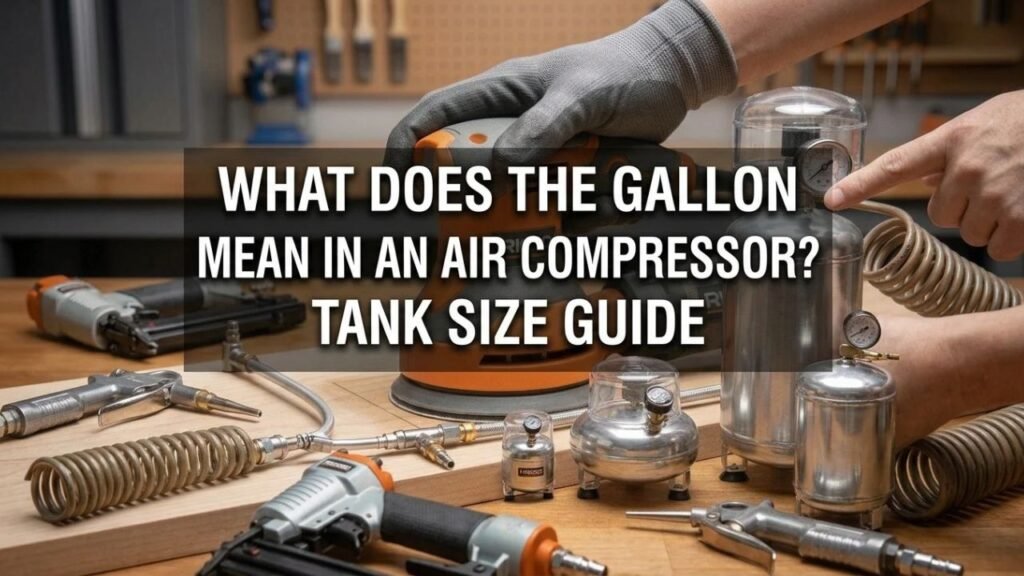
The gallon number is the internal volume of the receiver tank.
A compressor labeled:
- 2 gallon has roughly a 2-gallon receiver
- 6 gallon has roughly a 6-gallon receiver
- 20 gallon has roughly a 20-gallon receiver
- 60 gallon has roughly a 60-gallon receiver
- 80 gallon has roughly an 80-gallon receiver
It does not mean the machine produces that many gallons of air per minute.
Gallons Measure Tank Volume
The air receiver acts like a reservoir between the compressor pump and your air tool.
The pump compresses air and sends it into the tank. As tank pressure rises, more air mass is stored inside that fixed physical volume.
When you pull the trigger on an air tool, air flows from the tank through the regulator and hose.
Campbell Hausfeld describes air tank capacity as the amount of stored air available for immediate use. A larger receiver gives a bigger reserve when tool demand temporarily exceeds pump output.
The Tank Holds Compressed Air, Not Liquid
The gallon unit can sound confusing because gallons are commonly associated with water or fuel.
In this case, it simply describes volume.
A six-gallon air tank has about the same internal volume as six U.S. gallons, but the tank contains compressed air rather than six gallons of liquid.
Pressure Lets More Air Fit Into the Same Tank
A tank does not become physically larger as pressure increases.
Instead, the compressor forces more air mass into the same volume.
That is why a 6-gallon tank at 150 PSI contains much more usable compressed air than the same tank at 50 PSI.
The pressure rating and gallon rating work together, but they describe different properties.
Key Takeaway: Gallons tell you the physical size of the air-storage tank; pressure determines how densely air is stored inside that tank.
Gallons vs CFM vs PSI
These three specifications answer different questions.
| Specification | What it tells you | Why it matters |
| Gallons | Tank storage volume | How much reserve air is available |
| CFM/SCFM | Airflow delivered per minute | How well the compressor keeps up with tools |
| PSI | Air pressure | Whether the tool receives enough pressure |
| Horsepower | Motor/pump power rating | Gives some indication of compressor drive capacity |
Gallons: How Much Reserve You Have
A larger tank gives more stored air.
That can let you operate a high-demand tool for a short period even if the compressor pump itself cannot continuously supply all of the tool’s airflow.
Campbell Hausfeld specifically notes that larger tanks can support intermittent use of tools whose air demand temporarily exceeds the compressor’s rated delivery.
The key word is intermittent.
Once the stored reserve is depleted, pump output becomes the limiting factor.
CFM: How Fast the Compressor Supplies Air
CFM means cubic feet per minute.
SCFM means standard cubic feet per minute and reports airflow under standardized conditions.
Ingersoll Rand recommends starting compressor sizing with the CFM requirement of the tools being operated.
A tool that consumes 8 CFM continuously will eventually outrun a compressor capable of supplying only 4 CFM, no matter how large the receiver tank is.
A larger tank only delays the pressure drop.
PSI: How Much Pressure Is Available
PSI means pounds per square inch.
Air tools generally have a specified operating pressure, often expressed as CFM or SCFM at a particular PSI.
For example:
- 2.5 SCFM at 90 PSI
- 5 SCFM at 90 PSI
- 10 SCFM at 90 PSI
Those ratings describe airflow at a defined pressure.
Campbell Hausfeld calls the combination of PSI and SCFM the compressor’s air delivery and recommends matching that combination to the tool requirement.
Key Takeaway: Gallons describe stored air, CFM describes delivered airflow, and PSI describes pressure. CFM and PSI usually matter more than gallons when matching a compressor to a tool.
Does a Bigger Gallon Air Compressor Mean More Power?
No.
A larger tank does not automatically mean the compressor has a stronger pump or motor.
Tank Capacity and Pump Output Are Separate
Consider two machines:
- Compressor A: 20-gallon tank, 4 CFM at 90 PSI
- Compressor B: 10-gallon tank, 6 CFM at 90 PSI
Compressor A stores more air.
Compressor B replenishes air faster.
For short bursts, the 20-gallon machine may run longer before pressure falls.
For a tool requiring continuous airflow, the 10-gallon compressor may perform better if its 6-CFM output matches the tool while the 4-CFM machine does not.
Current Compressors Show the Difference
Campbell Hausfeld lists one 2-gallon portable compressor at only 0.4 SCFM at 90 PSI. Its 8-gallon quiet model produces 2.4 SCFM at 90 PSI, while an 80-gallon stationary unit produces 11.9 SCFM at 90 PSI. The larger machines in these examples also have stronger pumps, but the separate ratings show that tank gallons and airflow are distinct specifications.
You should therefore compare SCFM at the pressure your tool requires rather than selecting a compressor from tank size alone.
Key Takeaway: More gallons mean more storage, not automatically more pump power or airflow.
What Does a Larger Air Compressor Tank Do?
A bigger receiver changes how the compressor handles short-term demand.
Gives You More Stored Air
The most direct benefit is a larger reserve.
If two compressors have the same pump but one has a larger tank, the larger-tank model can usually supply a burst-demand tool longer before tank pressure falls significantly.
Reduces Rapid Cycling
The pump usually starts when tank pressure drops to a preset cut-in pressure and stops when the tank reaches cut-out pressure.
With more stored volume, pressure often changes more slowly.
That can reduce very short, frequent cycling under intermittent demand.
Quincy Compressor explains that receiver tanks store compressed air to manage changes in demand and reduce strain on the compression system.
Provides a Buffer for Short High-Demand Tasks
Suppose an impact wrench briefly demands more CFM than your pump can produce.
A sufficiently charged tank can supply the difference for a short period.
If the tool runs continuously, tank pressure will continue falling unless pump output eventually matches air consumption.
Gives the Compressor More Opportunity to Rest
With a suitable combination of tank size, pump capacity, and intermittent tool use, a compressor may reach cut-out pressure and stop for periods between air demands.
The Home Depot notes that a larger tank paired with a pump exceeding the tool’s SCFM requirement can give the compressor additional time between cycles.
Key Takeaway: A bigger tank provides a larger air buffer, extends short-term runtime, and can smooth compressor cycling, but it cannot compensate indefinitely for insufficient CFM.
Does a Bigger Tank Make Air Tools Run Longer?
Yes, before the tank pressure drops—but there is an important limit.
Imagine two otherwise similar compressors:
- 6-gallon tank
- 20-gallon tank
If both begin at the same pressure and supply the same tool, the 20-gallon tank contains a larger compressed-air reserve.
The tool can therefore draw more air before pressure reaches the pump’s cut-in setting or becomes too low for the tool.
Runtime Depends on More Than Gallons
The actual runtime also depends on:
- Starting tank pressure
- Tool operating pressure
- Tool CFM consumption
- Pump CFM
- Regulator setting
- Compressor duty cycle
- Leaks
- Hose restrictions
A large tank connected to a small pump may give a long initial run, followed by a long recovery period.
A smaller tank with a high-output pump may cycle more often but maintain continuous airflow better.
Tank Size Matters Most for Intermittent Tools
Intermittent tools include:
- Brad nailers
- Finish nailers
- Roofing nailers
- Framing nailers
- Staplers
- Blow guns used briefly
- Impact tools used in short bursts
The Home Depot states that roughly 2- to 6-gallon compressors can suit tools such as brad and finish nailers because their air demand occurs in short bursts.
Continuous tools need a different approach.
Key Takeaway: More gallons generally extend burst runtime, but continuous tool performance still depends heavily on pump CFM.
Why Gallons Matter Less for Continuous Air Tools
Tools such as sanders and grinders can consume air continuously for minutes at a time.
For these tools, the compressor pump eventually has to keep pace.
A Tank Is Only Stored Air
Once the tank starts falling below cut-out pressure, the pump turns on.
If your tool consumes:
8 CFM
and the compressor produces:
5 CFM
you are losing about 3 CFM from stored reserve while the tool runs.
The tank can delay the drop, but not stop it.
Continuous Tools Need Enough SCFM
Lowe’s notes that tools such as grinders and sanders may require substantially more airflow than nailers, often pushing buyers toward compressors with higher CFM and larger tanks.
The airflow rating is the more meaningful number.
I would rather have a compressor that meets a sander’s continuous SCFM demand with a moderate tank than a huge tank attached to a pump producing far too little air.
Spray Painting Is Similar
Spray guns can consume a steady stream of air.
A large tank helps smooth supply, but the pump must provide enough airflow for the spray gun over the duration of the job.
If not, pressure falls and spray quality can change.
Key Takeaway: For grinders, sanders, spray guns, and other continuous users, prioritize SCFM at the required PSI before tank gallons.
Common Air Compressor Tank Sizes and Uses
Tank sizes range from tiny portable units to large stationary shop receivers.
1- to 3-Gallon Compressors
These are compact and easy to carry.
Common jobs include:
- Tire inflation
- Sports equipment
- Airbrushing
- Small staplers
- Light brad nailing
The small reserve limits long tool runs.
4- to 6-Gallon Compressors
This category includes many popular pancake compressors.
Common uses include:
- Brad nailers
- Finish nailers
- Staplers
- Trim work
- Tire inflation
- Light framing work
The Home Depot identifies 2- to 6-gallon tanks as suitable for many intermittent nail-gun applications.
8- to 15-Gallon Compressors
These provide additional reserve while remaining portable or semi-portable.
They may suit:
- Larger nailers
- Short impact-wrench use
- Light air-ratchet work
- Inflation
- Small DIY garage jobs
Check CFM before assuming a larger tank makes them suitable for continuous tools.
20- to 30-Gallon Compressors
This is a common range for home garages and mobile shop work.
Lowe’s points to larger 20- to 30-gallon compressors for higher-air-demand work such as automotive tasks, sanders, and paint-related jobs, though the required CFM still needs to match the tool.
Typical applications can include:
- Impact wrenches
- Air ratchets
- Limited grinding
- Limited sanding
- Automotive maintenance
- Small paint work
60- to 80-Gallon Compressors
These are commonly stationary machines designed for garage, shop, or production use.
The Home Depot notes that stationary compressors commonly use roughly 60- to 80-gallon tanks.
Campbell Hausfeld’s current 80-gallon two-stage example delivers 11.9 SCFM at 90 PSI and 11.3 SCFM at 175 PSI.
These larger systems can support higher-demand shop work when their pump output is sized correctly.
Key Takeaway: Small tanks suit brief air use, while 20- to 80-gallon systems give more reserve for garage and shop work. Tool SCFM still decides compatibility.
Is a 6-Gallon Compressor Better Than a 3-Gallon Compressor?
Not automatically, but the 6-gallon model has twice the physical tank volume.
If pump output, maximum pressure, and all other specifications are the same, the 6-gallon version stores a larger reserve.
That can mean:
- More tool cycles before pressure drops
- Longer inflation or blow-off time
- Less rapid pressure change
- More weight and bulk
- More time needed to fill an empty tank
For a brad nailer, both may work well.
For a high-air-demand grinder, neither may be adequate if their SCFM is too low.
The right comparison is therefore:
- Required tool PSI
- Required tool SCFM
- Compressor SCFM at that PSI
- Tank gallons
- Duty cycle
Gallons should not be the first number you compare.
Does Higher PSI Make a Small Tank Equivalent to a Bigger Tank?
Higher maximum pressure lets a tank store more compressed air in the same physical volume, so it can increase usable reserve.
It does not make tank capacity irrelevant.
A small 6-gallon tank operating at a higher maximum pressure can sometimes provide more useful stored air than another 6-gallon tank with a lower pressure limit.
Still, a large tank at a similar pressure stores more.
You also cannot simply turn the regulator to the compressor’s maximum tank pressure if the air tool is designed for a lower pressure.
The regulator should be set to the tool manufacturer’s operating requirement.
How Long Does a Larger Tank Take to Fill?
A larger empty tank generally takes longer to reach the same pressure if pump output is unchanged.
Ingersoll Rand’s compressor formulas show that receiver volume is part of the pump-up-time calculation: more tank volume requires more free air to reach a given pressure.
This creates a tradeoff:
Larger tank
- More stored reserve
- Longer initial fill time
Smaller tank
- Less reserve
- Faster pressure changes
- Usually faster initial fill with an equal pump
A larger tank does not make the compressor pump faster.
How Many Gallons Do You Need in an Air Compressor?
Start with the air tool rather than picking gallons first.
For Nail Guns
A small compressor is often enough because nailers consume air in short bursts.
A 2- to 6-gallon compressor can work for many brad and finish nailers when its pressure and SCFM meet the tool’s requirements.
For Tire Inflation
Tank size is usually less important than adequate pressure and reasonable refill speed.
A small portable compressor can handle passenger-car tires.
Larger tires or repeated inflation work benefits from more airflow and storage.
For Impact Wrenches
A larger tank is useful because an impact wrench can consume substantial air during extended use.
A 20- to 30-gallon system is commonly more comfortable for garage work than a tiny pancake compressor, but check the wrench’s actual SCFM rating.
For Sanders and Grinders
Focus on SCFM first.
These are among the more demanding air tools because they may run continuously.
A 30-, 60-, or 80-gallon tank with insufficient pump output will still lose pressure during long use.
For Spray Painting
Check the spray gun’s CFM requirement carefully.
A large tank can stabilize supply, but pump output needs to support the gun throughout the spraying period.
Key Takeaway: Choose the compressor around tool SCFM and PSI first, then select enough tank capacity to give the runtime and cycling behavior you want.
Does Tank Shape Change the Gallon Rating?
No.
A 20-gallon vertical tank and a 20-gallon horizontal tank provide roughly the same rated receiver volume.
The difference is mainly packaging.
Vertical Tanks
Vertical receivers use less floor space.
They are common on larger garage compressors where floor area is limited.
Horizontal Tanks
Horizontal receivers keep the machine lower and may work well on portable wheeled compressors.
Tank orientation does not turn 20 gallons into more or less storage.
Pressure rating, CFM, and compressor design still deserve separate comparison.
Why Air Compressor Gallons Can Be Misleading When Shopping
The gallon number is easy to see, which is why shoppers often focus on it first.
Yet it tells only one part of compressor performance.
Consider these two specifications:
Compressor A
- 30 gallons
- 4 SCFM at 90 PSI
- 150 PSI maximum
Compressor B
- 20 gallons
- 7 SCFM at 90 PSI
- 150 PSI maximum
The 30-gallon unit stores more air.
The 20-gallon unit pumps air into the system much faster.
For a continuous tool needing 6 CFM at 90 PSI, Compressor B is the stronger match even with the smaller tank.
Ingersoll Rand advises sizing compressed-air equipment around airflow, required pressure, and operating duration rather than relying on horsepower or one other specification by itself.
Conclusion
For what does the gallon mean in an air compressor, gallons measure the physical storage capacity of the receiver tank. They do not directly measure compressor power, airflow, pressure, or the size of air tool the machine can run.
A larger gallon rating gives you a bigger reserve of compressed air. That can extend short-term runtime, reduce rapid pressure changes, and support tools that use air in bursts.
The more useful buying approach is to start with your tool’s required SCFM and PSI, confirm that the compressor can supply those numbers, then choose a tank size that suits your runtime and portability needs.
A 60-gallon compressor is not automatically better than a 20-gallon machine for every job. The best setup is the one with enough airflow, pressure, storage, and duty cycle for the way the tool will actually be used.
FAQs About Gallons on an Air Compressor
Does more gallons mean a better air compressor?
No. More gallons mean a larger air-storage tank. A smaller compressor with a high-output pump can outperform a larger-tank compressor on a continuous air tool if it delivers more SCFM at the required pressure.
Is a 6-gallon air compressor enough for air tools?
It can be enough for brad nailers, finish nailers, staplers, inflation, and other intermittent jobs. High-air-demand grinders, sanders, and spray equipment usually require more SCFM than many 6-gallon compressors can continuously supply.
What is more important, CFM or gallons?
CFM is usually more important when determining if a compressor can continuously operate an air tool. Gallons affect how much compressed air is stored. Ingersoll Rand recommends starting compressor sizing with required CFM and PSI.
Does a bigger air compressor tank give more PSI?
No. Maximum PSI is determined by the compressor design, pressure controls, and rated tank pressure. A larger tank can store a greater volume at a given pressure, but tank size by itself does not create higher PSI.
Does a larger tank make the compressor run less?
It can reduce very short cycling in some applications because the system has more stored air between cut-in and cut-out pressures. The result also depends on pump capacity, air demand, pressure settings, and duty cycle.
Is a 20-gallon compressor stronger than a 6-gallon compressor?
Not necessarily. The 20-gallon unit stores more air, but its pump could still deliver less CFM than the 6-gallon model. Compare SCFM at the PSI required by your air tool before judging performance.
What gallon air compressor is best for a home garage?
For light inflation and nailers, 4 to 6 gallons may be enough. A 20- to 30-gallon compressor gives more reserve for many automotive jobs. Frequent sanding, grinding, spraying, or other high-air-demand work may justify a larger 60- to 80-gallon system with sufficient SCFM.