
What Size Generator to Run a Air Compressor? Complete HP Guide
An air compressor needs a generator that can supply both its normal running power and the much larger surge required when the electric motor starts. Small 1–2 HP compressors may work with roughly 5,000–8,000 starting watts, while a true 5 HP single-phase compressor can require a much larger generator, often in the 15–20 kW starting-capacity range.
Motor startup is the part that causes most generator-sizing problems. A generator may have enough continuous watts to keep a compressor running but still bog down, trip its breaker, or fail to start the motor when the pressure switch closes.
Champion Power Equipment currently lists a 1 HP air compressor at about 1,500 running watts and 4,500 starting watts, while its 2 HP example is 2,500 running watts and 7,500 starting watts. That three-to-one difference shows why sizing from compressor horsepower or running watts alone can leave a generator far too small.
For what size generator to run a air compressor, the best answer comes from the compressor motor’s actual voltage, full-load amps, starting or locked-rotor current, and the generator’s continuous and surge ratings. Generator manufacturers also recommend considering the largest motor-starting load rather than only adding normal running wattage.
The compressor’s unloader valve, tank pressure, extension-cord size, generator outlet rating, and any other loads connected at the same time can also change startup performance.
For quick planning, a 1.5 HP compressor often calls for a generator with roughly 5,000–6,000 or more starting watts, a 2 HP model commonly needs around 7,500–8,000 or more, and a true 5 HP 230-volt compressor should be calculated from its motor nameplate rather than assumed from horsepower alone.
What Size Generator to Run a Air Compressor?
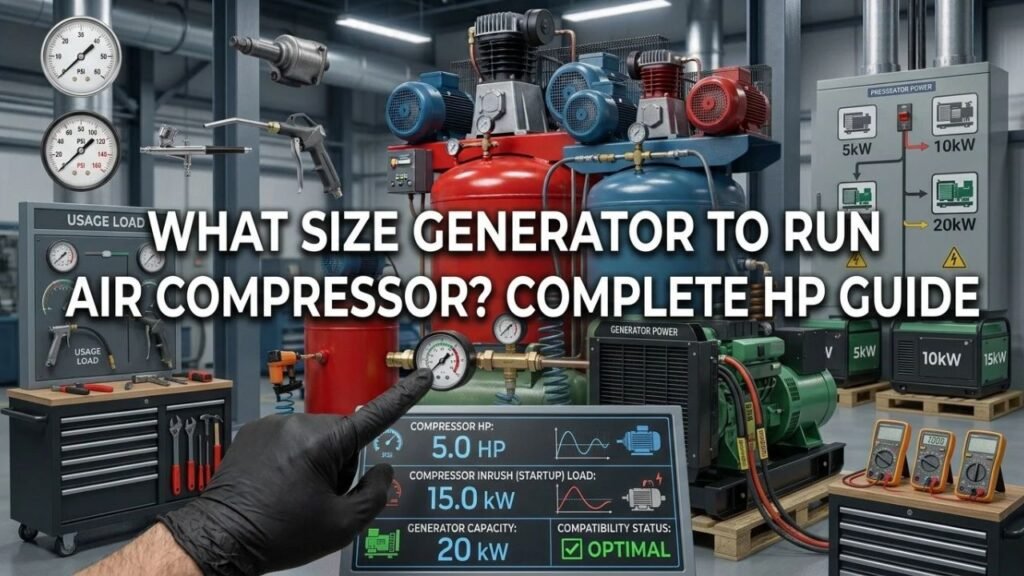
The generator must satisfy two electrical demands:
- Running watts — power required after the compressor motor reaches normal speed.
- Starting watts — the brief surge needed while the motor accelerates from a stop.
Starting capacity is normally the limiting factor.
Quick Generator Size Estimates
| Compressor Motor | Approx. Running Load | Approx. Starting Requirement | Practical Generator Starting Capacity |
| 1 HP | ~1,500 W | ~4,500 W | 5,000–5,500+ W |
| 1.5 HP | ~2,000–2,500 W | ~5,000–6,000 W | 6,000–7,000+ W |
| 2 HP | ~2,500 W | ~7,500 W | 7,500–9,000+ W |
| 3 HP | ~3,500 W | ~10,500 W | 11,000–12,000+ W |
| 5 HP | ~4,500–5,100 VA running on many 230V units | Can exceed 10,000–15,000 W equivalent during startup | Often 15,000–20,000 W class; verify motor LRA |
The 1 HP, 2 HP, and 3 HP values align with Champion’s current generator wattage chart. The 1.5 HP and 5 HP figures need more model-specific judgment because starting characteristics differ considerably between motors and compressor designs.
Do not buy a generator solely from this table. Treat it as a starting point and check the compressor nameplate.
Why Generator Size Cannot Be Based on Horsepower Alone
Horsepower describes mechanical motor output.
It does not directly tell you:
- Electrical input
- Motor efficiency
- Power factor
- Starting current
- Voltage
- Phase
- Type of starting capacitor
- Unloader condition
Two compressors labeled 2 HP can place very different demands on a generator.
Key Takeaway: Size the generator for motor startup first and continuous operation second; the compressor’s actual nameplate values are more reliable than horsepower alone.
What Size Generator to Run a 1.5 HP Air Compressor?
For many 1.5 HP compressors, I would start by looking at generators with at least 5,000–6,000 watts of starting capacity, then move up if the compressor has a difficult startup or if other equipment will run simultaneously.
A generator in the 6,000–7,000 starting-watt class gives more practical margin.
1.5 HP Compressor Running Watts
The exact electrical load varies.
An older Champion wattage reference listed a 1.5 HP compressor at approximately:
- 2,500 running watts
- 2,500 additional starting watts
That puts the total temporary startup requirement near 5,000 watts in that example.
Modern motors can differ, so check the nameplate before relying on 5,000 watts as a fixed number.
Why Extra Generator Headroom Helps
A compressor can be harder to start when:
- Tank pressure is high
- Unloader valve is not venting correctly
- Generator voltage falls during startup
- Extension cord is long or undersized
- Other devices are already drawing power
A generator operating right at its published surge limit may start the compressor under favorable conditions but struggle during a hot restart.
120V Compressors Can Draw High Current
A 1.5 HP motor running at 120 volts may require substantial current.
For example, Campbell Hausfeld lists one current 1.5 HP motor at 14.6 amps on 115 volts and 7.3 amps on 208–230 volts.
Starting current is much higher than the normal running current.
Key Takeaway: A 1.5 HP compressor often calls for roughly 5,000–6,000 starting watts, with a 6,000–7,000-watt-class generator giving better startup margin.
What Size Generator to Run a 2HP Air Compressor?
A 2 HP air compressor commonly needs about 2,500 running watts and up to approximately 7,500 starting watts in generator sizing charts.
For that reason, an 8,000-watt-class generator or larger is a sensible planning point when the compressor is the main load.
Champion’s 2 HP Compressor Example
Champion currently lists:
- Running watts: 2,500 W
- Starting watts: 7,500 W
for a 2 HP air compressor.
A generator rated for only 3,000 continuous watts but 3,500 surge watts would therefore be far too small even though it appears to cover the compressor’s normal running load.
Check Continuous Rating Too
Suppose a generator is advertised as:
- 8,000 starting watts
- 6,500 running watts
That gives substantially more running capacity than a compressor using about 2,500 watts, while the 8,000-watt temporary rating is near the compressor’s estimated startup requirement.
That is much more appropriate than selecting a generator based solely on 2,500 running watts.
Leave Capacity for Other Equipment
If the generator will also run:
- Lights
- Battery chargers
- Saw
- Refrigerator
- Fans
add those normal running loads before checking compressor startup.
Generac’s sizing method is to add the simultaneous running loads and then account for the largest motor starting requirement.
Key Takeaway: For a typical 2 HP compressor, plan around 7,500 watts of starting capacity and choose an 8,000-watt-class or larger generator when extra margin or additional loads are present.
What Size Generator to Run a 5HP Air Compressor?
A true 5 HP compressor is a very different generator load from a small portable 1–2 HP machine.
For a 230-volt single-phase 5 HP compressor, a generator around 15–20 kW of starting capability is a safer planning range until you know the motor’s actual starting-current specification.
Do not purchase a generator for a 5 HP compressor without checking the motor nameplate.
A True 5 HP Motor Can Draw Around 20–22 Amps at 230V
Current Campbell Hausfeld 5 HP compressor-duty motors are rated at:
- 5 HP
- 230 volts
- Single phase
- 22 amps
The company’s 5 HP stationary compressors similarly list around 20–22 amps depending on model.
At 22 amps and 230 volts:
230 × 22 = 5,060 volt-amps
That represents the approximate apparent electrical load at rated current, not starting demand.
Startup Is Much Higher
Generac notes that motor-driven equipment often requires roughly two to three times its running wattage during startup.
Using three times 5,060 VA as a rough planning reference gives more than:
15,000 VA
during startup.
Some motors can demand still more depending on locked-rotor current and the generator’s ability to support a sudden inductive load.
A 10,000-Watt Generator May Still Struggle
A generator labeled 10,000 peak watts can look large enough until a 5 HP compressor attempts to restart.
Possible symptoms include:
- Generator engine bogging
- Low voltage
- Frequency drop
- Breaker trip
- Compressor motor humming
- Motor overload opening
Generac warns that an undersized generator can experience speed, voltage, and frequency instability under excessive motor-starting load.
Three-Phase 5 HP Compressors Are Different
Campbell Hausfeld also sells a 5 HP three-phase compressor rated at 208–230/460 volts with much lower line current per conductor than its single-phase 230-volt models.
That does not mean a normal single-phase portable generator can run it.
The generator must produce the correct:
- Voltage
- Phase
- Frequency
for the compressor motor.
Key Takeaway: A true 5 HP single-phase compressor can require a generator far larger than its normal 5 kW-class running load suggests; plan around 15–20 kW starting capacity unless nameplate or manufacturer data supports a smaller generator.
Why Air Compressors Need So Many Starting Watts
An induction motor behaves differently while stationary than after it reaches operating speed.
Starting Current Is High
At startup, the motor has not yet developed normal back electromotive force.
Current rises sharply while the rotor accelerates.
This condition lasts only briefly, but the generator must support it.
The Generator Must Respond Instantly
A utility grid has enormous generating capacity compared with one compressor motor.
A portable generator does not.
When the compressor starts, generator engine speed and alternator output can dip if the unit lacks reserve capacity.
Champion specifically notes that compressors can be difficult generator loads and that a generator with inadequate startup capability may labor or stall.
Starting Under Pressure Is Harder
Reciprocating compressors normally use an unloader mechanism to release trapped pressure from the pump discharge when the motor stops.
This lets the motor restart with less mechanical resistance.
If the unloader or tank check valve is not functioning correctly, starting torque can rise sharply.
A compressor that starts easily from an empty tank but trips the generator when restarting at cut-in pressure may have:
- Insufficient generator capacity
- Voltage drop
- Unloader problem
- Check-valve problem
Key Takeaway: The generator must deliver a large burst of power while the compressor motor accelerates, and starting becomes harder if the pump is still loaded with trapped pressure.
How to Calculate Generator Size From the Compressor Nameplate
Nameplate information gives a better result than a generic HP chart.
Step 1: Find the Compressor Voltage
Typical compressors may use:
- 120V
- 230V or 240V single phase
- 208/230/460V three phase
The generator must provide the correct voltage and phase.
Step 2: Find Running Amps
For a single-phase motor, apparent running power can be estimated with:
VA = Volts × Amps
Example:
230V × 22A = 5,060 VA
Actual watts can differ because an AC motor’s power factor is not always 1.0.
Step 3: Find Starting or Locked-Rotor Amps
If the motor nameplate or manufacturer provides LRA, locked-rotor current, or starting amps, use that instead of guessing.
Approximate starting VA is:
Starting VA = Voltage × Starting Amps
If the compressor manual provides a generator requirement directly, use that specification.
Step 4: Compare With Generator Ratings
Check both:
- Continuous/running watts
- Starting/surge watts
The generator must satisfy both.
Step 5: Add Other Simultaneous Loads
If other equipment will remain on while the compressor starts, add its running load.
Generac recommends adding all running loads plus the largest additional motor-starting requirement when estimating generator capacity.
Key Takeaway: Use voltage, running current, and especially locked-rotor or starting current when available; those numbers describe the actual motor better than HP alone.
Starting Watts vs Running Watts for an Air Compressor
These two generator ratings should not be confused.
Running Watts
Running watts are what the compressor needs after the motor reaches operating speed.
The generator must provide this level continuously while the compressor pump runs.
Starting Watts
Starting watts are needed only briefly.
For example, Champion currently lists:
| Compressor | Running Watts | Starting Watts |
| 1 HP | 1,500 | 4,500 |
| 2 HP | 2,500 | 7,500 |
| 3 HP | 3,500 | 10,500 |
The startup figure is roughly three times running watts in each of these examples.
Generator Marketing Can Be Confusing
A unit marketed as a “9,000-watt generator” may actually provide:
- 9,000 starting watts
- 7,000 running watts
Always read both specifications.
Key Takeaway: Running watts determine if the generator can keep the compressor operating; starting watts determine if it can get the motor moving in the first place.
Does 120V vs 240V Change Generator Size?
Changing voltage does not eliminate the compressor’s power requirement, but it changes current.
Higher Voltage Means Lower Current for the Same Power
A motor drawing about 2,400 VA might require roughly:
20 amps at 120V
or:
10 amps at 240V
The actual motor ratings can differ, but the relationship explains why larger compressors commonly use 230/240V supplies.
The Generator Needs the Correct Outlet
A 240V compressor needs a generator capable of delivering its required voltage from a correctly rated receptacle.
Check:
- Receptacle voltage
- Receptacle amperage
- Generator breaker size
- Plug configuration
- Generator continuous rating
A generator can have enough total advertised wattage yet still have an individual 240V outlet that is not suitable for the compressor.
Do Not Use Improvised Adapters
High-current compressor motors are not a good place for homemade plug adapters or undersized wiring.
Match the generator connection to the compressor’s electrical requirements.
Key Takeaway: A 240V motor draws less current than an equivalent 120V load, but the generator still needs adequate wattage, startup capacity, and a properly rated 240V connection.
Can an Inverter Generator Run an Air Compressor?
Yes, if its electrical ratings are high enough.
An inverter generator is not automatically too small or too weak for compressor use.
The same checks apply:
- Running watts
- Surge watts
- Voltage
- Outlet amperage
- Motor starting requirement
A 2,000-watt inverter generator will not reliably start a compressor that requires 4,500 starting watts simply because it produces high-quality electricity.
Large inverter generators with enough surge capacity can be suitable.
Why a Generator May Run the Compressor but Not Start It
This is one of the most common symptoms of undersizing.
Running Load Is Much Lower Than Starting Load
You may be able to start the compressor on utility power, transfer it to a generator in a test setup, and find that the generator easily keeps it running.
That does not prove the generator can restart the motor.
Eco Mode Can Slow Generator Response
Some generators reduce engine RPM during light load.
A sudden compressor start can demand power faster than the engine accelerates.
If the generator manufacturer recommends disabling economy mode for large motor loads, follow that instruction.
Long Extension Cords Cause Voltage Drop
A small or long cord adds electrical resistance.
The compressor then receives less voltage while trying to draw its largest current.
Use the cord type, conductor size, and maximum length permitted by the equipment manufacturers.
Compressor Problems Can Mimic a Small Generator
Check the compressor if it suddenly becomes harder to start.
Possible faults include:
- Failed start capacitor
- Weak run capacitor
- Sticking unloader
- Leaking tank check valve
- Tight pump
- Low voltage
- Motor problem
Key Takeaway: If the compressor runs normally once started but the generator struggles during each restart, startup surge, voltage drop, generator response, and compressor unloading all need to be checked.
How Much Generator Headroom Should You Allow?
Avoid sizing the generator so tightly that compressor startup uses every available surge watt.
A margin helps accommodate:
- Generator altitude derating
- Hot weather
- Fuel type
- Voltage drop
- Other loads
- Motor aging
- Compressor restart pressure
Generac’s mobile-generator guidance notes that generator overload can cause speed, voltage, and frequency instability and that generator sizing must account for starting demands.
For a compressor near the generator’s limit, moving to the next generator size is usually more dependable than relying on the advertised peak rating every time the pressure switch cycles.
Generator Safety When Running an Air Compressor
A correctly sized generator can still be dangerous if operated in the wrong location.
Never Run a Fuel-Powered Generator in a Garage
This applies even if the garage door is open.
The U.S. Consumer Product Safety Commission warns that portable generators can create lethal carbon monoxide levels in enclosed and partly enclosed areas.
Keep the Generator at Least 20 Feet From Buildings
CPSC recommends operating portable generators outdoors at least 20 feet from homes and buildings, with the exhaust pointed away from doors, windows, and vents.
CPSC estimates that about 750 people died from generator-associated carbon monoxide poisoning from 2012 through 2022.
Protect the Generator From Wet Conditions
Follow the generator manufacturer’s instructions for operation during rain or snow.
Do not create an enclosure that traps exhaust.
Turn Off Loads Before Connecting
A practical startup sequence is:
- Start the generator.
- Let its voltage and engine speed stabilize.
- Keep unnecessary loads disconnected.
- Connect the compressor.
- Start the compressor.
- Add smaller loads afterward if capacity permits.
Key Takeaway: Run portable generators outside at least 20 feet from buildings, protect them from unsafe wet conditions, and minimize other electrical loads while the compressor motor starts.
Conclusion
For what size generator to run a air compressor, starting wattage is usually more important than the compressor’s normal running wattage. Air-compressor motors can demand several times their operating power for the brief period when they start.
A 1.5 HP compressor will often need roughly 5,000–6,000 starting watts, making a 6,000–7,000-watt-class generator a useful planning range. A 2 HP compressor commonly falls around 2,500 running watts and 7,500 starting watts, so an 8,000-watt-class or larger generator is a more comfortable match.
A true 5 HP compressor requires more care. Current 230V single-phase 5 HP compressor motors can draw about 20–22 amps while running, and startup demand can be several times higher. A generator with roughly 15–20 kW of starting capacity may be required, but motor LRA and manufacturer data should determine the final size.
Check voltage, phase, running amps, starting amps, generator outlet capacity, and compressor unloader operation before buying. A slightly larger generator with enough startup reserve is much more useful than one that has enough running watts but stalls every time the compressor cycles.
FAQs About Generator Size for an Air Compressor
What Size Generator Do I Need for a 1 HP Air Compressor?
Champion lists a 1 HP air compressor at approximately 1,500 running watts and 4,500 starting watts.
A generator with at least about 4,500 starting watts is therefore needed for that example, with a 5,000–5,500-watt-class unit providing more margin.
What Size Generator to Run a 1.5 HP Air Compressor?
Plan on roughly 5,000–6,000 starting watts for many 1.5 HP units and consider a generator in the 6,000–7,000-watt class for extra starting reserve.
Use the motor nameplate if starting amps are available.
What Size Generator to Run a 2HP Air Compressor?
Champion lists a 2 HP compressor at about 2,500 running watts and 7,500 starting watts.
An 8,000-watt-class generator or larger is a practical choice when the compressor is the main load.
What Size Generator to Run a 5HP Air Compressor?
A true 5 HP, 230V single-phase compressor may need a generator with roughly 15–20 kW of motor-starting capability.
Check the exact motor LRA or starting-current data because 5 HP compressor motors differ considerably.
Will a 5,000-Watt Generator Run an Air Compressor?
It can run many smaller compressors.
Champion’s 1 HP example needs about 4,500 starting watts, putting it within that general range. A 2 HP example requires about 7,500 starting watts and would exceed a 5,000-watt generator’s capacity.
Will a 7,500-Watt Generator Run a 2 HP Air Compressor?
Possibly.
Champion lists 7,500 starting watts for a 2 HP compressor, placing a 7,500-watt surge generator right at the estimated requirement. Moving to an 8,000-watt or larger model gives more startup margin.
Why Does My Generator Stall When the Air Compressor Starts?
The compressor’s starting current may exceed the generator’s surge rating.
Other causes include voltage drop, an undersized extension cord, economy mode response, a faulty compressor unloader, a bad check valve, or a failing motor capacitor.
Can I Run an Air Compressor and Other Tools From the Same Generator?
Yes, if the generator has enough capacity.
Add the running watts of everything that will operate simultaneously, then account for the largest motor-starting surge. Avoid starting another large motor at the same moment the air compressor starts.