What to Look for in a Portable Air Compressor: Specs That Matter
Choose a portable air compressor by matching its CFM and working pressure to your air tools first. After airflow, compare tank size, duty cycle, recovery speed, noise, weight, power source, pump type, regulator quality, couplers, and electrical requirements. Maximum PSI and horsepower alone do not tell you how well a compressor will run your tools.
Portable compressors range from tiny 1-gallon trim units to wheeled 20- or 30-gallon machines. Two compressors with similar maximum PSI can have very different airflow, run time, noise, and portability.
Quincy Compressor recommends sizing a portable compressor from tool CFM, required PSI, duty cycle, tank size, and power source. Its current guidance suggests choosing airflow about 25% above the combined CFM demand of tools that will run together.
Noise deserves attention for indoor or garage use. OSHA requires a workplace hearing conservation program when employee exposure reaches an 8-hour time-weighted average of 85 dBA. Some current portable compressors operate far below that level; Makita rates its MAC100Q at 58 dB, while California Air Tools lists models around 56–60 dB.
For what to look for in a portable air compressor, start with the airflow your tools consume at their required pressure. Then decide how much tank storage, run time, portability, and noise control fit the jobs you actually plan to do.
A small compressor may be perfect for tire inflation and trim nailers yet frustrating for an impact wrench, grinder, sander, or spray gun. Buying around the tool demand instead of the biggest PSI number leads to a much better match.
What to Look for in a Portable Air Compressor First
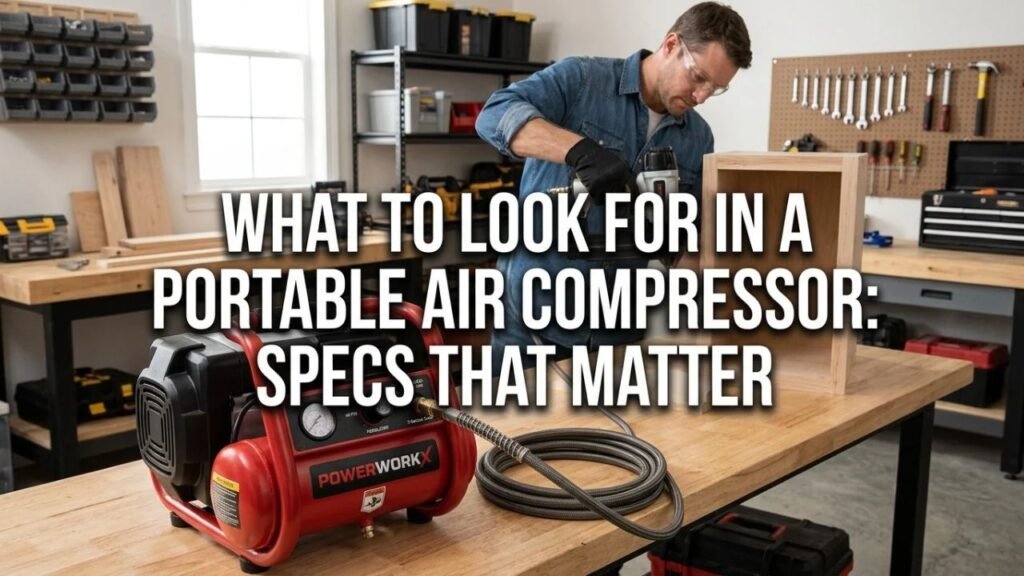
The first three specifications to compare are CFM, PSI, and tank capacity.
They describe different things, and confusing them is one of the most common compressor-buying mistakes.
CFM Determines How Much Air the Compressor Delivers
CFM means cubic feet per minute.
SCFM means standard cubic feet per minute and is another common way manufacturers state air delivery.
This number tells you how much air the compressor pump can supply.
Air tools normally list a required CFM at a stated pressure. For example, a tool might require 4 CFM at 90 PSI.
Your compressor should meet or exceed that airflow at the same pressure.
Quincy currently recommends adding about a 25% margin over the combined demand of tools running together. A tool setup consuming 8 CFM would therefore point toward roughly 10 CFM of compressor output as a starting target.
PSI Tells You the Air Pressure
PSI means pounds per square inch.
Most pneumatic tools have an operating-pressure requirement.
Maximum tank pressure is different from delivered tool pressure.
A compressor advertised at 165 or 200 PSI may still produce modest CFM.
For example, DEWALT’s DWFP55126 has a 6-gallon tank, 165 PSI cut-out pressure, and delivers 2.6 SCFM at 90 PSI. Those three specifications describe storage pressure, tank capacity, and airflow separately.
When comparing compressors, look at SCFM or CFM at 90 PSI, not maximum PSI by itself.
Tank Size Controls Stored Air
Tank capacity is usually listed in gallons.
A larger tank stores more compressed air before the pump needs to refill it.
Small tanks make sense for:
- Tire inflation
- Brad nailers
- Finish nailers
- Staplers
- Airbrushes
- Blow guns
- Light intermittent work
Larger tanks fit tools that use air for longer periods.
A large tank does not create extra CFM. Once the stored air is depleted, the pump’s output determines how well the tool continues running.
Key Takeaway: CFM is the main performance number, PSI must match the tool, and tank gallons determine stored-air reserve. Do not choose a compressor from maximum PSI alone.
Match the Compressor CFM to Your Air Tools
Before shopping, list every pneumatic tool you expect to use.
Find each tool’s operating CFM and PSI in its manual or specification sheet.
Size for the Highest-Demand Tool
If you only use one tool at a time, size the compressor around the tool with the highest airflow requirement.
For example, tire inflation and brad nailing require far less continuous airflow than sanding or grinding.
A compact compressor such as the Makita MAC100Q produces 0.7 CFM at 90 PSI and is aimed at trim, finish carpentry, cabinet work, and similar intermittent tasks.
California Air Tools’ 1P1060S delivers 1.2 CFM at 90 PSI and lists uses such as brad nailing, stapling, airbrushing, inflation, and blow-gun work.
Those machines are highly portable, but neither is meant to replace a high-airflow shop compressor.
Add the CFM if Tools Run Together
If two people will use pneumatic tools at once, add their airflow requirements.
Suppose:
- Tool A needs 4 CFM
- Tool B needs 3 CFM
Their combined demand is 7 CFM.
Using Quincy’s 25% sizing margin gives about:
7 × 1.25 = 8.75 CFM
A compressor rated near or above that output at the required pressure gives more breathing room than a machine rated exactly at 7 CFM.
Continuous Tools Need More Pump Capacity
Some tools consume air in short bursts.
Nailers are a classic example.
Other tools may run for long periods:
- Die grinders
- Air sanders
- Air drills
- Spray equipment
- Certain pneumatic production machines
California Air Tools recommends substantially more compressor capacity for long continuous operation than for short intermittent use. Its sizing guidance suggests doubling tool CFM in some continuous-use situations.
A large tank may delay pressure loss, but it cannot compensate forever for a pump that produces less air than the tool consumes.
Key Takeaway: Size around the highest CFM demand, add simultaneous tools together, and leave airflow reserve instead of selecting a compressor that barely meets the stated tool requirement.
Check the Duty Cycle
Duty cycle tells you how long the compressor pump is intended to run within a given period.
This specification becomes more relevant as tool run time increases.
A 50% Duty Cycle Limits Pump Run Time
DEWALT states that the DWFP55126 should maintain a 50% duty cycle, meaning it should not run more than about five minutes in a ten-minute period.
That is suitable for many intermittent jobs.
It is a poor match for a tool that forces the compressor to run almost nonstop.
Other Portable Compressors Have Different Ratings
California Air Tools lists a 70/30 duty cycle for its 1P1060S. The company also publishes run-time guidance for larger models based on output and operating conditions.
Do not assume all portable compressors have the same run-time capability.
Check the exact model.
An Undersized Compressor Runs Too Much
If a tool consumes air faster than the pump replaces it, tank pressure keeps falling.
The pump then runs for longer periods trying to catch up.
Signs that the compressor is undersized include:
- Tool slows during use
- Pressure drops continuously
- Compressor rarely shuts off
- Motor overload trips
- Pump gets unusually hot
- Long recovery periods interrupt work
For frequent grinding, sanding, painting, or other extended air use, duty cycle deserves as much attention as tank size.
Key Takeaway: A compressor can have enough PSI yet still be a poor match because its duty cycle is too short for the job. Compare allowable pump run time with your work pattern.
Choose the Right Tank Size
Tank size affects portability, stored-air reserve, cycle frequency, and physical dimensions.
There is no single gallon size that fits every user.
1 to 3 Gallons
These compressors are easy to carry and store.
They suit:
- Trim nailers
- Staplers
- Airbrushes
- Tire topping
- Small blow-off jobs
Makita’s Quiet Series shows how compact these units can be: the MAC100Q has a 1-gallon tank, while the MAC210Q and MAC320Q use 2- and 3-gallon tanks.
4 to 8 Gallons
This range gives more stored air while remaining reasonably portable.
A pancake compressor commonly falls in this group.
DEWALT’s DWFP55126 uses a 6-gallon tank and weighs about 30 pounds, making it easy to move around a house or jobsite compared with larger wheeled models.
10 to 30 Gallons
Larger portable tanks work better when you need more reserve.
They also become heavier and usually require wheels.
DEWALT currently offers wheeled portable units in larger sizes, including a 20-gallon model producing 6.2 SCFM at 90 PSI and a 30-gallon model rated at 5.3 CFM.
A larger receiver is useful for intermittent high-demand tools, but pump output still sets sustained performance.
Key Takeaway: Small tanks favor carrying and storage, while larger tanks provide more reserve. Pick tank size after confirming that pump CFM is adequate.
Look at Recovery Time
Recovery time tells you how quickly the compressor raises tank pressure after air has been used.
This matters when working repeatedly with nailers, inflators, blow guns, or other intermittent tools.
Fast Recovery Reduces Waiting
Two compressors may have similar tank sizes but different pump outputs.
The stronger pump restores tank pressure faster.
California Air Tools lists a 15-second recovery from 90 to 120 PSI for its 1P1060S, while Makita lists a 90-second empty-to-full fill time for its 1-gallon MAC100Q. These numbers apply to different test conditions, so they should not be compared directly, but they show why fill and recovery specifications deserve attention.
Tank Size Affects Fill Time
A large tank requires more air to refill.
That is not a problem when the pump is sized appropriately.
A large receiver paired with a weak pump can create long waiting periods after heavy air use.
Compare:
- CFM
- Tank capacity
- Cut-in pressure
- Cut-out pressure
- Published recovery time
Together, these give a clearer picture than tank gallons alone.
Key Takeaway: Recovery speed affects how long you wait between tool cycles. Higher CFM generally shortens recovery, while larger tanks require more air to refill.
Compare Noise Level Before Buying
Noise can become one of the biggest differences between two portable compressors used indoors.
Quiet Models Can Run Near 56–60 dB
California Air Tools lists its 1P1060S at 56 dB, while Makita lists its MAC100Q at 58 dB.
California Air Tools also lists several 1- to 8-gallon portable models at 56–60 dB.
These low-noise machines are attractive for:
- Garages
- Finished homes
- Cabinet work
- Trim installation
- Workshops near neighbors
- Indoor repair work
Traditional Portable Compressors May Be Louder
DEWALT’s current DWFP55126 manual lists 78.8 dBA for that 6-gallon model.
That does not make it a poor compressor. It simply shows how much sound level can vary across portable designs.
Lower RPM Often Reduces Noise
Makita’s MAC100Q runs at 1,750 RPM, while California Air Tools’ 1P1060S runs at 1,680 RPM. Both use low-speed designs as part of their quiet operation.
For indoor use, I would put dBA near the top of the comparison list.
Key Takeaway: Check the actual dBA rating rather than trusting a “quiet” label. Around 56–60 dB is very quiet for a portable piston compressor, while some traditional designs approach 80 dBA.
Check Weight, Wheels, Handles, and Shape
A compressor is only truly portable if you can move it where you need it.
Check Actual Weight
Small differences matter if you carry the compressor upstairs or load it into a vehicle often.
Makita lists the MAC100Q at about 25.5 pounds, while DEWALT’s 6-gallon DWFP55126 is around 30 pounds.
Larger portable units can weigh far more.
Look at Handle Placement
A well-positioned handle keeps the compressor balanced while carrying.
A badly positioned handle can make a light machine feel awkward.
Check that the handle does not force your hand against:
- Hot pump parts
- Regulators
- Gauges
- Air fittings
Wheels Matter on Large Tanks
Once tank size reaches 10, 20, or 30 gallons, wheels become more useful than a carry handle.
DEWALT’s larger portable compressors use pneumatic wheels for shop and jobsite movement.
Check Storage Orientation
Some compact compressors can be stored vertically or horizontally.
DEWALT’s 2.5-gallon DWFP55130, for example, is designed for either orientation and weighs 36 pounds.
That feature can matter in a crowded garage or service van.
Key Takeaway: Compare real weight, handle balance, wheel size, overall dimensions, and storage orientation. Portability is about more than having a handle on the tank.
Electric, Battery, or Gas: Pick the Right Power Source
Portable compressors use several power sources.
The right one depends on where the machine will work.
120-Volt Electric Compressors
Corded 120V compressors fit garages, homes, and jobsites with reliable electrical power.
Advantages include:
- No fuel storage
- No engine exhaust
- Simple starting
- Lower routine maintenance than gas engines
Check amperage and circuit requirements.
DEWALT’s DWFP55126 uses 120V power and calls for a minimum 15-amp branch circuit.
Battery Compressors
Cordless compressors offer mobility where no outlet is nearby.
They make sense for service work, mobile repairs, and short pneumatic tasks.
Check battery runtime, recharge time, and CFM before buying. A battery compressor intended mainly for inflation is not the same as a receiver-style compressor built to run pneumatic tools.
Gas-Powered Compressors
Gas engines make sense on remote jobsites where electrical power is unavailable.
They tend to be heavier, louder, and require engine maintenance.
Never operate a gasoline engine in an enclosed area because of carbon monoxide.
For indoor use, electric or battery power is the better category.
Key Takeaway: Choose 120V electric for common garage and indoor work, battery power for short mobile jobs, and gasoline for outdoor locations without electrical service.
Oil-Free vs Oil-Lubricated Pump
Portable compressors come in both designs.
Each has practical tradeoffs.
Oil-Free Pumps Need Less Routine Service
Oil-free compressors do not need crankcase oil changes.
They work well for users who prioritize:
- Low maintenance
- Easy transport
- Cold-weather starting
- Uneven jobsite surfaces
- Cleaner ownership
Makita’s MAC100Q and California Air Tools’ 1P1060S both use oil-free pumps.
Oil-Lubricated Pumps Remain Common on Larger Units
Oil-lubricated compressors require regular oil checks and changes.
They are common on larger piston compressors designed for heavier shop use.
DEWALT’s 30-gallon DXCMLA1683066 uses an oil-lubricated cast-iron pump and includes an oil-level sight glass.
Do Not Choose From Pump Type Alone
A modern oil-free compressor may be quieter than an oil-lubricated machine.
An oil-lubricated pump may offer the capacity and construction you want for heavier work.
Compare the complete machine:
- CFM
- Duty cycle
- Noise
- Maintenance
- Weight
- Pump life expectations
- Intended application
Key Takeaway: Oil-free designs reduce maintenance and work well in many portable applications, while oil-lubricated pumps remain common in larger machines. Judge the complete specification set.
Check the Regulator, Gauges, and Couplers
Small hardware details affect daily use more than many buyers expect.
Regulator
The regulator sets tool pressure.
Look for a control that is easy to adjust while wearing gloves and holds its setting during use.
A high-flow regulator matters more on tools with substantial air demand.
Gauges
Two gauges are useful:
- Tank-pressure gauge
- Regulated outlet-pressure gauge
Large, clearly marked gauges are easier to read from a standing position.
Makita highlights large pressure gauges on its Quiet Series models.
Quick Couplers
Check:
- Coupler size
- Plug style
- Number of outlets
- Flow restriction
Dual couplers make it easier to connect two hoses without installing a separate splitter.
DEWALT’s DWFP55130 includes two universal air couplers for two-nailer setups.
Tank Drain
A drain valve should be easy to reach.
Compressed air produces condensate, so the receiver needs regular draining.
A drain tucked underneath the tank with poor access becomes annoying very quickly.
Key Takeaway: A good regulator, readable gauges, suitable couplers, and an accessible tank drain make the compressor easier to use and maintain.
Check Electrical Requirements Before Purchase
Portable does not always mean it will run happily from every outlet.
Look at Amperage
Check:
- Voltage
- Full-load amperage
- Minimum circuit rating
- Startup demand
DEWALT’s 6-gallon DWFP55126 calls for a 120V, 15-amp circuit.
Larger portable compressors may draw close to a household circuit’s practical limit.
Avoid Undersized Extension Cords
Voltage drop can make a compressor motor struggle, run hot, or trip protection.
DEWALT recommends using more air hose rather than an undersized extension cord and states that incorrect extension-cord sizing can cause voltage drop, power loss, and motor overheating.
If an extension cord is allowed by the compressor manual, follow its specified wire gauge and maximum length.
Check Generator Requirements
A compressor motor can require much more power during startup than its normal running load.
If you plan to use a generator, compare both running and startup requirements.
California Air Tools lists a minimum 2,000-watt generator for its small 1P1060S despite the compressor’s modest 0.6 HP running motor.
Key Takeaway: Confirm voltage, amperage, branch-circuit needs, extension-cord limits, and generator startup capacity before bringing the compressor home.
Look for Protection and Safety Features
A portable compressor gets moved, bumped, transported, and operated in changing environments.
Physical protection matters.
Roll Cage
A roll cage protects:
- Motor
- Pump
- Gauges
- Regulator
- Fittings
Makita uses full roll-cage construction on the MAC100Q to protect the pump and motor during transport, use, and storage.
Thermal Overload
A thermal protector shuts the motor down if operating conditions cause excessive heat.
This is useful protection, but it does not make an undersized compressor suitable for nonstop work.
Safety Relief Valve
The receiver needs an operating pressure-relief valve.
Never modify or block it.
Stable Feet
Rubber feet reduce vibration and keep the compressor from moving across a floor.
For wheeled models, check that the machine sits securely while running.
Key Takeaway: Roll-cage protection, thermal overload, relief valves, stable feet, and protected controls matter on a machine that will be moved frequently.
Best Portable Compressor Size by Job
The tool demand should set the compressor size.
| Job | Typical Compressor Direction |
| Tire inflation | Small portable unit |
| Brad/finish nailing | 1–6 gallon, low CFM often works |
| Stapling | Small portable compressor |
| Airbrushing | Small quiet compressor |
| Blow gun | Small to medium, depending on duration |
| Impact wrench | Higher CFM and more reserve |
| Ratchet | Medium airflow capacity |
| Die grinder | High continuous CFM |
| Orbital air sander | High continuous CFM |
| Spray painting | Match gun CFM closely; larger tank often preferred |
| Multiple nailers | Higher CFM, dual couplers useful |
These are directions rather than fixed gallon rules.
Always check the specific tool’s air requirement.
A 1-gallon compressor that delivers enough air for a trim nailer may be a better purchase than a 6-gallon machine if low weight and quiet indoor operation are the priorities.
The opposite is true for a high-demand pneumatic tool.
Conclusion
For what to look for in a portable air compressor, start with CFM at the pressure your tools require. Give the pump enough airflow reserve instead of buying from maximum PSI, horsepower, or tank size alone.
Next, compare tank gallons, duty cycle, recovery time, and noise. Small tanks keep weight down, while larger tanks provide more stored air. Long-running pneumatic tools need strong pump output and a duty cycle suited to extended operation.
Portability also means checking weight, handle design, wheels, dimensions, power requirements, regulator quality, couplers, and storage shape.
A good buying sequence is simple: identify the tools, total their CFM demand, match the required PSI, add airflow reserve, then choose the tank size and physical design that fit how and where you work.
FAQs About Choosing a Portable Air Compressor
What is the most important specification on a portable air compressor?
CFM at the pressure required by your air tool is usually the first specification to check. CFM describes air volume, while PSI describes pressure. A compressor can have very high maximum PSI and still lack enough CFM for a demanding pneumatic tool.
How much CFM should a portable air compressor have?
Start with the highest CFM requirement of the tool or combination of tools you will run. Quincy recommends about 25% airflow reserve over combined demand. A tool setup needing 8 CFM would point toward roughly 10 CFM as a starting target.
Is a higher PSI portable air compressor better?
Not automatically. Higher tank pressure stores more compressed air in the same receiver, but the compressor still needs enough CFM to run your tool. Compare CFM at 90 PSI or at the pressure your equipment requires.
What tank size is best for a portable air compressor?
One- to 6-gallon tanks work well for inflation, nailers, staplers, and other intermittent jobs. Larger 10- to 30-gallon portable tanks provide more reserve for higher-demand work but add weight and size. Pump CFM should still guide the decision.
Is an oil-free portable air compressor better?
Oil-free compressors require less pump maintenance and are common in small portable models. Oil-lubricated pumps are common in larger compressors built for heavier use. Neither design is automatically better for every job; compare airflow, duty cycle, noise, weight, and service requirements.
How quiet should a portable air compressor be?
Models around 56–60 dB are very quiet for portable piston compressors. Makita rates the MAC100Q at 58 dB, while California Air Tools lists several portable models around 56–60 dB. If you work indoors, compare published dBA ratings closely.
Is a 6-gallon portable air compressor enough?
A 6-gallon compressor works well for many intermittent tasks such as nailing, inflation, and short blow-gun use if its CFM meets the tool requirement. Continuous tools such as sanders or grinders can consume air faster than many 6-gallon compressor pumps can replace it.
Should I buy a bigger tank or higher CFM?
Choose higher CFM first when the tool needs sustained airflow. A larger tank gives more stored air but cannot fix an undersized pump. Once CFM meets your tool demand, select tank size based on desired reserve, weight, cycle frequency, and portability.