
What Size Wire for 60 Gallon Air Compressor? Wire and Breaker
Many 60-gallon stationary air compressors use a dedicated 230/240-volt circuit with 10 AWG copper conductors, but that is not a universal rule. Some larger 5 HP compressors or longer wiring runs may need 8 AWG. The correct size comes from the motor rating, manufacturer instructions, wiring method, conductor temperature rating, and installation distance.
A 60-gallon rating only tells you the tank capacity. It does not tell you how much electrical current the compressor needs. Two 60-gallon compressors can have very different motors and electrical requirements.
For what size wire for 60 gallon air compressor, start with the compressor data plate and owner’s manual rather than selecting wire from tank size. Look for voltage, phase, horsepower, full-load current, minimum circuit ampacity if listed, and recommended breaker or fuse size.
Current U.S. electrical rules also treat motor circuits differently from ordinary resistance loads. NEC motor-conductor rules generally require conductors for a single continuous-duty motor to have ampacity of at least 125% of the applicable motor full-load current. The NEC table value for a 5 HP, 230-volt, single-phase motor is 28 amps, producing a 35-amp minimum conductor ampacity before other adjustments are considered.
Real 60-gallon compressors show why the model matters. Campbell Hausfeld’s current CE5002 60-gallon compressor is rated 3.7 HP, 230 volts, and 17.2 amps, while Ingersoll Rand sells a 60-gallon compressor with a 5 HP, 230-volt single-phase motor.
For many home garages, 10 AWG copper on a dedicated 240V circuit is a common setup, but never buy cable or a breaker until you have checked the exact compressor specifications.
What Size Wire Do You Need for a 60 Gallon Air Compressor?
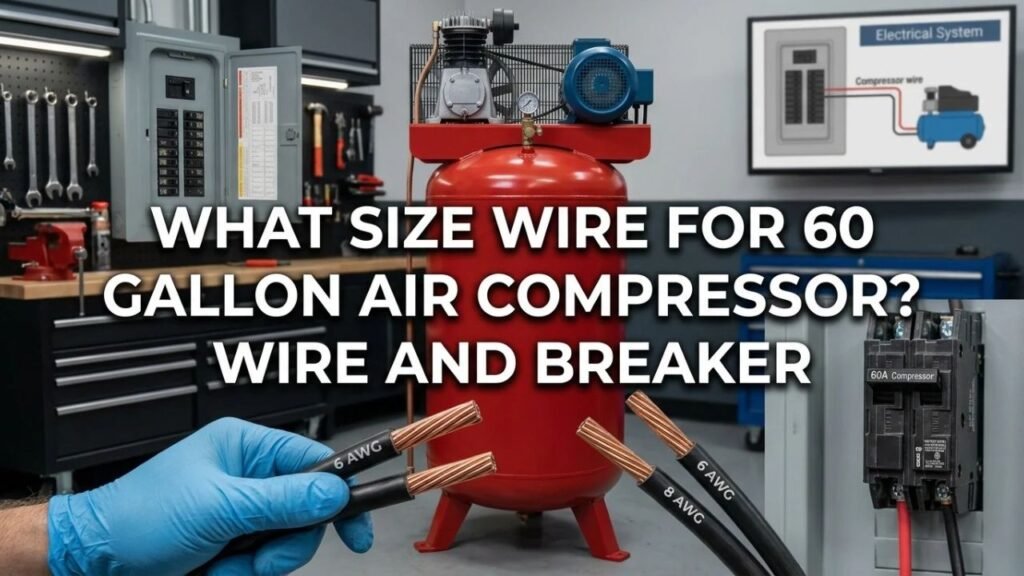
The most common answer is 10 AWG copper for many 230/240V 60-gallon compressors, with 8 AWG becoming more common for higher-current motors or long runs.
A simple breaker-to-wire chart is not enough because motor circuits have special sizing rules.
10 AWG Copper Is Common on 30-Amp Compressor Circuits
Many 60-gallon compressors in the 3 to 5 HP class are installed on dedicated 230/240V circuits using 10 AWG copper.
For example, some 60-gallon units specifically call for:
- 230/240V supply
- 30-amp circuit
- 10 AWG copper wiring
A current Atlas 5 HP, 60-gallon compressor lists a 220V single-phase supply, 30-amp breaker, and No. 10 wire as its electrical requirement.
This is a good example of why the compressor manufacturer’s instructions should be checked first.
8 AWG May Be Needed for Higher-Amp or Long-Distance Installations
A larger conductor may be needed when:
- Required conductor ampacity exceeds what the chosen 10 AWG wiring method permits
- The wire run is long
- Ambient temperature requires derating
- Several current-carrying conductors share a raceway
- Terminal temperature ratings change usable ampacity
- The manufacturer specifically requires a larger conductor
For a 5 HP, 230V single-phase motor, the NEC table full-load current is 28 amps. Applying the 125% motor-conductor rule produces 35 amps. That can place the installation right at the limit of certain 10 AWG copper configurations and make 8 AWG a practical choice in some installations.
Tank Size Does Not Determine Wire Size
A 60-gallon tank can be paired with:
- 3 HP motor
- 3.7 HP motor
- 5 HP motor
- Other motor sizes
The electrical load comes from the motor and controls, not from how much compressed air the tank stores.
Key Takeaway: 10 AWG copper is common for many 60-gallon 230/240V compressors, but a larger motor, wiring method, derating, or long run can move the installation to 8 AWG.
60 Gallon Air Compressor Wire Size Chart
The table below is a starting reference rather than a substitute for the compressor manual or electrical calculation.
| Compressor Electrical Setup | Common Copper Wire Starting Point | Common Circuit Range |
| Small 230V stationary motor | 12 or 10 AWG | 20A |
| Many 3–3.7 HP 230/240V compressors | 10 AWG | 20–30A |
| Many 5 HP 230/240V compressors | 10 or 8 AWG | 30–40A+ |
| Long-run 230/240V compressor circuit | Upsize one gauge when calculation calls for it | Model dependent |
| Three-phase commercial compressor | Calculate from motor table/nameplate and manual | Model dependent |
Do not choose the wire only from the breaker column.
Motor branch circuits are different from ordinary receptacle circuits. The circuit breaker may be sized higher than the conductor’s normal load current because it must tolerate motor starting current, while separate motor overload protection handles sustained overload.
What Size Wire for a 5 HP 60 Gallon Air Compressor?
A true 5 HP single-phase 230V motor deserves closer attention than the tank capacity.
NEC Table Current for a 5 HP Motor
For a 5 HP single-phase motor at 230 volts, NEC Table 430.248 lists 28 amps of full-load current.
For a continuous-duty motor conductor calculation:
28A × 125% = 35A minimum conductor ampacity
That does not automatically mean every 5 HP compressor must use exactly the same AWG cable.
The final selection depends on:
- Conductor insulation
- Copper or aluminum
- Cable versus individual conductors
- Terminal temperature rating
- Ambient temperature
- Raceway fill and conductor grouping
- Voltage drop
- Manufacturer instructions
Why You May See 10 AWG on a 5 HP Compressor
10 AWG copper THHN/THWN-type conductors can have a 35-amp ampacity under qualifying 75°C conditions.
That can meet the 35-amp motor conductor calculation in an installation where the conductor and terminal ratings permit it.
This is different from automatically saying that every 10 AWG cable should be treated as a 35-amp conductor.
Why You May See 8 AWG Instead
8 AWG provides additional ampacity and reduces voltage drop.
It may be selected when:
- The wiring method limits 10 AWG
- The run is long
- Derating applies
- The electrician wants more starting-voltage margin
- Local code or manufacturer instructions call for it
Key Takeaway: A 5 HP, 230V single-phase motor has a 28A NEC table current and a 35A conductor-ampacity target before other factors, which can result in either 10 AWG or 8 AWG depending on the installation.
What Breaker Size Does a 60 Gallon Air Compressor Need?
Common 60-gallon compressor circuits use 20-, 30-, or 40-amp two-pole breakers, but the compressor manual decides which range applies.
Many 230V Units Use a 30-Amp Circuit
A 230V compressor drawing around the low-20-amp range may specify a 30-amp circuit.
For example, a California Air Tools 60-gallon model lists a 208/230V, 24A electrical requirement and a suggested 30A breaker.
Some Compressors Specify a 40-Amp Breaker
Other 5 HP compressors can specify 40A protection even though their normal running current is substantially lower.
That is not necessarily a contradiction.
Electric motors can draw several times their running current for a brief period while starting.
A breaker must tolerate that startup without nuisance tripping while still supplying the required short-circuit and ground-fault protection.
Motor Breakers Do Not Follow Ordinary Load Rules Alone
NEC motor rules permit branch-circuit short-circuit and ground-fault protective devices to be sized differently from the conductor’s normal running ampacity.
For common motor types using an inverse-time circuit breaker, Table 430.52 permits values substantially above normal full-load current to accommodate starting.
This is why you should not assume:
- 10 AWG always means a 30A breaker
- A 40A motor breaker automatically requires the same conductor sizing method as a 40A general-purpose circuit
- Breaker size should be calculated from running amps alone
Key Takeaway: Breaker sizing for an air-compressor motor must follow the compressor instructions and NEC motor rules because motor starting current changes the protection calculation.
Does a 60 Gallon Air Compressor Need 240 Volts?
Most large stationary 60-gallon residential and shop compressors use 230 or 240 volts.
These terms are commonly encountered together because equipment may be labeled 230V while the building supply is nominally 240V.
Why Larger Compressors Use 240V
For the same power level, raising voltage reduces current.
A larger compressor motor can therefore be supplied more practically at 240V than at 120V.
Benefits include:
- Lower current for a given power level
- Smaller voltage drop than an equivalent 120V high-current load
- More practical wiring for 3–5 HP motors
Check the Motor Plate Before Connecting Power
Look for markings such as:
- 230V
- 208/230V
- 230/240V
- 240V
- 1 PH
- 3 PH
Never connect a three-phase motor to a typical residential single-phase supply without appropriate equipment and design.
Does a 240V Air Compressor Need a Neutral Wire?
Many 240V single-phase air compressors do not need a neutral.
A typical straight-240V hardwired compressor may use:
- Hot conductor L1
- Hot conductor L2
- Equipment grounding conductor
The two hot conductors provide the 240V supply.
Some Compressors May Need a Neutral
A neutral can be required if the machine contains 120V components supplied from the same circuit.
Examples can include:
- Controls
- Lighting
- Auxiliary receptacles
- Electronic accessories
Check the compressor wiring diagram.
Do not omit a neutral if the equipment specifically calls for one.
Ground and Neutral Are Not Interchangeable
The equipment grounding conductor is a safety path.
It is not a replacement for a neutral conductor.
Never use the ground wire as a normal current-carrying neutral.
Key Takeaway: Many 240V compressors need two hot wires plus equipment ground, but the compressor wiring diagram determines if a neutral is also required.
Should a 60 Gallon Compressor Have a Dedicated Circuit?
Yes, a stationary 60-gallon compressor should normally be supplied by the circuit specified for that machine rather than sharing a heavily loaded general-purpose circuit.
Starting Current Is High
The motor briefly draws much more current when it starts than it does after reaching operating speed.
Sharing the circuit with other equipment can contribute to:
- Voltage drop
- Nuisance breaker trips
- Slow motor starting
- Light dimming
- Motor heating
Dedicated Wiring Simplifies Protection
A dedicated branch circuit allows the breaker, conductors, disconnect, and grounding to be selected for the compressor motor.
Stationary units are commonly hardwired rather than connected through an ordinary household receptacle.
Follow the Compressor’s Listed Installation Instructions
If the manual specifies:
- Dedicated circuit
- Hardwiring
- Particular breaker
- Disconnect
- Specific receptacle
follow those instructions.
Key Takeaway: A dedicated circuit prevents other loads from interfering with compressor startup and lets the circuit be sized around the motor’s actual requirements.
What Wire Do You Use for a 240V Air Compressor?
Copper THHN/THWN conductors in conduit and approved cable assemblies are both used, depending on the installation.
THHN/THWN in Conduit
Individual copper conductors in conduit are common for garages and workshops.
Advantages include:
- Easy conductor upsizing
- Replaceable conductors
- Good mechanical protection when paired with suitable conduit
- Clear grounding arrangement
The insulation and terminal ratings affect allowable ampacity.
NM-B Cable
NM-B is commonly used in dry residential areas where permitted.
Its ampacity rules differ from individual 75°C-rated conductors, even though the conductor may physically be the same AWG size.
Do not assume that an AWG size has one universal ampacity in every wiring method.
Outdoor or Damp Locations
Ordinary NM-B cable is not for wet locations.
Outdoor or underground installations may require:
- THWN-2 conductors in approved raceway
- UF cable where appropriate
- Wet-location fittings
- Outdoor-rated disconnect equipment
The exact method depends on the installation.
How Far Can You Run 10 Gauge Wire to an Air Compressor?
There is no single distance limit, but voltage drop becomes more important as the circuit gets longer.
Long Runs Increase Resistance
Wire resistance causes voltage to fall between the panel and compressor.
A motor already draws heavy current during startup, so excess voltage drop can make it harder to accelerate.
Possible symptoms include:
- Slow starting
- Motor humming
- Breaker trips
- High motor temperature
- Contactor chatter
The NEC Uses 3% as a Useful Branch-Circuit Design Target
NEC informational guidance describes keeping branch-circuit voltage drop around 3% at the farthest outlet and total feeder plus branch-circuit drop around 5% as a reasonable design target.
These figures are often used when deciding if a long compressor circuit should be upsized.
Long Runs May Justify 8 AWG
If a compressor is 75, 100, or more feet from the panel, 8 AWG can make sense even where the shorter circuit might have worked with 10 AWG.
The exact distance at which upsizing is needed depends on:
- Motor current
- Supply voltage
- Conductor material
- Wire size
- One-way distance
- Starting characteristics
Key Takeaway: There is no fixed maximum distance for 10 AWG, but voltage-drop calculations become increasingly important as the compressor moves farther from the electrical panel.
Can You Use Aluminum Wire for a 60 Gallon Air Compressor?
It may be possible in some installations, but copper is much more common for this type of equipment circuit.
Aluminum has different:
- Ampacity
- Termination requirements
- Minimum practical conductor sizes
- Oxidation considerations
- Connector requirements
Equipment terminals must be rated for aluminum if aluminum conductors are used.
Do not insert aluminum conductors into terminals marked only for copper.
For a relatively short 20–40A compressor branch circuit, copper is often the simpler installation.
Can You Use an Extension Cord With a 60 Gallon Air Compressor?
A large stationary compressor should generally be connected using the permanent electrical arrangement required by its manual.
Long extension cords can create voltage drop.
Low Voltage Hurts Motor Starting
A motor draws heavy current while accelerating from a stop.
Excess resistance in an undersized extension cord can reduce voltage just when the motor needs it most.
Possible results include:
- Slow startup
- Breaker trips
- Overheating
- Damaged cord connections
- Motor overload trips
Move the Air Hose Instead
For shop use, it is normally better to keep the compressor correctly wired and extend the compressed-air piping or hose to the work area.
This avoids adding electrical resistance to the motor circuit.
Why Does My Air Compressor Trip the Breaker?
Do not automatically install a larger breaker.
A breaker that starts tripping after the compressor previously worked correctly may indicate a mechanical or electrical problem.
Low Supply Voltage
Voltage drop can increase current and make starting difficult.
Check for:
- Undersized wire
- Excessive circuit length
- Loose terminals
- Poor connections
Compressor Is Trying to Start Under Pressure
The unloader valve should relieve head pressure when the compressor stops.
A failed unloader can make the motor restart against trapped pressure.
This can produce very high starting current.
Motor or Start Components Are Failing
Single-phase compressor motors may use:
- Start capacitor
- Run capacitor
- Centrifugal switch
- Starting relay
Failure can prevent normal acceleration.
Pump Is Mechanically Tight
Problems can include:
- Bearing failure
- Incorrect belt tension
- Pump damage
- Wrong oil
- Cold, thick lubricant
Breaker Is Incorrect
The installed breaker may be smaller than the manufacturer specifies.
That should be verified from the manual rather than corrected by guessing.
Key Takeaway: Breaker trips can come from voltage drop, restart pressure, motor-start components, mechanical drag, poor wiring connections, or incorrect circuit sizing.
How to Determine the Exact Wire Size for Your Compressor
Use this sequence before purchasing wire.
1. Find the Compressor Data Plate
Record:
- Voltage
- Phase
- Horsepower
- Full-load amps
- Model number
2. Read the Electrical Section of the Manual
Look for:
- Minimum circuit requirements
- Breaker size
- Fuse size
- Wire recommendations
- Hardwired versus cord-connected instructions
3. Determine the Wiring Method
Decide if the installation uses:
- THHN/THWN in conduit
- NM-B
- UF
- Another approved method
The wiring method affects usable ampacity.
4. Measure the Circuit Length
Measure the one-way distance from the electrical panel to the compressor.
Long circuits may need larger conductors for voltage-drop control.
5. Account for Installation Conditions
Wire ampacity can change due to:
- High ambient temperature
- Multiple conductors in a raceway
- Terminal ratings
- Insulation type
6. Size the Motor Circuit Under Applicable Code
The 2026 NEC is the current NFPA 70 edition, though individual states and municipalities may enforce an earlier edition or modify requirements.
Local adopted code is the one that applies to the installation.
7. Have the Circuit Checked Before Energizing
A hardwired 240V motor circuit involves enough current to create serious shock and fire hazards if installed incorrectly.
A licensed electrician can verify:
- Panel capacity
- Breaker type
- Conductor ampacity
- Grounding
- Disconnect
- Voltage drop
- Local inspection requirements
Key Takeaway: Use the data plate, manual, wiring method, run length, and locally adopted electrical code together rather than selecting wire from tank size alone.
Conclusion
For what size wire for 60 gallon air compressor, 10 AWG copper is a common choice for many 230/240V stationary compressors, especially units designed for a 30-amp circuit. It should not be treated as a universal specification.
A true 5 HP, 230V single-phase motor is listed at 28 amps in the NEC motor table, giving a 35-amp conductor-ampacity requirement before derating and other installation factors. Depending on the wiring method, terminals, run length, and manufacturer instructions, that can result in 10 AWG or 8 AWG copper.
The breaker is a separate calculation. Air-compressor motors have high starting current, and NEC motor-circuit rules allow breaker sizing that differs from ordinary household load circuits. Follow the compressor’s specified breaker or fuse requirements instead of matching breaker size to wire size with a simple household chart.
Check the model plate and manual before buying cable. If the circuit is long, hardwired, outdoors, or serving a 5 HP motor, having the final sizing checked by a qualified electrician is the safest way to avoid voltage drop, nuisance trips, motor damage, and unsafe wiring.
FAQs About 60 Gallon Air Compressor Wire Size
Is 10 gauge wire enough for a 60 gallon air compressor?
It is enough for many 230/240V 60-gallon compressors, especially models specifically designed for a 30A circuit. Larger motors, long runs, different wiring methods, or derating conditions can require 8 AWG. Check the compressor manual and motor-circuit calculation.
What breaker do I need for a 60 gallon air compressor?
Many models use a 30A or 40A two-pole breaker, but the exact size depends on the motor and manufacturer instructions. Motor breaker sizing also accounts for high starting current, so running amperage alone does not determine breaker size.
What size wire do I need for a 5 HP 230V air compressor?
A 5 HP, 230V single-phase motor has a 28A full-load current in NEC Table 430.248. At 125%, the conductor needs at least 35A of applicable ampacity before other adjustments. Depending on wiring method and conditions, 10 AWG or 8 AWG copper may be used.
Can I use 12 gauge wire for a 60 gallon compressor?
Some lower-current motors could theoretically have requirements that fit 12 AWG, but many common 60-gallon 230V compressors need larger conductors. Do not use 12 AWG unless the compressor instructions and electrical calculations specifically support it.
Does a 60 gallon air compressor need a 30 amp breaker?
Many do, but not all. Some 60-gallon compressors specify 20A, 30A, or 40A circuits. Tank capacity does not determine breaker size; motor electrical requirements do.
Does a 60 gallon air compressor need 10/2 or 10/3 wire?
A straight 240V single-phase compressor that does not need a neutral may use two hot conductors plus equipment ground, making a 10/2-with-ground cable arrangement possible where that wiring method is permitted. A unit requiring 120V controls from the same circuit may need a neutral and a different cable arrangement.
Should I use 8 gauge wire for a long compressor run?
It may be a good choice when a 10 AWG circuit would experience excessive voltage drop. Long runs can make motor starting harder, so calculate voltage drop using the motor current, voltage, conductor size, and circuit length before choosing.
Can I put a 60 gallon air compressor on a regular outlet?
Most large stationary 60-gallon compressors require a dedicated 230/240V circuit and cannot use a standard 120V household receptacle. Some are hardwired, while others use a specific 240V plug and receptacle stated by the manufacturer.