
What Size Wire for 220 Air Compressor? Wire Size & Breaker Guide
A 220/240V air compressor may use anything from 12 AWG to 8 AWG copper or larger, based on motor horsepower, full-load current, terminal temperature rating, circuit length, and the compressor maker’s wiring instructions. Voltage alone is not enough to select the conductor size.
In U.S. residential and light-commercial wiring, the supply commonly called “220 volts” is normally a nominal 240V circuit. Compressor motors are often labeled 230V. NEC motor tables treat 220–240V systems as the voltage range associated with many 230V-rated motors.
For what size wire for 220 air compressor, start with the equipment manual and motor specifications, then apply the motor-circuit rules that govern conductor ampacity, short-circuit protection, grounding, and voltage drop.
A current Campbell Hausfeld 5 HP, 80-gallon, single-phase compressor is rated at 230V and 22A, yet its installation information calls for 8 AWG copper on the 230V single-phase supply. This is a good example of why simply looking at the 22A operating number and choosing ordinary 20A or 30A household-circuit wiring can produce the wrong answer.
For a single continuous-duty motor, NEC Article 430 generally requires branch-circuit conductors with an ampacity of at least 125% of the motor full-load current taken from the applicable NEC motor table. Motor overload protection and short-circuit protection are calculated separately.
A permanently installed 240V compressor involves hazardous voltage and high motor-starting current. Use this information for planning and comparison; final conductor, breaker, disconnect, cable method, and grounding choices should match the listed equipment instructions, the electrical code adopted in your area, and the local authority having jurisdiction.
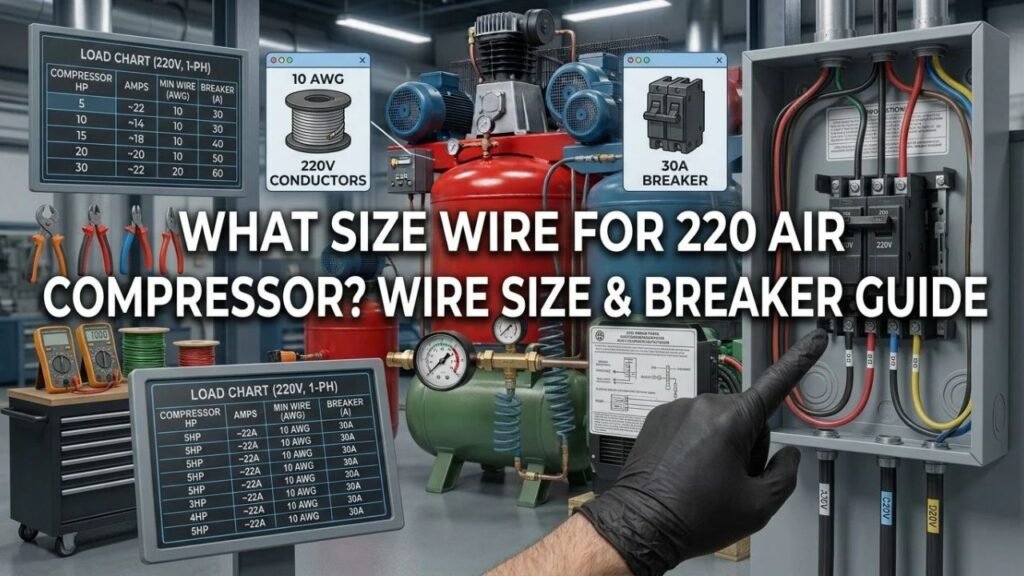
Quick Answer: What Wire Size Is Common for a 220V Air Compressor?
There is no universal AWG size for every 220V compressor.
For common single-phase shop compressors, these examples give a useful starting point:
| Compressor example | Electrical basis | Possible copper conductor |
| Smaller 230V motor around 16A table FLC | 16A × 125% = 20A | 12 AWG may satisfy the ampacity calculation |
| 3 HP, 230V single-phase motor | NEC table FLC 17A × 125% = 21.25A | 10 AWG in the NEC example |
| 5 HP, 230V single-phase motor | NEC table FLC 28A × 125% = 35A | 10 AWG may qualify with proper 75°C terminations; many compressor installations call for 8 AWG |
| Campbell Hausfeld 5 HP 230V compressor | Manufacturer installation requirement | 8 AWG copper |
EC&M gives a 3 HP, 230V single-phase example with 17A table full-load current. After applying the 125% motor-conductor rule, the required ampacity becomes 21.25A, and the example uses 10 AWG copper.
For a 5 HP, 230V single-phase motor, the NEC table full-load current is 28A. Applying 125% gives 35A. EC&M shows that 10 AWG copper can carry 35A when the applicable 75°C ampacity and terminal conditions permit it.
That does not mean every 5 HP air compressor should automatically get 10 AWG.
Campbell Hausfeld specifies 8 AWG copper for its 5 HP, 230V single-phase compressor installation. The equipment instructions should be followed when they require a larger conductor.
Why Compressor Wire Size Is Different From Ordinary 240V Loads
An air compressor uses an electric motor, and motors have special NEC rules.
A resistance heater may draw nearly the same current once switched on as it does during steady operation.
A compressor motor can draw a large inrush current during startup as it accelerates the pump against mechanical load.
That affects:
- Conductor sizing
- Circuit-breaker sizing
- Motor overload protection
- Disconnect selection
- Voltage drop
- Starting performance
Motor branch-circuit rules are therefore not the same as simply matching a general-purpose breaker to the normal ampacity of a cable.
EC&M explains that single-motor conductors are normally sized to at least 125% of table full-load current under NEC 430.22.
The motor’s overload device is treated separately and commonly uses motor nameplate current rather than the same table value used to select branch conductors.
This distinction matters when wiring a large compressor.
How to Calculate Wire Size for a 220V Air Compressor
A useful planning process has several stages.
Start with the compressor identification plate and installation manual.
Record:
- Voltage
- Phase
- Horsepower
- Motor nameplate amps
- Manufacturer minimum conductor size
- Required or permitted breaker size
- Minimum circuit ampacity, if listed
- Maximum overcurrent protection, if listed
Then determine if the equipment instructions give a complete wiring specification.
If they do, follow that specification along with local electrical rules.
For a conventional field-wired motor circuit where Article 430 calculations are required, NEC 430.6 generally directs the installer to use the applicable table full-load current instead of simply using motor nameplate amperage to size the branch conductors.
For a single continuous-duty motor:
Minimum conductor ampacity = NEC motor-table FLC × 125%
Example for a 3 HP, 230V single-phase motor:
17A × 1.25 = 21.25A
EC&M’s worked example selects 10 AWG copper for that motor circuit.
Example for a 5 HP, 230V single-phase motor:
28A × 1.25 = 35A
A 75°C 10 AWG copper conductor can have a 35A ampacity in the applicable table, but terminal ratings and the wiring method still have to permit that value.
Schneider Electric notes that equipment rated 100A or less generally uses the 60°C conductor ampacity unless the termination is identified for 75°C conductors.
This is one reason a simple online statement such as “10 gauge handles a 5 HP compressor” can be incomplete.
220V vs 230V vs 240V Air Compressor Wiring
These numbers often describe equipment operating on the same general class of U.S. power system.
You may see:
- 220V in casual conversation
- 230V on a motor nameplate
- 240V describing the nominal electrical supply
EC&M notes that NEC motor tables use rated motor voltages such as 230V while recognizing system voltage ranges from roughly 220V through 240V.
This does not mean 208V and 230/240V are interchangeable.
A current Campbell Hausfeld installation manual warns that a 230V single-phase motor should not be connected to a 208V single-phase source unless the motor nameplate also identifies it for 208V operation.
Always check the actual compressor voltage rating before wiring.
What Size Wire for a 3 HP 220V Air Compressor?
A 3 HP, 230V single-phase motor is a useful NEC example.
Table full-load current is 17A.
For conductor sizing:
17A × 125% = 21.25A
EC&M’s worked example selects 10 AWG copper for the branch-circuit conductor.
Do not assume that this same size applies to every compressor marketed as 3 HP.
The equipment may have:
- Different motor design
- Built-in controls
- Different terminal ratings
- Manufacturer wiring requirements
- A longer supply run
The installation manual still comes first.
What Size Wire for a 5 HP 220V Air Compressor?
This is one of the most common questions for 60- and 80-gallon shop compressors.
NEC motor tables place a 5 HP, 230V single-phase motor at 28A full-load current.
The basic conductor calculation is:
28A × 125% = 35A
EC&M demonstrates that 10 AWG copper can provide 35A ampacity using the applicable 75°C column when the equipment terminations permit that rating.
Yet many actual compressor manufacturers specify a larger conductor.
Campbell Hausfeld’s 5 HP single-phase 230V installation guidance specifies:
8 AWG copper
Its current XC802100 5 HP two-stage compressor is rated at 230V, single phase, and 22A.
That comparison shows why horsepower, nameplate amps, and a generic residential ampacity chart cannot replace the compressor’s installation manual.
What Breaker Size Goes With a 220V Air Compressor?
Do not select the breaker solely from the conductor size using the same rule you would apply to a simple lighting or receptacle circuit.
Motor circuits have separate short-circuit and ground-fault protection rules.
For many single-phase motors using an inverse-time circuit breaker, NEC Table 430.52 permits a value based on a percentage of the motor table FLC to accommodate starting current.
EC&M gives a 5 HP, 230V single-phase example:
- NEC table FLC: 28A
- Inverse-time breaker calculation: 28A × 250%
- Calculated breaker value: 70A
That example uses a breaker much larger than the motor’s normal running current because the breaker is serving short-circuit and ground-fault protection while a separate overload system protects the motor from sustained overload.
This surprises many homeowners.
It also means you should not copy the 70A value onto every 5 HP compressor installation.
Listed compressor assemblies may call for another breaker size, fuse type, starter, or overload arrangement.
Campbell Hausfeld directs installers of its applicable stationary units to use the specified slow-blow fuse or 240V double-pole breaker and follow the unit’s wiring instructions.
Does a 220V Air Compressor Need a Neutral Wire?
Many straight-240V compressor motors do not require a neutral.
A typical single-phase 240V motor circuit may use:
- Hot leg L1
- Hot leg L2
- Equipment grounding conductor
The voltage measured between L1 and L2 is approximately 240V.
Campbell Hausfeld’s wiring diagram for its 230/240V single-phase compressor shows two line conductors and a grounding conductor.
A neutral becomes necessary if the compressor assembly contains components that specifically require 120V line-to-neutral power.
Examples could include certain:
- Controls
- Receptacles
- Heaters
- Accessories
Do not add or omit a neutral based only on the horsepower. Read the compressor wiring diagram.
What Size Ground Wire Does a 220V Compressor Need?
The equipment grounding conductor is selected separately from the current-carrying conductors.
NEC Table 250.122 generally bases equipment-grounding-conductor size on the rating or setting of the circuit’s overcurrent protection device.
Common copper examples include:
| Overcurrent device | Copper equipment ground |
| 20A | 12 AWG |
| 30A | 10 AWG |
| 40A | 10 AWG |
| 50A | 10 AWG |
| 60A | 10 AWG |
| 100A | 8 AWG |
Current NEC reference tables show these values for copper equipment grounding conductors.
Motor circuits have additional Article 430 grounding provisions, so have the complete compressor circuit checked rather than choosing the ground wire from the hot-conductor size alone.
The grounding conductor must connect to the compressor’s specified grounding point.
Never use a neutral conductor as a substitute equipment ground.
Does Wire Length Change the Required Size?
It can.
A conductor may satisfy the ampacity requirement but still produce excessive voltage drop when the compressor is far from the electrical panel.
Motors are sensitive to low voltage during startup.
A long run can increase:
- Starting difficulty
- Starting current duration
- Motor heating
- Contactor problems
- Thermal-overload trips
The NEC informational guidance commonly points to about 3% maximum voltage drop on a branch circuit and roughly 5% combined feeder-plus-branch voltage drop as a design target.
These general voltage-drop notes are recommendations rather than universal mandatory limits, though equipment instructions can impose operating-voltage requirements.
Campbell Hausfeld specifically states that wire may need to be larger than the minimum size to avoid excessive line-voltage drop.
For a compressor 100 feet or more from the panel, voltage-drop calculations are worth doing before buying cable.
Copper vs Aluminum Wire for an Air Compressor
Copper is common for residential and small-shop compressor branch circuits.
Advantages include:
- Smaller conductor for a given ampacity in many cases
- Easy availability
- Broad terminal compatibility
- Straightforward use in short branch circuits
Aluminum can be used in some larger electrical installations, but every termination must be listed for the conductor material and the ampacity calculations must use the aluminum values.
Do not substitute aluminum of the same AWG number for copper.
For example, a manufacturer instruction that specifically calls for 8 AWG copper does not automatically permit 8 AWG aluminum.
Follow the conductor material stated in the installation instructions.
What Type of Cable Should You Use?
Wire gauge and wiring method are separate decisions.
Possible methods include:
- NM-B cable in permitted dry indoor locations
- THHN/THWN-2 conductors in conduit
- Other cable or raceway systems approved for the installation environment
A damp garage, outdoor installation, buried run, exposed wall, or commercial shop may need a wiring method different from a simple dry interior residential run.
Also check conductor temperature ratings.
Schneider Electric notes that conductor ampacity must be based on the termination temperature ratings required by NEC 110.14(C). Equipment at 100A or less generally defaults to the 60°C column unless it is marked for 75°C conductors.
Do not choose THHN merely because its insulation may be marked 90°C and then automatically use the 90°C ampacity. The termination rating can limit the usable ampacity.
Does a 220V Air Compressor Need a Dedicated Circuit?
Most large stationary compressors should have a dedicated branch circuit according to their installation instructions.
A compressor motor has substantial starting current, and placing other loads on the same circuit can contribute to:
- Voltage drop
- Nuisance trips
- Poor starting
- Overheated conductors
- Unstable tool operation
Campbell Hausfeld instructs installers of applicable stationary compressors to make sure no other equipment is operated from the same supply line.
Large stationary units may also need:
- A disconnect
- Motor starter
- Magnetic starter
- Overload protection
- Hardwired connection
The compressor wiring diagram identifies the required configuration.
Common Mistakes When Sizing Wire for a 220V Compressor
One common error is sizing from voltage alone.
“It’s 220V, so use 10 gauge” is not a valid general rule.
Another mistake is sizing directly from the motor’s displayed running amps without checking NEC motor-table current or the manufacturer wiring specification.
Also avoid:
- Assuming 220V, 230V, and 208V are interchangeable
- Choosing a breaker from a general residential ampacity chart alone
- Ignoring motor startup current
- Using an undersized long cable run
- Ignoring terminal temperature ratings
- Omitting the equipment grounding conductor
- Adding a neutral that the wiring diagram does not call for
- Omitting a neutral when the equipment does require one
- Reusing an old circuit without confirming its conductor material and condition
- Hardwiring before checking local permit and inspection rules
Motor circuits are one area where a breaker rating can legitimately be larger than the conductor’s ordinary general-purpose ampacity relationship because overload protection and short-circuit protection are handled under special motor rules.
That is also why copying wire and breaker combinations from an unrelated household circuit can be unsafe.
A Practical Wire-Sizing Checklist
Before buying cable for a 220/240V compressor, collect these details:
- Exact compressor model
- Motor horsepower
- Supply voltage
- Single-phase or three-phase
- Manufacturer amperage
- Manufacturer minimum wire size
- Manufacturer breaker or fuse instructions
- NEC table full-load current when Article 430 calculation applies
- Terminal temperature rating
- Copper or aluminum conductor
- One-way circuit length
- Indoor, outdoor, damp, or buried location
- Required neutral, if any
- Equipment grounding conductor
- Disconnect requirement
If the manual specifies 8 AWG copper, installing 10 AWG simply because an online ampacity chart appears to permit it is not a good substitution.
If the calculated conductor is adequate for ampacity but the run is long, moving to a larger conductor can reduce voltage drop and improve motor starting.
Conclusion
For what size wire for 220 air compressor, the answer cannot be determined from 220V alone. Motor horsepower, NEC table full-load current, equipment instructions, terminal ratings, wiring method, circuit length, and voltage drop all affect the final AWG size.
A 3 HP, 230V single-phase motor may use 10 AWG copper in a standard NEC calculation, while a 5 HP 230V compressor may call for 8 AWG copper even though its normal running amperage looks low enough to suggest a smaller conductor.
Check the compressor’s wiring manual first, then have the motor circuit sized under the electrical code adopted in your area. Do not select the breaker by ordinary household wire-size rules alone because motor starting and overload protection are handled differently under NEC Article 430.
FAQs About Wire Size for a 220V Air Compressor
What size wire should I use for a 220V air compressor?
It depends on motor horsepower, NEC motor-table current, manufacturer instructions, circuit length, and termination ratings. Smaller 230V motors may use 12 or 10 AWG copper, while many 5 HP stationary compressor installations call for 8 AWG copper.
What size wire do I need for a 5 HP 220V air compressor?
NEC tables list a 5 HP, 230V single-phase motor at 28A FLC, giving a basic 125% conductor calculation of 35A. Some conditions can permit 10 AWG copper at 75°C, but Campbell Hausfeld specifies 8 AWG copper for its 5 HP 230V stationary compressor installation.
Can I use 10/2 wire for a 220V air compressor?
It may be suitable for some compressors if 10 AWG meets the required conductor ampacity, the wiring method is permitted, and the machine does not require a neutral. It is not large enough for every compressor. Check the exact installation manual and motor-circuit calculation.
Can I use 12/2 wire for a 220V air compressor?
Only on a compressor circuit whose calculated ampacity and manufacturer specification permit 12 AWG. A 3 HP 230V single-phase motor already requires more conductor ampacity than a common 12 AWG 20A circuit provides in the NEC worked example, so 10 AWG is used there.
Does a 220V air compressor need three wires?
Many straight-240V single-phase compressors use two hot conductors plus an equipment grounding conductor. A neutral is not normally needed for a motor that operates entirely line-to-line, but some compressor assemblies may have controls or accessories that require one. Check the wiring diagram.
Why can an air compressor have a large breaker with smaller wire?
Motor circuits use separate protection for sustained motor overload and for short circuits or ground faults. NEC motor rules can therefore permit an inverse-time breaker larger than the conductor ampacity relationship normally seen on general household circuits so the motor can start without nuisance tripping.
Should I increase wire size for a long air-compressor circuit?
Often, yes. Long conductors create additional voltage drop, which can hurt motor starting. NEC informational guidance commonly uses about 3% branch-circuit voltage drop as a design target, and compressor manufacturers may recommend larger conductors on longer runs.