
How Many Gallon Air Compressor to Blow Out Sprinklers Safely
A 20- to 30-gallon air compressor can work for a small residential sprinkler system, while a 60-gallon unit gives more air reserve for larger zones. Tank capacity is not the main specification, though. The compressor’s CFM at the required pressure determines how well it can keep water moving through the sprinkler lines.
A big tank paired with a low-output pump can empty quickly and leave the sprinkler heads barely misting. A smaller compressor with stronger continuous airflow may perform better, though it may need several short passes through each zone.
Rain Bird’s residential winterization guidance calls for roughly 10 to 25 CFM and says blowout pressure should stay at or below 50 PSI. Hunter recommends much larger equipment—around 80 to 100 CFM for mainlines 2 inches or smaller—for its contractor-style blowout procedure. Those figures show why system size matters more than choosing a compressor by gallons alone.
Landscape irrigation is widespread in the United States. EPA WaterSense currently estimates that residential outdoor water use accounts for nearly 8 billion gallons per day, mainly for landscape irrigation. Proper fall winterization in freezing climates protects the piping and sprinkler components that distribute that water during the growing season.
For how many gallon air compressor to blow out sprinklers, a 30- to 60-gallon compressor is a practical range for many DIY residential systems if it produces enough CFM at 40–50 PSI. Very small compressors may work on tiny zones through repeated tank-refill cycles, while large irrigation systems usually need a high-CFM rental compressor rather than a bigger shop tank.
I’d look at the compressor’s SCFM or CFM rating at 40 or 50 PSI first, then tank gallons. A 60-gallon compressor producing only modest airflow cannot match a commercial compressor rated at 80 or 100 CFM.
The sections below explain tank sizes, CFM requirements, safe pressure, small-compressor techniques, zone size, and how to decide if your home compressor is large enough.
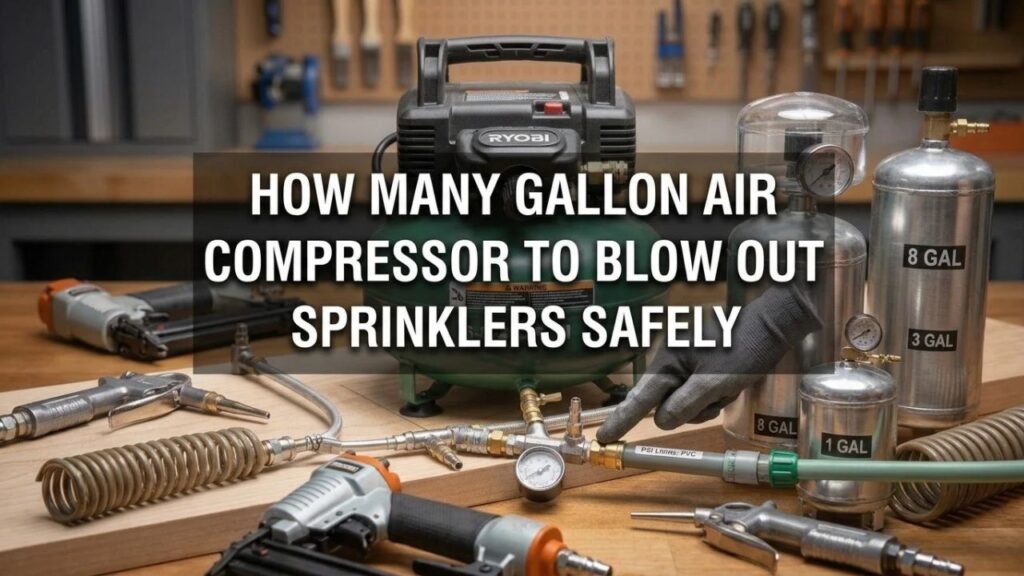
How Many Gallon Air Compressor to Blow Out Sprinklers?
For a typical residential sprinkler system, these tank sizes provide a useful starting point:
| Compressor Tank | Typical Sprinkler Use | My Take |
| 6–10 gallons | Very small zone or limited spot work | Usually too small |
| 15–20 gallons | Small residential zones | Possible with repeated cycles |
| 20–30 gallons | Small to medium systems | Good DIY starting range |
| 30–60 gallons | Medium residential systems | More air reserve |
| 60+ gallons | Larger residential systems | Better if CFM is also high |
| Commercial rental compressor | Large zones and long mainlines | Best choice when high CFM is required |
Tank size tells you how much compressed air can be stored before pressure falls.
It does not tell you how quickly the compressor pump can replace that air.
Is a 20-Gallon Compressor Big Enough?
A 20-gallon compressor can blow out a small sprinkler system if:
- Zones are relatively short
- There are only a few heads running at once
- Pipe diameter is modest
- The compressor has a decent CFM rating
- You allow the tank to recharge between passes
- You blow each zone more than once
It may struggle with a zone containing many large rotor heads.
The first burst of air may push water out strongly, then airflow can drop as the tank empties. Shut the air off, let the compressor recover, and repeat rather than increasing pressure to compensate.
Is a 30-Gallon Compressor Enough?
A 30-gallon tank is a better DIY size for many small residential systems.
The added stored air lets the heads remain raised longer before compressor pressure drops.
Still, compare CFM ratings.
A 30-gallon compressor capable of strong continuous output may outperform a 60-gallon model with a weak pump after the larger tank has discharged.
Is a 60-Gallon Compressor Good for Sprinkler Blowout?
A 60-gallon shop compressor gives a useful reserve and can work well on many residential systems.
It is especially practical if its pump can produce around the airflow required by your zones at the regulated blowout pressure.
A common mistake is assuming that a 60-gallon label automatically means commercial-grade sprinkler performance.
Hunter’s guidance calls for 80–100 CFM on mainlines up to 2 inches, which is far beyond the continuous output of many 60-gallon homeowner compressors.
A 60-gallon unit may still finish smaller systems through several controlled cycles.
Key Takeaway: Twenty to 30 gallons can work for smaller systems, while 30 to 60 gallons provides more reserve. CFM remains more important than tank gallons.
CFM Matters More Than Gallon Size
CFM means cubic feet per minute.
It tells you how much air the compressor can move continuously.
Sprinkler winterization needs air volume because you are trying to push a large amount of water through long pipes and out through multiple sprinkler heads.
Rain Bird Calls for 10–25 CFM
Rain Bird’s winterization guide recommends a compressor capable of delivering roughly 10 to 25 CFM for its residential blowout procedure.
It also stresses that the goal is high air volume at low pressure, not high pressure from an undersized compressor.
That makes 10–25 CFM a useful reference range for many residential systems.
Your exact demand changes with:
- Zone length
- Pipe diameter
- Number of sprinkler heads
- Nozzle size
- Rotor vs spray heads
- Elevation changes
- Remaining water volume
Hunter Specifies Much More Airflow
Hunter’s winterization instructions recommend 80–100 CFM for mainlines 2 inches or smaller.
The company also recommends rental-grade equipment for this type of service.
A separate Hunter reference states that systems with pipe up to 3 inches can use a 125 CFM compressor.
These larger figures are aimed at systems where fast, continuous air volume is needed.
A typical garage compressor cannot match that output.
Tank Gallons Only Store Air
Imagine two compressors:
Compressor A
- 60-gallon tank
- 6 CFM pump
Compressor B
- 30-gallon tank
- 15 CFM pump
Compressor A initially has more stored air.
Once its tank pressure drops, its 6 CFM pump cannot refill air nearly as quickly as Compressor B’s 15 CFM pump.
For a long blowout cycle, Compressor B may maintain airflow better.
Check CFM at the Pressure You Will Actually Use
Compressor ratings commonly list SCFM at specific pressures such as:
- 40 PSI
- 90 PSI
A machine that produces 12 CFM at 40 PSI may produce less at higher pressure.
For sprinkler work, you do not need to chase maximum PSI.
Look for the airflow available at the pressure your irrigation system can safely tolerate.
Key Takeaway: CFM determines continuous airflow. Gallons mainly determine how long you have stored air before the compressor pump must keep up.
What PSI Should You Use to Blow Out Sprinklers?
Pressure should remain low enough to protect the weakest component in the irrigation system.
Rain Bird Says 50 PSI Maximum
Rain Bird’s winterization guide states that air pressure must not exceed 50 PSI during its blowout procedure.
Its current homeowner blowout instructions also tell users to regulate the compressor to 50 PSI and warn against excess pressure.
That is a sensible ceiling for many residential setups.
Hunter Allows a Higher Maximum in Its Procedure
Hunter says blowout pressure should remain below the rating of the lowest-pressure component in the zone and should never exceed 80 PSI under its winterization procedure.
That does not mean every home sprinkler system should be run at 80 PSI.
If your sprinkler manufacturer specifies 50 PSI, stay at 50 PSI or below.
Do Not Compensate for Low CFM With More PSI
This is one of the biggest mistakes during DIY winterization.
A 6-gallon compressor runs out of air, so the user fills it to 120 or 150 PSI and dumps that pressure into the irrigation line.
Rain Bird specifically warns against this practice. High-pressure stored air is not a proper substitute for sufficient air volume and can place severe stress on irrigation components.
You want volume, not a high-pressure blast.
Key Takeaway: Many residential systems should be blown out around 40–50 PSI. Follow the lowest pressure rating in your system and never increase PSI just because your compressor lacks CFM.
What Size Compressor Do Different Sprinkler Systems Need?
Zone size provides a better way to estimate compressor needs than total yard size.
Small Sprinkler System
Examples:
- 3–5 zones
- Short pipe runs
- Few spray heads per zone
- 1/2- or 3/4-inch laterals
A 20- to 30-gallon compressor may work if it delivers adequate CFM.
Expect to let the tank recharge and make several short passes.
A tiny pancake compressor can sometimes move water from a very small line, but it generally lacks the stored air and continuous airflow needed for a smooth whole-system blowout.
Medium Residential System
Examples:
- 5–10 zones
- Mix of spray and rotor heads
- Longer pipe runs
- Several heads per zone
A 30- to 60-gallon compressor with strong CFM output is a more practical choice.
If your machine is below Rain Bird’s 10–25 CFM reference, multiple short cycles may be needed.
Large Residential System
Examples:
- Many zones
- Large rotors
- 1-inch or larger piping
- Long mainlines
- Large elevation changes
- High flow per zone
A normal shop compressor may take a long time or fail to move water well enough.
Rental compressors rated by CFM become more attractive here.
Hunter’s 80–100 CFM recommendation shows the level of airflow used for larger professional blowout work.
Commercial or Large Landscape System
Commercial systems should be sized from pipe diameter, zone flow, and site layout rather than tank gallons.
Hunter says systems with piping 3 inches or smaller can be blown out with a 125 CFM compressor in one of its freeze-protection references, while larger 4-inch systems may need 250 CFM or more.
This is equipment-rental or contractor territory.
Key Takeaway: Small systems may work with 20–30 gallons, medium systems often suit 30–60 gallons, and large systems should be sized primarily from CFM rather than tank capacity.
Can You Blow Out Sprinklers With a Small Air Compressor?
Yes, in some cases.
The trick is to use the tank as a reservoir and work in short cycles.
Let the Tank Fully Charge
Bring the compressor tank up to its normal storage pressure.
Use a regulator at the outlet so the irrigation system only receives its permitted pressure.
Tank pressure and sprinkler-line pressure are not the same thing.
For example, the tank may store air at 125 PSI while the outlet regulator limits the sprinkler system to 40–50 PSI.
Open a Zone Before Introducing Air
Rain Bird warns not to pressurize a closed sprinkler mainline. At least one zone should be open before air is introduced.
Hunter gives similar instructions: activate a zone first, then slowly introduce compressed air.
This reduces the chance of a sudden pressure surge.
Blow Until Airflow Falls
Start introducing air slowly.
The sprinkler heads should rise and push water out.
As tank pressure falls, the heads may drop or airflow may weaken.
Stop rather than increasing the regulator.
Let the compressor refill.
Repeat the Zone
Several shorter cycles are better than one long dry-air run.
Hunter recommends two or three short cycles rather than keeping dry air flowing through the zone because moving compressed air can generate heat.
Rain Bird likewise tells users not to run a circuit continuously for more than about two minutes in its homeowner procedure.
Key Takeaway: A small compressor can work on small zones through repeated fill-and-blow cycles, but raising pressure is not a substitute for low CFM.
How to Blow Out Sprinklers With an Air Compressor
The exact procedure depends on the sprinkler design, valves, backflow assembly, and manufacturer instructions.
The following is a general residential approach.
1. Shut Off the Irrigation Water
Close the irrigation water supply.
Do not rely on the controller alone.
2. Protect the Backflow Preventer
Connect the compressor downstream of the backflow device when the system is designed with a separate blowout fitting.
Hunter specifically warns against blowing compressed air through the backflow preventer.
Follow the backflow manufacturer’s winterization instructions separately.
3. Attach the Compressor to the Blowout Port
Use the correct fitting, hose, and regulator.
Do not improvise a connection that can separate under pressure.
4. Open One Sprinkler Zone
Open the zone before starting airflow.
Starting with an open path reduces pressure buildup.
Hunter advises beginning with a zone high in elevation and far from the compressor, then working toward closer zones.
5. Regulate the Air Pressure
For many Rain Bird residential systems, set the outlet to 50 PSI or lower.
Use the lowest permitted pressure when another component has a lower rating.
6. Introduce Air Slowly
Do not snap the valve fully open.
Gradually increase airflow until water begins leaving the sprinkler heads.
7. Stop Once the Heads Produce Mostly Mist
You do not need the lines bone dry.
Once the water changes to a fine mist, move to another zone or stop the air.
Running rotors dry for long periods can create heat and damage internal seals. Rain Bird warns against extended dry-air operation for this reason.
8. Make a Second Pass
Water can settle into low areas after the first cycle.
Run through the zones again after they have rested.
Hunter recommends multiple shorter passes rather than one prolonged blast.
9. Shut the Air Off With a Zone Open
Keep a discharge path open as you shut the compressor supply down.
Then allow pressure to leave the irrigation system before disconnecting fittings.
Key Takeaway: Shut off water, connect downstream of the backflow device, keep one zone open, regulate pressure, introduce air slowly, and use several short blowout cycles.
Why a 6-Gallon Pancake Compressor Often Struggles
A pancake compressor may have enough pressure but not enough volume.
That distinction causes a lot of confusion.
The machine might advertise:
- 150 PSI maximum
- 6-gallon tank
- Around 2–3 CFM at higher pressure
The 150 PSI number looks impressive, but sprinkler blowout needs high airflow at much lower pressure.
If the sprinkler zone requires more air than the pump produces, the tank empties rapidly.
The heads may rise for a few seconds and then fall.
You could repeat that process many times on a tiny system, but it becomes slow on long zones.
Rain Bird’s 10–25 CFM guidance gives a useful comparison against the output of many small portable compressors.
A small compressor is not automatically unsafe. Trying to compensate with excessive pressure is the unsafe part.
Is a 60-Gallon Compressor Better Than a 30-Gallon Compressor?
Not automatically.
Compare these specifications:
- CFM at 40 PSI
- CFM at 90 PSI
- Tank gallons
- Compressor duty cycle
- Maximum outlet pressure
- Regulator quality
A 60-gallon tank provides longer initial airflow.
A 30-gallon compressor with a much stronger pump can recover faster.
For sprinkler blowout, I would generally choose the machine with the higher usable CFM once both have enough storage to prevent rapid cycling.
Tank size becomes more useful when two compressors have similar pump output.
How Long Should You Blow Out Each Sprinkler Zone?
Avoid long continuous blowouts.
Rain Bird’s current homeowner guidance says not to blow a zone for more than about two minutes at a time because compressed air creates heat in the piping and sprinkler components.
Hunter also favors two or three short cycles per zone and says to stop once visible water has been removed.
For a homeowner compressor, that approach works well:
- Short first pass
- Let compressor recover
- Move through other zones
- Return for a second pass
- Stop once only a fine mist comes out
Do not try to remove every microscopic drop of moisture.
Common Sprinkler Blowout Mistakes
Using Too Much Pressure
High pressure can damage:
- Sprinkler heads
- Valves
- Fittings
- Pipes
- Seals
Rain Bird caps its homeowner procedure at 50 PSI.
Starting With Every Zone Closed
Compressed air needs somewhere to go.
Open a zone before introducing air.
Blowing Through the Backflow Preventer
Hunter specifically tells users to attach downstream of the backflow device rather than forcing compressed air through it.
Running Sprinkler Heads Dry Too Long
Compressed air produces heat.
Stop after water changes to a fine mist.
Choosing by Gallons Alone
A large tank may give one strong initial blast yet fail to sustain airflow.
Always check CFM.
Standing Over Sprinkler Components
Compressed-air blowout can eject debris or damaged parts.
Rain Bird and Hunter both tell users to wear eye protection and avoid standing over irrigation components while the system is pressurized.
Key Takeaway: Excess pressure, closed valves, long dry-air runs, backflow misuse, and judging compressors by tank size alone are the main mistakes to avoid.
When Should You Rent a Larger Compressor?
Renting makes sense when your home compressor cannot keep the sprinkler heads operating long enough to clear the lines.
Consider rental equipment if:
- Your compressor is below roughly 10 CFM
- You have many large zones
- Several rotors run in each zone
- Pipe runs are long
- Mainline diameter is large
- Your compressor needs constant lengthy recovery periods
- The heads drop almost immediately
- Winter temperatures in your area make incomplete draining risky
Hunter specifically points toward rental-grade 80–100 CFM equipment for its blowout procedure on mainlines 2 inches or smaller.
Rental compressors are commonly described by CFM rather than tank gallons because their ability to deliver a continuous volume of air is the main feature needed for this job.
Conclusion
For how many gallon air compressor to blow out sprinklers, a 20- to 30-gallon compressor can handle many small residential systems, while a 30- to 60-gallon compressor provides more air storage for medium systems. A 60-gallon unit is a good home-shop choice only if its CFM output is also high enough.
CFM should drive the decision. Rain Bird gives 10–25 CFM as a residential reference and limits its blowout procedure to 50 PSI. Hunter calls for 80–100 CFM in its larger professional-style winterization procedure.
If your compressor is small, use several short tank-refill cycles instead of increasing pressure. Keep at least one zone open, introduce air gradually, and stop once the heads produce mostly mist.
For a large lawn with long zones or many rotors, renting a high-CFM compressor is usually a better choice than buying a larger tank with a low-output pump.
FAQs About Air Compressor Size for Sprinkler Blowout
Is a 20-gallon air compressor enough to blow out sprinklers?
It can be enough for a small residential system. The compressor still needs adequate CFM, and you may need to let the tank recharge between passes. Use several short cycles rather than raising pressure after airflow drops.
Is a 30-gallon compressor enough for sprinkler winterization?
A 30-gallon compressor is a practical size for many small to medium residential systems if its pump produces suitable airflow. Compare its CFM rating at 40–50 PSI with the needs of your sprinkler zones rather than judging it only by tank size.
Is a 60-gallon compressor enough to blow out a sprinkler system?
A 60-gallon compressor can work well for many home systems because it stores more air. Large zones may still require more continuous CFM than a typical 60-gallon shop compressor produces. Tank capacity cannot replace airflow.
How many CFM do I need to blow out sprinklers?
Rain Bird’s residential winterization guide calls for roughly 10–25 CFM. Hunter recommends 80–100 CFM for mainlines up to 2 inches in its contractor-style procedure. The actual demand depends on zone flow, pipe diameter, heads, and system layout.
Can I use a 6-gallon air compressor to blow out sprinklers?
A 6-gallon compressor may push some water from a tiny zone, but its small tank and low CFM usually make whole-system winterization slow. Repeated refill cycles may be needed. Do not compensate by sending 100–150 PSI into the sprinkler system.
What PSI should I use to blow out my sprinkler system?
Rain Bird tells homeowners not to exceed 50 PSI during its blowout procedure. Hunter says pressure must stay below the rating of the weakest component and never exceed 80 PSI in its procedure. Follow the lowest limit specified for your system.
Is CFM or tank size more important for sprinkler blowout?
CFM is more important. Tank gallons tell you how much compressed air is stored, while CFM tells you how fast the compressor can keep supplying air. Sprinkler blowout depends heavily on sustained air volume.
Do I need a commercial air compressor to blow out sprinklers?
Not for every residential system. A strong home compressor may handle small zones through several controlled cycles. Large zones, long pipe runs, or high-flow rotor systems are better candidates for a high-CFM rental compressor.