What Can a 2 Gallon Air Compressor Do? Uses, Limits, and CFM
A 2-gallon air compressor is best for tire inflation, brad and finish nailers, pin nailers, staplers, small blow-gun jobs, and other tools that use air in short bursts. Its small tank and typically modest pump output make it a poor match for continuous-demand tools such as air sanders, grinders, spray guns, and sandblasters.
Tank capacity alone does not tell you how capable a compressor is. Two compressors can both have 2-gallon tanks while delivering very different airflow. The specification that matters most for tool compatibility is SCFM or CFM at the tool’s required pressure, commonly 90 PSI for many pneumatic tools.
A current Makita MAC210Q gives a useful real-world example. It has a 2-gallon tank, 1 HP motor, 135 PSI maximum pressure, 3 CFM at 40 PSI, and 2 CFM at 90 PSI. Makita positions it for trim, finish carpentry, cabinet work, and furniture work.
So, what can a 2 gallon air compressor do in practice? It can handle many intermittent jobs very well, but the stored air disappears quickly when a tool consumes several cubic feet per minute continuously.
A small tank does have advantages. A 2-gallon compressor is usually easier to carry, takes up little floor space, fills faster from empty than a large receiver using a similar pump, and fits jobs where portability matters more than extended runtime.
Compressed air becomes much more energy-intensive as compressor size and use increase. U.S. Department of Energy data shows that compressors 25 HP and larger represent less than 1% of annual compressor sales yet account for an estimated 80% of annual compressor electricity consumption, illustrating how different small portable compressors are from large industrial air systems.
What Can a 2 Gallon Air Compressor Do in Real Use?
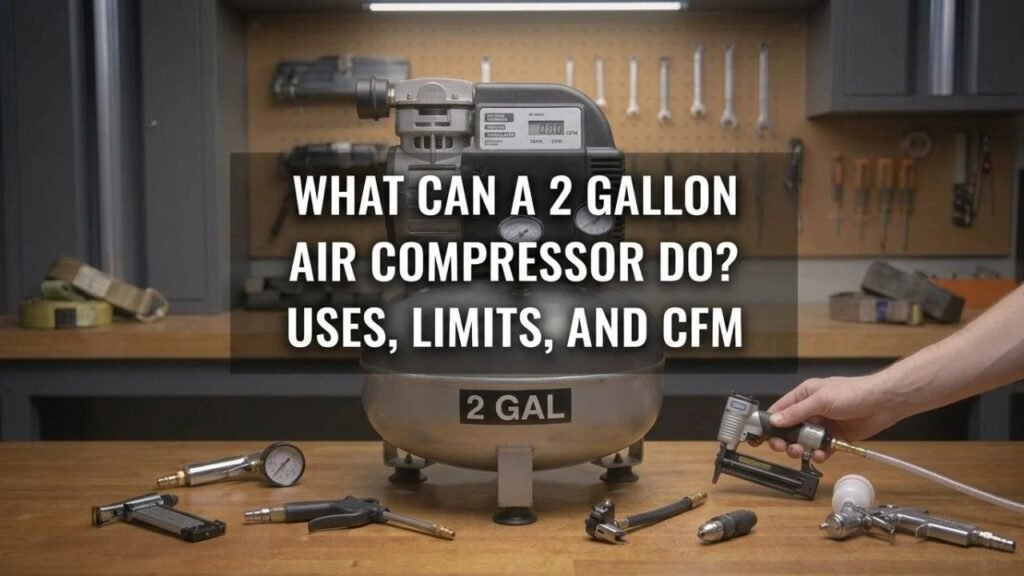
A 2-gallon unit works best when the tool uses a quick burst of air and then pauses long enough for the compressor to recover.
Inflate Car and Bike Tires
Tire inflation is one of the best jobs for a small compressor.
You can use it for:
- Car tires
- Motorcycle tires
- Bicycle tires with the correct chuck
- Lawn equipment tires
- Utility trailer tires
- Sports equipment
The tank gives you a useful reserve, and tire inflation does not normally require continuous high airflow.
The main limitation is speed. A small compressor may take longer to inflate a large truck tire than a higher-output unit.
Run a Brad Nailer
A 2-gallon compressor is well suited to many 18-gauge brad nailers.
Makita even sells a 1-gallon compressor package with an 18-gauge brad nailer, and its 2-gallon MAC210Q is marketed alongside brad, finish, pin, and narrow-crown fastening tools.
Nailers use a short pulse of air per fastener, then stop consuming air until the next shot.
That intermittent pattern is exactly where a small tank works well.
Run Finish Nailers and Staplers
A 2-gallon unit can also work well with many:
- 15-gauge finish nailers
- 16-gauge finish nailers
- Pin nailers
- Narrow-crown staplers
Check the tool’s operating-pressure and air-delivery specifications before buying.
Makita lists 70–120 PSI as the operating range for its AF601 finish nailer, which fits within the regulated output range of many small compressors.
Use a Blow Gun in Short Bursts
A blow gun can be used for:
- Clearing sawdust
- Cleaning small parts
- Blowing debris from a workbench
- Drying small components
A 2-gallon tank drains quickly if you hold the trigger open.
Use short bursts rather than expecting continuous shop-cleaning airflow.
Key Takeaway: A 2-gallon compressor is strongest with inflation, fastening, and short air bursts because those jobs give its small receiver and pump time to recover.
Is a 2 Gallon Air Compressor Enough for Nail Guns?
For many trim and finish nailers, yes.
Framing work needs a closer look.
Brad, Pin, and Finish Nailers
These are among the easiest pneumatic tools for a small compressor to support.
A nail gun consumes air for only a fraction of a second each time it fires.
That means the compressor does not need to match a continuous airflow demand.
A 2-gallon model can often drive many fasteners before the pump needs to recover, though actual shot count changes with:
- Tank pressure
- Nailer size
- Regulator setting
- Nail size
- Wood hardness
- Compressor CFM
Framing Nailers
A framing nailer may operate from a 2-gallon compressor for occasional shots, but rapid production framing can exceed the pump’s recovery rate.
Makita’s current AN924 framing nailer calls for a minimum 4.3 SCFM at 90 PSI. Its 2-gallon MAC210Q delivers 2 CFM at 90 PSI, so that pairing would not provide the nailer’s stated minimum sustained air delivery.
Another Makita framing model has been listed with a 6.1 SCFM minimum at 90 PSI, again well beyond the sustained output of the 2-gallon compressor example.
That does not mean one framing nail cannot fire from stored air. It means the compressor cannot replenish the tank fast enough to match the tool’s rated demand during repeated operation.
Roofing Nailers
Roofing work involves rapid firing.
A small compressor may cycle almost constantly and pressure may fall during fast production.
A larger pump or multiple compressors is usually a better setup for sustained roofing work.
Key Takeaway: Two gallons is plenty for many brad, pin, finish, and staple applications, but high-speed framing and roofing work may exceed the pump’s recovery capacity.
Is a 2 Gallon Air Compressor Enough for an Impact Wrench?
It can power some impact-wrench bursts, but it is not a strong match for sustained impact use.
The Tank Can Supply a Short Burst
An impact wrench does not always run continuously.
You may pull the trigger for a few seconds to remove a lug nut and then pause.
During that short burst, the receiver can supply airflow beyond what the compressor pump itself produces.
Air Demand Can Be Much Higher Than Pump Output
The Ingersoll Rand 231C 1/2-inch impact wrench is rated at 4.2 CFM average air consumption and 22 CFM under load at 90 PSI. It also calls for a minimum 3/8-inch air hose.
Compare that with the Makita 2-gallon example at 2 CFM at 90 PSI.
The impact can consume stored air much faster than the pump replaces it.
What You Will Notice
With a small compressor, you may get:
- A few strong trigger pulls
- Tank pressure dropping quickly
- Reduced torque as pressure falls
- Frequent recovery pauses
- Compressor motor running often
For changing an occasional wheel at home, that may be acceptable.
For automotive repair where an impact wrench runs repeatedly, a larger compressor with greater 90 PSI SCFM is a much better fit.
Key Takeaway: A 2-gallon tank can supply a 1/2-inch impact wrench for short bursts, but most small 2-gallon pumps cannot sustain the airflow needed for repeated high-torque work.
Can a 2 Gallon Air Compressor Run an Air Ratchet?
An air ratchet can work in short periods, but compressor output should be checked carefully.
Many ratchets consume several CFM at around 90 PSI.
If the compressor produces only around 2 CFM at 90 PSI, pressure will gradually fall while the ratchet runs.
For jobs where you:
- Break a fastener loose.
- Run it out for a few seconds.
- Stop and move to the next fastener.
the setup may be usable.
For long continuous runs, expect recovery pauses.
A cordless electric ratchet is often more practical when the only available compressor has a very small tank and low CFM output.
Can a 2 Gallon Air Compressor Run a DA or Orbital Sander?
Usually not for useful continuous sanding.
Sanders Are Air-Hungry
Pneumatic sanders differ from nailers because they need airflow the entire time the trigger is held.
Kellogg-American lists a typical orbital sander at about 6–9 CFM at 90 PSI and a dual-action sander at roughly 11–13 CFM.
A 2-gallon compressor delivering around 2 CFM at 90 PSI falls far below those figures.
The Tank Will Empty Fast
The sander may initially reach normal speed because the tank contains stored compressed air.
Within a short period:
- Tank pressure falls
- Sander RPM drops
- Sanding performance declines
- Compressor runs continuously
Stopping to let the tank recharge after every short sanding period defeats much of the reason for using a pneumatic sander.
Electric Sander Makes More Sense
For a small-compressor shop, a corded or cordless random orbital sander is usually the better setup.
Save the air compressor for:
- Fasteners
- Inflation
- Blow-off
- Other intermittent tools
Key Takeaway: A 2-gallon compressor is generally too small for sustained DA or orbital air sanding because those tools commonly demand several times the pump’s available CFM.
Can a 2 Gallon Air Compressor Run a Die Grinder?
A die grinder is another poor match for most 2-gallon compressors.
Die grinders run continuously during grinding and surface preparation.
Typical consumption can be around 4–6 CFM or more depending on the model.
A small receiver may give you a few seconds of strong tool speed, followed by pressure loss.
This can be frustrating for:
- Grinding welds
- Porting
- Deburring
- Surface preparation
- Using Roloc-style abrasive discs
For regular die-grinder work, compressor CFM at 90 PSI matters far more than tank gallons.
Can a 2 Gallon Air Compressor Run a Paint Sprayer?
Usually not for normal continuous spray painting.
Spray Guns Need Continuous Air
A spray gun needs a steady airflow while the trigger is pulled.
Typical paint spray guns can consume around 7–9 CFM in general tool charts, with some HVLP guns requiring still more air.
A low-CFM 2-gallon compressor may struggle to maintain:
- Stable atomization
- Consistent fan pattern
- Correct pressure
- Uniform finish
Small Airbrushes Are Different
An airbrush uses far less air than a full automotive or furniture spray gun.
A 2-gallon compressor may work nicely for certain:
- Airbrushes
- Detail spray tools
- Small touch-up guns
Check the actual CFM requirement at the operating pressure.
Small Tank Can Cause Frequent Cycling
Even if pump output is close to the gun’s requirement, a 2-gallon receiver gives little reserve.
The compressor may run frequently during spraying.
Key Takeaway: Two gallons is generally too little for full-size spray guns, but low-air-consumption airbrushes and some small touch-up equipment may work well.
Can a 2 Gallon Air Compressor Run a Sandblaster?
Not for practical continuous blasting in most cases.
Sandblasting is among the highest-air-demand common shop processes.
Even a small blasting setup can require far more airflow than a typical 2-gallon compressor produces.
Kellogg-American lists a sandblast cabinet around 9–15 CFM at 90 PSI as a general reference.
The tiny receiver would drain almost immediately.
For blasting, nozzle size and required pressure should be used to size the compressor, not tank gallons alone.
How Long Will a 2 Gallon Air Compressor Run an Air Tool?
There is no single runtime because both tank pressure and tool consumption matter.
Low-Air Tools Last Longer
A nailer uses one small pulse at a time.
The compressor may replenish much of that air between shots.
That is why a 2-gallon unit can feel surprisingly capable with trim nailers.
Continuous Tools Empty It Quickly
A pneumatic sander consuming 8 CFM can remove air several times faster than a 2 CFM pump can replace it.
The receiver only delays the pressure drop.
CFM Determines Recovery
Imagine:
- Tool demand: 6 CFM
- Compressor output: 2 CFM
Once the tank reserve is depleted, the system has a deficit of roughly 4 CFM while the tool is running.
It cannot reach steady operation without stopping the tool periodically.
Key Takeaway: The tank controls how long you can temporarily exceed the pump’s output; CFM determines if the compressor can eventually keep up.
Is a 2 Gallon Air Compressor Good for Tires?
Yes, for most normal passenger-vehicle tire inflation.
Passenger Cars
A 2-gallon receiver gives enough stored air to make routine pressure adjustments quickly.
For example, raising a tire a few PSI takes far less air than filling a completely flat high-volume tire.
Motorcycles and Bicycles
These generally require less total air volume than car and truck tires.
Use the correct chuck or valve adapter.
Truck and RV Tires
Pressure capability and airflow both matter.
A compressor may have enough maximum PSI to reach the target pressure but still take a long time due to modest airflow.
Do not judge inflation suitability from maximum PSI alone.
Portable Advantage
This is one area where a 2-gallon design makes a lot of sense.
It is easier to move around a garage or carry to a vehicle than a 20-, 30-, or 60-gallon compressor.
Is a 2 Gallon Air Compressor Enough for a Home Garage?
It depends on what you want the compressor to do.
Good Garage Uses
A 2-gallon unit is a good fit for:
- Tire inflation
- Brad nailers
- Finish nailers
- Pin nailers
- Staplers
- Small airbrushes
- Short blow-gun use
- Small pneumatic accessories
Marginal Garage Uses
It may work with pauses for:
- Small impact wrenches
- Air ratchets
- Air hammers used briefly
Performance depends heavily on the compressor’s SCFM.
Poor Garage Uses
A 2-gallon unit is generally a weak choice for:
- DA sanders
- Orbital air sanders
- Die grinders
- Continuous cut-off tools
- Full-size spray guns
- Sandblasters
- Heavy pneumatic grinders
A home mechanic who mainly inflates tires and uses a nailer may be very happy with 2 gallons.
A mechanic who wants to power pneumatic automotive tools all day will probably find it frustrating.
Key Takeaway: A 2-gallon compressor is good for light garage jobs and intermittent tools, but continuous pneumatic tools call for substantially more pump output.
Is 2 Gallons Enough, or Should You Buy a Bigger Compressor?
Choose based on your highest-air-demand job.
Stay With 2 Gallons If You Need Portability
A small compressor is attractive if you need to carry it between:
- Rooms
- Jobsites
- Vehicles
- Workbenches
The Makita MAC210Q, for example, is specifically built around jobsite portability and finish-carpentry applications.
Move Up for Framing and Frequent Automotive Work
A larger compressor provides:
- More stored air
- Longer bursts
- Less frequent cycling
More important, larger models often include a higher-output pump.
Look at SCFM before simply choosing a larger tank.
Choose High CFM for Sanders and Grinders
A 20-gallon compressor with weak pump output can still struggle with a DA sander.
Continuous tools should be matched to compressor SCFM at their operating PSI.
For example, a tool consuming 9 CFM at 90 PSI needs a compressor capable of supplying around that amount continuously, preferably with some reserve rather than one rated at only 2 or 3 CFM.
Key Takeaway: Keep the 2-gallon size for portability and intermittent tasks; move to a higher-CFM compressor when the job involves continuous sanding, grinding, spraying, or blasting.
2 Gallon Air Compressor vs Larger Tank Sizes
| Tank Size | Best General Use | Main Limitation |
| 1–2 gal. | Inflation, brad nailers, finish work | Very short reserve |
| 3–6 gal. | Nailers, jobsite work, light garage jobs | Limited continuous-tool runtime |
| 8–15 gal. | More garage versatility | Still may lack CFM for sanders |
| 20–30 gal. | Automotive and moderate air-tool use | Larger and less portable |
| 60–80 gal. | Stationary shop, higher air demand | Space, cost, electrical requirements |
These are general categories rather than fixed capability rules.
A high-output compressor with a small receiver may outperform a slow pump connected to a larger tank during continuous operation.
Always compare:
- SCFM at 90 PSI
- Maximum pressure
- Duty cycle
- Motor size
- Tool demand
before deciding.
What Specs Matter More Than the 2 Gallon Tank?
SCFM at 90 PSI
This is one of the most useful numbers for air-tool compatibility.
Many pneumatic tools are rated around 90 PSI.
If the compressor delivers 2 CFM at 90 PSI and the tool consumes 8 CFM, sustained operation will not work regardless of tank size.
Maximum PSI
Maximum PSI tells you how much pressure the receiver can store under its designed control system.
It does not tell you how quickly the compressor produces air.
The Makita 2-gallon example reaches 135 PSI but still supplies only 2 CFM at 90 PSI.
Pump Recovery Rate
A fast pump refills the receiver sooner.
Makita states that its MAC210Q fills its 2-gallon receiver from empty in about 65 seconds under the manufacturer’s test conditions.
Duty Rating
A compressor that must cool after prolonged operation is not suited to nonstop air demand.
Check the manual for operating and duty limitations.
Regulated Output Pressure
The tool receives regulator pressure, not necessarily full tank pressure.
Set output according to the pneumatic tool’s specification.
Key Takeaway: SCFM at working pressure tells you more about tool performance than tank gallons or maximum PSI alone.
Safety Tips for Using a Small Air Compressor
Do Not Raise the Pressure Switch Setting
Do not modify the compressor to exceed its rated tank pressure.
More pressure does not turn a small pump into a high-CFM compressor.
Drain the Tank
Compressed air creates condensate.
Drain the receiver according to the manufacturer’s instructions to reduce internal moisture accumulation.
Use Pressure-Rated Hoses and Fittings
Every downstream component needs an appropriate working-pressure rating.
Inspect hoses for:
- Cracks
- Cuts
- Bulges
- Damaged fittings
Regulate Pressure for the Tool
A tool rated for 90 PSI should not automatically receive the compressor’s 135 PSI tank pressure.
Use the regulator.
Do Not Block Cooling Air
Small portable compressors often rely heavily on airflow around the pump and motor.
Keep ventilation openings clear.
Key Takeaway: Keep the factory pressure limits intact, drain moisture, use rated hoses, regulate tool pressure, and allow the compressor to cool properly.
Conclusion
For what can a 2 gallon air compressor do, the best uses are tire inflation, brad and finish nailers, pin nailers, staplers, airbrush work, and short blow-gun jobs. These applications consume air intermittently, so a small receiver can recharge between bursts.
Is a 2 gallon air compressor enough? Yes for light home, woodworking, trim, and portable jobsite work. It becomes restrictive when you move into framing at high production rates or automotive air tools that consume several CFM continuously.
Is a 2 gallon air compressor good? It can be an excellent small compressor when portability matters and the tools match its output. The key is to judge the machine by its SCFM at working pressure as well as its tank size.
For continuous DA sanding, grinding, full-size spraying, or sandblasting, move to a compressor with substantially higher sustained airflow. A larger tank gives more reserve, but pump CFM is what decides if the machine can keep the tool running.
FAQs About 2 Gallon Air Compressors
What Can You Run With a 2 Gallon Air Compressor?
Common jobs include tire inflation, brad nailing, finish nailing, pin nailing, stapling, small airbrush work, and short blow-gun use.
Tool compatibility depends on compressor SCFM and the tool’s required pressure.
Is a 2 Gallon Air Compressor Enough for a Nail Gun?
Yes for many brad, pin, finish, and staple guns.
Some framing nailers require far more sustained airflow. Makita’s AN924, for example, lists 4.3 SCFM at 90 PSI, while its MAC210Q 2-gallon compressor delivers 2 CFM at 90 PSI.
Can a 2 Gallon Compressor Fill Car Tires?
Yes.
Routine passenger-car tire inflation is a good use for this compressor size. Large truck tires can take longer because the pump moves a relatively small volume of air.
Can a 2 Gallon Air Compressor Run an Impact Wrench?
It can provide short bursts, but many impact wrenches need much more airflow than a small compressor pump supplies.
The Ingersoll Rand 231C lists 4.2 CFM average consumption and 22 CFM under load at 90 PSI.
Can a 2 Gallon Compressor Run a Paint Gun?
Most full-size spray guns need more continuous airflow than a typical 2-gallon compressor produces.
Low-air-consumption airbrushes and some detail equipment are more realistic choices.
Can a 2 Gallon Compressor Run an Orbital Sander?
Not well for sustained sanding.
Air orbital sanders commonly consume around 6–9 CFM, while DA sanders can demand around 11–13 CFM in general tool references.
Is a 2 Gallon Air Compressor Good for Home Use?
Yes, if your jobs involve inflation, light fastening, small repairs, or short air bursts.
It is compact and portable while still giving you stored compressed air for common household and woodworking tasks.
Is CFM More Important Than Tank Size?
For continuous pneumatic tools, yes.
Tank size determines how much air is stored, while pump CFM determines how quickly that air is replaced. A large tank cannot make up for an undersized pump during long periods of tool use.