Do Air Compressors Run Out of Air? Causes, Runtime & Solutions
Yes, an air compressor can temporarily run out of usable compressed air when a tool consumes air faster than the pump replaces it. Tank pressure drops as you work, and the tool may slow down or stop until pressure recovers. A working compressor keeps drawing atmospheric air and automatically refills its tank.
This happens most often when a small compressor is paired with a high-air-demand tool. Nail guns use short bursts and give the pump time to recover, while sanders, grinders, spray guns, and continuous blow guns can drain stored air much faster.
Tank capacity affects how much compressed air is available before pressure falls. Pump output determines how quickly that air comes back. That is why a large tank alone does not guarantee long uninterrupted tool operation.
The practical answer to do air compressors run out of air is yes—the receiver tank can run low enough that your tool no longer gets the airflow and pressure it needs. The compressor itself should keep producing air as long as the motor, pump, intake, and electrical supply are working correctly.
If the compressor used to keep up with a tool but now loses pressure much faster, the issue may be different. Air leaks, a clogged intake filter, a worn pump, a faulty regulator, an open drain valve, or valve problems can reduce usable airflow.
To understand what is happening, you need to look at tank size, SCFM, PSI, tool demand, pump recovery rate, and duty cycle rather than gallons alone.
Do Air Compressors Run Out of Air?
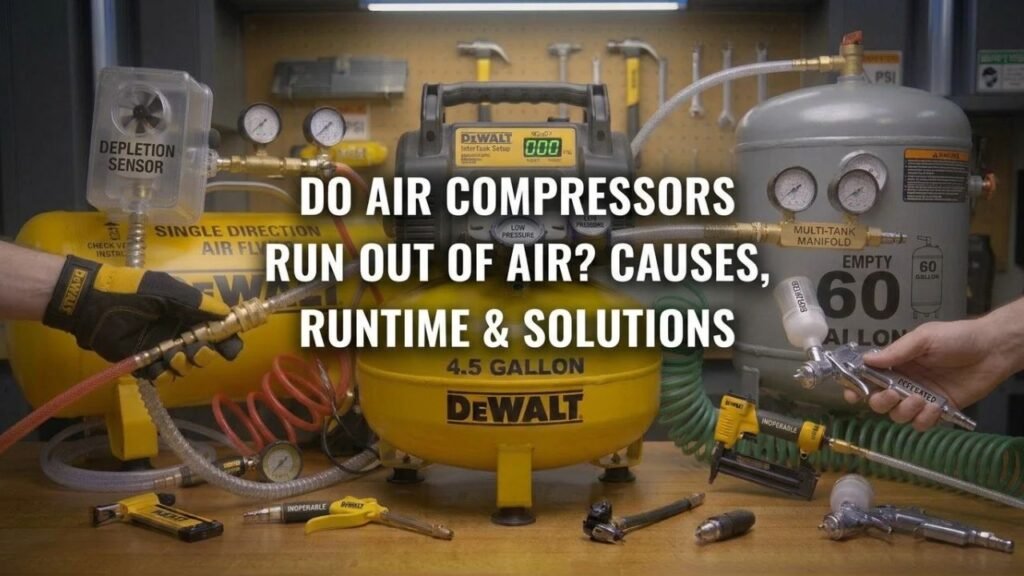
Yes. The stored air inside an air-compressor tank can be used faster than the pump can replace it.
Every time you pull the trigger on a pneumatic tool, compressed air leaves the tank. As air leaves, tank pressure falls.
Most tank-style compressors automatically respond to this pressure drop. When pressure reaches the compressor’s preset cut-in pressure, the pressure switch starts the motor.
The pump then draws outside air, compresses it, and sends it into the tank.
Once pressure reaches the cut-out pressure, the motor switches off again.
What Happens When the Compressor Can Keep Up?
Suppose a tool uses less air than the compressor can produce.
The pump replaces the used air fast enough to maintain workable tank pressure.
The motor may cycle on and off, but you can continue working without a major drop in tool performance.
What Happens When the Tool Uses Too Much Air?
Suppose your compressor delivers 2.6 SCFM at 90 PSI, while the tool needs 6 SCFM at 90 PSI.
The tank supplies the extra air at first.
As stored air is consumed, tank pressure drops. The compressor motor starts, but the pump can supply only 2.6 SCFM while the tool continues demanding 6 SCFM.
Pressure keeps falling.
Eventually, the tool may:
- Slow down
- Lose torque
- Spray inconsistently
- Stop working at full output
- Need a recovery break
Once you stop using the tool, the compressor can refill the tank.
Key Takeaway: A compressor runs low on usable air when air consumption exceeds pump output. The tank provides a temporary reserve, but it cannot make up for an ongoing SCFM shortage forever.
Why Does an Air Compressor Run Out of Air?
Several factors control how quickly a compressor loses usable pressure.
The Tool Requires More SCFM Than the Compressor Produces
This is the most common reason.
Pneumatic tools list their airflow needs in CFM or SCFM, normally at a specified pressure.
The compressor also lists an SCFM output.
For example:
| Equipment | Airflow |
| Compressor | 2.6 SCFM at 90 PSI |
| Air tool | 4.5 SCFM at 90 PSI |
The tool consumes 1.9 SCFM more than the compressor can continuously replace.
The tank covers that difference temporarily.
After enough use, tank pressure falls.
The Tank Is Small
A small tank contains less stored compressed air.
A 3-gallon or 6-gallon compressor can work well for intermittent tools because the pump gets frequent pauses to recover.
Continuous tools drain that reserve much faster.
Common high-air-demand tools include:
- Air sanders
- Die grinders
- Spray guns
- Continuous blow guns
- Some impact tools
- Pneumatic polishers
Moving to a larger tank can extend the initial operating time, but it does not change pump SCFM.
There Is an Air Leak
Leaks continuously drain stored air, even when no tool is running.
Common leak points include:
- Quick-connect couplers
- Hose fittings
- Regulator connections
- Tank drain valve
- Check valve
- Pressure-switch fittings
- Cracked hoses
A compressor with several small leaks may cycle frequently and appear to run out of air much faster than it should.
The Intake Filter Is Restricted
The pump needs a free supply of atmospheric air.
A dirty intake filter can reduce the amount of air entering the pump.
Tank recovery then takes longer.
If recovery time has gradually increased, checking the intake filter is an easy first step.
The Pump Is Worn
Internal wear can reduce compressor output.
Possible problems include:
- Worn piston rings
- Damaged reed valves
- Valve-plate problems
- Cylinder wear
- Head-gasket leaks
- Internal seal failure
The compressor may still reach full tank pressure, but it can take far longer than it did when new.
Key Takeaway: Low SCFM capacity, a small tank, air leaks, intake restriction, and pump wear can all make a compressor lose usable air quickly.
Tank Size vs. SCFM: What Determines How Long Air Lasts?
Tank size and SCFM affect compressor performance in different ways.
Understanding this distinction makes compressor sizing much easier.
Tank Size Determines Stored Air
The receiver tank stores compressed air.
Common tank sizes include:
- 1 gallon
- 3 gallons
- 6 gallons
- 10 gallons
- 20 gallons
- 30 gallons
- 60 gallons
- 80 gallons
A larger tank provides more stored air before pressure drops to the cut-in level.
It can therefore give you longer bursts of tool operation.
SCFM Determines Recovery
SCFM tells you how much airflow the compressor can deliver under standardized conditions.
For sustained pneumatic work, pump SCFM is usually more important than tank gallons.
Consider these two compressors:
| Compressor | Tank | Output at 90 PSI |
| Compressor A | 6 gallons | 2.6 SCFM |
| Compressor B | 6 gallons | 5.0 SCFM |
Both have the same tank capacity.
Compressor B replaces used air much faster.
That makes it better suited to tools with higher airflow demands.
Why a Bigger Tank Does Not Solve Every Problem
Imagine a tool needs 8 SCFM while your pump delivers only 4 SCFM.
Adding a larger tank gives you a bigger reserve.
Your tool can operate longer before pressure falls.
The airflow deficit still remains:
8 SCFM tool demand − 4 SCFM pump output = 4 SCFM shortage
Once the larger tank’s stored air has been consumed, pressure falls again.
A higher-SCFM compressor is the stronger fix for continuous use.
Key Takeaway: Gallons determine stored-air reserve. SCFM determines how quickly the compressor replaces the air you consume. Continuous tools need enough pump output, not merely a large tank.
How Does an Air Compressor Refill Itself?
Most tank-style compressors refill automatically through a pressure-switch system.
You normally do not need to manually restart the compressor every time the tank gets low.
What Is Cut-In Pressure?
Cut-in pressure is the lower pressure at which the motor starts.
For example, a compressor might stop pumping at its upper pressure setting and restart after tank pressure falls by several dozen PSI.
Exact cut-in pressure varies by compressor.
Do not change factory pressure-switch settings unless the manufacturer provides an approved procedure.
What Is Cut-Out Pressure?
Cut-out pressure is the upper tank-pressure setting.
When the compressor reaches this pressure, the pressure switch turns the motor off.
The tank then supplies stored air until pressure drops back to the cut-in point.
Why Does a Compressor Have Two Pressure Gauges?
Many portable compressors have:
- Tank-pressure gauge
- Regulated outlet-pressure gauge
Tank pressure tells you how much pressure is stored in the receiver.
Regulated pressure tells you what pressure is being delivered to the hose and tool.
For example, the tank may hold 150 PSI while the regulator supplies only 90 PSI to the tool.
Can Turning Up the Regulator Stop the Compressor From Running Out?
No.
A regulator changes outlet pressure. It does not increase pump SCFM.
If the tool needs 6 SCFM and the compressor makes only 2.6 SCFM, raising the regulator cannot produce the missing airflow.
It can also send excessive pressure to a tool if adjusted above the tool maker’s limit.
Key Takeaway: The pressure switch automatically refills the tank between cut-in and cut-out settings. The regulator controls outlet pressure but cannot increase compressor airflow.
Which Air Tools Run a Compressor Out of Air Fastest?
Tool type makes a large difference.
Some tools use short bursts of air. Others require continuous airflow.
Nail Guns and Staplers
Brad nailers, finish nailers, framing nailers, pin nailers, and staplers use air briefly each time they fire.
There is usually a pause between shots.
That gives a small compressor time to refill.
A 6-gallon pancake compressor can therefore work well with many pneumatic fastening tools even though its pump output is relatively modest.
Tire Inflators
Tire inflation is usually manageable for portable compressors.
Passenger-car tires generally involve intermittent demand rather than high continuous airflow.
Large truck tires or multiple tires can take longer because more total air must be supplied.
Impact Wrenches
Impact wrenches use air in bursts.
Removing a few lug nuts may work fine with a small tank.
Long sessions with frequent trigger use can drain stored pressure much faster.
Air Sanders
Air sanders can consume a large volume of air continuously.
A small pancake compressor may run almost nonstop and still fail to maintain sufficient pressure.
The tool may start at full speed and then slow down within seconds.
Die Grinders
Pneumatic grinders also tend to have substantial continuous airflow needs.
Small compressors may provide only short periods of usable grinding before tank pressure falls.
Spray Guns
Spray-gun airflow requirements vary considerably.
A small touch-up gun may work with a compact compressor.
A full-size spray gun can need far more SCFM than a portable unit supplies.
Compare the gun’s required airflow with the compressor’s SCFM rating before planning a paint job.
Key Takeaway: Burst-use tools such as nailers are easier for small compressors. Sanders, grinders, continuous blow guns, and many spray guns drain stored air much faster.
How Can You Tell If Your Air Compressor Is Too Small?
You do not need to wait until tank pressure approaches zero.
Several symptoms show that the compressor cannot keep up.
Tank Pressure Keeps Dropping While the Motor Runs
This is one of the clearest signs.
You start using the tool.
Tank pressure drops until the compressor motor switches on.
The motor continues running, but tank pressure keeps falling.
Your tool is consuming air faster than the pump supplies it.
Tool Power Fades During Use
A pneumatic tool may work strongly when the tank is full and gradually become weaker.
Examples include:
- Impact wrench loses torque
- Grinder slows down
- Sander speed falls
- Spray pattern changes
- Blow gun becomes weak
If performance returns after waiting for tank recovery, compressor capacity is a likely issue.
The Compressor Runs Almost Constantly
Frequent or continuous motor operation can mean the compressor is being asked to deliver close to or beyond its output capacity.
Check the compressor’s duty-cycle rating.
A small intermittent-duty compressor may require cooling periods.
Running beyond its specified duty cycle can increase motor and pump temperatures.
You Spend More Time Waiting Than Working
A compressor may technically operate a tool while still being poorly matched to it.
If you work for 20 seconds and then wait several minutes for recovery, a higher-SCFM compressor may suit the job much better.
Key Takeaway: Falling pressure with the pump already running, fading tool output, nonstop motor operation, and frequent recovery pauses all point toward insufficient compressor capacity.
Why Does My Compressor Suddenly Run Out of Air Faster?
A compressor that previously handled the same job should not suddenly become undersized.
Look for a leak or mechanical problem.
Check for Air Leaks
Fill the tank and stop using all tools.
Watch the tank-pressure gauge.
A small pressure change from cooling can occur after filling, but ongoing pressure loss can point toward a leak.
Listen around:
- Couplers
- Fittings
- Regulator
- Drain valve
- Hose
- Check valve area
A soap-and-water solution can reveal many external leaks by producing bubbles.
Keep liquid away from electrical parts.
Check the Drain Valve
Tank drain valves are used to remove accumulated water.
If the valve is not fully closed after draining, compressed air can leak continuously.
Inspect the valve for dirt or damage if it does not seal.
Check the Intake Filter
A clogged filter restricts pump intake air.
Follow the maintenance instructions for cleaning or replacement.
Check Tank Recovery Time
Record how long the compressor takes to move from cut-in pressure to cut-out pressure with no tool being used.
If recovery is much slower than it used to be, possible causes include:
- Intake restriction
- Air leak
- Worn piston rings
- Valve damage
- Head-gasket leak
- Pump wear
Check the Regulator and Hose
A restriction after the tank can make a tool feel starved even while tank pressure remains high.
A damaged regulator, restrictive coupler, kinked hose, or undersized hose can limit airflow to the tool.
Key Takeaway: If runtime becomes shorter without changing tools, inspect for leaks, a partially open drain, intake restriction, slow pump recovery, regulator faults, and hose restrictions.
Can You Make an Air Compressor Air Supply Last Longer?
Yes, several changes can extend usable runtime.
Repair Air Leaks
Every leak wastes compressor output.
Fix damaged hoses, leaking fittings, worn couplers, and drain-valve problems.
Use the Correct PSI
Set the regulator to the pressure recommended for the tool.
Supplying more pressure than required wastes stored air and can place unnecessary stress on the tool.
Reduce Continuous Tool Use
Some tools can be used in shorter intervals.
Giving the compressor recovery time between bursts prevents the tank from dropping as quickly.
This works best when the workflow naturally allows pauses.
Choose a Lower-Air-Demand Tool
Two tools designed for the same job can have different SCFM ratings.
A lower-consumption model may work much better with a small compressor.
Add an Auxiliary Tank When Appropriate
An extra air tank increases stored-air volume.
That can provide longer bursts for intermittent work.
It also makes the compressor take longer to fill the total system.
Any auxiliary tank, hose, valve, and fitting must be properly rated for the compressor’s maximum pressure.
Upgrade to More SCFM
For sustained pneumatic work, increasing pump output is the better long-term answer.
Compare the tool’s required SCFM at its operating pressure with the compressor’s delivered SCFM at the same pressure.
Key Takeaway: Fixing leaks, reducing unnecessary pressure, changing tool usage, or adding storage can extend runtime. High-demand continuous work usually calls for more compressor SCFM.
Can an Air Compressor Run Continuously Without Running Out of Air?
Yes, if the compressor is designed for the required duty cycle and its airflow output meets or exceeds the tool’s demand.
Both conditions matter.
Duty Cycle Controls Motor and Pump Runtime
Duty cycle describes how much operating time a compressor is designed to handle within a given period.
A compressor might be rated for:
- Intermittent duty
- 50% duty cycle
- 75% duty cycle
- 100% duty cycle
Follow the specification in the owner’s manual.
A compressor that needs cooling periods should not be forced to run continuously simply because the tank pressure keeps falling.
Continuous Duty Does Not Mean Unlimited Air
A compressor rated for continuous duty still has a maximum airflow output.
Suppose it produces 10 SCFM.
A tool consuming 7 SCFM may be sustainable.
A tool consuming 15 SCFM will still drain the tank because demand exceeds production.
Compressor Output Should Match Tool Demand
For frequent continuous operation, select a compressor whose SCFM output at the required PSI meets or exceeds the tool’s actual airflow demand.
Leaving some capacity above the tool rating also reduces the chance that the compressor spends the entire job running at its limit.
Key Takeaway: Continuous operation requires both enough SCFM and a suitable duty-cycle rating. A 100% duty-cycle compressor can still run low on air if the tool consumes more airflow than the pump produces.
Quick Troubleshooting Guide for a Compressor Running Out of Air
| Symptom | Possible Cause |
| Pressure falls while tool is running | Tool SCFM exceeds pump output |
| Pressure falls while compressor is off | Air leak |
| Motor runs almost constantly | Heavy demand, leak, or weak pump |
| Tool slows but tank pressure remains high | Regulator, hose, or fitting restriction |
| Tank takes longer to refill than before | Leak, dirty filter, or pump wear |
| Works with nailer but not sander | Sander needs much more continuous airflow |
| Bigger tank still eventually empties | Pump SCFM remains too low |
| Compressor trips thermal overload | Duty cycle, voltage, or mechanical problem |
| Motor starts repeatedly with no tool use | Air leak |
| Tool works again after waiting | Compressor needs recovery time |
Conclusion
Yes, do air compressors run out of air has a simple practical answer: the tank can run low on usable compressed air when a tool consumes air faster than the pump can replace it. The compressor should automatically restart and refill the tank once pressure reaches its cut-in setting.
Tank gallons determine how much compressed air is stored, while SCFM determines how quickly the compressor replenishes that supply. A larger tank extends your reserve, but it cannot permanently compensate for a pump that produces less airflow than the tool consumes.
If your compressor suddenly starts losing air faster than it did before, I would check for leaks, intake-filter restriction, regulator problems, hose restrictions, and slower pump recovery before replacing the machine.
FAQs About Air Compressors Running Out of Air
Do Air Compressors Refill Themselves?
Yes. Most tank-style electric compressors refill automatically.
When tank pressure reaches the cut-in setting, the pressure switch starts the motor. The pump fills the tank until pressure reaches the cut-out setting, then the motor stops.
Can a 6-Gallon Air Compressor Run Out of Air?
Yes.
A 6-gallon compressor can run low quickly with a high-SCFM continuous tool. The same compressor may work very well with nailers, staplers, tire inflation, and other intermittent jobs.
Why Does My Air Compressor Run Out of Air So Fast?
The tool may consume more SCFM than the compressor produces.
Air leaks, a clogged intake filter, an open drain valve, pump wear, or a restrictive hose can also make stored air disappear unusually fast.
Does a Bigger Tank Give an Air Compressor More Air?
A larger tank stores more compressed air, so it provides a larger reserve.
It does not increase pump SCFM. If the tool consumes more air than the compressor produces, the larger tank will eventually lose pressure too.
Can I Use an Air Compressor While It Is Refilling?
Yes. That is normal operation.
You can continue using air while the motor runs. If tool consumption is greater than pump output, tank pressure will keep falling until the tool can no longer operate properly.
Why Does My Compressor Keep Running but Pressure Keeps Dropping?
The tool may require more airflow than the compressor produces.
If this is a new problem with a tool that previously worked properly, inspect for leaks, filter restriction, valve problems, or reduced pump output.
Does PSI Tell Me How Long My Compressor Air Will Last?
No.
PSI tells you pressure. Runtime also depends on tank volume, pump SCFM, tool airflow demand, starting tank pressure, and how continuously you use the tool.
What Size Air Compressor Will Not Run Out of Air?
Choose a compressor whose delivered SCFM at the tool’s required PSI meets or exceeds the tool’s airflow demand.
For continuous pneumatic tools, pump output is more important than choosing a tank based only on gallons.