
Can I Put a Bigger Tank on My Air Compressor? Setup & Safety
Yes, you can often add a larger air receiver to an existing compressor, but the tank must be designed for compressed air and rated for at least the compressor’s maximum operating pressure. A larger tank stores more air and reduces rapid cycling, but it does not increase the compressor pump’s CFM output.
There are two very different ways to make a compressor’s air storage larger. You can add a separate auxiliary receiver, or you can replace the compressor’s original tank with a larger one. Adding a properly rated auxiliary receiver is usually the safer and simpler approach.
Tank size also changes how the compressor operates. A larger receiver takes longer to fill, which can make the motor and pump run continuously for a longer period. That can become a problem with compressors that have limited duty cycles.
For can i put a bigger tank on my air compressor, the answer is yes when the tank pressure rating, relief valve, plumbing, pump capacity, motor duty cycle, and pressure controls all remain within their original limits. A bigger tank is not permission to raise the compressor’s cutoff pressure.
Compressed-air receivers need to be treated as pressure vessels rather than ordinary metal containers. U.S. OSHA workplace rules require covered air receivers to have a visible pressure gauge, a spring-loaded safety valve, and a method for draining accumulated water and oil. The safety system must prevent pressure from rising more than 10% above the receiver’s maximum allowable working pressure.
The sections below explain what a larger tank changes, what it does not change, auxiliary-tank installation, pressure ratings, CFM, fill time, duty cycle, safety valves, moisture, and how to choose a sensible receiver size.
What Happens If You Put a Bigger Tank on an Air Compressor?
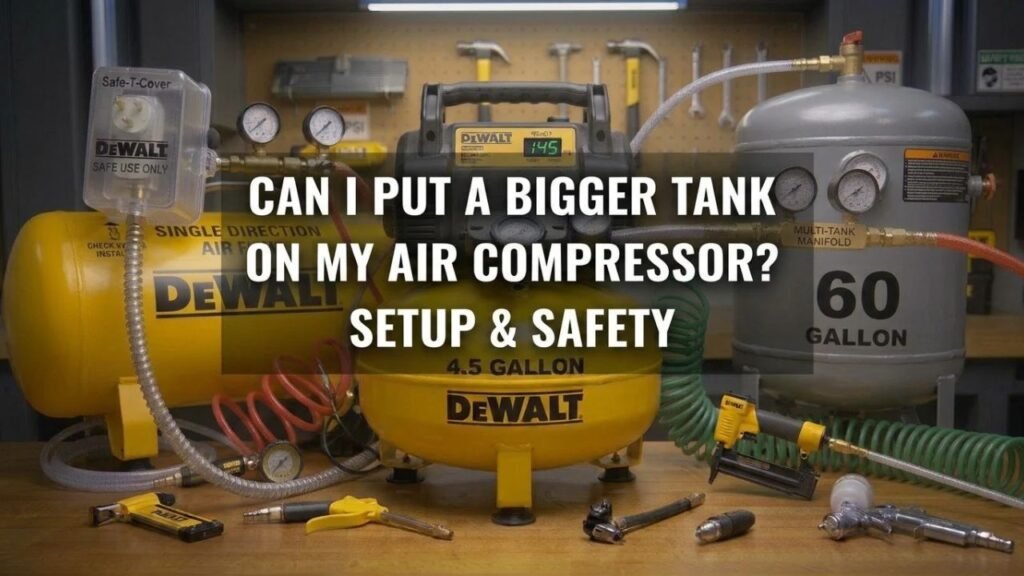
A larger tank increases the volume of compressed air available before tank pressure falls enough for the compressor to restart.
It changes storage capacity rather than the basic output of the pump.
You Get More Stored Air
Suppose a compressor has a 20-gallon tank and you add another 20-gallon receiver.
The system now has roughly 40 gallons of total receiver volume.
That extra capacity gives you a larger reserve for short bursts of air, such as:
- Impact-wrench use
- Nail-gun bursts
- Air blowoff
- Tire inflation
- Short sanding sessions
- Intermittent pneumatic tools
The benefit is most noticeable when the tool occasionally uses air faster than the compressor can produce it.
The Compressor Runs Longer to Refill
The larger tank also needs more compressed air before it reaches cutoff pressure.
If you triple the total tank volume, filling the system through the same pressure range will take roughly three times as long under similar conditions.
For example, moving from a 20-gallon system to 60 gallons does not give the pump three times more output. It gives the same pump roughly three times as much receiver volume to fill.
Starts May Become Less Frequent
A larger receiver can reduce short cycling.
Instead of the pressure falling from cutoff to cut-in after a short burst of tool use, the larger volume lets you use more air before the pressure switch restarts the compressor.
Fewer starts can be desirable because starting an electric motor creates a high current surge.
The tradeoff is longer run periods once the compressor does restart.
Key Takeaway: A larger receiver gives you more stored air and can reduce frequent cycling, but every refill takes longer because the same pump must compress a greater volume of air.
Does a Bigger Air Compressor Tank Increase CFM?
No. A larger tank does not increase the compressor’s actual sustained CFM.
CFM comes primarily from the compressor pump, motor, operating pressure, and pump speed.
Tank Capacity and CFM Are Different
Tank capacity is measured in gallons.
Air delivery is commonly rated in cubic feet per minute, such as:
- 3 CFM at 90 PSI
- 5 CFM at 90 PSI
- 10 CFM at 90 PSI
Imagine a compressor that produces 5 CFM at 90 PSI.
Connecting a 60-gallon auxiliary tank does not turn it into a 10 CFM compressor.
It is still capable of producing about 5 CFM at the stated pressure.
A Larger Tank Can Provide Temporary Extra Flow
A stored-air reserve can make a small compressor feel stronger for a short time.
For example, a tool requiring 8 CFM may run briefly from a compressor that produces only 5 CFM because the difference comes from air already stored in the receiver.
Once the tank pressure falls, the compressor cannot keep up indefinitely.
The long-term air balance remains:
Tool air consumption must stay at or below compressor output for continuous operation.
Continuous Tools Still Need Enough Compressor CFM
High-demand tools include:
- Sandblasters
- DA sanders
- Air grinders
- Spray equipment
- Pneumatic polishers
A larger tank may extend the time before pressure drops, but it does not solve a large continuous CFM shortage.
If a tool needs 12 CFM and the pump delivers 5 CFM, adding tank capacity only delays the pressure drop.
Key Takeaway: Bigger tanks increase stored air, not pump output. They work well for intermittent demand but cannot make an undersized compressor continuously supply a high-CFM air tool.
Is It Better to Add an Auxiliary Tank or Replace the Original Tank?
Adding a separate receiver is usually the better option.
Replacing the original pressure vessel can involve mounting, plumbing, vibration, pressure-control, and safety issues that were addressed by the compressor’s original design.
Adding an Auxiliary Air Tank
An auxiliary receiver is a separate pressure-rated tank connected to the compressed-air system.
Advantages include:
- Original compressor remains mostly intact
- Extra storage can be added remotely
- Easier to remove later
- No need to transfer the pump and motor
- Existing compressor pressure controls remain in use
- Receiver can be positioned closer to high-demand equipment
Industrial compressed-air systems commonly use additional receivers for exactly this reason.
Replacing the Original Compressor Tank
Swapping the original tank is more involved.
The larger receiver must safely support:
- Pump
- Motor
- Belt guard
- Pressure switch
- Check valve
- Unloader system
- Safety valve
- Pressure gauge
- Drain
- Discharge piping
Mounting geometry and vibration also matter.
Never drill or weld new openings into a pressure vessel to make the old compressor components fit.
Modifying the pressure-bearing shell can weaken it and void its pressure-vessel rating.
Do Not Use a Homemade Tank
Do not substitute:
- Propane cylinders
- LPG tanks
- Fire extinguishers
- Refrigerant cylinders
- Water tanks
- Fabricated steel cylinders
- Unknown used pressure vessels
A container that can physically hold air for a few minutes is not automatically safe for repeated compressed-air service.
Use a receiver intended and rated for compressed air.
Key Takeaway: Adding a properly rated auxiliary receiver is generally simpler than transferring a compressor onto a larger tank. Never drill, weld, or improvise a pressure vessel to create extra storage.
What PSI Rating Does the Bigger Tank Need?
The receiver’s maximum allowable working pressure must be compatible with the compressor’s pressure controls.
Do not compare only normal outlet pressure.
Check Compressor Cut-Out Pressure
The pressure switch usually controls two values:
Cut-in pressure: pressure where the compressor starts.
Cut-out pressure: pressure where the compressor stops.
A compressor might operate from 125 PSI cut-in to 155 PSI cut-out, for example.
An added receiver must be rated for the full pressure it can receive from the system.
If the compressor can reach 155 PSI, a tank rated only to 125 PSI is not suitable for connection to the unregulated side.
Tank Rating Must Not Be Exceeded
Look for the receiver data plate.
It may show:
- Maximum allowable working pressure
- MAWP
- Tank capacity
- Manufacturer
- Serial number
- Construction information
Never increase the compressor’s pressure-switch setting simply because the new tank has a higher pressure rating.
The compressor pump, discharge tube, valves, original tank, regulator, and other components still have their own limits.
Each Receiver Needs Proper Pressure Protection
A larger receiver should have a correctly sized pressure-relief or safety valve.
For covered U.S. workplaces, OSHA requires air receivers to have a spring-loaded safety valve and states that the relieving capacity must keep receiver pressure from exceeding its MAWP by more than 10%.
There should not be a shutoff valve positioned between the receiver and its safety valve.
Key Takeaway: Choose a tank whose working-pressure rating safely covers the compressor’s full cut-out pressure. Never raise system pressure just because the added receiver has a higher rating.
Can a Bigger Tank Damage the Air Compressor?
It can contribute to overheating or excessive wear if the compressor is forced outside its intended duty cycle.
The tank itself is not usually what damages the compressor. The longer run period needed to refill it is the concern.
Duty Cycle Matters
Duty cycle describes how long the compressor is designed to run during a given period.
For example, a 50% duty-cycle compressor may be intended to spend roughly half its operating period running and half cooling under the manufacturer’s stated conditions.
A 100% duty-rated machine is designed for much longer continuous operation.
Check the owner’s manual rather than assuming a portable or homeowner compressor can run continuously.
A Larger Tank Creates Longer Fill Cycles
Imagine a small compressor that takes two minutes to fill its original tank.
Connecting a tank several times larger may make the pump run much longer from empty.
That extended run can raise:
- Pump temperature
- Motor temperature
- Discharge temperature
- Oil temperature on lubricated models
A compressor with good thermal protection may shut itself off before permanent damage, but repeatedly triggering thermal protection is not normal operation.
More Tank Is Not Always Better
A 5-gallon compressor does not automatically become a better system when connected to a 120-gallon receiver.
Technically, the pump may eventually pressurize it. In practical use, fill time and thermal load can make the combination unreasonable.
Quincy Compressor uses a general receiver-sizing guideline of roughly 3–4 gallons of storage for each CFM of compressor output in many compressed-air applications.
That is a starting point rather than a hard rule for every garage compressor.
Key Takeaway: A larger tank can make the compressor run much longer during refill. Check the motor and pump duty cycle before greatly increasing receiver capacity.
How Much Bigger Can the Air Tank Be?
There is no universal maximum tank size that works for every compressor.
A sensible size depends on pump output, pressure range, usage pattern, and duty rating.
Small Portable Compressor
For a compressor producing around 2–4 CFM, adding a modest 5-, 10-, or 20-gallon auxiliary receiver may provide useful extra storage without creating extremely long refill periods.
Connecting a very large stationary receiver to the same tiny pump may create excessive refill time.
Mid-Size Garage Compressor
A compressor delivering around 5–10 CFM can often work with significantly more receiver capacity.
Examples might include:
- 20-gallon compressor plus 20-gallon receiver
- 30-gallon compressor plus 30-gallon receiver
- 60-gallon compressor plus secondary receiver
The actual choice should reflect tool demand and run-time limits.
Larger Shop Compressor
Industrial systems frequently use large primary and secondary receivers.
Storage may be placed near equipment that consumes large bursts of air.
The key difference is that the compressor, controls, piping, receiver, cooling system, and duty rating are selected as one system.
Key Takeaway: There is no magic maximum gallon size. Choose enough storage to handle temporary demand without forcing a small compressor into excessively long refill cycles.
How to Add an Auxiliary Tank Safely
The exact plumbing method should follow the compressor and receiver manufacturers’ instructions.
The basic system needs pressure-rated components from the compressor to the added receiver.
Use a Real Air Receiver
The auxiliary tank should be built for compressed-air service.
For workplace installations covered by OSHA rules, applicable air receivers are subject to pressure-vessel construction requirements.
A used receiver should have a readable pressure rating and no questionable internal corrosion.
Use Pressure-Rated Hose or Pipe
Every component exposed to receiver pressure must be rated above the system’s operating pressure.
That includes:
- Hose
- Pipe
- Tees
- Couplers
- Valves
- Fittings
- Gauges
Avoid ordinary low-pressure tubing.
Keep the Safety Valve Connected Directly to the Receiver
Never install a shutoff valve that can isolate the receiver from its relief valve.
The receiver must remain protected even if another part of the system is closed.
Add a Pressure Gauge
A gauge on the auxiliary receiver lets you verify actual tank pressure.
Do not rely on a regulator-output gauge to tell you receiver pressure if the two sides operate at different pressures.
Provide a Drain
Compressed air contains water vapor.
As air cools inside the receiver, water condenses and collects at the bottom.
The tank should have a drain placed where accumulated liquid can be removed.
OSHA workplace requirements call for air receivers to be drained often enough to prevent excessive liquid accumulation.
Do Not Modify the Pressure Vessel Shell
Use existing factory ports.
Do not:
- Drill another hole
- Weld a fitting
- Weld mounting brackets to the tank
- Grind into the pressure shell
- Repair corrosion with a patch
Pressure-vessel modifications require engineering and code considerations far beyond an ordinary garage modification.
Key Takeaway: Use a pressure-rated receiver, factory ports, correctly rated plumbing, a gauge, relief valve, and drain. Never alter the pressure-bearing shell to make an auxiliary tank fit your setup.
Should the Extra Tank Go Before or After the Regulator?
The answer changes what the auxiliary tank can store.
Tank on the Unregulated Side
A receiver connected to full tank pressure stores air at the compressor’s normal cut-in and cut-out pressures.
This offers the most usable stored energy for a given tank size.
Modifying the unregulated pressure side also exposes the auxiliary receiver and its plumbing to full system pressure.
That connection should follow manufacturer-approved methods.
Tank After the Regulator
An auxiliary tank connected to a regulated outlet receives only the pressure allowed through the regulator.
For example, a compressor tank may hold 150 PSI while the outlet regulator is set to 90 PSI.
An auxiliary receiver connected downstream will generally fill only to the regulated pressure.
That provides less stored air, but it can be a simple arrangement for certain portable setups when every component is rated for the service.
Do Not Bypass Safety Controls
Adding a tank should not bypass:
- Pressure switch
- Safety relief valve
- Check valve
- Unloader system
- Regulator where required
The original compressor should continue stopping at its normal factory cut-out pressure.
Key Takeaway: Full-pressure storage provides more usable air, but modifications on the unregulated side require greater care. Never bypass the compressor’s original pressure and safety controls.
Will a Bigger Tank Make the Compressor More Powerful?
No.
It changes reserve capacity, not motor horsepower or pump displacement.
What Will Improve
A larger receiver can provide:
- Longer bursts before pressure falls
- Fewer short cycles
- More reserve during intermittent use
- More stable system pressure during sudden demand
What Will Not Improve
A larger receiver does not increase:
- Motor horsepower
- Pump displacement
- Maximum compressor CFM
- Safe maximum PSI
- Pump cooling capacity
- Duty-cycle rating
If you regularly run out of air while the compressor runs continuously, the real issue is usually insufficient CFM rather than insufficient tank size.
In that situation, a larger compressor pump may be the better solution.
Does a Bigger Tank Take Longer to Fill?
Yes.
With the same compressor pump and the same starting and finishing pressures, fill time rises roughly with total receiver volume.
Consider a simplified example.
If a compressor fills a 20-gallon tank through a certain pressure range in three minutes, adding another 20 gallons gives roughly twice the storage volume.
A comparable refill through the same pressure range may take around twice as long.
Real fill time varies because pump output changes somewhat with pressure, temperature rises during compression, and system losses are not constant.
The key point remains: more gallons require more compressed air.
Will a Bigger Tank Reduce Moisture?
Not by itself, but it can change where moisture collects.
More storage volume gives compressed air additional time and surface area to cool.
As the air cools, water vapor can condense inside the receiver.
That means an auxiliary receiver can act as another place where water collects before reaching downstream tools.
This can be useful only if the water is actually drained.
Drain Both Tanks
If you have an original tank and auxiliary receiver, both need moisture management.
Do not drain only the compressor’s original tank and forget the added receiver.
Standing water can promote internal corrosion.
Air Treatment May Still Be Needed
Painting, plasma cutting, and other moisture-sensitive jobs may still need:
- Water separator
- Coalescing filter
- Refrigerated dryer
- Desiccant dryer
Extra tank volume is not a replacement for proper air treatment.
Key Takeaway: A larger receiver can collect more condensed water as compressed air cools. Drain every receiver and use proper air treatment when the application requires dry air.
When Adding a Bigger Tank Is a Good Idea
Extra storage makes the most sense when the compressor has enough output for average demand but occasionally encounters short air-use spikes.
Good examples include:
- Impact wrench
- Framing nailer
- Tire service
- Short blow-gun use
- Intermittent pneumatic ratchet
- Brief spray operations within compressor capacity
The tank supplies the temporary peak, then the compressor restores the air reserve during lower demand.
When You Need a Bigger Compressor Instead
A larger receiver is less useful when the compressor runs continuously and still cannot maintain working pressure.
That points toward a CFM shortage.
For example, if a sander needs 12 CFM at 90 PSI and the compressor produces 5 CFM at 90 PSI, a large receiver may let the tool operate longer before pressure falls.
Eventually, the deficit catches up.
For continuous high-air-demand work, select a compressor whose rated CFM exceeds the tool’s actual consumption with some working margin.
Conclusion
For can i put a bigger tank on my air compressor, yes, adding a larger or secondary receiver can work well when the tank is designed for compressed air, rated for the compressor’s full pressure, and fitted with proper pressure protection, drainage, and plumbing.
The added gallons give you more stored air and can reduce frequent motor starts. They do not increase pump CFM, motor horsepower, maximum safe PSI, or duty-cycle rating. The compressor will also run longer each time it has to refill the larger air volume.
An auxiliary receiver is usually a better approach than transferring the pump and motor onto an unrelated larger tank. Keep the original pressure controls intact, never drill or weld the pressure vessel, and make sure every receiver has suitable pressure protection.
If your compressor already runs continuously while using a tool, extra tank capacity will only delay the pressure drop. A compressor with greater CFM is the better answer for sustained high-air-demand work.
FAQs About Putting a Bigger Tank on an Air Compressor
Can I Add a 20-Gallon Tank to a 6-Gallon Air Compressor?
Yes, it can be done if the auxiliary tank and plumbing are rated for the compressor’s full pressure and the connection is set up correctly.
The 6-gallon compressor will take much longer to fill the combined 26-gallon volume. Check the pump’s duty-cycle rating before using a much larger receiver.
Can I Add a 60-Gallon Tank to a Small Air Compressor?
It may be physically possible, but it may not be practical.
A small pump can take a long time to fill 60 gallons, increasing continuous motor and pump run time. The tank also will not raise the compressor’s CFM output.
Does a Bigger Tank Increase Air Pressure?
No.
Maximum pressure is controlled by the compressor’s pressure switch and design limits.
Adding tank capacity should not change the original cut-out setting.
Does a Bigger Tank Increase Air Tool Run Time?
Yes, for intermittent use.
More stored compressed air lets a tool run longer before receiver pressure falls. Once the stored reserve is depleted, sustained tool performance is still limited by compressor CFM.
Can I Use an Old Propane Tank as an Air Compressor Tank?
That is not a recommended conversion.
Use a receiver specifically intended and rated for compressed-air service. Unknown corrosion, different vessel design, unsuitable fittings, and pressure-vessel modification can make improvised tanks hazardous.
Can I Connect Two Air Compressor Tanks Together?
Yes, properly rated air receivers can be connected into one compressed-air system.
Both receivers need suitable pressure ratings, drainage, and pressure protection. All connecting pipe, hose, valves, and fittings must also be rated for full system pressure.
Will a Larger Tank Stop My Compressor From Running Constantly?
Not if your average air demand exceeds the compressor’s CFM output.
A larger tank may delay the start of continuous operation, but once the stored reserve is used, the pump still has to replace air at its original CFM rate.
Does an Auxiliary Air Tank Need a Safety Valve?
A properly configured receiver needs pressure protection.
For U.S. workplaces covered by OSHA’s air-receiver rules, each receiver must have a pressure gauge and one or more spring-loaded safety valves, and the tank must be drainable. Do not place a valve between the receiver and its safety valve.