
How to Connect a Second Air Tank to Compressor Safely
A second air tank can be connected to an air compressor with pressure-rated hose and fittings so the compressor fills both receivers. The simplest setup runs the compressor outlet into the auxiliary tank and then supplies the tool from that tank. A direct full-pressure connection requires more care because the second receiver, relief valve, fittings, and plumbing must safely handle the compressor’s cut-out pressure.
Adding another receiver increases the amount of compressed air stored in the system. That can give an impact wrench, nailer, spray tool, or other pneumatic equipment a longer burst before system pressure drops.
The extra tank does not make the compressor pump more air. A compressor producing 5 SCFM at 90 PSI still produces roughly that airflow after another receiver is added. The larger reserve simply stores more of the air the pump has already produced.
For how to connect a second air tank to compressor, the safest approach is to use a purpose-built compressed-air receiver, check its pressure rating, connect through approved pressure-rated components, preserve every safety valve, and test the finished system for leaks before normal use.
The second supplied keyword, how to connect extra tank to air compressor, follows the same principle. The connection can be made downstream of the compressor regulator for a simple portable setup or at an approved full-pressure manifold/tank port when the system is specifically designed for that type of expansion.
The important distinction is where the second tank connects. A downstream tank is easier to add but stores air only at the regulated pressure. A tank connected before the regulator can store air at full receiver pressure, which demands stricter attention to tank ratings, relief protection, plumbing, and manufacturer instructions.
What Happens When You Connect a Second Air Tank to a Compressor?
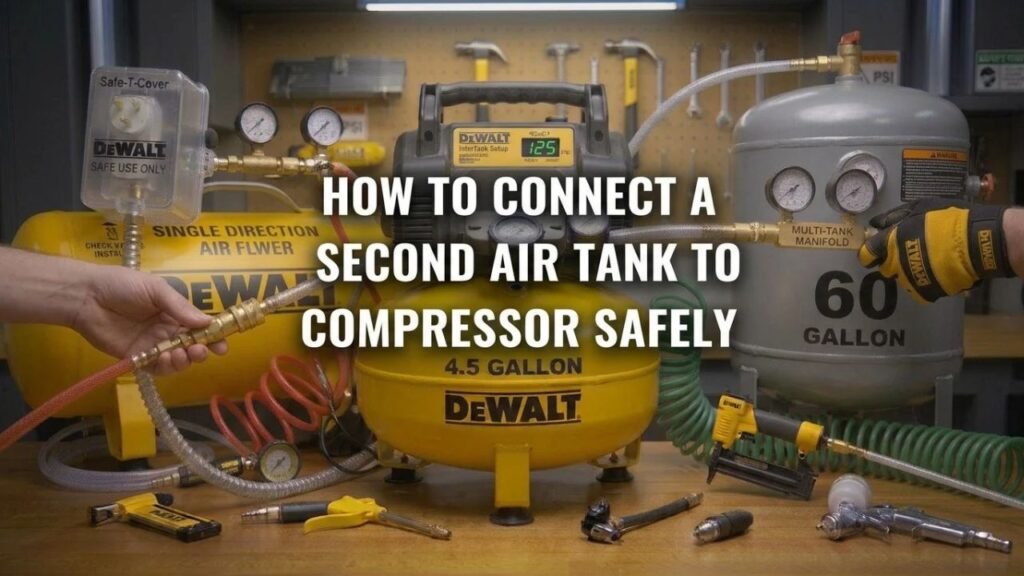
A second tank adds air-storage volume to the compressor system.
It does not add horsepower or increase the pump’s actual air-production rate.
A Second Air Tank Gives You More Stored Air
Suppose the compressor has a 10-gallon tank and you add another 10-gallon receiver.
The system now has roughly 20 gallons of receiver volume available when both tanks are connected and able to equalize.
That extra capacity can give short-demand tools more working time before pressure falls enough for the compressor to recover.
The Compressor Takes Longer to Fill Both Tanks
The pump now has more volume to pressurize.
Starting from empty, two tanks will take longer to reach operating pressure than the original tank alone.
Once filled, the compressor may start less frequently during intermittent work, but each recovery cycle can run longer because more stored air must be replenished.
A Second Tank Does Not Increase Compressor CFM
This is the most important limitation.
If an air sander consumes 10 CFM while the compressor produces only 5 CFM at the required pressure, another tank does not erase the 5-CFM deficit.
The larger receiver delays the pressure drop.
Once the stored reserve is depleted, the compressor still cannot sustain a 10-CFM continuous demand.
Key Takeaway: A second receiver increases stored air and burst time, but it does not increase the compressor pump’s CFM or create a higher safe working pressure.
What You Need to Connect an Extra Tank to an Air Compressor
Use components specifically rated for compressed-air service.
Typical parts include:
- Compressed-air receiver tank
- Pressure-rated air hose or approved rigid piping
- Correct NPT fittings
- Tee or manifold if required
- Quick-connect couplers
- Pressure gauge
- Pressure relief valve
- Drain valve
- Ball valve for isolation when appropriate
- Thread sealant approved for compressed-air fittings
- Regulator where required
Do not substitute random containers for an air receiver.
Use a Real Compressed-Air Receiver Tank
The auxiliary tank should be built and rated for compressed air.
Do not repurpose:
- Propane cylinders
- Refrigerant tanks
- Fire extinguishers
- Homemade welded vessels
- Unrated steel containers
A pressure vessel stores a large amount of energy.
Its maximum allowable working pressure must be suitable for the pressure it will see.
Check the Auxiliary Tank Pressure Rating
The second tank’s rated working pressure must never be lower than the maximum pressure that can reach it.
For example, if a compressor shuts off at 150 PSI, a directly connected auxiliary receiver must be approved for at least that system pressure.
Do not rely only on the compressor’s normal working pressure.
Consider its maximum cut-out pressure.
Use Pressure-Rated Hose and Fittings
Every component between the tanks must be rated for the system.
That includes:
- Hose
- Couplers
- Nipples
- Tees
- Ball valves
- Regulators
The system is only as safe as its lowest-rated pressure-containing component.
Key Takeaway: The auxiliary receiver, hose, valves, couplers, and fittings all need pressure ratings suitable for the highest pressure they can experience.
How to Connect a Second Air Tank to Compressor Through the Outlet
For many home-garage users, connecting a portable auxiliary tank through the normal compressor outlet is the simplest arrangement.
The general airflow path is:
Compressor → regulator/outlet → air hose → auxiliary tank → tool hose → air tool
This avoids opening or modifying the main receiver plumbing.
Step 1: Shut Off and Depressurize the Compressor
Turn the compressor off.
Unplug it or disconnect its electrical supply.
Open the drain or outlet and wait until the system gauge reaches zero.
The auxiliary tank should also be completely depressurized before fittings are installed or changed.
Never loosen a fitting while a tank is pressurized.
Step 2: Check the Second Tank
Before connecting anything, inspect the receiver for:
- Correct pressure rating
- Damage
- Heavy corrosion
- Missing drain
- Damaged threads
- Working gauge
- Correct relief valve
Do not use a tank with serious rust, dents, structural damage, or questionable repairs.
Step 3: Install the Auxiliary Tank Fittings
A portable tank normally needs an inlet and an outlet.
A typical arrangement may include:
- Inlet quick coupler
- Pressure gauge
- Pressure relief valve
- Outlet valve or coupler
- Drain at the low point
Follow the tank manufacturer’s intended port layout.
Do not move or replace a safety component simply to create a convenient connection point.
Step 4: Connect the Compressor to the Auxiliary Tank
Run pressure-rated air hose from the compressor outlet to the tank inlet.
Make sure all quick-connect fittings are fully seated.
For threaded fittings, use an appropriate thread sealant according to the fitting manufacturer’s directions.
Keep sealant away from the inside of valves and air passages.
Step 5: Connect the Air Tool to the Auxiliary Tank
Connect the working hose to the auxiliary tank outlet.
The airflow becomes:
compressor → second tank → tool
This lets the tank act as additional downstream storage.
Step 6: Set a Safe Compressor Outlet Pressure
The pressure reaching the extra tank must remain below its rated working pressure.
If the auxiliary receiver is connected after the compressor regulator, that regulator becomes part of the pressure-control arrangement.
Never turn the regulator above the tank, hose, or fitting rating.
Step 7: Pressurize the System Gradually
Start the compressor.
Let the pressure rise while watching:
- Main tank gauge
- Auxiliary tank gauge
- Connections
- Hose
- Valves
Do not walk away during the first pressurization of a new setup.
Step 8: Check Every Connection for Air Leaks
Apply soapy water to threaded joints and connections.
Growing bubbles indicate a leak.
Depressurize the system completely before tightening or resealing any leaking fitting.
Step 9: Test the Tool at Low Demand
Connect the intended air tool and test the system.
Watch how quickly:
- Auxiliary pressure falls
- Compressor starts
- Compressor recovers
- Tool pressure changes
A large pressure drop during tool operation may indicate undersized hose, restrictive couplers, regulator limits, or more tool demand than the compressor can supply.
Key Takeaway: The simplest extra-tank setup connects the compressor’s normal outlet to a rated auxiliary receiver, then supplies the tool from that receiver without modifying the main compressor tank.
How to Connect an Extra Tank Before the Compressor Regulator
A second receiver can also be connected so it sees the compressor’s full tank pressure.
This arrangement makes both tanks function more like one larger air-storage system.
It is also a more involved installation.
Use a Manufacturer-Approved Full-Pressure Connection Point
Suitable systems may have:
- Spare receiver port
- Approved manifold port
- Factory auxiliary-air connection
A connection upstream of the regulator can expose the extra tank to the compressor’s full cut-out pressure.
Do not randomly remove components from the compressor to create a port.
Do Not Remove or Block the Safety Relief Valve
The primary receiver’s safety valve must remain able to protect the tank.
Do not install a shutoff valve between a receiver and its safety relief valve.
The auxiliary receiver should also retain the safety protection specified for that tank.
Install an Appropriate Connecting Line
Use pressure-rated hose or approved compressed-air piping from the approved main-system port to the auxiliary receiver.
The line should be large enough to avoid unnecessary airflow restriction.
Add an Isolation Valve Only in a Safe Location
A ball valve can make it possible to disconnect or service the second tank.
The valve must not isolate a receiver from its required pressure relief protection.
If closing a valve can trap pressurized air, the isolated section still needs appropriate pressure protection.
Use a Check Valve Only When the System Calls for One
Some compressor manufacturers require a one-way check valve when an auxiliary receiver is added.
Its purpose may include preventing:
- Backflow
- Moisture migration
- Unwanted pressure interaction
Other systems are intentionally plumbed so both receivers equalize in both directions.
Do not assume a check valve belongs in every two-tank arrangement.
Follow the compressor and receiver manufacturer’s plumbing requirements.
Key Takeaway: A full-pressure auxiliary receiver should connect only through an approved system port while preserving relief valves, pressure ratings, drains, and any manufacturer-required check-valve arrangement.
Where to Connect the Second Air Tank on a Compressor
There are two practical connection locations, and they produce different results.
After the Compressor Regulator
Connecting after the regulator is simpler.
Advantages include:
- Minimal compressor modification
- Easy portable setup
- Pressure can be limited before reaching the auxiliary tank
- Quick-disconnect hoses are easy to use
The disadvantage is that the regulator and outlet fittings can restrict how fast the second tank fills and how much airflow reaches the tool.
Before the Compressor Regulator
A pre-regulator tank can store air at full receiver pressure.
This gives more stored air for a tank of the same size.
It also means the auxiliary tank and all connecting hardware must tolerate the compressor’s full cut-out pressure.
Which Connection Makes More Sense?
For a portable DIY setup, I would generally favor the normal regulated outlet unless the compressor manufacturer provides a specific auxiliary-receiver connection.
For a permanent full-pressure installation, use the compressor’s approved plumbing arrangement rather than improvising around the safety valve, pressure switch, or tank check valve.
Key Takeaway: A downstream connection is simpler and pressure-limited, while a pre-regulator connection stores full receiver pressure but requires a properly engineered full-pressure installation.
Do You Need a Check Valve Between Two Air Tanks?
Not automatically.
The answer depends on how the tanks and outlets are arranged.
When a Check Valve May Be Required
A compressor manufacturer may specify a check valve to:
- Prevent auxiliary-tank backflow
- Keep moisture from moving toward the compressor
- Protect a special separator or control system
- Maintain correct unloading behavior
In that case, use the specified direction and valve type.
When Tanks Need to Equalize
If two receivers are intended to behave as one common storage volume, the plumbing may allow air to flow in both directions.
Installing a one-way valve in the wrong location can prevent the second tank from feeding the point of use.
Do Not Confuse the Tank Check Valve With an Auxiliary Valve
Many compressors already contain a check valve between the pump discharge and main receiver.
That valve serves a different function from an optional valve between receiver tanks.
Key Takeaway: A check valve is system-dependent; install one only when the compressor design, auxiliary-tank arrangement, or manufacturer instructions call for it.
Does a Second Air Tank Need Its Own Pressure Relief Valve?
A directly pressurized auxiliary receiver should have the safety equipment specified for that pressure vessel.
A typical receiver setup includes:
- Pressure relief valve
- Pressure gauge
- Drain valve
The relief valve protects the tank if pressure rises beyond its safe operating range.
Never:
- Plug the relief-valve port
- Disable the valve
- Tie the pull ring closed
- Put a shutoff valve between the receiver and its relief valve
If the second tank was designed as a portable compressed-air receiver, keep its original safety hardware intact.
What Size Hose Should Connect an Extra Air Tank?
Hose size affects how quickly air moves between the compressor, tank, and tool.
A small hose may work for inflation or low-flow tools while creating too much restriction for:
- Air sanders
- Die grinders
- Spray equipment
- Large impact tools
Common portable compressor systems use 1/4-inch, 3/8-inch, or larger air lines depending on required airflow.
Do not choose hose size based on tank gallons alone.
Check the tool’s airflow demand and the compressor’s outlet size.
Quick Couplers Can Also Restrict Flow
A large hose still cannot move high airflow efficiently through a very restrictive coupler.
For demanding tools, evaluate the whole flow path:
- Regulator
- Coupler
- Hose
- Tee
- Tank port
- Tool fitting
The smallest restriction can become the bottleneck.
How Large Should a Second Air Tank Be?
There is no single ideal size.
Common portable auxiliary receivers may range from a few gallons to 20 gallons or more.
Small Extra Tank
A small receiver works well for:
- Tire inflation
- Nailers
- Small impact tools
- Short bursts
It fills relatively quickly.
Medium Extra Tank
A larger portable receiver can add useful reserve for:
- Automotive work
- Intermittent air tools
- Remote tool use
Large Extra Receiver
A 20-, 30-, or larger gallon tank provides much more storage but also takes substantially longer to fill.
The compressor pump still determines recovery.
Adding a huge tank to a small compressor may create a long initial fill and long recovery cycle without making a continuous high-CFM tool practical.
Will an Extra Air Tank Increase CFM?
No.
An extra tank increases the amount of air stored, not the rate at which the compressor produces air.
Think of it as adding a larger battery of compressed air.
The larger reserve can supply a high-demand tool temporarily.
Once stored pressure drops, pump output becomes the limiting factor again.
For continuous tools, compare:
compressor SCFM at tool pressure vs. tool CFM requirement
If the tool consistently consumes more air than the compressor produces, the second tank only extends the time before pressure drops.
Will an Extra Air Tank Increase PSI?
No.
Connecting two tanks does not add their pressure ratings together.
If both tanks equalize at 120 PSI, the combined system is still at approximately 120 PSI.
You gain:
- More air volume
You do not get:
- 240 PSI
Never exceed the lowest safe pressure rating in the connected system.
Can You Connect Tanks With Different Sizes?
Yes, provided both are proper compressed-air receivers and every pressure-containing component is suitable for the system pressure.
For example, a 6-gallon compressor can be connected to a 10- or 20-gallon auxiliary tank.
Tank size does not have to match.
The main changes are:
- Total stored-air volume
- Fill time
- Recovery behavior
- Physical size
Pressure ratings matter more than matching gallon capacity.
Can the Extra Air Tank Be Placed Near the Air Tool?
Yes, and this can be useful.
Placing an auxiliary receiver near a high-demand tool creates a local reservoir of compressed air.
This may reduce short-duration pressure drop caused by a long hose.
A remote setup can be useful for:
- Impact wrench
- Tire service
- Nailers
- Intermittent shop tools
The hose feeding the remote tank still needs enough capacity to refill it properly.
For high-flow continuous work, undersized long hose remains a restriction.
How to Add a Regulator to the Second Air Tank
A regulator controls tool pressure.
It does not increase airflow or stored pressure.
A useful arrangement can be:
compressor → auxiliary tank → regulator → tool
This lets the tank store air at its approved pressure while the tool receives a lower pressure.
For example, the receiver may store air above 100 PSI while the tool operates around its specified working pressure.
Always set the regulator based on the tool manufacturer’s requirement.
Do not use excessive tool pressure in an attempt to compensate for low CFM.
How to Drain Moisture From a Second Air Tank
Compressed air contains water vapor.
As air cools inside a receiver, some moisture condenses into liquid.
The second tank therefore needs routine draining just like the main compressor receiver.
Use the Lowest Drain Point
A receiver drain is normally located at or near the bottom.
This lets accumulated water escape.
Depressurize as Required Before Service
Follow the tank instructions when draining or working on the valve.
Never remove a threaded drain fitting from a pressurized receiver.
Drain Both Tanks
Adding an auxiliary receiver creates another place where water can collect.
Do not maintain only the original compressor tank.
Keep the Drain Accessible
Do not install the second tank where its drain cannot be reached.
Key Takeaway: An auxiliary receiver collects condensate too, so its drain must remain accessible and be used regularly along with the main tank drain.
How to Check an Extra Air Tank Connection for Leaks
A leak wastes stored air and makes the compressor run more often.
Pressurize the System
Bring the system up gradually.
Apply Soapy Water
Brush or spray soapy water around:
- Threaded connections
- Tees
- Nipples
- Couplers
- Valve stems
Watch for Growing Bubbles
A persistent growing bubble indicates escaping air.
Depressurize Before Repairing the Leak
Do not tighten fittings while they are fully pressurized.
Bleed the system to zero, correct the joint, then test again.
For a newly assembled system, checking every connection is worth the extra few minutes.
Common Mistakes When Connecting a Second Air Tank to a Compressor
Several mistakes can turn a useful auxiliary tank into an unsafe or disappointing setup.
Using an Unrated Tank
Only use a vessel designed for compressed air.
Exceeding the Auxiliary Tank Pressure Rating
The second tank must safely tolerate every pressure it can receive.
Removing a Safety Valve to Gain a Port
Do not sacrifice pressure protection for plumbing convenience.
Installing a Shutoff Valve Before a Relief Valve
A receiver must not be isolated from its required pressure-relief protection.
Assuming the Second Tank Doubles CFM
Storage and compressor output are different.
Assuming Two Tanks Double PSI
Pressure does not add when receiver tanks are connected.
Using Tiny Hose for a High-CFM Tool
Restricted fittings and hoses can cause large pressure drop.
Using PVC Water Pipe for Compressed Air
Ordinary PVC or CPVC water piping is not a safe exposed compressed-air distribution choice because failure can send sharp fragments outward.
Use materials intended and rated for compressed-air service.
Ignoring Condensate
Both receivers require drainage.
Modifying the Compressor’s Pressure Switch
Adding a tank is not a reason to increase cut-out pressure.
Do not adjust a compressor above its approved operating range.
Key Takeaway: The most serious mistakes involve unrated pressure vessels, defeated safety valves, excess pressure, unsuitable piping, and expecting an auxiliary tank to create compressor output it cannot produce.
Why the Second Air Tank Fills Slowly
Some fill delay is normal because the compressor now has more receiver volume.
Very slow filling can also point to restriction.
Possible causes include:
- Compressor regulator set too low
- Small hose
- Restrictive quick coupler
- Partially closed valve
- Clogged fitting
- Air leak
- Compressor pump already near its limit
If the tank is connected after the regulator, that regulator may intentionally limit fill flow.
A direct full-pressure connection through an approved manifold usually fills differently because it does not depend on the downstream tool regulator.
Why the Second Air Tank Does Not Improve Tool Runtime Much
The tool may simply require too much airflow.
For example, adding extra storage may noticeably improve an impact wrench used for a few seconds at a time.
The same tank may make little long-term difference with a random orbital air sander that runs almost continuously.
Other causes include:
- Small auxiliary tank
- Low storage pressure
- Restrictive hose
- Leaking connections
- Undersized couplers
- Tool pressure set incorrectly
Compare actual compressor output with the tool’s required CFM at the same PSI.
Can You Disconnect the Second Air Tank After It Is Filled?
A portable auxiliary receiver can be used independently if it was specifically designed for that purpose and has the correct valves and fittings.
Close the isolation valve according to the tank’s instructions before disconnecting it.
Remember that the tank remains pressurized even though it is no longer attached to the compressor.
Protect the couplers and valve from impact.
Do not leave a pressurized portable receiver:
- In extreme heat
- Where it can roll around
- Where fittings can be struck
- Near corrosive chemicals
Release or retain pressure according to the tank manufacturer’s storage instructions.
When You Should Not Add a Second Air Tank
An auxiliary tank is not the answer to every compressor problem.
Do not use one as a workaround for:
- Severely undersized compressor pump
- Rusted primary receiver
- Faulty pressure switch
- Bad safety valve
- Compressor overheating
- Excessive duty-cycle operation
- Electrical problems
- Large continuous CFM deficit
If the compressor runs nearly nonstop with the existing workload, adding storage may simply create longer run cycles.
For continuous sanding, grinding, blasting, or spraying, upgrading compressor output may be more useful than adding tank volume.
Conclusion
For how to connect a second air tank to compressor, the simplest approach is to connect a proper auxiliary air receiver to the compressor’s normal outlet with pressure-rated hose and fittings, then connect the tool downstream of the extra tank. This adds storage without requiring modification of the main receiver.
For how to connect extra tank to air compressor at full receiver pressure, use only a manufacturer-approved tank or manifold connection. The auxiliary receiver must have appropriate pressure capacity, drainage, pressure indication, and relief protection, and no modification should disable the compressor’s existing safety devices.
The extra tank can extend short tool runs, reduce how quickly stored pressure falls, and provide useful remote air storage. It cannot increase compressor CFM or make two tank pressures add together.
Before using the finished setup, pressurize it gradually, inspect every joint for leaks, check both tank pressure ratings, keep drains accessible, and confirm that the tool receives the correct regulated pressure. If the compressor has no approved full-pressure expansion point, a normal outlet-fed auxiliary tank is the safer approach than modifying pressure-vessel plumbing.
FAQs About Connecting an Extra Air Tank to an Air Compressor
Can I add a second tank to any air compressor?
A second tank can be used with many compressors, but the receiver, hose, fittings, and valves must suit the compressor’s pressure and airflow. Compressor-specific instructions should be checked before modifying any full-pressure plumbing.
Does adding another air tank make my compressor more powerful?
No. It increases stored-air capacity but does not increase motor horsepower or pump CFM. It can give a high-demand tool a longer short burst before pressure falls.
Should I connect the second air tank before or after the regulator?
Connecting after the regulator is simpler and useful for portable setups. Connecting before the regulator stores full receiver pressure but requires a properly rated tank and an approved full-pressure connection.
Do I need a check valve when connecting an extra air tank?
Not in every setup. Some compressor manufacturers require a one-way valve, while other systems allow the tanks to equalize freely. Use the arrangement specified for the compressor and receiver.
Can I connect a 20-gallon tank to a 6-gallon air compressor?
Yes, if the 20-gallon receiver and all connecting components are properly pressure-rated. The compressor will take longer to fill the combined 26 gallons, and its CFM output will remain unchanged.
Does a second air tank increase PSI?
No. Two connected tanks equalize at the system pressure. A 120-PSI tank connected to another tank at the same system pressure does not produce 240 PSI.
Can I use an old propane tank as an auxiliary air tank?
No. Use a receiver designed, rated, and equipped for compressed-air service. Repurposing an unrelated pressure vessel introduces unnecessary structural and safety uncertainty.
Why does my compressor run longer after adding an extra tank?
The pump has more total air volume to refill. Longer recovery cycles are normal after increasing receiver capacity, even though the larger reserve may reduce how frequently the compressor starts during intermittent use.