
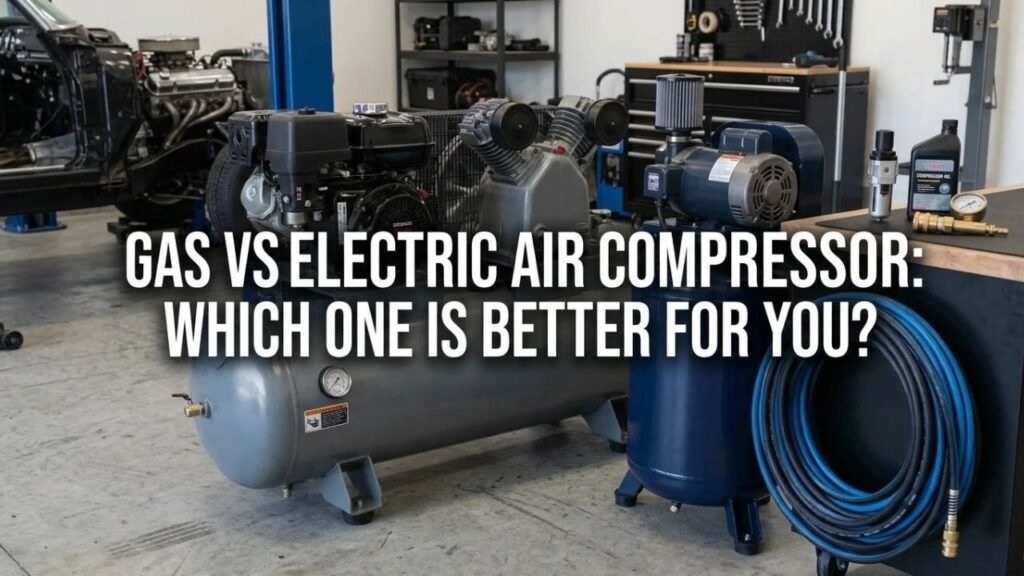
Gas vs Electric Air Compressor: Which One Is Better for You?
A gas air compressor is better for remote jobsites, outdoor work, and situations where electrical power is unavailable. An electric air compressor is usually better for garages, workshops, home use, and indoor environments because it is quieter, easier to maintain, cheaper to operate, and does not produce engine exhaust.
Both types can power pneumatic tools, inflate tires, run nailers, and supply shop air. The main difference is how the compressor motor or engine receives its power.
A gas compressor uses a gasoline engine to turn the compressor pump. This gives it excellent mobility, but it also creates exhaust, noise, heat, and additional maintenance.
An electric compressor uses an electric motor. It needs an outlet or hardwired electrical supply, but operation is generally simpler because there is no gasoline engine, fuel system, or combustion exhaust.
For gas vs electric air compressor, neither type is universally better. Gas wins for portability and independence from the electrical grid. Electric wins for most fixed shop and residential applications.
If you are asking what is better gas or electric air compressor, an electric model is usually the better choice when reliable electricity is available. Choose gas when the compressor must regularly work away from electrical service or where supplying enough electrical power would be difficult.
Gas vs Electric Air Compressor at a Glance
| Feature | Gas Air Compressor | Electric Air Compressor |
| Power Source | Gasoline engine | Electric motor |
| Indoor Use | No | Yes, with normal ventilation |
| Portability | Excellent | Depends on power access |
| Remote Jobsite Use | Excellent | Limited without generator |
| Noise | Higher | Lower |
| Exhaust | Yes | No combustion exhaust |
| Maintenance | More | Less |
| Fuel Cost | Higher | Usually lower |
| Cold Starting | Can be difficult | Usually easier |
| Large Portable Output | Excellent | Good |
| Garage Use | Poor choice indoors | Excellent |
| Jobsite Use | Excellent | Good when power is available |
| Starting Convenience | Pull/electric start | Switch or pressure control |
| Best For | Remote outdoor work | Shops, garages, homes |
What Is a Gas Air Compressor?
A gas-powered air compressor uses an internal-combustion engine to drive the compressor pump.
The Gas Engine Replaces the Electric Motor
The basic compressor section may resemble an electric reciprocating compressor.
The difference is that power comes from a gasoline engine through:
- Belt drive
- Direct drive
- Pulley system
depending on the machine.
It Does Not Need an Electrical Outlet
This is the biggest advantage.
A gas compressor can operate:
- At construction sites
- On farms
- Along roads
- In fields
- At remote properties
- From service trucks
as long as fuel is available.
Many Gas Models Are Built for Heavy Work
Gas-powered units are common where high airflow and mobility are both important.
Typical applications include:
- Framing crews
- Roofing
- Mobile tire service
- Agricultural repairs
- Construction
- Road work
Exhaust Makes Indoor Use Dangerous
Gasoline engines produce carbon monoxide and other combustion gases.
Do not run a gas-powered compressor in:
- Garage
- Basement
- Workshop
- Trailer
- Shed
- Enclosed building
unless the equipment is specifically designed and installed for safe external-engine operation.
Key Takeaway: A gas compressor uses a gasoline engine instead of an electric motor, giving it strong portability but limiting it to safe outdoor or properly engineered operating locations.
What Is an Electric Air Compressor?
An electric air compressor uses an electric motor to drive the pump.
It Can Be Portable or Stationary
Electric compressors range from:
- Small pancake models
- Hot-dog compressors
- Portable twin-stack units
- 20-gallon shop compressors
- 60-gallon vertical models
- Large industrial systems
Power Requirements Vary
Small compressors may operate from a standard household circuit.
Larger machines may require:
- 240 volts
- Dedicated circuits
- Hardwiring
- Three-phase power
Always match electrical supply to the compressor nameplate.
No Combustion Exhaust
Electric motors do not create carbon monoxide.
That makes electric compressors suitable for indoor shops when normal equipment ventilation and dust-control practices are followed.
Electric Motors Need Less Routine Service
There is no need to maintain:
- Fuel
- Carburetor
- Engine oil on engine-equipped models
- Spark plug
- Fuel filter
The compressor pump itself may still require oil and other routine service.
Key Takeaway: Electric compressors are available in everything from small portable models to large stationary systems and are usually simpler, quieter, and easier to operate indoors.
What Is Better, Gas or Electric Air Compressor?
For most homeowners and fixed workshops, electric is better.
For remote outdoor work, gas is better.
Choose Electric If
You normally work in:
- Garage
- Workshop
- Home
- Manufacturing facility
- Auto repair shop
and have suitable electrical service.
Choose Gas If
You regularly work:
- On construction sites
- Away from utility power
- From a service truck
- On farms
- In remote locations
Think About the Work Location First
The most important question is not horsepower.
Ask:
Will reliable electrical power be available where the compressor needs to operate?
If yes, electric usually makes more sense.
If no, gas may solve the problem without needing a generator.
Key Takeaway: Electric is the better default choice where suitable power exists; gas becomes the stronger option when reliable electricity is unavailable.
Gas vs Electric Air Compressor for Power
Both can produce substantial airflow.
Power source alone does not determine compressor performance.
Compare CFM Rather Than Fuel Type
The most useful number for air-tool compatibility is usually:
SCFM at the required PSI
For example, compare both compressors at:
- 90 PSI
- 100 PSI
- Whatever pressure your tool needs
Gas Compressors Can Deliver High Portable Output
Large gasoline engines make it practical to build portable compressors with enough airflow for demanding tools.
This is especially useful where providing equivalent electrical power would require:
- Large generator
- Heavy electrical service
- Long high-capacity cables
Electric Compressors Can Be Extremely Powerful
Stationary electric compressors can easily exceed the performance of portable gas machines.
Large industrial electric units can support entire production facilities.
So gas does not automatically mean more powerful.
Key Takeaway: Compare SCFM at working pressure rather than assuming gas or electric automatically produces more air.
Gas vs Electric Air Compressor for Portability
Gas wins when true independence from electrical power matters.
Gas Compressor Portability
You can place a gas unit near the work area without finding an outlet.
That makes it useful for:
- Framing
- Roofing
- Fence installation
- Agricultural work
- Roadside repair
Electric Portable Compressors
Small electric compressors can be very easy to carry.
The limitation is the power cord.
You need:
- Suitable outlet
- Correct circuit
- Proper extension cord when permitted
Cordless Compressors Are Another Option
Battery-powered compressors have become useful for:
- Tire inflation
- Trim nailers
- Light jobsite work
They cannot normally replace a large gas compressor for continuous high-CFM demand.
Key Takeaway: Gas compressors offer greater functional portability because they do not depend on electrical infrastructure, even though some electric models are physically smaller and lighter.
Gas vs Electric Air Compressor for Indoor Use
Electric wins clearly.
Gas Engines Produce Carbon Monoxide
Carbon monoxide is:
- Colorless
- Odorless
- Potentially deadly
It can accumulate quickly in enclosed spaces.
Opening a garage door does not automatically make indoor operation safe.
Electric Motors Produce No Combustion Exhaust
An electric compressor can be used in a garage or workshop when installed properly.
You still need to manage:
- Heat
- Noise
- Airborne dust
- Moisture
- Electrical safety
but carbon monoxide from the compressor is not a concern.
Do Not Put a Running Gas Compressor Just Outside an Opening
Exhaust can enter through:
- Door
- Window
- Vent
- HVAC intake
Place gas-powered equipment well away from occupied spaces according to manufacturer and safety guidance.
Key Takeaway: Electric compressors are the proper choice for indoor use because gasoline engines create dangerous carbon-monoxide exhaust.
Gas vs Electric Air Compressor for Noise
Electric compressors are generally quieter.
Gas Compressors Have Two Noise Sources
You hear:
- Compressor pump
- Gasoline engine
Engine exhaust adds another strong sound source.
Electric Compressors Eliminate Engine Noise
You still hear:
- Pump
- Cooling fan
- Intake noise
- Vibration
but there is no gasoline engine running beside it.
Quiet Electric Models Are Available
Some electric compressors use:
- Low-RPM pumps
- Isolation mounts
- Intake silencers
- Enclosures
to reduce sound significantly.
Hearing Protection May Still Be Needed
Even electric compressors can produce high sound levels.
Use appropriate hearing protection when exposure is prolonged or the measured noise level calls for it.
Key Takeaway: Electric compressors are usually quieter because they avoid gasoline-engine and exhaust noise, while gas units tend to be noticeably louder.
Gas vs Electric Air Compressor Maintenance
Electric compressors usually require less maintenance.
Gas Compressor Maintenance
Depending on the model, service may include:
- Engine oil
- Spark plug
- Air filter
- Fuel system
- Carburetor
- Fuel stabilizer
- Engine cooling system
- Compressor pump oil
- Belts
There are essentially two machines to maintain:
- Engine
- Compressor pump
Electric Compressor Maintenance
The electric motor usually needs little routine attention.
Service often centers on:
- Compressor oil, if oil-lubricated
- Air filter
- Belts
- Tank draining
- Fasteners
- Valves
Storage Is Easier With Electric
Long-term gasoline storage can create problems with:
- Old fuel
- Carburetor deposits
- Moisture
- Starting
Electric compressors avoid those fuel-related issues.
Key Takeaway: Electric compressors have fewer routine service items because they do not include a gasoline engine or fuel system.
Gas vs Electric Air Compressor Operating Cost
Electric models are normally cheaper to operate where utility power is available.
Gas Requires Fuel
Operating expense changes with:
- Gasoline price
- Engine efficiency
- Load
- Runtime
Small gasoline engines are not especially efficient compared with an electric motor connected to utility power.
Electricity Is Usually More Economical
Electric motors convert a high percentage of input energy into mechanical output.
They also avoid:
- Fuel trips
- Fuel storage
- Engine maintenance
Jobsite Economics Are Different
If no electrical service exists, the comparison changes.
Running an electric compressor may require:
- Generator
- Fuel for generator
- Additional equipment
- Larger electrical cabling
A gas compressor may then be simpler and cheaper overall.
Key Takeaway: Utility-powered electric compressors usually cost less to run, while gas can make economic sense when supplying adequate electricity would require extra equipment.
Gas vs Electric Air Compressor Starting
Electric compressors are easier to start.
Electric Compressor
Normally you:
- Connect power.
- Turn the pressure switch on.
- Let the compressor cycle automatically.
Gas Compressor
Depending on design, starting may require:
- Fuel valve
- Choke
- Throttle setting
- Pull start
- Electric starter
Cold weather or old fuel can make starting harder.
Gas Models Still Use Automatic Compressor Controls
The gas engine may continue running while the compressor pump unloads when the receiver reaches pressure.
The exact control system varies by model.
Key Takeaway: Electric compressors offer simpler push-button or automatic starting, while gas engines involve additional fuel and engine-starting controls.
Gas vs Electric Air Compressor for Continuous Use
Either can handle demanding work if correctly rated.
Duty Cycle Matters
Do not assume gas can run forever simply because the engine is fueled.
The compressor pump still has:
- Temperature limits
- Lubrication requirements
- Duty-cycle rating
Industrial Electric Compressors Are Built for Long Runtime
Many electric systems are designed for:
- Continuous production
- Manufacturing
- Large workshops
Electric motors are well suited to long operating periods.
Gas Is Useful for Mobile Continuous Demand
A heavy-duty gas compressor can be valuable for prolonged jobsite use where there is no practical electrical supply.
Key Takeaway: Continuous-use capability depends on compressor design and duty rating, not simply on whether the power source is gas or electricity.
Gas vs Electric Air Compressor for Air Tools
Both can power pneumatic tools when they provide enough airflow.
Nail Guns
Most nailers use air intermittently.
A small electric compressor is usually sufficient.
Gas offers little advantage unless the worksite lacks electricity.
Impact Wrenches
Both can work well.
Check:
- Tool SCFM
- Compressor SCFM at operating PSI
- Tank size
- Hose diameter
Air Sanders
Air sanders consume a lot of air continuously.
A larger compressor is needed regardless of power source.
Die Grinders
These also have high sustained airflow requirements.
Compare continuous CFM rather than tank gallons.
Spray Guns
A compressor must provide adequate clean airflow.
For indoor spraying, an electric compressor avoids engine exhaust near the work area.
Key Takeaway: Tool compatibility depends primarily on SCFM at required PSI, while the gas-or-electric decision depends more on location and power availability.
Gas vs Electric Air Compressor for Construction Sites
Gas often has the advantage.
Construction Power May Be Limited
Early in a project, permanent electrical service may not exist.
A gas compressor can immediately run:
- Framing nailers
- Roofing nailers
- Blow guns
- Other pneumatic equipment
Heavy Extension Cords Can Be Problematic
Long cords create:
- Voltage drop
- Tripping hazards
- Motor-starting problems
Gas Gives Crews More Placement Flexibility
The compressor can be positioned where:
- Exhaust disperses safely
- Noise is manageable
- Hose runs remain practical
Electric Is Better When Site Power Is Reliable
Once adequate power is available, an electric compressor can eliminate:
- Fuel handling
- Exhaust
- Engine maintenance
Key Takeaway: Gas is especially useful on construction sites before adequate electrical service is available, while electric becomes attractive once reliable power is established.
Gas vs Electric Air Compressor for a Garage
Electric is the clear choice for a typical garage.
Indoor Safety
Gas compressors should not operate inside an enclosed garage because of carbon monoxide.
Easy Automatic Cycling
An electric unit can remain connected and automatically start when receiver pressure falls.
Lower Noise
This matters in:
- Residential garages
- Attached shops
- Neighborhoods
Less Maintenance
There is no gasoline engine to service.
For garage use, choose the compressor size based on the highest-demand air tools rather than selecting gas for extra power.
Key Takeaway: For a home or automotive garage with suitable electricity, an electric compressor is safer, quieter, simpler, and usually cheaper to operate.
Gas vs Electric Air Compressor for a Service Truck
Gas has traditionally been a strong option for mobile service vehicles.
No External Power Needed
A gas unit can supply air wherever the truck goes.
This can support:
- Tire service
- Roadside repair
- Equipment maintenance
- Agricultural repair
Electric Systems Are Possible
A truck may use:
- Generator
- Inverter
- Engine-driven electrical system
- Battery bank
to power an electric compressor.
The electrical system must be sized for compressor startup and sustained load.
Other Mobile Compressor Types Exist
Some commercial service trucks use:
- Hydraulic compressors
- PTO-driven compressors
- Engine-driven screw compressors
These may be more appropriate than either a standalone gas or conventional electric machine for high-demand fleet work.
Gas vs Electric Air Compressor in Cold Weather
Electric units generally start more easily.
Gas Engines Can Be Harder to Start
Cold temperatures affect:
- Oil viscosity
- Battery output
- Fuel vaporization
- Carburetion
Electric Motors Avoid Combustion Starting Problems
They still face cold-weather issues involving:
- Compressor oil
- Condensation
- Electrical supply
but starting is usually more straightforward.
Use the Correct Lubricant
Oil-lubricated compressors may specify different lubricant requirements for low-temperature service.
Always follow the pump manual.
Key Takeaway: Electric compressors generally offer easier cold-weather starting, while gas engines add fuel, oil, choke, and battery considerations.
Gas vs Electric Air Compressor for High CFM
Do not choose from the power source alone.
Gas Can Deliver High CFM in a Portable Package
This is one of its strongest benefits.
A large engine can drive a substantial pump without requiring access to high-capacity electrical service.
Electric Can Deliver Even More in Fixed Installations
Large electric compressors can provide:
- High CFM
- High duty cycle
- Multi-compressor sequencing
for industrial environments.
Match Output to the Tool
For example, if an air sander requires 12 CFM at 90 PSI, choose a compressor capable of supplying at least that amount under sustained conditions.
Do not compare only:
- Horsepower
- Tank gallons
- Maximum PSI
Key Takeaway: Gas is attractive for high portable airflow, while electric handles extremely high airflow well in fixed installations with adequate electrical service.
Gas vs Electric Compressor Reliability
Both can last a long time with proper maintenance.
Gas Has More Systems That Can Fail
A gasoline unit includes:
- Ignition
- Fuel delivery
- Carburetion
- Engine lubrication
- Exhaust
along with the compressor components.
Electric Motors Are Mechanically Simpler
Electric units eliminate most engine-related failure points.
Compressor Pump Quality Still Matters
A high-quality gas compressor may outlast a poorly built electric model.
Compare:
- Pump speed
- Lubrication
- Duty cycle
- Cylinder design
- Parts availability
instead of relying on power source alone.
Gas vs Electric Air Compressor Environmental Considerations
Electric models have no local combustion exhaust.
Gas Produces Emissions at the Machine
Combustion produces:
- Carbon dioxide
- Carbon monoxide
- Nitrogen oxides
- Hydrocarbons
Electric Produces No Tailpipe Emissions
The environmental footprint of electricity depends on how the power is generated.
At the point of use, the compressor creates no combustion exhaust.
Noise Also Matters
Lower-noise electric machines can reduce disturbance around:
- Homes
- Indoor workplaces
- Neighborhoods
Advantages of a Gas Air Compressor
Gas compressors have several strong advantages.
Works Without Electricity
The main benefit.
Excellent Remote Portability
Good for mobile and outdoor operations.
High Portable Output
Large gasoline engines can support demanding compressor pumps.
Good for Construction
Useful before permanent electrical service is available.
No High-Amperage Outlet Required
You do not need a nearby high-capacity circuit.
Key Takeaway: Gas compressors excel when mobility, outdoor use, and independence from the electrical grid matter most.
Disadvantages of a Gas Air Compressor
The freedom from electricity comes with tradeoffs.
Cannot Be Safely Operated Indoors
Carbon-monoxide risk is the biggest drawback.
More Maintenance
The gasoline engine adds service requirements.
Louder
You hear both the engine and pump.
Fuel Cost
Gasoline generally costs more than utility electricity for equivalent work.
Fuel Storage
Gasoline requires proper storage and handling.
Harder Starting
Cold weather or stale fuel may cause starting problems.
Key Takeaway: Gas compressors are portable but bring exhaust, noise, fuel cost, and additional maintenance.
Advantages of an Electric Air Compressor
Electric models are the best fit for most fixed installations.
Safe From Combustion Exhaust
No carbon monoxide from an engine.
Lower Operating Cost
Utility electricity is generally economical.
Less Maintenance
No engine fuel or ignition system.
Quieter
Electric motors produce much less noise than gasoline engines.
Easy Starting
Flip a switch or let the pressure control start the machine.
Wide Size Range
Electric compressors are available for everything from trim nailers to industrial facilities.
Key Takeaway: Electric compressors offer simple operation, low maintenance, lower noise, and good indoor suitability when adequate power is available.
Disadvantages of an Electric Air Compressor
The main limitation is dependence on electricity.
Needs a Suitable Power Source
A large compressor may require:
- 240V
- Dedicated circuit
- Three-phase supply
Extension-Cord Limitations
Long or undersized extension cords can cause voltage drop and hard starting.
Less Convenient at Remote Sites
Without power, you may need a generator.
Installation Cost for Large Models
A stationary shop compressor may require electrical upgrades.
Key Takeaway: Electric compressors work extremely well when proper electrical service exists, but power availability can limit mobility and increase installation cost.
Should You Buy a Gas or Electric Air Compressor?
Start with your operating location.
Buy Gas If
You regularly need compressed air:
- Far from electrical service
- Outdoors
- On construction sites
- On farms
- From mobile service equipment
Gas is especially attractive when high portable CFM is required.
Buy Electric If
You work mainly in:
- Garage
- Home workshop
- Auto shop
- Woodworking shop
- Factory
and have suitable power.
For Most Homeowners
Electric is usually the better purchase.
Home compressor jobs often include:
- Tire inflation
- Nailers
- Impact wrench use
- Blow guns
- Occasional painting
- DIY projects
None normally justify the exhaust and maintenance of a gas engine when electricity is readily available.
Key Takeaway: Buy electric for most fixed residential and shop use; buy gas when outdoor mobility and lack of electrical power are regular parts of the job.
Common Mistakes When Choosing Gas vs Electric
Looking only at horsepower can lead to a poor purchase.
Comparing Horsepower Instead of CFM
Tool performance depends heavily on airflow at the required pressure.
Buying Gas for Indoor Use
A gas engine creates dangerous exhaust.
Do not select one for operation inside a garage or workshop.
Assuming Electric Means Weak
Large electric compressors can produce far more air than many gasoline models.
Ignoring Electrical Requirements
A large electric compressor may need circuit upgrades.
Ignoring Gas Maintenance
A gas compressor that sits unused for months can develop fuel-system problems.
Choosing by Tank Size Alone
A larger tank stores more air but does not increase the compressor pump’s continuous CFM.
Key Takeaway: Compare airflow, pressure, duty cycle, work location, electrical supply, and maintenance rather than choosing based on horsepower or tank size alone.
Conclusion
For gas vs electric air compressor, gas is better when portability and independence from utility power are the main priorities. It works well on remote construction sites, farms, service trucks, and outdoor locations where running a large electric compressor would be impractical.
Electric is the stronger choice for most garages, workshops, homes, and fixed commercial installations. It is quieter, simpler to start, cheaper to maintain, and produces no gasoline-engine exhaust.
For what is better gas or electric air compressor, choose based first on where the compressor will run. If reliable electricity is available, an electric compressor usually makes more sense. If you frequently work far from electrical service and need substantial airflow, gas offers more freedom.
Whichever type you choose, size it from the required SCFM at the tool’s operating PSI rather than horsepower or tank gallons alone. That determines whether the compressor can actually keep up with your equipment.
FAQs About Gas vs Electric Air Compressors
Is a gas air compressor more powerful than electric?
Not necessarily. Gas models can provide high portable airflow, but large electric compressors can be much more powerful. Compare SCFM at the required PSI rather than power source alone.
Which is cheaper to run, gas or electric air compressor?
Electric is usually cheaper where utility electricity is readily available. Gas requires fuel and adds engine-maintenance costs.
Can you use a gas air compressor inside a garage?
No. A gasoline engine produces carbon monoxide and should not be operated inside an enclosed garage, workshop, trailer, or similar space.
Is an electric air compressor better for a home garage?
Yes in most cases. Electric models are suitable for indoor operation, create less noise, require less maintenance, and work well for common garage air tools.
Is a gas air compressor good for construction?
Yes. Gas-powered compressors are well suited to construction sites where permanent electrical service is unavailable or insufficient.
Which lasts longer, gas or electric air compressor?
Lifespan depends more on pump quality, operating conditions, maintenance, and duty cycle than on the power source. Electric units have fewer engine-related components to maintain.
Do gas air compressors make more CFM?
Some portable gas compressors offer high CFM, but gas itself does not guarantee more airflow. Compressor pump size and design determine output.
Should I buy gas or electric for air tools?
Buy electric if you normally use air tools in a powered garage or shop. Choose gas when the same tools must operate outdoors or at remote jobsites without reliable electricity.