
Belt Driven vs Electric Air Compressor: Key Differences Explained
A belt-driven air compressor and an electric air compressor are not actually opposite types. “Belt-driven” describes how power is transferred from the motor to the compressor pump, while “electric” describes what powers the motor. Many belt-driven compressors are electric, so the more useful comparison is usually belt drive versus direct drive.
In a belt-driven unit, an electric motor turns a pulley, and a belt transfers that rotation to another pulley attached to the compressor pump. The pulley ratio lets the pump operate at a different speed from the motor.
A direct-drive electric compressor connects the motor much more directly to the compressor pump. This removes belts and pulleys, creates a more compact design, and reduces routine drive-system maintenance.
For belt driven vs electric air compressor, the terminology causes confusion because an electric compressor can use either system. Quincy Compressor, Atlas Copco, and ELGi all describe belt drive and direct drive as alternative ways of connecting the motor to the compressor element.
Belt-driven designs are common on stationary reciprocating compressors and some rotary screw units because pulley ratios provide flexibility and can allow the pump to run slower than the motor. Direct-drive designs eliminate the belt and tend to provide simpler power transmission with fewer drive components.
Energy use can matter substantially in larger shops and industrial facilities. U.S. Department of Energy data has estimated that compressed-air generation accounts for about 10% of electricity use in a typical industrial facility, showing why drive efficiency, compressor sizing, and operating pattern deserve attention.
The better choice depends on your required CFM, duty cycle, noise tolerance, maintenance preference, portability needs, and budget—not simply on whether the compressor has a belt.
Belt Driven vs Electric Air Compressor: What Is the Real Difference?
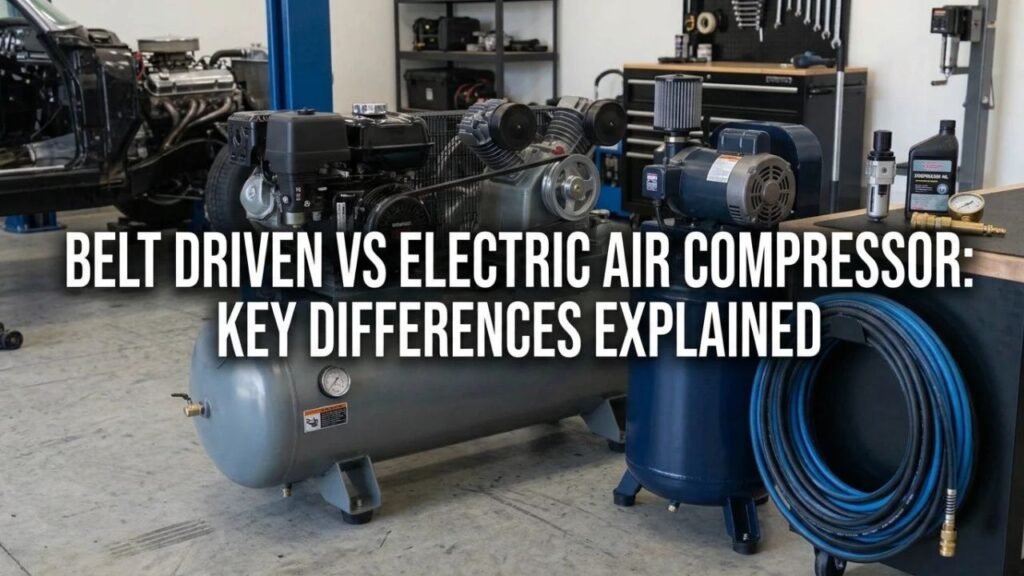
The first step is separating power source from drive system.
What Does Belt Driven Mean?
A belt-driven compressor uses:
- Motor
- Motor pulley
- V-belt or similar belt
- Pump pulley or flywheel
- Compressor pump
The motor spins one pulley.
The belt carries that rotational force to the pump pulley, which drives the compressor.
Atlas Copco describes a belt-drive compressor as using a belt connected between the motor and compressor pump, while a direct-drive unit connects the crankshaft or compressor element directly to the motor.
What Does Electric Air Compressor Mean?
An electric air compressor simply uses an electric motor as its power source.
That motor can drive the compressor in several ways.
An electric compressor may be:
- Belt driven
- Direct driven
- Gear driven on some industrial systems
So an electric compressor can also be a belt-driven compressor.
What Are People Usually Comparing?
When someone searches for a belt-driven versus electric compressor, the intended comparison is often:
Belt-driven electric compressor vs direct-drive electric compressor
That is the comparison used through most of this guide.
If your real choice is electric vs gas-powered air compressor, that is a different comparison involving portability, fuel, exhaust, indoor use, and electrical availability.
Key Takeaway: Belt drive describes how the motor transfers power to the pump, while electric describes the motor’s energy source. Many belt-driven compressors are electric.
Belt-Driven vs Direct-Drive Electric Air Compressor Comparison
Here is the practical difference between the two common electric designs.
| Feature | Belt-Driven Electric | Direct-Drive Electric |
| Motor-to-pump connection | Belt and pulleys | Direct coupling |
| Drive components | More | Fewer |
| Pump speed flexibility | Higher | Usually lower |
| Belt maintenance | Required | None |
| Footprint | Usually larger | Often more compact |
| Portability | Usually lower | Often higher on small models |
| Power-transfer losses | Some belt loss | Typically lower |
| Noise | Often lower on slow-speed piston models | Can be higher on small high-RPM piston units |
| Pump-speed adjustment | Possible through pulley design | Generally fixed |
| Common applications | Garage/shop, stationary compressors | Portable, industrial, compact systems |
| Purchase cost | Often moderate | Varies widely |
| Continuous industrial operation | Depends on compressor design | Common on industrial direct-drive systems |
Do not choose a compressor from this table alone.
CFM, PSI, duty cycle, pump design, motor size, and tank capacity can matter more than the drive type.
How Does a Belt-Driven Air Compressor Work?
The motor and compressor pump are separate components connected by a belt.
Motor Turns the Drive Pulley
When the pressure switch calls for air, the electric motor starts.
The motor shaft rotates a relatively small pulley.
Belt Transfers Power
A V-belt runs between the motor pulley and the larger pump pulley or flywheel.
As the motor pulley rotates, the belt turns the compressor pump.
Pulley Size Controls Pump Speed
One advantage of belt drive is that the pump does not necessarily have to rotate at motor speed.
The ratio between the two pulleys determines pump RPM.
ELGi notes that pulley sizes in belt-drive compressors can be used to alter compressor output and operating speed.
This is useful because many reciprocating compressor pumps operate well at lower speeds than common electric motors.
The Flywheel Can Also Cool the Pump
On many reciprocating compressors, the large pump pulley doubles as a flywheel with fan-like spokes or blades.
As it turns, it moves cooling air across the pump cylinders and intercooler.
This is one reason belt guards need proper ventilation rather than being blocked.
Key Takeaway: A belt-driven compressor uses pulleys and a belt to transfer motor power while allowing the compressor pump to operate at a different speed from the motor.
How Does a Direct-Drive Electric Air Compressor Work?
A direct-drive compressor eliminates the external belt-and-pulley arrangement.
Motor Connects Directly to the Pump
The motor shaft is directly coupled to the compressor mechanism.
Quincy describes direct drive as a system where the crankshaft is connected directly to the motor, eliminating the belt and pulley system.
Fewer Drive Components Are Needed
Without belts and pulleys, there is no need to:
- Adjust belt tension
- Align pulleys
- Replace worn drive belts
This simplifies maintenance.
Small Direct-Drive Piston Compressors May Run Fast
Many portable compressors use high-speed direct-drive pumps to keep the package:
- Small
- Light
- Affordable
- Easy to carry
The tradeoff can be more pump noise and faster cycling compared with a large, slow-speed shop compressor.
This should not be generalized to every direct-drive design. Large industrial direct-drive rotary screw compressors can be engineered for continuous operation and high efficiency.
Key Takeaway: A direct-drive compressor connects the motor directly to the compression mechanism, reducing drive parts and allowing a compact layout.
Which Is More Efficient: Belt Drive or Direct Drive?
Direct drive generally has an advantage in mechanical power-transfer efficiency because it eliminates belt losses.
Belt Drives Have Transmission Losses
A belt bends around pulleys and experiences friction.
Properly designed belt drives can still perform very well, but some motor power is lost through the drive system.
ELGi notes that belt drives can experience power loss through friction, while direct-drive systems avoid belts and offer higher transmission efficiency.
Direct Drive Eliminates Belt Slip
There is no belt to:
- Slip
- Stretch
- Lose tension
- Run out of alignment
This makes the power path more direct.
Compressor Efficiency Is Bigger Than Drive Efficiency Alone
Do not assume a direct-drive compressor always costs less to run solely because it lacks a belt.
Overall energy use also depends on:
- Compressor pump efficiency
- Motor efficiency
- Operating pressure
- Air leaks
- Unloaded running time
- Duty cycle
- Control system
- Compressor sizing
A correctly sized belt-driven unit can be a better purchase than an oversized or inefficient direct-drive unit.
Key Takeaway: Direct drive generally transfers motor power more efficiently, but total compressor energy use depends on the complete machine and compressed-air system.
Which Type Is Quieter?
For common reciprocating shop compressors, a belt-driven unit often has a noise advantage.
Belt-Driven Pumps Can Run at Lower RPM
A pulley ratio allows the pump to operate slower than the electric motor.
Lower pump speed can reduce:
- Mechanical noise
- Valve noise
- Vibration
- Piston speed
Quincy and Atlas Copco both identify smoother or quieter operation as a potential belt-drive advantage.
Belts Can Absorb Some Vibration
The flexible belt separates the motor and pump mechanically.
This can prevent some vibration from transferring directly between them.
Direct Drive Is Not Always Loud
Drive type alone does not determine decibel level.
A premium enclosed direct-drive rotary screw compressor may be far quieter than an inexpensive belt-driven piston compressor.
When noise matters, compare the manufacturer’s actual dB(A) rating rather than assuming the belt configuration guarantees quiet operation.
Key Takeaway: Belt-driven reciprocating compressors often run more quietly because their pumps can operate at lower speeds, but actual decibel ratings are more useful than drive type alone.
Which Compressor Needs More Maintenance?
Belt-driven units have additional drive-system maintenance.
Belt Inspection
Belts should be checked for:
- Cracking
- Fraying
- Glazing
- Excessive wear
- Incorrect tension
- Misalignment
A loose belt can slip.
An overly tight belt can place unnecessary load on motor and pump bearings.
Pulley Alignment
Motor and pump pulleys should remain correctly aligned.
Poor alignment can cause:
- Fast belt wear
- Vibration
- Heat
- Bearing stress
Direct Drive Eliminates Belt Service
A direct-drive compressor has no external belt to replace or tension.
Quincy and ELGi both cite fewer drive components and reduced routine maintenance as direct-drive advantages.
Both Types Still Need Compressor Maintenance
Direct drive does not mean maintenance-free.
Depending on design, both types may still require:
- Air-filter service
- Oil changes
- Tank draining
- Safety-valve inspection
- Cooling-system cleaning
- Intake-filter replacement
- Oil-filter replacement on applicable units
Oil-free compressors avoid pump-oil changes but still need other service.
Key Takeaway: Belt drive adds belt tension, alignment, and replacement to the maintenance list, while direct drive eliminates those specific tasks.
Which Lasts Longer?
There is no universal winner because compressor construction, pump speed, operating conditions, and maintenance matter more than the label.
Slow-Speed Belt-Driven Piston Compressors Can Have Long Service Lives
A properly sized pulley arrangement can run a reciprocating pump at a moderate speed.
Lower pump speed may reduce:
- Heat
- Bearing speed
- Piston speed
- Valve cycling frequency
This is one reason many heavy stationary piston compressors use belt drives.
Direct-Drive Systems Have Fewer Drive Wear Parts
A direct-drive compressor eliminates belt wear and pulley alignment problems.
Atlas Copco and ELGi note that this simpler power path can reduce maintenance and improve suitability for demanding continuous applications, particularly in industrial compressor designs.
Quality Matters More Than the Drive Label
A commercial-quality direct-drive compressor can outlast a cheap belt-drive unit.
Likewise, a properly maintained industrial belt-driven compressor can run for many years.
Compare:
- Rated duty cycle
- Pump RPM
- Warranty
- Service interval
- Motor quality
- Pump construction
- Parts availability
These tell you more about likely longevity.
Belt-Driven vs Direct-Drive for Continuous Use
The answer changes according to compressor design.
Belt-Driven Piston Compressors
Large belt-driven piston compressors are common in garages and shops where air demand is frequent but not perfectly continuous.
Examples include:
- Automotive repair
- Tire service
- Fabrication
- Woodworking
- General shop air
A two-stage, belt-driven reciprocating compressor can deliver high pressure and substantial airflow.
Industrial Direct-Drive Compressors
Direct-drive rotary screw compressors are widely used for continuous industrial air supply.
ELGi describes direct-drive compressors as well suited to continuous-duty industrial applications because of their efficiency and reduced drive maintenance.
So it would be inaccurate to say belt drive is always the heavy-duty option.
Compressor technology and duty rating matter.
Key Takeaway: Belt-driven piston compressors are common in garages, while direct-drive rotary screw compressors are common in continuous industrial service; drive type alone does not determine duty capability.
Which Is Better for a Home Garage?
A belt-driven electric compressor is often a strong choice if you have room for a stationary unit and use pneumatic tools regularly.
Belt Drive Makes Sense When You Want
- Larger tank capacity
- Lower pump RPM
- Frequent automotive work
- Higher CFM options
- Easier pump or motor replacement
- Reduced noise compared with many small direct-drive piston compressors
A 20-, 30-, 60-, or 80-gallon shop compressor may use a belt-driven pump.
Direct Drive Makes Sense When You Want
- Compact storage
- Lower weight
- Easy portability
- Occasional inflation
- Brad or finish nailing
- Light DIY work
- Less belt maintenance
A pancake or hot-dog compressor is often direct driven.
CFM Should Decide More Than Drive Type
If your tools need 10 SCFM at 90 PSI, a quiet belt-driven compressor delivering only 6 SCFM is still undersized.
Add up the airflow requirements of the tools that may run together and select enough compressor output first.
Which Is Better for Air Tools?
It depends on the tool’s airflow pattern.
Nail Guns
Nailers use short bursts of air.
A small direct-drive electric compressor is often enough.
Portability may matter more than belt-drive advantages.
Impact Wrenches
An impact wrench is usually intermittent.
Either design can work if the compressor supplies sufficient CFM and tank reserve.
Air Sanders
Sanders consume air continuously.
Here, high sustained CFM and duty cycle matter more than drive type.
A larger belt-driven shop compressor may be a practical choice, but a properly sized direct-drive rotary screw compressor can perform even better in a commercial shop.
Die Grinders
Die grinders are also heavy air users.
Small portable direct-drive piston compressors often struggle because their pumps cannot replace air fast enough.
Spray Guns
Painting needs stable airflow.
Select the compressor based on:
- Spray-gun CFM
- Required pressure
- Duty cycle
- Moisture control
Drive type is secondary.
Key Takeaway: For air tools, choose the required CFM and duty cycle first; then use drive design, noise, maintenance, and portability to narrow the choices.
Belt-Driven Electric vs Direct-Drive Electric Compressor Cost
Purchase price varies across compressor classes, so there is no simple rule that one always costs more.
Belt-Driven Piston Units
These can offer good value for stationary garage use.
The motor and pump are separate, which can also make certain repairs easier because one major component may be replaced without replacing the entire power unit.
Direct-Drive Portable Units
Small direct-drive piston compressors are often inexpensive because the design is compact and uses fewer external drive components.
Industrial Direct-Drive Units
Large direct-drive rotary screw compressors can cost far more than common belt-driven garage compressors.
Quincy and ELGi both show that cost comparisons depend heavily on compressor class and application rather than drive style alone.
Consider Long-Term Cost
Compare:
- Purchase price
- Electricity use
- Belt replacement
- Oil and filters
- Repair parts
- Downtime
- Expected operating hours
For a compressor that runs many hours per day, energy cost can outweigh the initial price difference over its life.
Belt-Driven Air Compressor Pros and Cons
Advantages of Belt Drive
Common advantages include:
- Pump speed can differ from motor speed
- Pulley ratios provide design flexibility
- Often quieter on reciprocating shop compressors
- Good fit for stationary garage compressors
- Motor and pump remain separate
- Belt can absorb some shock and vibration
- Widely available parts on many conventional piston designs
Disadvantages of Belt Drive
Possible drawbacks include:
- Belt wear
- Belt tension checks
- Pulley alignment requirements
- Larger overall footprint
- Belt guard required
- Some transmission loss
- Usually less portable than compact direct-drive piston models
Direct-Drive Electric Air Compressor Pros and Cons
Advantages of Direct Drive
Common advantages include:
- No belt replacement
- Fewer external drive components
- Compact package
- Reduced alignment maintenance
- Lower mechanical transmission losses
- Good portability on small models
- Strong efficiency potential on industrial models
Disadvantages of Direct Drive
Possible drawbacks include:
- Pump speed is less flexible
- Small high-speed piston units may be louder
- Motor and pump can be more integrated
- Some repairs may require replacing larger assemblies
- Portable models may prioritize size over high continuous airflow
Is a Belt-Driven Compressor More Powerful?
Not automatically.
Power should be judged by performance specifications rather than the presence of a belt.
Check:
- SCFM at 90 PSI
- SCFM at 40 PSI
- Maximum PSI
- Motor horsepower
- Duty cycle
- Pump stages
A 5 HP belt-driven compressor will usually produce much more air than a small portable direct-drive model, but that is because the compressor itself is larger.
A large industrial direct-drive compressor can easily outperform both.
Can a Belt-Driven Compressor Be Electric?
Yes.
In fact, many common shop compressors are exactly that.
A typical stationary unit may consist of:
- Electric motor
- Small motor pulley
- V-belt
- Large pump flywheel
- Reciprocating compressor pump
- Air receiver tank
Quincy notes that belt-driven compressors can be used with different power configurations, and its compressor overview specifically describes belt-driven equipment in both electric and gas-powered applications.
So seeing a belt on a compressor does not mean the unit is gas powered.
Belt Driven vs Gas Air Compressor: If That Is What You Mean
If by “electric” you actually mean a compressor with an electric motor versus a belt-driven compressor with a gasoline engine, the comparison changes.
A gasoline compressor can also use belts.
Electric Compressor Advantages
An electric compressor generally offers:
- No engine exhaust at the compressor
- No gasoline storage
- Easier starting
- Less engine maintenance
- Lower operating noise than a gasoline engine
- Good fit for garages and shops with suitable electrical service
Gas Compressor Advantages
Gas-powered compressors are useful where electrical power is unavailable.
Typical applications include:
- Construction sites
- Service trucks
- Remote jobs
- Agricultural work
- Roadside repair
Gasoline engines create carbon monoxide and must not be run in enclosed spaces.
The power-source decision should therefore be treated separately from the belt-versus-direct-drive decision.
How to Choose the Better Air Compressor
Start with what you need the compressor to accomplish.
Check Required CFM
Find the CFM rating for your most demanding air tool.
If several tools may run together, include their combined demand.
Check Required PSI
Most common shop air tools operate somewhere around 90 PSI, though individual tools vary.
Spray guns may use lower pressure but substantial airflow.
Consider Duty Cycle
Occasional tire inflation and continuous sanding are completely different workloads.
A compressor that performs well for one may fail to keep up with the other.
Decide How Portable It Needs to Be
Choose direct-drive portable models when the machine needs to move regularly.
A large belt-driven tank compressor makes more sense when the unit can remain stationary.
Consider Noise
If the compressor sits near your workbench, noise can become one of the most noticeable ownership differences.
Compare published dB(A) ratings.
Consider Maintenance
If you do not want to inspect belts and pulley alignment, direct drive removes those tasks.
If you prefer conventional serviceable components and do not mind belt maintenance, belt drive may fit well.
Key Takeaway: Match the compressor to CFM, PSI, duty cycle, portability, and noise requirements before deciding which drive mechanism you prefer.**
Conclusion
For belt driven vs electric air compressor, remember that the two terms describe different characteristics. A belt-driven compressor can—and very often does—use an electric motor.
The true mechanical comparison is generally belt drive vs direct drive. Belt-driven compressors use pulleys and a belt, allowing the pump speed to differ from motor speed. They are common on stationary piston compressors and often suit garages where lower pump speed, serviceability, and noise control matter.
Direct-drive compressors connect the motor more directly to the pump. They remove belt maintenance, reduce drive-system losses, and allow compact designs. Small direct-drive piston models are popular for portable work, while large direct-drive rotary screw systems are widely used for continuous industrial service.
Neither design wins every category. For a home garage or repair shop, I would choose first by CFM, PSI, duty cycle, and tank capacity, then decide which drive arrangement offers the maintenance, noise, size, and cost characteristics you prefer.
FAQs About Belt Driven vs Electric Air Compressors
Is a Belt-Driven Air Compressor Electric?
It can be.
Many belt-driven shop compressors use an electric motor to turn a pulley and belt that drives the compressor pump. Belt drive refers to the mechanical connection, not the energy source.
Is Belt Drive Better Than Direct Drive?
Neither is better in every situation.
Belt drive provides pump-speed flexibility and is common on stationary piston compressors. Direct drive removes belts and can reduce drive maintenance and power-transfer losses.
Are Belt-Driven Air Compressors Quieter?
Belt-driven piston compressors are often quieter than small high-speed direct-drive piston units because the pulley system can let the pump run more slowly.
Compare actual manufacturer noise ratings before buying.
Do Belt-Driven Air Compressors Last Longer?
They can last a long time when properly sized and maintained, especially slow-speed stationary piston models.
Drive type alone does not determine life. Pump construction, duty cycle, operating temperature, maintenance, and overall build quality matter more.
Are Direct-Drive Air Compressors More Efficient?
Direct drive normally reduces mechanical transmission losses because there is no belt between the motor and pump.
Overall compressor energy consumption still depends on pump efficiency, motor efficiency, system pressure, control strategy, and air demand.
Which Air Compressor Is Better for a Home Garage?
A belt-driven electric piston compressor is a strong option for regular automotive or pneumatic-tool use when you have space for a stationary unit.
A direct-drive portable compressor may be better for tire inflation, nailers, light DIY jobs, and situations where portability is more important.
Do Belt-Driven Compressors Need More Maintenance?
Yes, the belt-drive system adds some maintenance.
Belts need periodic inspection for wear, correct tension, and pulley alignment. Direct-drive compressors eliminate those belt-specific tasks.
Which Is Better for Continuous Air Tool Use?
Choose based primarily on sustained CFM and duty cycle.
A large belt-driven piston compressor can work well for a garage, while a properly sized direct-drive rotary screw compressor is often better suited to continuous commercial or industrial air demand.