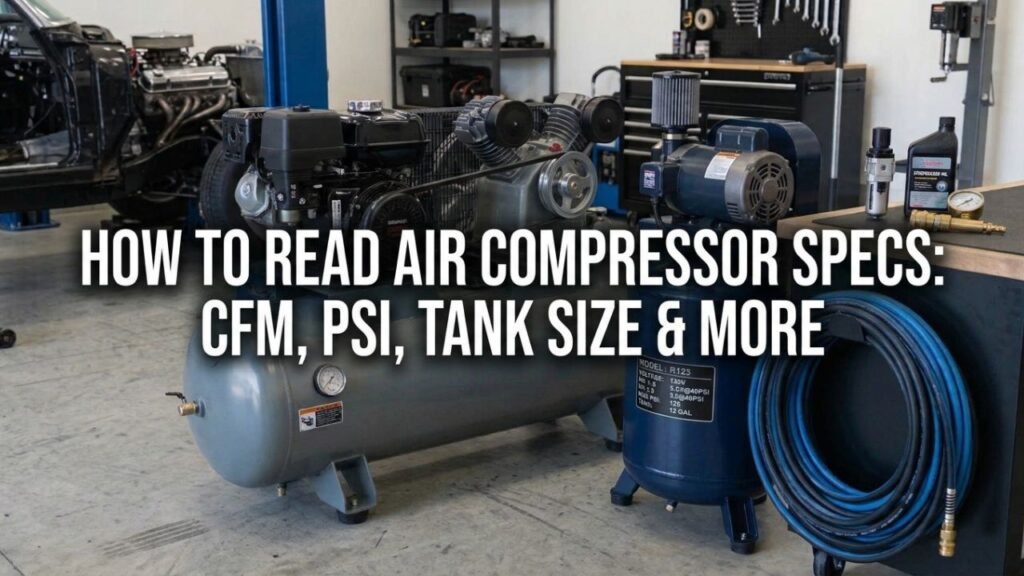
How to Read Air Compressor Specs: CFM, PSI, Tank Size & More
Start with airflow and pressure rather than tank gallons or horsepower. The compressor must deliver enough CFM or SCFM at the PSI required by your air tool. After that, compare tank capacity, duty cycle, voltage, amperage, noise level, pump type, maximum pressure, and portability to see if the machine fits your work.
Air-compressor labels often place large numbers such as horsepower, gallons, or maximum PSI in the most visible spots. Those numbers matter, but they do not tell you by themselves if a compressor will keep a grinder, impact wrench, nailer, or spray gun supplied with enough air.
Airflow is usually the better place to start. Atlas Copco recommends matching compressor CFM and PSI to the actual demand of the connected equipment rather than choosing from horsepower or receiver size alone. A compressor can have plenty of pressure but still fall short if it cannot deliver enough air volume.
For how to read air compressor specs, read CFM and PSI together first. Then look at tank gallons, duty cycle, power requirements, pump type, and noise. Comparing only “6 gallon,” “150 PSI,” or “2 HP” can give a misleading picture of what the compressor can run.
Compressed air also has a large energy footprint. The U.S. Department of Energy reports that compressed-air systems consume around 90 billion kWh of electricity each year in the United States, which is one reason compressor output and operating demands matter far beyond the number printed on the tank.
CAGI uses standardized compressor data sheets so buyers can compare measured flow, pressure, power, and related performance information on a more consistent basis. Those sheets are especially useful for larger rotary compressors where energy use and delivered airflow matter more than tank size.
The sections below explain each common compressor rating, which numbers matter most for air tools, how to compare two machines, and what specs to check before plugging one into a home garage circuit.
How to Read Air Compressor Specs in the Right Order
A compressor specification sheet becomes much easier to read if you follow the numbers in a fixed order.
I would use this sequence:
- Tool PSI requirement
- Tool CFM or SCFM requirement
- Compressor SCFM at that PSI
- Duty cycle
- Tank size
- Maximum PSI
- Horsepower
- Voltage and amperage
- Pump type
- Noise level
- Weight and dimensions
Start With the Air Tool
Find the air-consumption rating for the tool you plan to run.
For example, a tool may say:
5.0 SCFM at 90 PSI
That means the compressor needs to deliver around 5 SCFM while maintaining 90 PSI at the required operating condition.
A compressor advertised at 5 SCFM at 40 PSI is not an equal match because airflow ratings change with pressure.
Lowe’s notes that CFM and SCFM describe the air volume delivered at specific PSI levels and that available CFM changes as pressure changes.
Compare Compressor Output at the Same PSI
Suppose you are choosing between:
Compressor A
- 5.0 SCFM at 90 PSI
Compressor B
- 5.5 SCFM at 40 PSI
- 4.2 SCFM at 90 PSI
For a tool needing 5 SCFM at 90 PSI, Compressor A is the stronger match even though Compressor B shows a bigger airflow number elsewhere on its spec sheet.
Check Continuous Demand
An impact wrench may consume a lot of air in short bursts.
An orbital sander may need air almost continuously.
The same compressor can feel fine with the impact wrench and undersized with the sander because the sander drains the tank faster and keeps doing so.
Atlas Copco recommends considering which tools operate at the same time and how frequently they run rather than adding every connected tool at full demand automatically.
Key Takeaway: Read tool pressure and airflow first, then compare the compressor’s delivered SCFM at that same pressure before looking at tank gallons or horsepower.
What Does CFM Mean on an Air Compressor?
CFM means cubic feet per minute.
It measures airflow volume.
Why CFM Matters
Your air tool consumes air while it runs.
If the compressor produces air as fast as the tool uses it, pressure can stay fairly stable.
If the tool consumes air faster than the pump produces it, the tank pressure gradually falls.
That is why CFM is one of the most useful compressor specs.
CFM Must Be Tied to PSI
A CFM number without pressure does not tell the full story.
Airflow usually falls as discharge pressure rises.
A compressor might be rated:
- 6.2 SCFM at 40 PSI
- 5.1 SCFM at 90 PSI
If your tool runs at 90 PSI, use the 90-PSI number.
What Is SCFM?
SCFM means standard cubic feet per minute.
It reports airflow referenced to standardized air conditions so different machines can be compared more consistently.
Exact standard conditions can vary by test method, so manufacturer or CAGI data is preferable when comparing larger compressors.
CAGI uses standardized performance sheets to report flow and pressure in a common format for participating compressor types.
CFM vs Displacement CFM
Some specifications may list pump displacement.
Displacement is a calculated theoretical amount of air moved by the pump.
Delivered airflow accounts for real losses.
When both are listed, use delivered CFM, SCFM, or free-air delivery rather than pump displacement for tool sizing.
Key Takeaway: CFM tells you how much air the compressor delivers; compare delivered CFM or SCFM at the same PSI your tool requires.
What Does PSI Mean on an Air Compressor?
PSI means pounds per square inch.
It measures pressure rather than airflow volume.
Maximum PSI
A label such as:
Max pressure: 150 PSI
means the receiver may be charged up to around that compressor’s cut-out pressure.
It does not mean your air tool should be operated at 150 PSI.
A regulator lowers stored tank pressure to the pressure required by the tool.
Tool Operating PSI
Many common pneumatic tools are rated around 90 PSI, though exact requirements differ.
Always use the tool manufacturer’s specification.
Running a tool above its rated pressure can create excess wear or safety problems.
High Maximum PSI Gives More Storage
A tank charged to 175 PSI contains more compressed air than the same physical tank charged to 125 PSI.
That can give more usable reserve after the regulator.
It still does not increase pump CFM.
PSI Is Not the Same as Power
A small tire inflator may reach very high PSI but deliver very little airflow.
A large shop compressor may operate at similar pressure while producing many times more CFM.
Pressure tells you how hard the air is pushed. Flow tells you how much air is moving.
Key Takeaway: PSI tells you pressure, not airflow. Maximum tank PSI is different from the regulated operating pressure your air tool needs.
What Does Tank Size Mean?
Tank size is usually shown in gallons in the United States.
Examples include:
- 1 gallon
- 6 gallon
- 20 gallon
- 30 gallon
- 60 gallon
- 80 gallon
Gallons Measure Stored-Air Volume
A larger tank gives the system more air reserve between the compressor’s cut-in and cut-out pressures.
This is useful for tools that consume air in bursts.
Tank Size Does Not Increase CFM
A 60-gallon tank attached to a pump producing 5 CFM still has a 5-CFM pump.
The large tank may let you operate a high-demand tool longer before pressure drops, but once the reserve is depleted, the pump still has to supply the ongoing demand.
Atlas Copco states that a larger receiver stores more compressed air but does not increase continuous compressor airflow.
Small vs Large Tanks
Small tanks are useful for:
- Brad nailers
- Finish nailers
- Tire inflation
- Staplers
- Portable trim work
Larger tanks are more convenient for:
- Impact tools
- Automotive work
- Sanding
- Grinding
- Spraying
- Repeated shop use
The pump still needs adequate SCFM for continuous tasks.
Key Takeaway: Tank gallons tell you storage capacity, not pump output; large tanks extend reserve time but do not create extra CFM.
What Does Horsepower Mean?
Horsepower, or HP, describes motor or engine power.
It can give you a rough idea of compressor class, but it should not be your main sizing number.
Why HP Can Be Misleading
Two compressors with the same motor horsepower can produce different airflow because of differences in:
- Pump design
- Speed
- Number of stages
- Mechanical losses
- Cooling
- Operating pressure
Atlas Copco states that compressors with similar motor sizes can deliver different airflow, so CFM at the required pressure is the better comparison.
Running HP vs Peak HP
Some consumer compressor advertising has historically used peak horsepower or similar marketing figures.
The number you care about for electrical planning is the motor’s actual nameplate data and rated current.
Do not assume that a larger HP decal means more usable air than another compressor.
HP Matters for Electrical Requirements
As motor power rises, electrical demand usually rises too.
A large stationary compressor may need:
- 240V
- Dedicated circuit
- Larger breaker
- Proper wire size
- Hardwiring
- Single-phase or three-phase supply
Check the nameplate and manual before purchase.
Key Takeaway: Horsepower describes motor power, but SCFM at the required PSI gives a clearer picture of usable compressor output.
What Does Duty Cycle Mean?
Duty cycle describes how much of a given operating period the compressor is permitted to run under specified conditions.
50% Duty Cycle Example
A 50% duty cycle may mean the pump should operate roughly half the time within the manufacturer’s stated cycle.
It should not be assumed that every manufacturer calculates duty cycle using exactly the same time window.
Read the manual for the actual operating limit.
Why Duty Cycle Matters
A compressor may have enough SCFM on paper but still be a poor choice if your task demands near-continuous operation and the pump needs frequent cooling periods.
Continuous-use tasks include:
- Sanding
- Grinding
- Sandblasting
- Spray work
- Production air tools
Short-burst tools place less demand on duty cycle.
Reciprocating vs Rotary Screw
Many piston compressors are intended for intermittent operation.
Rotary screw compressors are commonly used where air demand runs for long periods.
For industrial sizing, airflow requirement and operating time should be considered together rather than reading only the rated CFM. Atlas Copco specifically includes tool usage frequency as part of compressor sizing.
Key Takeaway: Duty cycle tells you how hard and how long the compressor can be run within its rated operating pattern; it matters most with sustained air demand.
What Do Cut-In and Cut-Out Pressure Mean?
The pressure switch controls when the compressor starts and stops.
Cut-In Pressure
Cut-in is the tank pressure at which the pump starts.
Example:
Cut-in: 120 PSI
When receiver pressure falls to around 120 PSI, the motor starts refilling the tank.
Cut-Out Pressure
Cut-out is the pressure where the compressor stops.
Example:
Cut-out: 150 PSI
Once the tank reaches around 150 PSI, the pump turns off.
Why the Difference Matters
The pressure range between cut-in and cut-out is the working storage band of the receiver.
A larger tank or wider pressure band gives more stored air between pump cycles.
Do not adjust factory pressure-switch settings beyond approved limits.
Tank rating, relief-valve setting, motor load, and pump limits are tied to the compressor’s pressure design.
What Do Voltage and Amps Mean?
Electrical specifications determine if your circuit can operate the compressor.
Voltage
Common U.S. compressor supplies include:
- 120V
- 240V single phase
- 208/230/460V three phase on commercial equipment
Small portable machines commonly use 120V.
Larger stationary compressors often use 240V or commercial three-phase power.
Amperage
Amps indicate current draw.
Check:
- Running amps
- Motor nameplate
- Required breaker
- Plug type
- Manual instructions
Do not choose a breaker from a rough horsepower estimate.
Follow the compressor manufacturer’s circuit instructions and applicable electrical code.
Single Phase vs Three Phase
Most homes have single-phase service.
Three-phase compressors are common in industrial shops.
Buying a three-phase compressor for a residential garage can create a major electrical compatibility problem unless the site is equipped for it.
Key Takeaway: Confirm voltage, phase, amperage, plug type, and circuit requirements before buying a compressor, especially for stationary models.
What Does Single-Stage vs Two-Stage Mean?
This refers to how the pump compresses air.
Single-Stage Compressor
A single-stage piston compressor compresses the air in one compression stage before sending it to the tank.
These machines are common in:
- Home garages
- Portable units
- Light automotive work
- DIY shops
Two-Stage Compressor
A two-stage piston compressor compresses air in one cylinder or stage, cools it, then compresses it again to a higher pressure.
These units are common in larger stationary shop systems.
Two-stage machines often operate at higher maximum pressure and are suited to heavier workloads.
Do Not Confuse Cylinders With Stages
A compressor with two cylinders is not automatically a two-stage compressor.
Some twin-cylinder pumps are single stage.
Check the specification sheet rather than counting cylinder heads.
What Does Oil-Free vs Oil-Lubricated Mean?
This describes pump lubrication.
Oil-Free Compressor
Oil-free pumps use materials and designs that do not require regular crankcase oil changes.
Common benefits include:
- Lower routine maintenance
- Easy portability
- No compressor-oil changes
They are common on small portable compressors.
Oil-Lubricated Compressor
These pumps use compressor oil for lubrication.
They are common in larger shop and industrial piston compressors.
They require oil checks and changes according to the manual.
Do not confuse an oil-free pump with oil-free compressed air for sensitive industrial processes. Those are separate topics.
How to Read an Air Compressor Noise Rating
Noise is normally listed in decibels, often dBA.
Lower dBA Means Less Noise
A compressor rated at 60 dBA will generally sound much quieter than one rated at 80 dBA.
The decibel scale is logarithmic, so a difference that looks small on paper can sound substantial.
Check the Test Conditions
Noise figures are more useful when the manufacturers measured them under similar conditions.
Distance from the compressor and the test environment affect the number.
Do not compare one dBA figure measured at several feet with another measured right beside the machine unless the test details are similar.
Noise Matters in Small Garages
A loud compressor can become tiring in:
- Attached garages
- Indoor workshops
- Basements
- Residential work areas
If quiet operation matters, treat dBA as a real buying spec rather than an extra feature.
What Does Pump RPM Mean?
Pump RPM tells you how fast the compressor pump is rotating.
Higher RPM can allow a smaller pump to move more air.
Lower-speed pumps are often associated with reduced mechanical noise and lower wear rates, though pump quality and design matter too.
RPM alone does not tell you how long the compressor will last.
Compare it alongside:
- CFM
- Duty cycle
- Pump type
- Lubrication
- Cooling
- Manufacturer service guidance
How to Compare Two Air Compressors From Their Specs
Suppose you are comparing these two fictional machines.
| Specification | Compressor A | Compressor B |
| Tank | 20 gal | 30 gal |
| Max PSI | 150 | 175 |
| SCFM @ 90 PSI | 6.2 | 5.0 |
| Motor | 1.8 HP | 2 HP |
| Voltage | 120V | 120V |
| Noise | 78 dBA | 74 dBA |
For a 5.5-SCFM Tool at 90 PSI
Compressor A is the better airflow match because it produces 6.2 SCFM at 90 PSI.
Compressor B has:
- Larger tank
- Higher maximum pressure
- Larger HP number
- Lower noise
Yet it only produces 5.0 SCFM at 90 PSI.
A continuous 5.5-SCFM tool could slowly outrun it.
For a Nailer
Either compressor may have more than enough airflow because nailers use short bursts.
In that situation, lower noise, portability, price, tank capacity, or recovery behavior may matter more.
For Continuous Sanding
Airflow and duty cycle move to the top of the list.
A large tank can extend initial runtime, but the pump must eventually keep pace.
Key Takeaway: Compare compressors against the actual tool workload; the machine with the biggest tank, PSI, or HP number is not automatically the better match.
How Much Extra CFM Should You Buy?
A compressor should not sit exactly at the tool’s stated consumption if the tool runs for long periods.
Some reserve is useful for:
- Hose losses
- Fittings
- Small leaks
- Pressure drop
- Tool variation
- Future equipment
For home-shop use, a practical target is often to choose compressor airflow somewhat above the tool’s rated demand rather than matching it to the decimal point.
For multiple tools, add the airflow of the tools that will truly run at the same time.
Atlas Copco recommends sizing around actual simultaneous air demand and realistic future additions rather than blindly totaling every connected machine.
Which Air Compressor Specs Matter Most for Common Tools?
Nailers and Staplers
Focus on:
- Required PSI
- Enough SCFM for firing rate
- Portability
- Tank size
- Recovery speed
- Noise
A small 4- to 6-gallon compressor is often enough for many trim nailers.
Impact Wrenches
Focus on:
- SCFM at 90 PSI
- Tank reserve
- Hose size
- Regulator flow
- Duty pattern
Short bursts are easier on the compressor than holding the trigger continuously.
Sanders and Grinders
Focus heavily on:
- SCFM at 90 PSI
- Duty cycle
- Tank size
- Hose and fitting restriction
Continuous air use makes these much harder to run than most nailers.
Spray Guns
Check the gun’s stated airflow carefully.
Some spray guns require high continuous CFM even at moderate pressure.
A large tank with a weak pump may give only a short spraying window before pressure falls.
Common Mistakes When Reading Air Compressor Specs
Looking Only at Maximum PSI
High PSI does not guarantee high airflow.
Buying by Gallons Alone
Large tank volume does not create more pump CFM.
Comparing CFM at Different Pressures
5 CFM at 40 PSI and 5 CFM at 90 PSI are not the same performance point.
Buying by Horsepower
Motor power is not a direct substitute for delivered air.
Ignoring Duty Cycle
A compressor that must rest frequently may frustrate you during continuous sanding or spraying.
Forgetting the Electrical Circuit
A large compressor may require 240V and a dedicated circuit.
Ignoring Noise
A powerful compressor that is unpleasant to operate in an attached garage may be the wrong fit for the space.
Key Takeaway: The most common reading errors come from focusing on one large marketing number instead of comparing airflow, pressure, duty cycle, storage, and electrical requirements together.
How to Read Industrial Compressor Data Sheets
Large rotary-screw compressor sheets contain some extra numbers.
Rated Flow
This is the delivered airflow at the listed operating pressure.
Compare models at similar pressures.
Full-Load Operating Pressure
This is the pressure at which the rated performance applies.
Input Power
This shows electrical power consumed at the operating point.
Specific Power
CAGI defines specific power as the electrical input needed to deliver a given amount of airflow at a stated discharge pressure. It is commonly reported as power per 100 CFM.
Lower energy input for the same verified flow and pressure generally means lower operating energy demand.
Isentropic Efficiency
CAGI has introduced isentropic efficiency on rotary-compressor data sheets to make performance comparisons easier across machines with slightly different rated discharge pressures.
For a home garage, you probably will not need this number.
For a production plant running compressors many hours each year, it matters much more.
Conclusion
For how to read air compressor specs, start with the tool rather than the compressor. Find the tool’s required PSI and CFM or SCFM, then check that the compressor can deliver enough airflow at that same pressure.
After airflow, review duty cycle, tank gallons, maximum PSI, voltage, amperage, pump type, horsepower, noise level, dimensions, and weight. Gallons tell you storage, PSI tells you pressure, and CFM tells you airflow. These numbers do different jobs.
I would give the most attention to SCFM at 90 PSI for common air tools, then check duty cycle if the tool runs continuously. Tank size is useful for reserve, but it cannot make up for a pump that is too small for the workload.
FAQs About Reading Air Compressor Specs
What is the most important air compressor spec?
For running air tools, delivered CFM or SCFM at the required PSI is usually the first spec to check. A compressor must provide enough airflow at the tool’s operating pressure. Tank size and horsepower are secondary if the pump cannot keep up with air demand.
Is CFM or PSI more important on an air compressor?
You need both. PSI tells you the pressure available, while CFM tells you the amount of air delivered at that pressure. A tool requiring 6 CFM at 90 PSI needs a compressor capable of supplying both figures at the same time.
What does SCFM at 90 PSI mean?
It means the compressor delivers the stated standardized airflow while operating at 90 PSI. For example, 5.0 SCFM at 90 PSI means around five standard cubic feet of air per minute is delivered at that pressure under the manufacturer’s test conditions.
Does a bigger gallon tank mean a stronger compressor?
No. A bigger tank stores more compressed air, but pump output is still determined by compressor capacity. A 60-gallon compressor can have lower SCFM than a smaller machine if its pump produces less air.
Is higher horsepower always better?
No. Compressors with similar horsepower can have different airflow outputs because pump design and operating pressure differ. Compare delivered CFM at the pressure you need instead of buying from horsepower alone.
What does 150 PSI max mean on an air compressor?
It means the compressor receiver system is built to operate up to roughly that maximum pressure under its controls. Your tool does not normally receive 150 PSI directly; the regulator reduces tank pressure to the tool’s required operating pressure.
What specs should I check before buying an air compressor?
Check tool SCFM and PSI requirements first, then compare compressor SCFM at that pressure. After that, review duty cycle, tank size, maximum PSI, voltage, amperage, pump type, noise rating, weight, and dimensions.