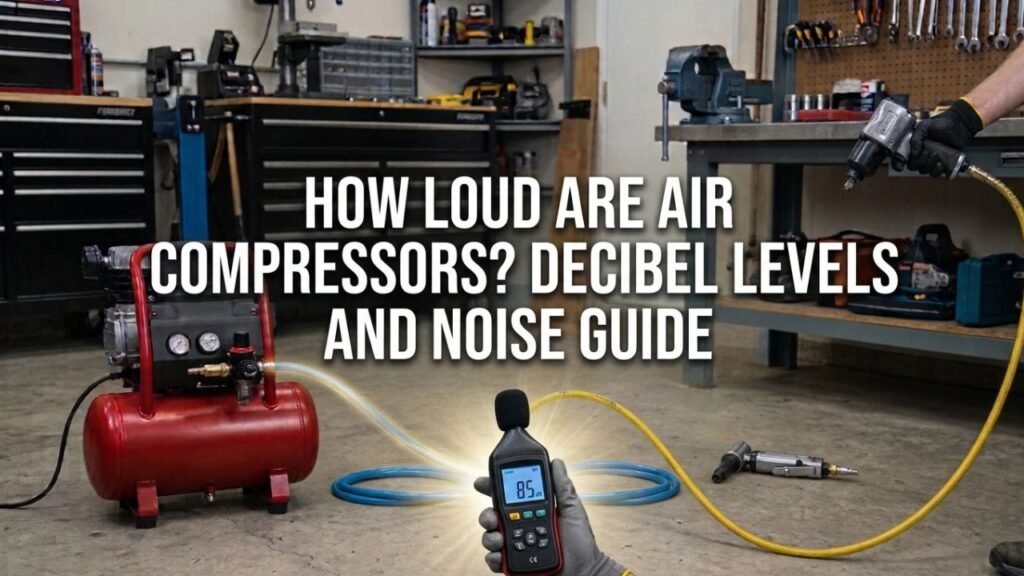
How Loud Are Air Compressors? Decibel Levels and Noise Guide
Air compressors can produce roughly 40 to 90+ decibels depending on the pump, motor, enclosure, horsepower, and measurement distance. Quiet portable models commonly fall around 55–70 dB, while larger piston compressors may reach 80–90 dB or more. Noise near 85 dBA deserves added attention when exposure is repeated or lasts for long periods.
Compressor noise varies enough that tank size alone tells you very little. A compact 8-gallon quiet compressor may run near 60 dB, while another unit with a similar tank can be far louder because of its pump speed, motor design, vibration, and enclosure.
Current quiet models show how low compressor noise can go. Makita rates several Quiet Series compressors at 58–60 dB, while California Air Tools currently lists models ranging from about 40 dB in sound-reducing cabinets to 90 dB for some larger belt-driven units.
For how loud are air compressors, a practical general range is about 60–90 dB, with quieter specialty models below that range and some larger equipment at or above its upper end. Always compare the manufacturer’s stated noise rating and the distance or test method used to produce it.
Noise level also matters for hearing. NIOSH considers repeated workplace exposure at 85 dBA or higher hazardous and recommends an occupational exposure limit of 85 dBA averaged across eight hours. For every 3 dBA increase, the recommended exposure duration is cut in half.
A compressor may also sound much louder in a small garage than outside. Concrete walls, floors, corners, vibration, and nearby metal surfaces reflect and transmit sound, so installation location can change the experience even when the machine itself has not changed.
The sections below cover typical decibel levels, quiet versus standard compressors, tank size, pump type, hearing risk, garage use, measurement distance, and ways to reduce compressor noise without blocking necessary cooling airflow.
How Loud Are Air Compressors in Decibels?
Most common workshop compressors fall somewhere from roughly 60 dB to 90 dB, though equipment exists on both sides of that range.
The exact figure depends heavily on compressor design.
Quiet Air Compressors: About 40–65 dB
Compressors marketed specifically for low-noise operation often run near 55–65 dB.
Current examples include Makita Quiet Series units rated at 58–60 dB. California Air Tools lists several 1 HP portable models at 56–60 dB and sound-cabinet models as low as 40 dB.
At this level, the compressor is still easy to hear, but conversation nearby may be much easier than around a traditional loud piston compressor.
Quiet models are attractive for:
- Home garages
- Indoor trim work
- Workshops attached to houses
- Apartment-adjacent workspaces
- Small repair shops
- Areas where conversation matters
Standard Portable Compressors: About 70–85 dB
Many conventional portable compressors operate somewhere in the 70s or low 80s.
Pump speed, motor size, direct-drive design, vibration, and tank construction all affect the rating.
A machine around 75 dB can sound dramatically quieter than one around 85 dB because the decibel scale is logarithmic rather than linear.
Larger Piston Compressors: About 80–90+ dB
Larger reciprocating compressors can produce substantially more mechanical noise.
Current California Air Tools listings show some larger industrial models around 85–90 dB, including belt-driven units rated at 90 dB.
At these levels, hearing protection and exposure duration deserve attention, especially in a workplace where the compressor cycles repeatedly throughout the day.
Sound-Enclosed Compressors
A cabinet can reduce noise reaching the room.
One current California Air Tools 20-gallon configuration is rated at 75 dB without a sound-reducing cabinet and 65 dB in a soundproof-cabinet version.
That 10 dB difference is substantial because decibels do not increase in a straight-line manner.
Key Takeaway: Quiet compressors often fall around 55–65 dB, common workshop units may reach 70–85 dB, and some larger piston machines approach or exceed 90 dB.
Air Compressor Noise Level Comparison
The table below gives useful context for common compressor sound levels.
| Compressor Noise Level | General Impression |
| 40–50 dB | Very quiet for a compressor |
| 55–60 dB | Quiet compressor territory |
| 65–70 dB | Moderate mechanical noise |
| 75–80 dB | Clearly loud in a small garage |
| 85 dB | Hearing-risk threshold for repeated workplace exposure |
| 88 dB | NIOSH 4-hour daily exposure level |
| 91 dB | NIOSH 2-hour daily exposure level |
| 94 dB | NIOSH 1-hour daily exposure level |
NIOSH recommends 85 dBA for no more than an eight-hour occupational exposure, 88 dBA for four hours, 91 dBA for two hours, and 94 dBA for one hour under its 3-dB exchange-rate system.
These limits refer to occupational noise exposure rather than a rule saying every short sound above 85 dBA immediately damages hearing.
Duration and repeated exposure matter.
Why a Small Increase in Decibels Matters
The decibel scale is logarithmic.
That means an increase from 70 dB to 80 dB is much larger than the numbers make it look.
A 3 dB Increase Doubles Sound Energy
NIOSH uses a 3 dB exchange rate for occupational noise.
For every 3 dBA increase, the recommended exposure time is cut in half because the sound energy has doubled.
For example:
- 85 dBA — 8 hours
- 88 dBA — 4 hours
- 91 dBA — 2 hours
- 94 dBA — 1 hour
- 97 dBA — 30 minutes
- 100 dBA — 15 minutes
This is one reason buying a compressor rated only a few decibels quieter can make a meaningful difference in a workshop.
A 10 dB Difference Sounds Much Larger
A 10 dB rise represents roughly ten times the sound intensity.
To human hearing, an increase of about 10 dB is often perceived as roughly twice as loud, though perception varies with frequency, surroundings, and the listener.
A 60 dB compressor and an 80 dB compressor therefore do not feel only slightly different.
Key Takeaway: Small numerical changes in decibels represent large changes in sound energy, so comparing compressor ratings by only a few dB can still matter.
Why Are Air Compressors So Loud?
Several noise sources operate at the same time.
A compressor creates mechanical, airflow, motor, vibration, and sometimes belt noise.
Pump Pulsation
A reciprocating piston compressor repeatedly pulls air in and compresses it.
Each intake and compression stroke creates pressure pulses and mechanical movement.
Faster pump speeds usually produce a sharper and more frequent sound.
Electric Motor Noise
The motor creates its own electrical and mechanical noise.
Bearings, cooling fans, rotor speed, mounting, and motor construction all change the sound character.
Intake Noise
Air rushing through the compressor intake can be surprisingly loud.
The intake often produces a sharp pulsing sound as the pump repeatedly draws air through its filter.
Some quiet-compressor designs use special intake systems to lower this noise.
Vibration
The motor and pump create vibration that travels through the frame and tank.
If the compressor sits directly on concrete, wood flooring, or a metal platform, that vibration can transfer into the building and make the machine seem louder.
Loose covers, handles, guards, and fittings can add rattling.
Belt and Pulley Noise
Belt-driven compressors have extra moving components.
A properly aligned belt system may still produce noise from the belt, pulleys, fan, motor, and pump.
Worn bearings or incorrect belt tension can make the noise worse.
Key Takeaway: Compressor noise comes from the pump, motor, intake airflow, vibration, cooling system, and moving drive parts rather than from a single source.
Are Oil-Free Air Compressors Louder?
Oil-free compressors have traditionally had a reputation for being louder than oil-lubricated piston compressors, but design matters more than the label alone.
Many modern low-noise compressors are oil-free.
Makita’s Quiet Series models rated at 58–60 dB use oil-free pumps, and California Air Tools offers numerous oil-free machines around 56–70 dB.
This shows that an oil-free compressor does not automatically have to be loud.
Pump speed is a major factor.
Low-RPM designs tend to create less mechanical noise than high-speed direct-drive pumps working at several thousand RPM.
Oil-lubricated belt-driven units may have a lower-frequency sound that some people find less harsh, but they can still be very loud if the motor, pump, and fan are large.
Does a Bigger Air Compressor Make More Noise?
Not always.
Tank size has little direct connection to noise.
A 20-gallon compressor can be quieter than a 6-gallon model if the larger unit uses a slow-running pump, better isolation, and a low-noise motor.
California Air Tools currently lists some 20-gallon units at about 65–78 dB, while its 20-gallon continuous-run model is listed at 77 dB.
A smaller compressor may also cycle more often if its tank cannot store enough air for the tool.
That means a quieter large-tank compressor could produce less annoying noise during a work session simply because its motor runs less frequently.
Judge compressor noise from the published dB rating, not gallons.
How Loud Is a 60 dB Air Compressor?
A 60 dB compressor is very quiet by air-compressor standards.
Makita markets its 58–60 dB Quiet Series for indoor work, and California Air Tools uses 60 dB ratings across many of its small ultra-quiet models.
You will still hear the pump running, especially in a small room.
Conversation should generally be far easier near a 60 dB unit than near an 85–90 dB compressor.
For a home garage, basement workshop, trim job, or workspace close to living areas, 60–65 dB is a useful target if the compressor’s airflow capacity also meets your tools.
Is a 70 dB Air Compressor Loud?
A 70 dB compressor is noticeable but relatively quiet compared with many traditional shop compressors.
California Air Tools currently rates several 2 HP models at 70 dB.
In an open garage, 70 dB may be tolerable for many users.
In a small reflective room, the machine can seem louder because sound bounces from the walls, ceiling, floor, cabinets, and vehicles.
The compressor’s duty cycle matters too. A 70 dB machine that runs for two minutes every half hour may be far less irritating than one that runs almost continuously.
Is an 80 dB Air Compressor Loud?
Yes. Around 80 dB, a compressor is clearly loud at close range.
Short use is very different from spending an entire workday next to it.
NIOSH’s occupational recommendation starts at 85 dBA for an eight-hour average, so an 80 dBA compressor alone falls below that reference level. Other tools in the same shop can raise total exposure substantially.
Impact wrenches, grinders, saws, nailers, and other machinery may all add noise during the same shift.
Measure the actual work area if hearing exposure is a concern.
Is a 90 dB Air Compressor Too Loud?
A 90 dB compressor is loud enough that hearing exposure needs serious consideration.
NIOSH’s limits place 88 dBA at four hours and 91 dBA at two hours per workday under its recommended 3-dB exchange rate.
A 90 dB compressor that runs only briefly is different from one operating for hours.
In a commercial shop, worker location, compressor duty cycle, nearby machines, walls, and hearing protection all affect total noise dose.
NIOSH also notes that if you need to raise your voice to speak to someone at arm’s length, the environment may be loud enough to justify a closer noise check.
Does Distance Make an Air Compressor Quieter?
Yes.
Sound pressure generally drops as you move away from the source.
In an open area with few reflections, doubling the distance from a small sound source can reduce sound level by roughly 6 dB.
For example, a compressor measured at 84 dB from a short distance may sound substantially quieter several times farther away.
Real garages do not behave like perfect open spaces.
Walls, concrete floors, ceilings, vehicles, and workbenches reflect sound, so the reduction may be smaller than the theoretical free-field figure.
This is why a compressor placed in a separate room can seem dramatically quieter than the same machine sitting beside your workbench.
Why Does My Compressor Sound Louder in the Garage?
Garages contain many hard surfaces.
Concrete floors, drywall, metal doors, storage cabinets, vehicles, and ceilings reflect sound instead of absorbing it.
A compressor pushed into a corner can sound especially harsh because several nearby surfaces reflect energy back into the room.
Vibration can also travel through the floor.
Placing the compressor on manufacturer-approved rubber isolation pads can reduce structure-borne vibration.
Do not place the machine on soft material that blocks cooling airflow, traps heat, or makes it unstable.
How to Make an Air Compressor Quieter
You can reduce compressor noise without modifying the pressure vessel or interfering with safety components.
Move the Compressor Farther Away
Distance is one of the simplest noise controls.
Put the compressor in another approved part of the shop and run a longer air line to the work area.
Keep the electrical connection compliant with the compressor manual. Long undersized extension cords can create voltage drop and motor problems.
Use Vibration Isolation
Rubber isolation feet or pads designed for machinery can reduce vibration transferred into the floor.
Check that the compressor remains level and stable.
Tighten Loose Components
Inspect:
- Belt guards
- Handles
- Wheels
- Shrouds
- Mounting bolts
- Intake housings
- Piping and fittings
A loose piece can add a loud metallic buzz that makes the compressor seem much noisier than its pump actually is.
Maintain the Intake Filter
A dirty filter can affect airflow and pump operation.
Follow the compressor maker’s filter inspection and replacement schedule.
Do not modify the intake with improvised mufflers that restrict airflow unless the compressor maker approves the setup.
Use a Sound Enclosure Designed for Compressors
A proper enclosure can reduce noise substantially.
Current California Air Tools data shows a 20-gallon model dropping from 75 dB to 65 dB with a soundproof cabinet configuration.
The enclosure still needs enough ventilation to remove motor and pump heat.
Never seal a normal compressor inside an unventilated wooden box. Heat buildup can shorten motor life and create a safety problem.
Choose a Low-RPM Quiet Model
If noise is a major buying factor, starting with a quiet compressor often works better than trying to silence a loud one later.
Compare:
- Published dB rating
- Test distance
- Pump RPM
- Motor horsepower
- CFM at 90 PSI
- Tank size
- Duty cycle
A quiet compressor that cannot supply your air tools will run too often and may still be frustrating.
Key Takeaway: Distance, vibration control, maintenance, purpose-built enclosures, and low-noise compressor design can lower the sound reaching your work area.
Do You Need Hearing Protection Around an Air Compressor?
The answer depends on the measured sound level and exposure duration.
NIOSH recommends controlling workplace exposure below an eight-hour average of 85 dBA. Its 3-dB exchange rate halves the exposure duration for each 3 dB rise.
OSHA’s workplace permissible exposure limit uses a different framework: 90 dBA over eight hours with a 5-dB exchange rate.
For personal workshop use, a sound-level measurement gives better information than guessing from how irritating the compressor feels.
A phone app may provide a rough screening number, while a calibrated sound-level meter or dosimeter is better for formal workplace exposure decisions.
If the compressor and surrounding tools regularly push the workspace into hazardous-noise territory, reduce the source noise, increase distance, limit exposure, and use properly selected hearing protection.
How to Check How Loud Your Air Compressor Is
Start with the manufacturer’s published rating.
Look in:
- Owner’s manual
- Specification label
- Product page
- Technical data sheet
Check if the maker states the measurement distance.
Two machines cannot be compared fairly if one rating was measured much farther away.
For a real-world workshop reading, measure the sound where your ears normally are while working.
NIOSH recommends A-weighted measurements for hearing-risk evaluation and provides a Sound Level Meter app for compatible iOS devices as a screening tool.
Measure during the loudest normal operating stage rather than only when the compressor is idling or switched off.
Conclusion
For how loud are air compressors, expect a broad range of roughly 60–90 dB for many common workshop machines. Quiet specialty models can operate below 60 dB, while some larger piston and industrial units reach around 90 dB.
A difference of only a few decibels can matter because the scale is logarithmic. NIOSH uses 85 dBA over eight hours as its recommended occupational limit and cuts recommended exposure time in half with each 3 dBA increase.
Tank size alone does not tell you how loud a compressor will be. Pump speed, motor design, intake noise, vibration, enclosure, installation location, and measurement distance all play larger roles.
If noise matters in a garage or indoor workspace, I would target a compressor around 60–70 dB that still delivers enough CFM for the tools. Moving it farther away, isolating vibration, and using a properly ventilated sound enclosure can reduce the noise further.
FAQs About Air Compressor Noise
What is a quiet dB level for an air compressor?
Around 60 dB or less is very quiet for an air compressor. Current Makita Quiet Series models are rated at 58–60 dB, while several California Air Tools models are rated around 56–60 dB. Some sound-cabinet systems are rated even lower.
Is 70 dB quiet for an air compressor?
Yes, 70 dB is relatively quiet compared with many traditional piston compressors. It is still clearly audible, especially indoors, but conversation near the machine is generally easier than around an 85–90 dB compressor.
Is 80 dB too loud for a garage compressor?
An 80 dB compressor is loud but remains below NIOSH’s 85 dBA eight-hour occupational reference level by itself. Other tools can raise total exposure, and a reflective garage may make the compressor feel louder. Measure the actual work area if exposure is frequent.
Can an air compressor damage your hearing?
Repeated exposure to sufficiently high noise can contribute to permanent hearing loss. NIOSH considers repeated workplace noise at 85 dBA or above hazardous and recommends lower exposure duration as sound levels rise.
Are oil-free air compressors louder than oil-lubricated compressors?
Not always. Some older or high-speed oil-free designs are loud, but many current quiet compressors are also oil-free. Pump RPM, motor design, vibration control, and enclosure matter more than lubrication type alone.
Does a bigger air tank make a compressor louder?
No. Tank capacity does not directly determine compressor noise. A larger-tank unit can be quieter than a small compressor if it uses a slower, quieter pump. A larger tank may also reduce how frequently the motor cycles during intermittent air use.
Why is my air compressor suddenly louder than normal?
A sudden change can come from a loose guard, worn bearing, damaged belt, loose mounting hardware, clogged intake filter, leaking fitting, or internal pump problem. Shut the compressor down and inspect it if the sound changes sharply, especially if it begins knocking, grinding, or squealing.
How can I quiet an air compressor in my garage?
Increase the distance from your work area, use suitable vibration-isolation pads, tighten loose components, maintain the intake filter, and consider a purpose-built ventilated sound enclosure. Do not block the motor or pump cooling airflow.