
Do I Need a Filter for My Air Compressor? Types, Uses, and Setup
Yes, most air compressors should have an intake filter, and many setups also benefit from a filter or moisture separator on the compressed-air side. The exact filtration required depends on what the air will power. Basic nailers need less air treatment than spray painting, plasma cutting, or precision pneumatic equipment.
An air compressor pulls ordinary atmospheric air into its pump. That air contains dust and water vapor. After compression and cooling, part of the moisture can condense inside the tank and air lines.
The factory intake filter protects the compressor pump from airborne dirt. A downstream air-line filter serves a different purpose: it protects pneumatic equipment and the workpiece from dirt, rust, liquid water, and, with the right filter, oil aerosol.
Parker states that water makes up the vast majority of liquid contamination found in many compressed-air systems. Campbell Hausfeld also recommends installing a water separator/filter when moisture reaches pneumatic tools, noting that separators work better after the compressed air has had time to cool.
For do I need a filter for my air compressor, the short answer is that the compressor itself should have its proper intake filter, while an additional line filter becomes increasingly useful as moisture, dirt, oil, or finish quality becomes a concern.
A filter does not replace routine tank draining. Water can still collect inside the receiver, so the tank drain remains part of normal compressor maintenance.
The sections below explain each filter type, where to install it, which jobs need extra filtration, how micron ratings affect airflow, and what setup works for common garage and workshop tools.
Do I Need a Filter for My Air Compressor?
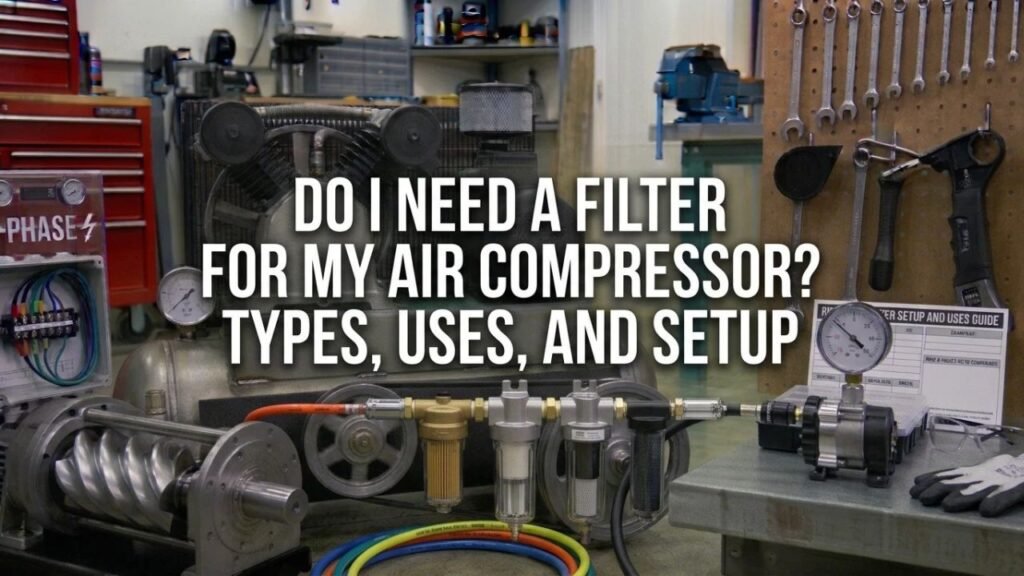
In most cases, yes, but you may need more than one type because compressor filters perform different jobs.
The first distinction is between the air-intake filter and compressed-air line filters.
Air-Intake Filter
The intake filter sits before the compressor pump.
Its job is to stop atmospheric dirt from entering the pump cylinders or compression element.
Without a good intake filter, dust can contribute to:
- Cylinder wear
- Piston-ring wear
- Valve contamination
- Reduced pump life
- Dirt entering the tank and air system
If your compressor came with an intake filter, do not operate it with the filter removed.
Inspect and replace or clean the element according to the compressor manual.
Moisture Separator
A moisture separator removes liquid water from the compressed-air stream.
Water forms because atmospheric moisture enters the compressor and condenses as compressed air cools.
A separator is useful for:
- Nailers
- Impact tools
- Blow guns
- Tire service
- Garage air lines
- General pneumatic tools
Campbell Hausfeld specifically recommends a water separator/filter when moisture reaches an air tool and advises placing it far enough from the compressor for the air to cool first.
Particulate Filter
A particulate filter removes solid debris such as:
- Rust
- Pipe scale
- Dust
- Dirt
- Compressor wear particles
Parker describes general-purpose compressed-air particulate filters as suitable for removing solid contamination and bulk liquids.
This type is a good addition to a permanent garage air system.
Coalescing Filter
A coalescing filter removes much smaller droplets of water and oil aerosol than a basic separator.
Parker’s filtration data describes coalescing filters designed to remove water and oil aerosols along with fine solid particles, with some grades reaching 0.01-micron particle and droplet removal.
This level of filtration becomes more relevant for:
- Automotive painting
- Fine finishing
- Instrumentation
- Precision pneumatic controls
- Applications sensitive to oil contamination
Key Takeaway: Keep the compressor’s intake filter installed, then add downstream moisture, particulate, or coalescing filtration according to the air quality required by your tools and work.
What Is the Difference Between an Intake Filter and an Air-Line Filter?
These filters sit on opposite sides of the compressor pump.
Mixing them up can lead to the wrong purchase.
Intake Filter Protects the Compressor
The intake filter cleans air before compression.
It primarily protects the pump.
A clogged intake element can restrict airflow and reduce compressor output.
Inspect it for:
- Heavy dust
- Oil contamination
- Damaged foam
- Broken filter media
- Cracked housing
Replace the element if it cannot be serviced correctly.
Air-Line Filter Protects the Equipment
A downstream filter cleans air after compression.
It protects:
- Air tools
- Spray equipment
- Valves
- Cylinders
- Regulators
- The finished workpiece
Compressed air can pick up additional contamination from the tank and piping, including rust and scale.
Parker notes that compressed-air contamination can include atmospheric particles, condensed moisture, pipe scale, rust, and debris generated inside the distribution system.
Key Takeaway: The intake filter protects the compressor pump, while downstream filtration protects your air tools, piping, and work.
Do You Need a Water Separator on an Air Compressor?
A water separator is a very useful addition for most shop compressors.
The need increases in humid climates and when the compressor runs long enough to heat the air substantially.
Why Water Gets Into Compressed Air
Atmospheric air naturally contains water vapor.
Compressing the air does not remove that moisture.
As the compressed air cools in the tank, piping, or hose, water vapor condenses into liquid droplets.
This is why water often appears when you drain the tank.
Tank Draining Does Not Remove Every Drop
Draining the tank removes water that has already settled in the receiver.
Some moisture remains suspended in the outgoing air.
That moisture can travel through the hose and reach the tool.
A separator downstream catches much of that liquid before it reaches the equipment.
Separator Placement Matters
Installing the separator directly against the compressor outlet may reduce its ability to remove moisture because the discharge air is still hot.
Campbell Hausfeld recommends locating a water separator/filter as far from the compressor as practical so the air can cool before reaching the separator.
A practical garage arrangement can look like:
Compressor → cooling pipe or hose → moisture separator/filter → regulator → tool hose
Drain the filter bowl regularly.
Key Takeaway: A water separator is useful even when the tank is drained regularly, and it performs better after the compressed air has cooled enough for water vapor to condense.
Do I Need an Air Filter for Pneumatic Tools?
For occasional general-purpose air tools, a basic moisture and particulate filter is usually enough.
More demanding tools may need cleaner or drier air.
Impact Wrenches and Air Ratchets
Impact wrenches and ratchets can tolerate ordinary shop air better than paint equipment, but repeated water exposure can still promote internal corrosion.
A moisture separator is a sensible addition.
Many pneumatic tools also require periodic air-tool oil unless their manufacturer says otherwise.
Do not confuse a filter with a lubricator. A filter removes contaminants; a lubricator intentionally introduces a controlled oil mist for tools designed to receive it.
Nail Guns
Brad, finish, framing, and roofing nailers generally benefit from clean, dry air.
A small filter/water separator protects internal valves and seals from liquid moisture and debris.
Check the nailer’s instructions before adding an automatic lubricator because some modern nailers are designed for oil-free operation.
Die Grinders and Sanders
These tools use large volumes of air.
Filtration is useful, but the filter must have enough flow capacity.
An undersized filter can create a pressure drop and make the tool feel weak.
When selecting a filter, compare its rated flow with the compressor and tool SCFM.
Blow Guns
A basic moisture and particulate filter is usually enough for general workshop blow-off use.
If air is being directed at a surface that must remain free of oil or water, finer filtration may be required.
Key Takeaway: Most pneumatic tools benefit from moisture and particulate filtration, but high-airflow tools need a filter sized to pass their required SCFM without excessive pressure drop.
Do I Need a Filter for Spray Painting?
Yes. Painting demands much cleaner and drier compressed air than ordinary shop tools.
Water or oil reaching a spray gun can damage the finish.
Moisture Can Ruin Paint
Water droplets reaching the spray gun can contribute to:
- Fish-eyes
- Blushing
- Uneven finish
- Poor adhesion
- Surface defects
- Rework
A small separator next to the compressor is often not enough for demanding paint work.
Oil Aerosol Can Reach the Air Line
Oil-lubricated piston compressors may introduce tiny quantities of oil into the compressed air.
A basic water trap may not remove fine oil aerosol.
Parker recommends coalescing filtration where very fine oil and water aerosols must be removed and identifies paint spraying as an application needing higher air quality.
Painting May Need Several Stages
A paint-air setup may use:
Compressor → cooling section → water separator → particulate filter → coalescing filter → regulator → final point-of-use filter → spray gun
Professional systems may add a refrigerated or desiccant dryer.
A desiccant dryer removes water vapor that ordinary separators cannot capture.
Key Takeaway: Spray painting needs cleaner and drier air than most pneumatic tools, so moisture separation plus fine particulate and coalescing filtration is a better setup than a single basic filter.
Does an Oil-Free Air Compressor Still Need a Filter?
Yes.
“Oil-free” describes the pump’s lubrication design. It does not mean the compressed air contains no moisture, dust, rust, or other contamination.
Oil-Free Does Not Mean Water-Free
The compressor still draws humid atmospheric air.
Water can still condense inside:
- Tank
- Pipes
- Hoses
- Filter bowls
- Tools
Parker notes that compressed-air systems can contain liquid contamination even when using an oil-free compressor.
Rust and Dirt Can Still Enter the Air Stream
Steel tanks and piping can produce rust particles over time.
Atmospheric dust can also enter through the intake system.
A particulate filter remains useful.
Fine Work Still Needs Air Treatment
An oil-free compressor used for paint, instrumentation, or other contamination-sensitive work may still require:
- Moisture separator
- Particulate filter
- Dryer
- Final point-of-use filtration
Key Takeaway: Oil-free compressors still produce wet compressed air and can carry dirt or rust, so downstream filtration may still be needed.
What Micron Filter Should You Use for an Air Compressor?
Micron rating describes the approximate size of particles a filter is designed to capture.
Smaller micron numbers mean finer filtration.
40-Micron Filters
A coarse 40-micron filter may be enough for basic industrial pneumatic equipment where removing large debris and bulk water is the main goal.
Parker notes that 40-micron filtration has traditionally been sufficient for many general industrial applications.
5-Micron Filters
A 5-micron particulate filter is a common choice for general workshop air.
It catches much finer dirt while keeping pressure drop manageable when properly sized.
Parker’s current FRL particulate filters include 5-micron elements intended for removing harmful dirt particles and bulk liquid contamination.
1- or 0.01-Micron Coalescing Filters
Fine coalescing elements are used when small oil and water aerosols need to be removed.
Some Parker coalescing elements are rated down to 0.01 micron.
Finer filtration does not automatically mean better for every air line.
A restrictive filter can reduce airflow and tool performance.
Choose the filtration level required by the application and size the housing for your maximum SCFM.
Key Takeaway: A 5-micron particulate filter is a practical general-shop choice, while fine coalescing filtration is better reserved for applications that need very clean air.
Where Should an Air Compressor Filter Be Installed?
Placement depends on the type of filter.
Intake Filter Goes at the Pump Inlet
Use the intake housing designed for the compressor pump.
Do not move this filter to the pressure side.
Water Separator Should Be Downstream
Give compressed air time to cool before the separator.
A length of metal piping, an aftercooler, or sufficient downstream distance allows more moisture to condense into liquid form.
The separator can then remove that liquid more readily.
Fine Filters Usually Follow Bulk Water Removal
A practical order is:
Compressor → receiver → cooling section → water separator → particulate filter → coalescing filter → regulator → equipment
The exact arrangement changes with the application.
Point-of-Use Filters Add Final Protection
Painting and precision work may benefit from another small filter near the tool.
This catches contamination formed or collected in long distribution piping.
Key Takeaway: Remove bulk water first, then use finer filtration farther downstream; placing all filters immediately against a hot compressor outlet reduces moisture-separation performance.
Will a Filter Reduce Air Compressor Pressure?
Every filter creates some airflow resistance.
A correctly sized clean filter should create only a modest pressure drop.
Problems appear when the filter is:
- Too small
- Clogged
- Filled with water
- Equipped with excessively fine media
- Asked to pass more SCFM than rated
Parker notes that finer filtration can increase pressure drop and that compressed-air filters need to be sized for the system’s flow and operating pressure.
If your impact wrench suddenly becomes weak, inspect the filter along with the hose, regulator, couplers, and compressor output.
Does a Filter Replace an Air Dryer?
No.
A standard water separator removes liquid water.
An air dryer removes much more of the water vapor remaining in the compressed air.
This difference matters for:
- Automotive painting
- Plasma cutting
- CNC equipment
- Instrument air
- Cold-weather air lines
- Sensitive industrial equipment
Common dryer types include:
- Refrigerated dryers
- Desiccant dryers
- Membrane dryers
A home user running nailers and impact tools may not need a full dryer.
A paint shop or shop with a large permanent air system has a stronger reason to install one.
How Often Should an Air Compressor Filter Be Changed?
There is no single replacement interval for every filter.
Check the product’s maintenance instructions.
Replace or service the filter if you notice:
- Increasing pressure drop
- Dirty element
- Water carrying past the filter
- Reduced tool power
- Damaged filter bowl
- Automatic drain failure
- Oil or dirt reaching downstream equipment
Some Parker compressed-air filter products specify 12-month element replacement intervals for certain coalescing and particulate elements.
Small garage filters may use different schedules.
Drain manual filter bowls before liquid reaches the maximum fill line.
A Simple Filter Setup for a Home Garage
For general garage work, you usually do not need a complicated multi-stage system.
A practical setup is:
Compressor → tank → cooled air line → 5-micron filter/water separator → regulator → hose → tool
This works well for:
- Tire inflation
- Impact wrench
- Ratchet
- Air hammer
- Nailers
- Blow gun
- General garage work
For paint spraying, add finer treatment:
Compressor → tank → cooling section → water separator → particulate filter → coalescing filter → dryer if needed → regulator → final filter → spray gun
Do not install an air-tool lubricator upstream of a paint line. Oil deliberately added for pneumatic tools can contaminate paint air.
Common Air Compressor Filter Mistakes
A few mistakes reduce filtration performance or create unnecessary pressure loss.
Avoid:
- Running the compressor with no intake filter
- Installing the water separator directly beside a hot pump discharge
- Forgetting to drain the filter bowl
- Using a filter with too little SCFM capacity
- Assuming oil-free means moisture-free
- Using very fine filtration when the job does not need it
- Failing to drain the compressor tank
- Putting an air-line lubricator on a paint-spray line
- Ignoring a clogged intake filter
- Using filters above their rated pressure
Check the housing pressure rating before installation.
The filter must be rated above the compressor’s maximum operating pressure.
Conclusion
For do I need a filter for my air compressor, the answer is yes in most setups, but the type of filter matters.
Keep the correct intake filter on the compressor pump. For general garage air, adding a downstream water separator and particulate filter is a practical way to protect tools from condensation, rust, and debris.
Painting and other clean-air applications require more treatment. A coalescing filter and, in some cases, an air dryer may be needed to remove fine oil and moisture contamination that a basic water trap cannot catch.
I would start with a properly sized moisture separator and 5-micron particulate filter for ordinary home-garage work. Size it for the compressor’s airflow, place it after the air has had some time to cool, keep the filter bowl drained, and continue draining the compressor tank as part of normal maintenance.
FAQs About Air Compressor Filters
Can I Run an Air Compressor Without an Intake Filter?
You should not run a compressor designed for an intake filter without it. Unfiltered dust can enter the pump and contribute to valve, cylinder, and piston wear. Replace a missing or damaged element with the correct part for the compressor.
Do I Need a Water Separator for My Air Compressor?
A separator is a good addition for most workshop compressors because water vapor condenses after air is compressed and cooled. It becomes even more useful for pneumatic tools, long air lines, and humid operating conditions.
Do I Need Both a Filter and a Regulator?
They perform different jobs. A filter removes moisture and contaminants, while a regulator controls outlet pressure. Combination filter-regulator units place both functions in one assembly.
Should the Filter Go Before or After the Regulator?
Many filter-regulator assemblies place filtration before pressure regulation. This keeps contamination from reaching the regulator and downstream equipment. Follow the flow arrows and installation instructions on the specific unit.
Do I Need a Filter on an Oil-Free Air Compressor?
Yes, if your work requires clean or dry air. An oil-free pump still compresses humid atmospheric air, so condensation can form in the tank and lines. Dirt and rust can also remain present.
What Size Filter Do I Need for My Air Compressor?
Choose a filter rated for at least the compressor’s maximum pressure and enough SCFM for the highest-air-demand tool you plan to run. An undersized filter can create a noticeable pressure drop.
Is a 5-Micron Filter Good for Air Tools?
Yes. A 5-micron particulate filter is a common general-purpose choice for pneumatic equipment. Painting and contamination-sensitive work may need additional coalescing or drying stages.
Do I Still Need to Drain the Tank if I Have a Water Filter?
Yes. A downstream separator does not remove water already collected inside the receiver. Drain the compressor tank according to the manufacturer’s instructions and drain the filter bowl separately.