
How to Clean Air Compressor Filter: Easy Step-by-Step Process
Cleaning an air compressor intake filter usually involves shutting the compressor off, removing the filter element, inspecting it, removing loose dust with low-pressure air or washing it only if the manufacturer identifies it as washable, allowing it to dry completely, and reinstalling it securely. Paper elements generally should not be washed.
The intake filter protects the compressor pump from dust, dirt, wood particles, and other airborne debris. As contamination builds on the filter, airflow through the intake becomes more restricted.
A dirty filter can reduce compressor output and make the pump run longer to refill the tank. Quincy notes that inlet-filter condition affects pressure drop, while Atlas Copco warns that a clogged intake element can reduce airflow and raise energy consumption.
For how to clean air compressor filter, the first thing to identify is the filter material. Foam and some polyester elements may be washable, while many pleated paper filters are intended to be cleaned only as the manufacturer permits or replaced when dirty.
Filter maintenance is also part of energy management. A U.S. Department of Energy compressed-air sourcebook reports that more than one million air compressors have historically been sold annually in the United States and identifies intake-filter inspection as routine compressor maintenance.
Never operate the compressor without its intake filter just to see if performance improves. Atlas Copco specifically advises against running a piston compressor without the filter, even briefly, because abrasive particles can reach the cylinders and valves.
The correct procedure depends on the filter type, compressor design, and manufacturer instructions, so the safest method begins with identifying the element before applying water, solvent, or compressed air.
What Does an Air Compressor Filter Do?
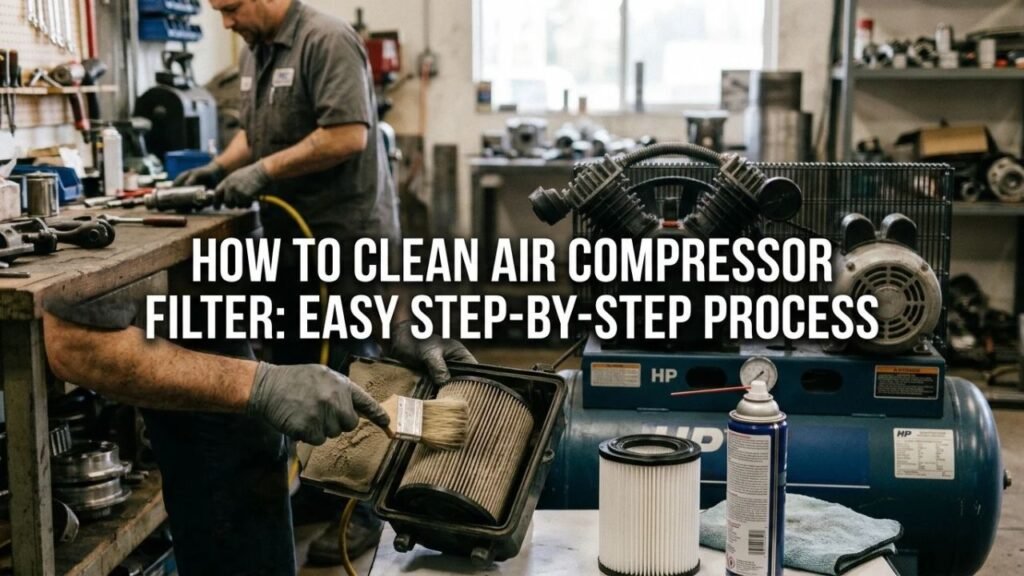
The intake filter cleans atmospheric air before the compressor pump draws it into the compression chamber.
Air around a garage or workshop may contain far more contamination than it appears to.
It Keeps Dust Out of the Pump
Without filtration, airborne dirt can enter the compressor.
That contamination can accelerate wear on parts such as:
- Cylinder walls
- Piston rings
- Valves
- Rotary compressor elements
- Intake components
Atlas Copco states that the intake filter protects airflow while limiting abrasive particles from entering cylinders and valves.
It Helps Maintain Compressor Airflow
The pump has to draw a large volume of atmospheric air through the intake.
As the filter becomes clogged, resistance increases.
A restricted filter can cause:
- Slower tank fill time
- Reduced CFM
- Longer pump run time
- Higher operating temperature
- Increased energy consumption
Quincy identifies a clean intake filter as a factor in maintaining inlet pressure and minimizing airflow resistance.
It Protects Downstream Components
Keeping dirt out of the compressor also reduces contamination reaching other parts of the compressed-air system.
The intake filter is not the same as a downstream moisture separator or air-line filter, but it forms the first barrier against outside contaminants.
Key Takeaway: The intake filter protects compressor internals and preserves airflow; a heavily restricted element can lower output and make the compressor work longer.
How to Clean Air Compressor Filter
The following procedure works as a general method for many small reciprocating compressors, but the owner’s manual should take priority.
Step 1: Shut Off the Air Compressor
Turn the compressor off.
Unplug an electric compressor from its power source.
For a gasoline-powered compressor, shut the engine down and prevent accidental restarting.
Allow hot components to cool before working near the pump.
Step 2: Release Stored Pressure if Required
An intake filter is normally located on the atmospheric side of the pump and may not require the tank to be completely emptied on every small compressor.
Still, follow the service instructions for your model.
If you are servicing a filter that is part of the pressurized downstream air system rather than the compressor intake, isolate the line and vent it fully before opening the housing.
Atlas Copco warns never to loosen a filter bowl on a live compressed-air line.
Step 3: Locate the Intake Filter
Look near the compressor pump’s air inlet.
Depending on the model, the filter housing may appear as:
- Small round plastic housing
- Metal canister
- Rectangular filter box
- Screw-on silencer/filter
- Large industrial intake enclosure
Small piston compressors often have one filter attached directly to the cylinder head.
Multi-cylinder units may have more than one intake.
Step 4: Remove the Filter Cover
Remove the housing according to its design.
It may use:
- Threaded cap
- Clips
- Screws
- Wing nut
- Snap-fit cover
Quincy describes a common design where the filter top is unscrewed and the element is lifted out of the base.
Avoid letting dirt from the outside of the housing fall into the open compressor intake.
Step 5: Inspect the Filter Element
Before cleaning anything, determine what material you have.
Look for:
- Foam
- Pleated paper
- Polyester or synthetic media
- Metal screen
- Cracks
- Tears
- Deformation
- Oil saturation
- Missing sections
If the filter is damaged, cleaning is not enough.
Replace it.
Step 6: Remove Loose Dust
For an element that the manufacturer permits you to clean, remove loose surface dirt carefully.
Quincy recommends low-pressure air for suitable filter elements and warns that excessive air pressure or aggressive scrubbing can damage the media.
Direct the air so dirt is pushed away from the clean side rather than driven deeper into the filter.
Do not hold a high-pressure blow gun directly against delicate paper pleats.
Step 7: Wash Only Washable Filters
If the manual identifies the element as washable, clean it using the specified method.
Some washable foam or synthetic filters can be rinsed in mild soapy water.
Atlas Copco documentation distinguishes washable polyester media from paper elements that are not washable.
Do not automatically soak every filter.
Step 8: Let the Filter Dry Completely
A washed element needs to be completely dry before reinstallation unless the manufacturer specifically gives a different procedure.
Installing a wet intake filter can restrict airflow and pull moisture into the compressor.
Place it in a clean area and let it air-dry naturally.
Avoid damaging the material with excessive heat.
Step 9: Clean the Filter Housing
Wipe dust from the inside of the housing.
Pay attention to:
- Housing base
- Sealing surface
- Cover
- Intake opening
Do not push debris into the compressor inlet.
A clean housing also makes it easier to see whether the element seals properly.
Step 10: Reinstall the Filter
Return the dry, undamaged element to the correct position.
Make sure it sits flat and seals around its edges.
ELGi notes that correct filter seating and sealing are necessary to keep unfiltered air from bypassing the element.
Reinstall the cap or cover securely without overtightening fragile plastic parts.
Step 11: Start the Compressor and Check Operation
Reconnect power and run the compressor.
Listen for:
- Intake air leaks
- Loose housing noise
- Unusual whistling
- Abnormal pump noise
Confirm that the cover remains secure and the compressor builds pressure normally.
Key Takeaway: Shut the machine down, identify the filter type, clean only reusable media with an approved method, dry washable filters completely, and reinstall the element with a proper seal.
How to Clean a Foam Air Compressor Filter
Foam elements are common on some small portable compressors and are often reusable.
Check the manual before washing one.
Remove Loose Dirt First
Gently tap the filter away from the compressor to dislodge loose dust.
Do not tear or stretch the foam.
Wash the Foam if Approved
For a washable element, use mild soap and clean water if the manufacturer permits it.
Work the water through the foam gently.
Avoid harsh solvents unless specifically approved.
Gasoline, brake cleaner, carburetor cleaner, and other aggressive chemicals can damage some filter materials.
Rinse Thoroughly
Rinse until detergent and loose dirt are gone.
Do not leave soap trapped inside the foam.
Remove Excess Water Gently
Do not twist the element aggressively.
Lightly squeeze or press it according to the filter maker’s directions.
Twisting can tear old foam.
Dry Before Installation
Let the filter dry fully in a clean location.
If the element remains brittle, cracked, distorted, or heavily stained after cleaning, replace it.
Key Takeaway: Wash a foam filter only when it is identified as reusable, use a mild approved cleaning method, and reinstall it only after it has fully dried.
How to Clean a Paper Air Compressor Filter
Paper elements require more caution.
Many are intended to be replaced rather than washed.
Do Not Soak a Paper Filter
Water can damage the paper media, adhesives, and pleat structure.
Atlas Copco specifically identifies paper intake elements as non-washable in its filter documentation.
Do not use soap and water unless the exact manufacturer says the element is washable.
Remove Light Surface Dust Carefully
Some equipment manufacturers permit gentle dry cleaning of lightly contaminated elements.
If your manual allows this, use low-pressure air and avoid damaging the pleats.
Quincy recommends low-pressure air rather than aggressive blowing or scrubbing on applicable filters.
Replace a Heavily Loaded Paper Element
Replacement is safer when the filter is:
- Very dark
- Oil soaked
- Wet
- Torn
- Crushed
- Deformed
- Clogged deep inside the pleats
Cleaning cannot restore damaged filtration media.
Do Not Judge Only by Appearance
Fine dust can clog the pores of a paper element without creating a dramatic visible layer.
If cleaning no longer restores airflow or the filter has reached its service interval, replace it.
Key Takeaway: Paper intake filters generally should not be washed; lightly loaded elements may allow gentle dry cleaning, but damaged or heavily clogged media should be replaced.
Can You Wash an Air Compressor Filter?
Some filters can be washed and others cannot.
Filter material decides the answer.
Filters That May Be Washable
Depending on manufacturer design, washable elements can include:
- Foam
- Certain polyester media
- Some reusable synthetic filters
- Certain prefilters
Ingersoll Rand, for example, lists a washable primary element for one of its industrial intake-filtration systems.
Filters That Usually Should Not Be Washed
These often include:
- Disposable paper elements
- Coalescing filter elements
- Fine downstream filtration cartridges
- Damaged filter media
Atlas Copco advises against washing and reusing compressed-air filtration elements where contamination is embedded in the media.
That downstream filter guidance should not be confused with a reusable foam intake filter.
Check the Filter Part Number
If you are unsure, search the compressor manual or replacement-filter specification by model and part number.
Do not guess based only on color or appearance.
Key Takeaway: Foam and some synthetic intake elements may be washable, while paper and many downstream filter cartridges are designed for replacement rather than washing.
Can You Use Compressed Air to Clean the Filter?
Yes for some elements, but pressure and direction matter.
Use Low Pressure
High-pressure air can tear paper, separate pleats, or create holes that let dirt enter the compressor.
Quincy specifically recommends low-pressure air when cleaning suitable intake elements.
Blow From the Clean Side Out
When the design permits it, directing air from the clean side toward the dirty side helps push particles out rather than deeper into the media.
Keep the nozzle some distance away.
Do Not Try to Restore a Worn-Out Filter
Compressed air will not repair:
- Torn media
- Broken seals
- Hardened foam
- Oil saturation
- Collapsed pleats
A damaged element needs replacement.
How Often Should You Clean an Air Compressor Filter?
There is no single schedule for every compressor.
Dust levels and operating hours make a major difference.
Follow the Manufacturer’s Interval
The U.S. Department of Energy’s compressed-air sourcebook gives a general reciprocating-compressor maintenance example calling for intake-filter inspection and cleaning or replacement around every 360 operating hours or monthly, whichever comes first. This is a general maintenance reference, not a universal service interval.
Your compressor manufacturer may specify something very different.
Inspect More Often in Dusty Areas
A compressor used in:
- Woodworking shop
- Auto body shop
- Construction site
- Farm building
- Fabrication shop
may collect contamination much faster than one in a clean indoor room.
Atlas Copco recommends shorter inspection intervals where dust levels are high.
Industrial Compressors May Use Hour-Based Schedules
ELGi provides maintenance schedules that include frequent prefilter cleaning and periodic intake-filter replacement, depending on compressor model and operating conditions.
Maintain a service log if the compressor is used regularly.
Key Takeaway: Inspect the filter according to the owner’s manual and shorten the interval in dusty environments rather than waiting for compressor performance to decline.
Signs Your Air Compressor Filter Is Dirty
A restricted intake can create several noticeable changes.
Compressor Takes Longer to Fill the Tank
Reduced intake airflow means the pump may produce less compressed air per minute.
Tank recovery time can increase.
Compressor Runs More Often
If output falls, the pump needs more running time to meet the same air demand.
Reduced CFM
Tools may feel weaker during extended use if the compressor can no longer replenish air at its normal rate.
Intake Noise Changes
A heavily restricted filter can alter intake sound.
This symptom alone is not enough to diagnose a filter problem, but it can justify an inspection.
Filter Looks Heavily Loaded
Visible dust is an obvious reason to inspect and service the element.
Also check deep between pleats rather than looking only at the outside surface.
Higher Operating Temperature
A restricted intake can contribute to harder compressor operation.
High temperature can have many other causes, including dirty coolers, low oil, poor ventilation, or mechanical problems, so inspect the complete system if overheating continues.
Key Takeaway: Slow tank filling, longer run times, reduced airflow, and visible filter loading are good reasons to inspect the compressor intake filter.
When Should You Replace Instead of Clean the Filter?
Cleaning has limits.
Replace the filter when the media can no longer perform its job reliably.
Replace a Damaged Element
Atlas Copco recommends replacement when filter media is torn, distorted, heavily loaded, or no longer seals correctly.
Do not patch a damaged filter with tape, adhesive, foam, or cloth.
Replace Oil-Soaked Media
A dry intake filter that becomes soaked in oil may be difficult to clean correctly.
Oil contamination also traps fine dust.
Investigate why oil reached the intake if this is unusual for your compressor.
Replace Hardened Foam
Foam deteriorates with age.
If it crumbles, cracks, or no longer returns to its original shape, replace it.
Replace at the Scheduled Interval
Some manufacturers specify replacement even if the element still appears usable.
That interval accounts for contamination and media degradation that may not be visible.
Mistakes to Avoid When Cleaning an Air Compressor Filter
A few mistakes can do more harm than leaving a lightly dirty filter alone.
Washing a Disposable Paper Element
Paper media can lose its structure and filtration properties after getting wet.
Replace it unless it is explicitly marked washable.
Using Full Compressor Pressure
High-pressure air can puncture delicate filter media.
Use only the cleaning pressure and method allowed by the manufacturer.
Reinstalling a Wet Filter
A wet intake element can restrict airflow and introduce moisture.
Let washable media dry completely.
Running the Compressor Without a Filter
Never operate the compressor without the intake element.
Atlas Copco warns against this practice because unfiltered particles can damage internal components.
Cleaning a Filter That Should Be Replaced
A filter can reach the end of its service life even if some dust can still be blown away.
Damaged seals and degraded media are replacement issues.
Installing the Element Incorrectly
An element that does not seal allows dirty air to bypass the filter.
Check that the gasket or sealing edge sits correctly before closing the housing.
Key Takeaway: Avoid washing disposable filters, blasting media with high pressure, reinstalling wet elements, running without a filter, or reusing damaged components.
Is Cleaning the Intake Filter the Same as Cleaning an Air-Line Filter?
No.
Air compressors can have several different filters.
Intake Filter
Located before the compressor pump.
It removes airborne dust from the air entering the compressor.
Air-Line Particulate Filter
Located after the compressor.
It removes particles traveling through compressed-air piping.
Coalescing Filter
Used downstream to capture fine oil aerosols and liquid contamination.
These elements are commonly replaced rather than washed.
Atlas Copco states that downstream filter elements should not be washed and reused because contamination becomes trapped in the filtration media.
Oil Filter
Oil-lubricated rotary compressors can have an oil filter in the lubrication circuit.
This is also generally a replacement service item, not an intake filter you wash with water.
Know which filter you are servicing before starting.
Conclusion
For how to clean air compressor filter, first shut the compressor down, remove the intake element carefully, inspect its material and condition, then use only the cleaning method approved for that filter.
Washable foam or synthetic elements may be cleaned with an approved mild washing method and allowed to dry completely. Paper elements generally should not be soaked, and heavily clogged or damaged filters should be replaced.
Use low-pressure air only when the manufacturer permits dry cleaning. Avoid aggressive scrubbing, solvents, and full shop-air pressure that could damage the filter media.
Keeping the intake element clean protects the pump, reduces airflow restriction, and helps the compressor maintain normal fill time and CFM. If cleaning no longer restores the filter or the element cannot seal correctly, install a new one rather than trying to extend its life.
FAQs About Cleaning an Air Compressor Filter
Can I Wash My Air Compressor Filter With Water?
Only if the filter is specifically designed to be washable.
Foam and some polyester elements may permit washing, while most paper intake filters should not be soaked. Check the compressor manual or filter specification before using water.
Can I Clean an Air Compressor Filter With Compressed Air?
Some intake elements can be cleaned with low-pressure air.
Keep the nozzle away from the media and avoid high pressure that could tear or puncture it. Quincy recommends gentle low-pressure air for suitable filter elements.
How Often Should I Clean My Air Compressor Filter?
Use the interval stated by the compressor manufacturer.
The DOE’s general reciprocating-compressor maintenance guidance includes inspection and cleaning or replacement around every 360 operating hours or monthly, while dusty environments can require more frequent checks.
What Happens if the Air Compressor Filter Is Clogged?
A clogged filter restricts intake airflow.
The compressor may take longer to fill its tank, deliver less air, run for longer periods, and use more energy. Severe restriction can also contribute to higher operating temperatures.
Can I Run an Air Compressor Without the Air Filter?
No.
Unfiltered air can carry abrasive dust directly into the compressor. Atlas Copco advises against operating a piston compressor without its intake filter, even for a brief test.
Should I Replace or Clean a Paper Air Compressor Filter?
A lightly dusty paper element may permit gentle dry cleaning if the manufacturer allows it.
Replace the filter if it is heavily clogged, wet, oily, torn, crushed, or at the end of its recommended service life. Do not wash ordinary paper media with water.
Can a Dirty Air Filter Make an Air Compressor Overheat?
It can contribute.
A clogged intake reduces airflow and can force the compressor to run longer. Overheating can also come from low oil, blocked cooling surfaces, poor ventilation, mechanical wear, or other faults, so persistent high temperature needs a broader inspection.
How Do I Know if My Air Compressor Filter Is Washable?
Check the filter part number, compressor manual, or manufacturer’s replacement-element description.
Foam and some polyester or synthetic filters may be reusable. Paper elements and many downstream coalescing filters are generally intended for replacement rather than washing.