
How to Clean Compressor Air Filter: Steps, Types, and Safety
To clean an air compressor intake filter, shut the compressor off, disconnect its power, remove the filter element, inspect it for damage, and clean it using the method approved for that filter material. Some elements tolerate low-pressure compressed air or warm soapy water, while paper and replace-only filters may need replacement instead of washing.
A dirty intake filter restricts the air entering the pump. That can make the compressor take longer to fill its tank, reduce air output, increase pump temperature, and keep the motor running longer than it normally would.
The cleaning method matters because compressor filters are made from different materials. ROLAIR allows warm soapy water or low-pressure air for filter elements on certain models, while Campbell Hausfeld states that the intake element on one of its screw compressors must be replaced rather than cleaned.
The U.S. Department of Energy reports that compressed-air systems consume around 90 billion kWh of electricity in the United States each year. DOE also notes that dirty filters create pressure drop and make compressed-air systems consume more energy to compensate.
For how to clean compressor air filter, the first step should always be identifying the element type and checking the compressor manual. A washable foam element, pleated paper element, and synthetic replacement cartridge should not all be cleaned the same way.
Cleaning also gives you a chance to inspect the filter housing, seals, intake opening, and mounting hardware. A cracked canister or poorly seated filter can let dust bypass the element and enter the compressor pump.
The process below covers safe removal, foam and paper filter cleaning, low-pressure air cleaning, drying, reinstallation, cleaning intervals, replacement signs, and common mistakes that can damage the filter or compressor.
How to Clean Compressor Air Filter Step by Step
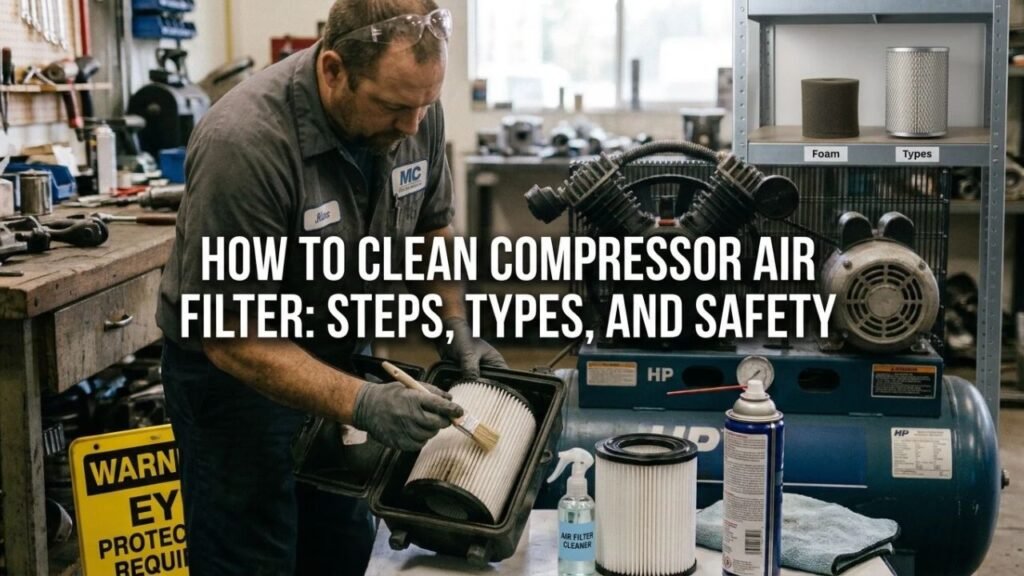
The exact procedure varies by compressor, but this sequence works as a general starting point for many portable and stationary piston compressors.
Step 1: Check the Compressor Manual
Before removing the filter, identify what the manufacturer says about servicing it.
The manual may tell you to:
- Clean with low-pressure air
- Wash with warm soapy water
- Gently tap out loose dust
- Replace the filter rather than clean it
- Service it at a set hour interval
Do not assume a filter is washable because it looks like foam or fabric.
California Air Tools, for example, instructs owners of certain compressors to open the filter housing, remove the old element, and install a new one once the filter becomes clogged.
Step 2: Shut the Compressor Down
Turn the compressor switch to OFF.
For an electric compressor, disconnect the power cord or isolate the electrical supply according to the manual.
For a gas-powered model, shut the engine down and prevent accidental starting.
ROLAIR instructs users to completely drain tank pressure, unplug the power cord, and allow the compressor to cool before maintenance on applicable models. Ingersoll Rand likewise instructs owners to release system pressure and disconnect or lock out the power source before compressor maintenance.
Waiting for the pump to cool also reduces the chance of burns from the cylinder head or discharge piping.
Step 3: Locate the Air Intake Filter
The intake filter is normally mounted directly on or near the compressor pump cylinder head.
It may look like:
- Round plastic canister
- Metal filter housing
- Small black silencer
- Threaded cartridge
- Rectangular filter box
Do not confuse the pump intake filter with a downstream compressed-air filter or water separator mounted near the regulator.
The intake filter cleans atmospheric air before that air enters the pump.
Step 4: Remove the Filter Housing
Unscrew or unclip the filter cover according to its design.
Some filters thread directly into the compressor head. Others use:
- Wing nuts
- Screws
- Plastic clips
- Threaded caps
Work carefully so loose dust does not fall into the open compressor intake.
ROLAIR also recommends inspecting the intake canister and elbow components for cracks and damaged seals while servicing the element.
Step 5: Remove and Inspect the Element
Take the element out without scraping dirt into the intake port.
Inspect it under good lighting.
Look for:
- Heavy dust buildup
- Oil saturation
- Torn material
- Holes
- Cracks
- Damaged pleats
- Hard or brittle foam
- Missing sections
- Distorted seals
ROLAIR advises replacement if holes are present or the element is excessively dirty.
A damaged filter should normally be replaced rather than cleaned and reused.
Step 6: Clean the Element Using the Correct Method
The correct method depends on filter construction.
A manufacturer that permits low-pressure air may allow you to blow loose dust from the element.
ROLAIR states that its compressor intake elements can be cleaned with warm soapy water or low compressed air on applicable models.
Quincy also recommends low-pressure compressed air for many serviceable compressor filters and warns that excessive pressure or aggressive scrubbing can damage the element.
Other filters must be replaced rather than cleaned.
Never choose the method based on appearance alone.
Step 7: Clean the Filter Housing
With the element removed, wipe loose dirt from the housing.
Use a clean, dry cloth or the cleaning method specified by the manufacturer.
Keep debris away from the exposed intake opening.
Do not blow dust directly into the compressor head.
Inspect the housing for:
- Cracks
- Broken threads
- Damaged seals
- Loose mounting points
- Distortion
- Missing hardware
A perfectly clean element cannot protect the compressor if dirty air can bypass it through a cracked housing.
Step 8: Let a Washed Filter Dry Completely
If the element is approved for washing, let it air-dry completely before reinstalling it.
Moisture should not be pulled directly into the compressor pump.
Do not speed drying with:
- Heat gun
- Open flame
- Very hot hair dryer
- High-pressure shop air
If the filter remains damp and the compressor is needed immediately, installing a new dry replacement element is the safer option.
Step 9: Reinstall the Filter
Put the clean or replacement element back into the housing in its original orientation.
Make sure it seats evenly around the sealing surface.
Reinstall the cover and tighten it according to the manufacturer instructions.
ROLAIR recommends installing intake filters hand-tight on compressors that use threaded filter assemblies.
Avoid overtightening plastic housings because the threads or filter body can crack.
Step 10: Run the Compressor and Check Operation
Restore power and start the compressor.
Listen for:
- Intake leaks
- Whistling
- Abnormal vibration
- Loose filter housing
- New mechanical noise
Check how long the compressor takes to build tank pressure.
A previously restricted filter may have caused slow pump-up time. DEWALT lists a restricted intake filter as a possible compressor fault and recommends cleaning or replacing it.
Key Takeaway: Shut the compressor down, remove and inspect the element, clean it only with a method approved for its material, clean the housing, let washable elements dry fully, and reinstall the filter securely.
How to Clean Different Types of Compressor Air Filters
Filter material determines what kind of cleaning it can tolerate.
| Filter Type | Common Service Method | Wash With Water? | Replace When |
| Washable foam | Warm soapy water if approved | Often, if manual permits | Torn, brittle, deformed |
| Dry reusable element | Low-pressure air | Usually not unless specified | Damaged or remains clogged |
| Pleated paper | Gentle tapping or approved dry cleaning | Usually no | Dirty, wet, damaged |
| Synthetic/fiberglass | Model-specific | Often replace-only | Service interval or contamination |
| Sealed cartridge | Replace | No | Clogged or scheduled interval |
Foam Air Filters
Some foam elements are washable.
If your compressor manual permits washing:
- Remove the element.
- Mix mild soap with warm water.
- Gently wash dirt from the foam.
- Rinse according to the manufacturer’s directions.
- Let it air-dry completely.
- Reinstall it only when fully dry.
Do not wring or aggressively twist delicate foam.
Do not add oil to the element unless the compressor manual specifically requires an oiled filter.
ROLAIR permits warm soapy water for filter elements on certain compressors.
Pleated Paper Filters
Pleated paper elements require more caution.
Water can distort the paper fibers and alter airflow through the filter.
If dry cleaning is permitted, gently tap loose dust out or use very low-pressure air in the direction specified by the manufacturer.
Do not hold a high-pressure blow gun close to the pleats.
Too much pressure can tear microscopic openings through the filter media even when the element still looks normal.
If the paper is oily, wet, torn, or heavily loaded with fine dust, replacement is normally a better choice.
Synthetic and Fiberglass Elements
Some compressor filters use synthetic or fiberglass media.
Ingersoll Rand’s current small reciprocating compressor replacement filters use synthetic fiberglass and are rated to capture 99.9% of contaminants at 10 microns on the listed applications.
Follow the service instructions for the exact element.
Some synthetic elements can be serviced. Others are disposable.
Do not wash one unless the manufacturer identifies it as washable.
Replace-Only Filter Elements
Certain compressor filters are specifically designed to be discarded when dirty.
Campbell Hausfeld states that the filter element on one screw-compressor design must not be cleaned and should always be replaced.
California Air Tools also gives replacement instructions rather than a washing procedure for some compressor intake filters.
Trying to save a disposable element through washing can damage its filtration structure.
Key Takeaway: Foam may be washable, some dry elements tolerate low-pressure air, paper needs gentle treatment, and many synthetic or cartridge filters are replacement items. The manual decides the method.
Can You Clean a Compressor Filter With Compressed Air?
Yes, if the filter manufacturer permits it.
ROLAIR and Quincy both describe low-pressure air as a cleaning method for suitable compressor filter elements.
The important word is low-pressure.
Why High Pressure Can Damage the Filter
A shop blow gun supplied directly from a 125- or 175-PSI receiver can produce a forceful jet.
Held close to the element, it may:
- Tear filter media
- Open small holes
- Damage pleats
- Separate glued seams
- Push dirt deeper into the element
The filter may look cleaner while allowing more dirt into the compressor.
Use the lowest pressure that removes loose debris and follow any limit printed in the compressor manual.
Blow Dirt Away From the Clean Side
On suitable pleated elements, dirt is normally collected on the side exposed to incoming ambient air.
If the manual allows air cleaning, blow from the cleaner side outward when possible so dirt is pushed back in the direction it entered.
Do not direct debris toward your face.
Wear eye protection.
Never Use the Compressor Without a Filter
Removing the dirty filter and operating the pump without one is not a cleaning solution.
Makita states that its compressor should not be operated without the intake filter because a dirty filter limits full capacity and an absent filter exposes the pump to contamination.
Campbell Hausfeld gives the same general warning for its applicable compressor systems.
Key Takeaway: Low-pressure air is suitable for some serviceable elements, but high-pressure blasting can damage filter media. Never run the compressor with the filter removed.
Can You Wash an Air Compressor Filter With Water?
Only if the filter is designed for washing.
Some washable foam elements can be cleaned with warm soapy water.
Paper filters generally should not be soaked.
Replacement-only elements should not be washed at all.
ROLAIR permits warm soapy water on certain compressor intake elements. That instruction applies to the filter systems covered by those manuals rather than every compressor filter on the market.
If there is no cleaning instruction in your manual, check the replacement element documentation before using water.
Never reinstall a wet intake filter.
What Should You Use to Clean a Compressor Air Filter?
For a washable element, mild soap and warm water are usually safer than aggressive solvents when the manufacturer allows wet cleaning.
For a dry-clean element, the approved method may be:
- Gentle tapping
- Soft brush
- Low-pressure air
Avoid improvising with:
- Gasoline
- Brake cleaner
- Carburetor cleaner
- Paint thinner
- Strong degreasers
- Harsh solvents
California Air Tools warns against flammable cleaning liquids such as gasoline or alcohol during compressor maintenance.
Chemical solvents can attack foam, adhesives, seals, or plastic housings.
How Often Should You Clean a Compressor Air Filter?
There is no single interval for every compressor.
Operating environment makes a large difference.
Weekly Inspection in Dusty Use
Ingersoll Rand lists air-filter inspection as a weekly task for some two-stage reciprocating compressors and calls for cleaning when needed.
Quincy advises more frequent intake-filter maintenance in dusty or humid operating conditions and includes air-intake cleaning among regular compressor service tasks.
A compressor used for woodworking, sanding, concrete work, or other dusty jobs may need attention much sooner than one sitting in a clean mechanical room.
Monthly Inspection for General Use
Quincy suggests monthly inspection as a useful general interval for many compressor filters, with at least seasonal inspection when use is light.
Campbell Hausfeld specifies monthly air-filter checks for one of its compressor systems.
Replace at the Manufacturer’s Interval
Cleaning does not allow a filter to remain in service forever.
Media eventually ages, becomes permanently loaded, or loses its shape.
Ingersoll Rand’s maintenance schedule for certain reciprocating compressors calls for periodic filter replacement even though intermediate inspection and cleaning are also listed.
Key Takeaway: Check the filter at least as often as the manual specifies, inspect more often in dusty locations, and replace the element once cleaning no longer restores its condition.
Signs Your Air Compressor Filter Needs Cleaning
The filter may need attention before its scheduled service date.
Compressor Takes Longer to Fill the Tank
A clogged filter reduces air entering the pump.
That can increase pump-up time.
If a compressor that normally reaches cut-out pressure quickly starts taking much longer, inspect:
- Intake filter
- Air leaks
- Reed valves
- Pump condition
- Belt drive
- Check valve
ROLAIR includes an obstructed intake filter among possible causes of slow tank-pressure buildup.
Reduced Air Output
Restricted intake flow can reduce the volume of air the pump compresses during each cycle.
The tool may appear to run out of air sooner, even though the tank pressure settings have not changed.
Pump Runs Hotter or Longer
If the pump has to run longer to refill the receiver, total heat buildup can increase.
Do not assume every hot compressor has a dirty filter. Poor ventilation, low oil, excessive duty cycle, internal wear, and valve faults can also raise temperature.
Filter Looks Dark or Packed With Dust
Visible contamination is an obvious reason for inspection.
A filter does not need to be completely covered before airflow begins dropping.
Fine particles can fill the filter pores while the outer surface still looks acceptable.
Oil Consumption Increases on Some Compressors
Campbell Hausfeld warns that operating certain compressor designs with a dirty intake filter can increase oil consumption and oil contamination in the discharge air.
If oil use changes suddenly, inspect the intake filter along with oil level, rings, crankcase ventilation, and pump condition.
Key Takeaway: Slow tank filling, lower air output, longer run time, visible dirt, and unusual oil use can all justify an intake-filter inspection.
When Should You Replace Instead of Clean the Filter?
Cleaning has limits.
Replace the element if it is physically damaged or cannot be restored without harming the filter media.
Replace a Torn or Cracked Element
Even a small hole can provide an easier path for dirt than forcing air through the filter media.
Once the media is torn, replacement is the correct repair.
Replace Hardened or Crumbling Foam
Foam deteriorates with age, heat, oil exposure, and environmental conditions.
If it breaks apart when touched, do not reinstall it.
Fragments can be pulled into the pump.
Replace Oil-Soaked Paper
Oil can permanently change airflow through a paper filter.
Trying to wash the oil away can damage the paper further.
Install a new element and check why oil reached the filter.
Replace a Filter That Stays Restricted
If cleaning removes surface dirt but the compressor still has abnormal intake restriction, replace the element.
Quincy recommends replacement when cleaning no longer restores compressor operation or the element remains heavily contaminated.
Replace at Scheduled Service Life
Even a clean-looking filter can reach its required service interval.
Use the replacement schedule in the manual.
Key Takeaway: Tears, brittle foam, oil saturation, permanent restriction, or the end of the service interval are reasons to replace the filter rather than keep cleaning it.
What Happens if You Never Clean the Compressor Air Filter?
Neglecting the intake filter can affect both compressor output and pump life.
Airflow Becomes Restricted
A compressor must draw atmospheric air into the pump before it can compress anything.
A clogged filter makes that intake path harder to breathe through.
Quincy explains that a dirty inlet filter creates airflow restriction and can raise operating costs in larger compressed-air systems.
Pump-Up Time Can Increase
Less air entering each intake stroke means the compressor may need more cycles to fill the receiver.
That increases run time.
Dirt Can Reach the Pump if the Filter Fails
A filter that is torn, poorly seated, or missing may let airborne contaminants enter the cylinder.
Ingersoll Rand states that its reciprocating intake filters are designed to prevent harmful contaminants from entering the compressor and to protect pump reliability.
Dust entering the pump can contribute to wear on internal surfaces.
Energy Use Can Rise
DOE states that dirty filters create pressure drops and can make compressed-air systems consume more energy as the system attempts to compensate.
For a small home compressor, the dollar impact may be modest, but the same airflow principle still applies.
Key Takeaway: A neglected filter can restrict intake airflow, extend pump run time, raise operating heat, and allow damaging dirt into the pump if the element deteriorates.
Intake Filter vs Air-Line Filter: Do Not Confuse Them
An air compressor may have more than one type of filter.
Compressor Intake Filter
The intake filter sits before the compressor pump.
Its job is to stop ambient dust and particles from entering the compressor.
That is the filter most people mean when asking how to clean a compressor air filter.
Compressed-Air Line Filter
A line filter is installed after the compressor.
It may remove:
- Water droplets
- Oil aerosols
- Rust
- Pipe debris
- Fine particles
Many line filters have a bowl and drain.
Quincy explains that downstream compressed-air filters can include filter elements, bowls, guards, and drains that need their own service routine.
Do not clean a downstream coalescing element using the same method as a foam compressor intake filter.
Air/Oil Separator
Oil-injected rotary screw compressors may also have an air/oil separator.
That component is not the same as an intake filter and often follows a strict replacement schedule.
Use the specific service procedure for each filter in the system.
Key Takeaway: Intake filters, downstream line filters, and air/oil separators perform different jobs and need different maintenance procedures.
Common Air Compressor Filter Cleaning Mistakes
Washing a Paper Filter
Unless the manufacturer specifically approves washing, keep pleated paper elements dry.
Water may distort the fibers and damage the filter.
Using Full Shop-Air Pressure
A high-pressure nozzle placed close to the element can tear or stretch filter media.
Use low pressure only when air cleaning is approved.
Reinstalling a Wet Filter
A washed filter should be completely dry before installation.
Moisture should not be deliberately drawn into the pump.
Using Strong Solvents
Gasoline, brake cleaner, carb cleaner, and aggressive degreasers can damage filter materials and housings.
Use the specified cleaning method.
Cleaning a Replace-Only Filter
Some filters are not serviceable.
If the manual says replace it, install a new element.
Running Without the Filter
A compressor may sound different or fill slightly faster without a restricted filter, but exposing the pump directly to dirt can cause damage.
Makita warns against running applicable compressors with the intake filter removed.
Ignoring the Filter Housing
A clean element inside a cracked housing cannot seal correctly.
Inspect the canister, cover, threads, and seals during every filter service.
Key Takeaway: Do not wash unapproved paper media, blast filters with high pressure, reinstall them wet, use harsh solvents, or run the compressor with the intake filter removed.
Conclusion
How to clean compressor air filter depends first on the type of element installed. Some reusable filters can be cleaned with low-pressure air, some foam elements can be washed with warm soapy water, and other filters should be replaced rather than cleaned.
Start by shutting down and isolating the compressor. Remove the filter carefully, inspect it for damage, clean it only with the approved method, clean the housing, and let any washable element dry fully before reassembly.
Check the filter more often when the compressor operates around sawdust, sanding dust, concrete dust, or other airborne debris. Slow pump-up time or reduced output can also indicate an intake restriction.
I’d replace an element rather than trying to rescue it once it is torn, brittle, oil-soaked, permanently clogged, or listed as non-serviceable. The replacement cost is small compared with allowing abrasive dirt into the compressor pump.
FAQs About Cleaning a Compressor Air Filter
Can you wash an air compressor filter?
Some filters can be washed, but not all. Certain foam elements tolerate warm soapy water when the manufacturer permits it. Pleated paper and replace-only cartridges should generally stay dry unless their service instructions specifically state otherwise.
Can I clean my compressor air filter with compressed air?
Yes, if the manufacturer permits air cleaning. Use low-pressure air and keep the nozzle far enough away that it does not tear the media. ROLAIR and Quincy both permit low-pressure air cleaning for suitable compressor filter elements.
How often should I clean my air compressor filter?
Follow the compressor manual. Some manufacturers call for weekly inspection, while others use monthly or operating-hour intervals. Compressors used in dusty shops should be checked more often because the element can load with debris much faster.
Can a dirty air filter make an air compressor run hot?
It can contribute. Intake restriction may reduce pump output and force the compressor to run longer while filling the receiver. Poor ventilation, excessive duty cycle, low oil, and mechanical faults can also cause overheating, so inspect the complete machine if temperatures rise abnormally.
Will a dirty compressor air filter reduce CFM?
Yes. A badly clogged intake element restricts the amount of atmospheric air entering the pump. That can reduce delivered air volume and increase tank refill time. Cleaning or replacing the restricted element restores the intended intake path if no other pump problem exists.
Can I run an air compressor without the intake filter?
Do not run it without the filter unless a manufacturer service procedure specifically requires a very short diagnostic test. The filter protects the pump from airborne particles. Makita and Campbell Hausfeld both warn against operating applicable compressors with the intake filter removed.
Should I oil my compressor air filter after cleaning?
Only if the compressor manufacturer specifically identifies it as an oiled filter. Many compressor intake elements are designed to operate dry. Adding oil to a dry element can attract dirt and restrict airflow, so do not oil it simply because some engine filters use that method.
How do I know when my compressor air filter needs replacement?
Replace it if the media has holes, cracks, torn pleats, brittle foam, heavy oil contamination, or dirt that remains after approved cleaning. Replacement is also due when the manufacturer lists a fixed service interval or identifies the element as non-serviceable.