
Are Portable Air Compressors Worth It? Pros, Cons & Best Uses
Portable air compressors are worth buying for tire inflation, nail guns, light automotive work, cleaning, and other jobs that need compressed air away from a large stationary system. Their main trade-offs are smaller tanks, lower airflow, and more frequent cycling, so they are less suitable for continuous air-hungry tools such as sanders and grinders.
Portability has improved a lot. Current compact cordless compressors can weigh roughly 20–30 pounds and produce around 1.2 CFM at 90 PSI, while common 6-gallon corded pancake models deliver around 2.6 SCFM at 90 PSI and remain easy enough to carry around a garage or jobsite.
That makes a portable compressor useful for homeowners, DIY mechanics, carpenters, remodelers, and anyone who does not want to dedicate floor space and electrical work to a large stationary machine.
For U.S. users, compressed-air safety matters even with a small compressor. OSHA rules for covered workplace cleaning applications require compressed air to be reduced to less than 30 PSI under specified dead-end conditions and used with proper chip guarding and protective equipment.
If you are asking are portable air compressors worth it, the answer is usually yes when your work is intermittent and your tools fit the compressor’s airflow rating. They offer a good balance of mobility, storage, price, and practical air supply.
They become less attractive when you need long periods of high CFM, very fast recovery, large air storage, or uninterrupted shop operation. In those cases, a larger stationary compressor usually fits the workload better.
Are Portable Air Compressors Worth It?
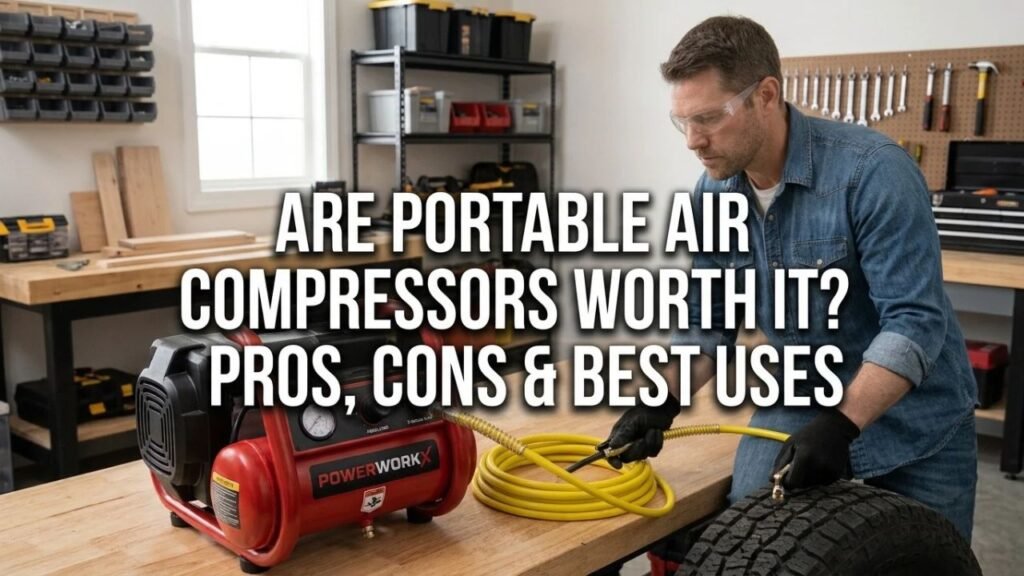
Yes, portable air compressors are worth it for many home, garage, workshop, and jobsite tasks.
The key is buying one for the type of work it can realistically support.
They Are Excellent for Intermittent Air Use
Portable compressors work particularly well when a tool uses compressed air in short bursts.
Examples include:
- Brad nailers
- Finish nailers
- Framing nailers
- Staplers
- Tire inflators
- Blow guns used briefly
- Small impact tools used intermittently
A nailer may consume only a small amount of air each time it fires. The compressor gets time between shots to restore tank pressure.
That operating pattern suits compact tanks and moderate pump output.
They Save Space
A 2- or 6-gallon portable compressor occupies far less floor space than a 60- or 80-gallon stationary unit.
Many models can be:
- Stored under a bench
- Carried into a vehicle
- Moved between rooms
- Taken to jobsites
- Put on shelving when not in use, if the storage arrangement supports the weight
This makes portable compressors attractive in garages where floor space is limited.
They Avoid Permanent Installation
Many small electric models plug into a normal 120V circuit.
You may not need:
- A 240V circuit
- Permanent hard piping
- A large concrete mounting area
- Dedicated compressor room
- Fixed air distribution
That lowers the commitment required to add compressed air to a home shop.
Key Takeaway: Portable compressors are a strong value for intermittent jobs, small workshops, and users who need mobility. Their strengths are convenience and compact size rather than high continuous airflow.
What Are the Main Benefits of a Portable Air Compressor?
Portable compressors solve several problems that larger stationary machines do not.
Easy to Move Between Jobs
Mobility is the most obvious advantage.
Small compressors commonly include:
- Carry handles
- Rubber feet
- Compact tanks
- Cord storage
- Lightweight oil-free pumps
You can move the compressor close to the task instead of installing a long permanent air line.
Cordless models take this idea further by removing the need for an AC outlet.
Useful for Several Types of Work
One portable compressor can support several jobs if its PSI and SCFM ratings match the equipment.
Typical uses include:
- Installing trim
- Building furniture
- Inflating tires
- Running staplers
- Blowing debris from parts
- Operating some air ratchets
- Using an impact wrench in short bursts
- Small hobby spraying with a suitable compressor
This makes the machine more useful than a single-purpose tire inflator for users who also own pneumatic tools.
Oil-Free Models Need Less Routine Pump Maintenance
Many modern portable compressors use oil-free pumps.
You do not need to:
- Check pump oil before every work session
- Change compressor oil on a regular schedule
- Keep the machine level for pump-oil lubrication in the same way as an oil-lubricated design
You still need to drain tank moisture and maintain the intake system according to the manual.
They Can Be Relatively Affordable to Operate
Small compressors use smaller electric motors than large stationary units and cycle off after reaching cut-out pressure.
For intermittent tasks, the motor may run only a fraction of the time you are working.
That makes a portable compressor practical for occasional use without keeping a large machine powered and ready.
Key Takeaway: Portability, multi-job use, compact storage, and low-maintenance oil-free pumps make small compressors appealing for homeowners and mobile workers.
What Are the Downsides of Portable Air Compressors?
Portable designs achieve their mobility by limiting tank size, pump size, or both.
Those trade-offs become obvious with demanding pneumatic tools.
Lower SCFM
Airflow is the biggest limitation on many portable compressors.
A typical compact cordless model may produce around 1.2 CFM at 90 PSI.
A common 6-gallon corded pancake compressor may produce roughly 2.6 SCFM at 90 PSI.
That is plenty for many nailers but far below the demand of some sanders, grinders, spray guns, and larger pneumatic tools.
Smaller Air Tanks
A small receiver stores less compressed air.
Once tool demand exceeds pump output, the tank pressure starts falling.
The motor then runs while the stored reserve continues shrinking.
Eventually, you have to stop using the tool and wait for pressure recovery.
Frequent Cycling
Small tanks reach cut-in pressure sooner.
That means the compressor may start and stop frequently during active use.
Frequent cycling can also be annoying in a quiet garage, especially with louder pancake compressors.
Noise Can Be Significant
Portable does not automatically mean quiet.
Current compact compressors range from quiet models around the upper-60-dBA area to conventional jobsite compressors around 80 dBA or more under their published test conditions.
If the compressor will operate close to you, sound level deserves attention before purchase.
Cordless Models Trade Runtime for Mobility
Cordless compressors are convenient where outlets are unavailable.
The compromise is battery runtime.
Battery-powered units are best suited to lighter tasks such as:
- Nailing
- Trim work
- Small repairs
- Short inflation jobs
Long continuous air use can drain batteries quickly and expose the compressor’s modest airflow.
Key Takeaway: Small tanks, lower SCFM, frequent cycling, noise, and limited battery runtime are the main drawbacks. These limitations matter most with continuous pneumatic tools.
What Can You Do With a Portable Air Compressor?
The usefulness of a portable compressor comes down to tool airflow requirements.
Maximum PSI alone does not tell you which tools it can run.
| Job or Tool | Portable Compressor Suitability |
| Brad nailer | Excellent |
| Finish nailer | Excellent |
| Stapler | Excellent |
| Framing nailer | Good with suitable SCFM |
| Car tire inflation | Excellent |
| Motorcycle tire inflation | Excellent |
| Short blow-gun use | Good |
| Small air ratchet | Often good for intermittent use |
| Impact wrench | Model and airflow dependent |
| Touch-up spray gun | Model dependent |
| Full-size spray gun | Often needs more SCFM |
| Die grinder | Usually demanding |
| Air sander | Usually demanding |
| Sandblasting | Usually better with larger compressor |
Nail Guns
Nailers are among the best tools for portable compressors.
They use a brief burst of air for each fastener rather than a continuous stream.
Even a modest compressor gets recovery time between shots.
Tire Inflation
Portable compressors are well suited to passenger-car tires.
A tank compressor can also inflate:
- Motorcycle tires
- Trailer tires
- Lawn-equipment tires
- Sports equipment with the correct attachment
Check the vehicle’s recommended tire pressure rather than using the maximum pressure printed on the tire sidewall as the normal inflation target.
Impact Wrenches
Many pneumatic impact wrenches operate around 90 PSI but can need substantial airflow.
A portable compressor may supply enough stored air for several short bursts.
If the wrench quickly loses force and becomes strong again after tank recovery, the compressor does not have enough continuous airflow for that usage pattern.
Sanders and Grinders
These are where many portable compressors fall short.
A pneumatic sander may consume several times the airflow that a small pancake compressor produces.
A large tank can extend the first run, but pressure still falls once air consumption exceeds pump production.
Key Takeaway: Portable compressors excel with intermittent tools such as nailers and inflators. Sanders, grinders, blasting equipment, and some spray guns expose their airflow limits quickly.
Corded vs. Cordless Portable Air Compressors
Both types are portable, but they suit different situations.
Corded Portable Compressors
A corded compressor is usually the better value when an outlet is available.
Advantages include:
- No battery-runtime limit
- Larger motor options
- Higher airflow at a similar purchase price
- No battery replacement expense
- Good fit for garage and workshop use
A common 6-gallon pancake compressor may weigh around 35 pounds while delivering about 2.6 SCFM at 90 PSI.
That is still portable enough for many homeowners and tradespeople.
Cordless Portable Compressors
Cordless models prioritize mobility.
Current 2-gallon professional models can offer roughly:
- 135 PSI maximum pressure
- 1.2 CFM at 90 PSI
- Oil-free pumps
- Brushless motors
- Weight in the low-20s to low-30s pounds, depending on battery and model
Their biggest advantage is working where AC power is awkward or unavailable.
They are particularly appealing to users who already own batteries in the same tool platform.
Which Type Gives Better Value?
Choose corded if:
- You mainly work near electrical outlets
- Higher airflow matters
- Runtime matters more than complete mobility
- You want lower cost for comparable pump performance
Choose cordless if:
- You move around jobsites frequently
- Power access is limited
- Nailers are a major use
- You already own compatible batteries
Key Takeaway: Corded models generally provide more airflow and unrestricted runtime for the money. Cordless models justify their premium when outlet-free operation has real value.
What Size Portable Air Compressor Is Worth Buying?
There is no single tank size that suits every portable-compressor buyer.
The work determines the useful size.
1- to 2-Gallon Compressors
These are highly portable.
They work well for:
- Brad nailers
- Finish nailers
- Staplers
- Small trim jobs
- Inflation
- Light blow-off work
They are easy to carry but have limited stored air.
4- to 6-Gallon Compressors
This range is popular for home and jobsite use.
A 6-gallon pancake compressor offers:
- More air reserve
- Less frequent cycling than tiny tanks
- Good nailer performance
- Useful tire-inflation capacity
- Manageable weight
This is often a good middle ground for general DIY use.
10-Gallon and Larger Portable Units
Larger wheeled portable compressors offer greater storage and may have stronger pumps.
They suit users who want more air without installing a stationary machine.
The trade-off is reduced portability.
A compressor becomes much less convenient to carry once tank, pump, motor, and wheel assemblies grow substantially.
Key Takeaway: Tiny compressors favor mobility, 4- to 6-gallon units balance portability and stored air, and larger wheeled machines make sense when airflow and reserve matter more than easy carrying.
What Specifications Matter Before You Buy?
Do not buy from tank size or maximum PSI alone.
A few specifications tell you far more about real performance.
SCFM at 90 PSI
For pneumatic tools, this is one of the first numbers to inspect.
Suppose a tool needs:
5 CFM at 90 PSI
and the compressor supplies:
2.6 SCFM at 90 PSI
The tool can use stored tank air initially, but the compressor cannot sustain the demand continuously.
Match the compressor’s airflow to the tool requirement at the same pressure.
Maximum PSI
Maximum PSI tells you the compressor’s pressure ceiling.
Higher tank pressure can increase the amount of usable stored air in a tank of a given size.
It does not substitute for pump airflow.
Tank Capacity
Gallons tell you how much physical receiver volume is available.
A larger tank:
- Extends short bursts
- Reduces how quickly pressure falls
- Can reduce cycling frequency
It does not increase SCFM.
Noise Rating
Check published dBA if the compressor will run indoors or near living spaces.
A quieter model can be worth paying more for when the machine will sit only a few feet from your workbench.
Weight
A compressor marketed as portable may still weigh 40–50 pounds.
Think about how you will move it.
A machine carried up stairs needs to be judged differently from one that rolls only across a garage floor.
Duty Cycle
Duty cycle describes how much run time the compressor is designed to handle.
A light-duty unit may not suit prolonged air demand even if it technically produces the required pressure.
Key Takeaway: SCFM at the tool’s operating pressure is the strongest performance check. Tank capacity, PSI, noise, weight, and duty cycle then determine how pleasant the compressor is to use.
Portable Air Compressor vs. Stationary Compressor
A stationary compressor is not automatically better.
It serves a different workload.
| Feature | Portable Compressor | Stationary Compressor |
| Mobility | High | Low |
| Storage space | Low to moderate | High |
| Installation | Simple on many models | Often permanent |
| Tank capacity | Small to medium | Medium to very large |
| Continuous airflow | Usually lower | Usually higher |
| 120V options | Common | Less common as size increases |
| High-CFM tools | Limited by model | Better suited |
| Nailers/inflation | Very good | Very good |
| Home DIY | Strong fit | Often more machine than needed |
| Production shop | Limited | Better fit |
A stationary unit makes more sense when your work includes:
- Continuous sanding
- Grinding
- Sandblasting
- Large spray guns
- Multiple simultaneous tools
- Daily professional pneumatic use
A portable unit makes more sense when you move between jobs or use compressed air intermittently.
Are Cheap Portable Air Compressors Worth It?
A low-priced compressor can be worth buying if its specifications fit the job.
Price alone does not tell you how useful the machine will be.
Check:
- SCFM at 90 PSI
- Tank size
- Maximum PSI
- Noise rating
- Weight
- Warranty
- Drain design
- Coupler quality
- Replacement-parts support
A budget compressor that reliably runs your nailer may be a better purchase than a larger machine you rarely use.
The opposite is also true. Buying an undersized compressor for an air sander because it costs less can lead to constant recovery pauses and frustration.
Pay for the airflow you actually need.
Who Should Buy a Portable Air Compressor?
A portable compressor is worth considering if most of your work includes:
- DIY home repairs
- Woodworking
- Trim installation
- Framing
- Furniture building
- Tire inflation
- Garage maintenance
- Occasional automotive work
- Mobile jobsite work
It is particularly useful when the same machine will serve several of those jobs.
For a homeowner who owns pneumatic nailers, maintains vehicles, and occasionally needs compressed air for cleaning or inflation, one compact tank compressor can cover a lot of ground.
Who Should Skip a Portable Air Compressor?
A portable compressor may disappoint you if the main goal is sustained operation of:
- DA sanders
- Large grinders
- Sandblasters
- High-CFM paint guns
- Multiple pneumatic tools at once
- Production equipment
Those jobs need more pump capacity than many compact machines provide.
A stationary compressor with a larger receiver and substantially higher CFM often makes more sense.
You may also not need a tank compressor at all if your only job is inflating car tires. A compact tire inflator is smaller, cheaper, and easier to store for that single task.
Safety and Maintenance Still Matter
Portable compressors are smaller, but they still contain a pressure vessel and powered machinery.
Drain tank condensation according to the manual.
Inspect:
- Air hose
- Couplers
- Drain valve
- Power cord
- Tank condition
- Safety valve
- Intake filter
Do not exceed the compressor, hose, or tool manufacturer’s pressure rating.
For workplace cleaning applications covered by OSHA rules, compressed air must meet the applicable less-than-30-PSI dead-end requirement along with chip guarding and personal protective equipment.
Never direct compressed air at yourself or another person.
Conclusion
For most homeowners, carpenters, remodelers, and light-duty garage users, are portable air compressors worth it can be answered with a clear yes. They provide compressed air without the space, wiring, and permanent installation associated with a large stationary compressor.
Their best jobs are nailers, staplers, tire inflation, short blow-gun use, and intermittent pneumatic work. Their weakest area is sustained high-CFM operation, where small tanks and pumps force frequent recovery pauses.
I would choose one based first on SCFM at the pressure your tools require, then compare tank size, weight, noise, duty cycle, and power source. If your main tools stay within its airflow capability, a portable compressor can be one of the more useful machines in a home garage or workshop.
FAQs About Portable Air Compressors
Are Small Portable Air Compressors Any Good?
Yes, when matched to light or intermittent jobs.
Small units work particularly well for nail guns, staplers, tire inflation, and short air-cleaning tasks. They are less suited to continuous tools that consume more air than the pump produces.
Is a 6-Gallon Air Compressor Worth It?
A 6-gallon compressor is a strong general-purpose size for many DIY users.
It offers more stored air than tiny 1- or 2-gallon models while remaining portable. Common 6-gallon pancake compressors also work well with many pneumatic nailers.
Is a Cordless Air Compressor Worth It?
A cordless compressor is worth paying for when mobility and outlet-free operation matter.
It is especially useful for trim work, nailing, and small jobsites. A corded compressor usually provides stronger airflow for the money when electrical power is readily available.
Can a Portable Air Compressor Run an Impact Wrench?
Some can.
Check the impact wrench’s CFM requirement and compare it with the compressor’s SCFM at the same pressure. Small compressors may run an impact wrench in short bursts but lose pressure during extended use.
Can a Portable Compressor Run an Air Sander?
Many small portable compressors cannot run an air sander continuously.
Air sanders commonly need much more CFM than compact pancake or cordless compressors provide. The sander may work briefly, then slow as tank pressure falls.
Are Portable Air Compressors Good for Car Tires?
Yes.
Tank-style portable compressors provide far more pressure than most passenger-car tires require. If tire inflation is your only intended use, a smaller dedicated inflator may be cheaper and easier to store.
How Long Do Portable Air Compressors Last?
Service life varies with pump design, operating hours, duty cycle, maintenance, storage conditions, and build quality.
Draining tank moisture, keeping the intake clean, fixing leaks, and avoiding operation beyond the specified duty cycle can reduce unnecessary wear.
What Is the Best Size Portable Air Compressor for Home Use?
A 4- to 6-gallon model is a practical range for many homeowners who want to run nailers, inflate tires, and perform light garage work.
If portability is the top priority, a 1- or 2-gallon model may suit better. If you plan to use higher-CFM pneumatic tools, look for greater pump output rather than focusing only on tank gallons.