
How Does a Portable Air Compressor Work? Parts and Airflow Guide
A portable air compressor pulls atmospheric air into a pump, squeezes that air into a smaller space, and sends it into a storage tank or directly to an outlet. A pressure switch controls when the motor starts and stops, while a regulator reduces stored pressure to the level required by your air tool.
The basic process happens automatically once the compressor is connected to power and switched on. Air enters through an intake filter, passes through the compressor pump, and moves through a check valve into the receiver tank. As more air enters the tank, pressure rises.
Once tank pressure reaches the compressor’s preset cut-out point, the pressure switch shuts the motor off. Using an air tool releases some of the stored air. When tank pressure falls to the cut-in point, the motor starts again and refills the tank.
For how does a portable air compressor work, the key is separating three specifications: the pump produces airflow, the tank stores compressed air, and the regulator controls the pressure sent to the tool. Tank size or maximum PSI alone does not tell you how well a compressor will run a pneumatic tool.
Portable models range from small inflators and 1-gallon units to pancake, hot-dog, twin-stack, and wheeled compressors with much larger receivers. Some are oil-free, while others use oil-lubricated pumps. The same basic compression cycle applies to most piston-style portable units.
Compressed air also requires care. For covered U.S. workplaces, OSHA generally limits compressed air used for cleaning to less than 30 PSI under the specified dead-end conditions and requires suitable guarding and personal protection. A compressor capable of 150 or 200 PSI should never be treated as if that full pressure is suitable for every task.
How Does a Portable Air Compressor Work Step by Step?
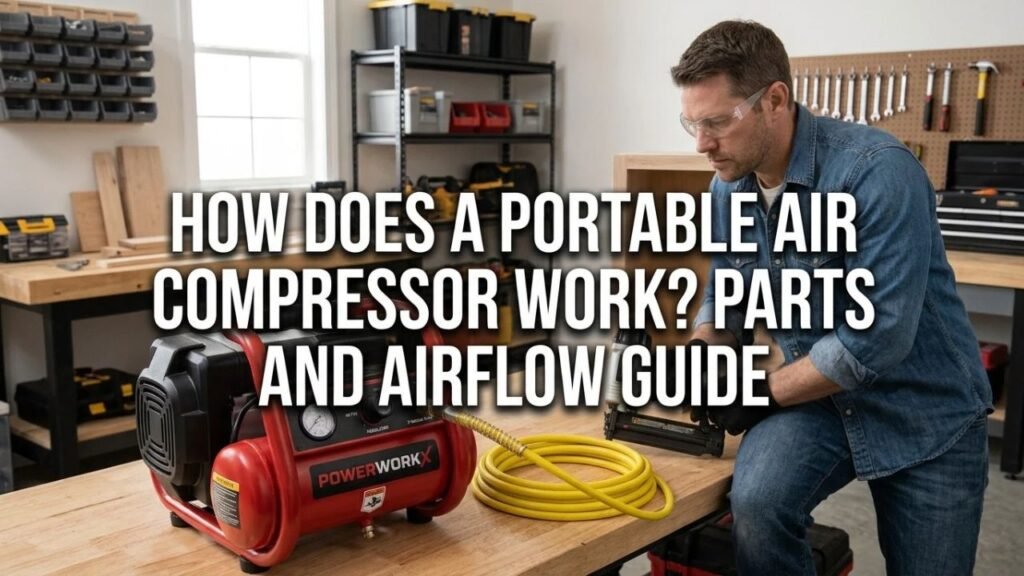
A typical portable piston compressor completes the same cycle repeatedly: intake, compression, storage, pressure control, and delivery.
1. The Motor Turns the Compressor Pump
An electric portable compressor uses a motor to drive the pump.
Depending on the design, the motor may connect to the pump through:
- Direct drive
- Belt drive
- Crankshaft mechanism
Direct-drive systems are common on small portable units because they are compact.
When you move the power switch to the ON or AUTO position, the pressure switch checks tank pressure. If pressure is below the cut-in setting, electrical power reaches the motor and the pump begins running.
Battery-powered portable compressors operate on the same basic principle, but a rechargeable battery supplies the motor instead of a wall outlet.
Gas-powered portable compressors use an internal-combustion engine rather than an electric motor.
2. Air Enters Through the Intake Filter
As the piston moves downward inside the cylinder, it creates a low-pressure area.
Atmospheric air is pulled through the compressor’s intake filter.
The filter keeps dust and debris from entering the pump. A dirty intake filter can restrict airflow, reduce compressor output, increase fill time, and make the pump work harder.
The intake valve opens during this stroke while the discharge valve remains closed.
3. The Piston Compresses the Air
The motor continues turning the crank mechanism, pushing the piston upward.
The intake valve closes.
The air trapped above the piston is forced into a smaller volume, causing its pressure and temperature to rise.
Once cylinder pressure becomes high enough, the discharge valve opens and compressed air exits the pump.
This is why the pump head and discharge tube can become very hot during operation.
4. Compressed Air Enters the Tank
On a tank-equipped compressor, the compressed air travels through a discharge tube toward the receiver.
Before entering the tank, it normally passes through a check valve.
The check valve allows air to flow:
Pump → tank
but stops compressed air from flowing backward:
Tank → pump
The receiver stores this air under pressure until you need it.
5. Tank Pressure Rises
Each pump cycle adds more compressed air.
A tank-pressure gauge displays the pressure inside the receiver.
As the tank fills, the pump has to compress air against increasing pressure, which is why a compressor often sounds more heavily loaded near the end of its fill cycle.
Maximum tank pressure depends on the model. Common portable units may have maximum ratings around:
- 125 PSI
- 135 PSI
- 150 PSI
- 165 PSI
- 175 PSI
- 200 PSI
Higher maximum pressure gives more stored-air capacity in a given tank volume, but it does not automatically mean higher CFM.
6. The Pressure Switch Stops the Motor
The pressure switch monitors receiver pressure.
When pressure reaches the factory-set cut-out pressure, the switch opens the motor circuit and the compressor stops.
For example, a compressor might:
- Start at 120 PSI
- Stop at 150 PSI
Another model may use completely different settings.
These pressure values should not be changed beyond manufacturer specifications.
7. The Unloader Releases Head Pressure
When many piston compressors stop, an unloader valve releases compressed air trapped between the pump and tank check valve.
You may hear a short:
pssshh
immediately after the motor stops.
That brief release is usually normal.
The purpose is to remove pressure from the pump head and discharge tube so the motor can restart without fighting trapped compressed air.
A faulty unloader can cause:
- Motor humming
- Slow starts
- Breaker trips
- Motor overload trips
- Failure to restart
8. The Regulator Controls Tool Pressure
Tank pressure and tool pressure are not the same thing.
Suppose the receiver contains 150 PSI but an impact wrench requires 90 PSI.
The regulator lowers outlet pressure to approximately 90 PSI.
You usually adjust it with a knob near the outlet.
A second gauge commonly shows regulated outlet pressure, while the first gauge shows tank pressure.
The regulator can reduce pressure. It cannot create pressure higher than the pressure available in the tank.
9. The Air Tool Uses Stored Air
When you pull the trigger on a pneumatic tool, air leaves the receiver through:
- Regulator
- Outlet
- Coupler
- Air hose
- Tool
Tank pressure begins falling as air is consumed.
If the tool uses air slowly, the stored reserve may last for a long time.
If the tool consumes more CFM than the pump produces, tank pressure will continue dropping even while the compressor is running.
10. The Compressor Restarts
Once tank pressure reaches the pressure switch’s cut-in point, the motor automatically starts again.
The pump refills the receiver while you continue working.
This cycle repeats:
Run → fill → stop → use air → pressure drops → restart
Key Takeaway: A portable compressor draws air into a pump, compresses it, stores it in a receiver, shuts off at cut-out pressure, and automatically restarts once tool use lowers pressure to the cut-in setting.
Main Parts of a Portable Air Compressor
Each major component performs a different job in the compression cycle.
Electric Motor
The motor supplies mechanical power to the pump.
Portable compressors commonly use 120V electric motors because they can run from standard U.S. household circuits.
Larger portable or wheeled units may require higher voltage.
Motor horsepower alone does not tell you actual air output. Compare SCFM or CFM ratings when selecting a compressor for tools.
Compressor Pump
The pump physically compresses the air.
Most small portable units use one or more pistons moving inside cylinders.
The pump contains parts such as:
- Piston
- Cylinder
- Connecting rod
- Crank mechanism
- Intake valve
- Discharge valve
Pump design has a major effect on CFM, heat, noise, durability, and duty cycle.
Air Receiver Tank
The tank stores compressed air.
Its size is normally stated in gallons.
Common portable tank sizes include:
- 1 gallon
- 2 gallons
- 3 gallons
- 6 gallons
- 8 gallons
- 10 gallons
- 20 gallons
- 30 gallons
A larger tank provides more reserve but takes longer for the same pump to fill.
Pressure Switch
The pressure switch automatically controls motor cycling.
It starts the compressor at the lower cut-in pressure and stops it at the upper cut-out pressure.
This is one of the main reasons you do not need to manually switch the motor on and off every time tank pressure changes.
Check Valve
The tank check valve prevents stored air from flowing backward toward the pump.
A leaking check valve may create:
- Air leaking near the pressure switch
- Difficult restarting
- Excessive load on the motor
- Repeated unloader leakage
Pressure Regulator
The regulator lets you choose the pressure delivered to the tool.
A compressor might store air at 150 PSI but run a nailer at 90 PSI or another tool at a lower setting.
Always use the tool manufacturer’s pressure specification.
Pressure Gauges
Many portable compressors have two gauges.
One displays:
Tank pressure
The other displays:
Regulated outlet pressure
Do not confuse the two when setting up a tool.
Safety Relief Valve
The safety valve protects the receiver if tank pressure becomes abnormally high.
It is independent of normal pressure-switch operation.
Air receivers used in covered U.S. workplaces are required to have suitable pressure gauges and spring-loaded safety valves.
Never tie, plug, block, or remove a relief valve.
Tank Drain
Compressing air also causes moisture to collect in the receiver.
The drain at the bottom of the tank lets you remove condensed water.
Leaving water inside a steel receiver can promote internal corrosion.
Drain the tank according to the compressor manufacturer’s instructions.
Key Takeaway: The motor drives the pump, the tank stores compressed air, the pressure switch controls cycling, the regulator sets tool pressure, and the safety valve protects against abnormal overpressure.
How Does an Oil-Free Portable Air Compressor Work?
Oil-free compressors use materials and pump designs that do not require the user to add lubricating oil to the compression chamber.
They are very common among small portable compressors.
Self-Lubricating Pump Materials
Oil-free piston compressors may use low-friction piston rings and cylinder materials designed to operate without an oil bath.
This eliminates routine pump-oil changes.
It also reduces the chance of compressor oil entering the air stream.
Advantages of Oil-Free Portable Compressors
Common advantages include:
- Lower maintenance
- Easy transport
- No pump oil changes
- Works well for occasional DIY jobs
- Often lighter
- No concern about oil spilling during transport
These features make oil-free designs popular for nail guns, tire inflation, trim work, and general home use.
Limitations of Oil-Free Designs
Some oil-free compressors can be:
- Louder
- Hotter-running
- Less suited to continuous industrial use
- More difficult to rebuild when worn
Design quality varies greatly, so oil-free does not automatically mean short-lived.
Key Takeaway: Oil-free compressors use low-friction internal materials instead of user-serviceable pump oil, making them convenient for portable and intermittent work.
How Does an Oil-Lubricated Portable Compressor Work?
An oil-lubricated piston compressor uses oil to reduce friction and heat inside the pump.
The basic air path remains similar to an oil-free compressor.
Oil Protects Moving Parts
Lubricant helps protect components such as:
- Bearings
- Cylinder walls
- Crankshaft
- Connecting surfaces
Oil-lubricated pumps are common on heavier portable and stationary compressors.
Oil Requires Maintenance
You may need to:
- Check oil level
- Change oil at scheduled intervals
- Use the specified compressor oil
- Watch for oil leaks
Running an oil-lubricated pump with too little oil can cause severe wear.
Do not substitute automotive engine oil unless the compressor manufacturer specifically approves it.
Which Type Is Better?
Oil-free is often convenient for:
- Home use
- Nailers
- Tire inflation
- Short jobs
- Frequent transport
Oil-lubricated designs may suit:
- Longer run times
- Workshop use
- Frequent pneumatic-tool work
- Serviceable pump applications
The choice depends more on workload than on one design being universally better.
Key Takeaway: Oil-lubricated compressors use pump oil to reduce friction and heat, while oil-free models use low-friction internal designs that remove routine oil maintenance.
What Do PSI and CFM Mean on a Portable Compressor?
These are two of the most important specifications.
They describe different things.
PSI Is Pressure
PSI stands for pounds per square inch.
It tells you how much pressure the compressor can create or deliver.
A compressor labeled 150 PSI can store air at a much higher pressure than most common pneumatic tools need.
CFM Is Airflow
CFM stands for cubic feet per minute.
It tells you how much air the compressor can deliver over time.
Manufacturers may list ratings such as:
2.6 SCFM at 90 PSI
or:
5.1 SCFM at 90 PSI
SCFM means standardized cubic feet per minute.
For tool use, compare the compressor’s airflow rating at the same pressure used to rate the tool.
Why CFM Matters More for Continuous Tools
A nail gun uses a short burst of air and then stops.
A DA sander may consume air continuously.
A small compressor can refill between nails, but it may never keep up with a continuously running sander.
Examples of higher-demand tools include:
- DA sanders
- Die grinders
- Large impact tools during continuous use
- Spray guns
- Sandblasters
A higher maximum PSI cannot compensate for inadequate CFM.
Key Takeaway: PSI measures pressure, while CFM measures airflow. For sustained pneumatic-tool use, CFM at the required working pressure is often the more useful performance number.
Why Does a Portable Air Compressor Keep Turning On and Off?
Cycling is normal.
The pressure switch is designed to operate the motor within a preset pressure range.
Normal Cycling
A typical cycle looks like this:
- Tank falls to cut-in pressure.
- Motor starts.
- Pump fills the receiver.
- Tank reaches cut-out pressure.
- Motor stops.
- Tool use lowers pressure.
- Cycle repeats.
Frequency depends on tank size, pump CFM, air-tool consumption, and leaks.
Rapid Cycling Is Different
If the compressor starts and stops every few seconds, inspect for:
- Air leak
- Very small tank relative to demand
- Faulty pressure switch
- Check-valve problem
- Incorrect pressure settings
Frequent motor starts create heat and electrical stress.
Continuous Running Can Also Signal a Problem
A compressor may run continuously because the connected tool consumes more air than the pump produces.
Other possible causes include:
- Air leak
- Dirty intake filter
- Worn pump
- Bad valve
- Loose fitting
- Damaged gasket
If the compressor used to reach cut-out easily but now runs constantly with no tool connected, inspect for a fault.
Key Takeaway: Normal compressors cycle between cut-in and cut-out pressure. Rapid cycling or failure to reach cut-out can point toward leaks, pump wear, control trouble, or excessive air demand.
Why Does Water Collect in a Portable Air Compressor Tank?
Atmospheric air naturally contains water vapor.
Compression and cooling turn some of that vapor into liquid water.
Compression Heats the Air
Air becomes hotter as the pump compresses it.
Hot compressed air can hold considerable moisture.
Cooling Causes Condensation
Once that hot air enters the receiver, it begins cooling.
As it cools, water vapor condenses into droplets and settles toward the bottom of the tank.
Humid weather can increase the amount of water collected.
Why the Tank Needs Draining
Standing water inside a steel receiver can contribute to internal corrosion.
Drain the receiver at the frequency stated in the owner’s manual.
Painting and other moisture-sensitive work may also need:
- Water separator
- Coalescing filter
- Air dryer
The receiver alone does not remove all moisture from compressed air.
Does a Portable Air Compressor Run While You Use It?
Yes, once tank pressure reaches the cut-in point.
The compressor can supply some air from the pump while also drawing from stored air in the receiver.
Imagine:
- Tool uses 4 CFM
- Compressor produces 2.6 CFM
The compressor cannot fully replace the air being consumed.
Tank pressure continues falling during tool operation.
If instead:
- Tool uses 2 CFM
- Compressor produces 4 CFM
the pump may eventually refill the tank even while the tool is being used intermittently.
This explains why matching CFM matters.
How Does a Tankless Portable Air Compressor Work?
Not every portable compressor has a storage tank.
Small tire inflators are common examples.
Air Goes Directly to the Outlet
A tankless compressor starts pumping air as soon as it is switched on.
Air flows:
Atmosphere → pump → hose → tire or device
There is little or no stored-air reserve.
Tankless Units Work Well for Inflation
They are useful for:
- Car tires
- Bicycle tires
- Sports equipment
- Small inflatables
They are generally poor choices for pneumatic tools that need bursts of high airflow.
Pressure Can Still Be High
A small tire inflator may reach a high PSI despite producing low CFM.
This again shows why maximum pressure alone does not describe compressor capacity.
How to Use a Portable Air Compressor Safely
Correct use protects the receiver, motor, tools, and operator.
Check the Compressor Before Starting
Inspect:
- Power cord
- Hose
- Couplers
- Tank
- Safety valve
- Drain
- Intake filter
- Oil level on lubricated models
Do not operate equipment with a badly rusted receiver or obvious structural damage.
Set the Regulator for the Tool
Never send full tank pressure into a lower-rated tool.
Set outlet pressure according to the tool manufacturer.
Do Not Defeat Safety Controls
Never disable:
- Pressure switch
- Safety relief valve
- Motor overload
- Grounding system
If the compressor repeatedly trips a safety device, find the cause.
Keep Cooling Airflow Clear
Portable compressors produce substantial heat.
Do not cover the machine while it runs or place it where ventilation openings are blocked.
Keep combustible materials away from hot pump and discharge components.
Drain the Receiver
Follow the manual’s draining procedure.
Turn the compressor off and handle stored pressure as directed before servicing components.
Key Takeaway: Use proper regulated pressure, keep cooling airflow clear, inspect hoses and the tank, drain moisture, and never bypass pressure or electrical safety devices.
Conclusion
For how does a portable air compressor work, the process begins when the motor drives a pump that draws atmospheric air through an intake filter. The pump compresses that air and sends it through a check valve into the receiver tank.
As tank pressure reaches the factory cut-out setting, the pressure switch shuts the motor off. A regulator then reduces stored pressure to the level needed by the connected tool. As you use air and tank pressure falls to the cut-in point, the compressor starts automatically and repeats the cycle.
Tank size determines how much reserve air is available, while CFM tells you how quickly the pump can supply air. PSI tells you pressure. Looking at all three specifications gives a much clearer picture of what a portable compressor can actually run.
Keep the intake clean, drain tank moisture, use the correct regulated pressure, and stay within the pump’s duty cycle. Those basic practices support reliable operation and reduce unnecessary wear.
FAQs About How Portable Air Compressors Work
Does a Portable Air Compressor Store Air?
Tank-equipped models do.
The pump fills a receiver with compressed air, which remains stored until a tool or outlet uses it. Tankless tire inflators send compressed air directly from the pump to the tire instead.
Why Does My Portable Compressor Stop Automatically?
The pressure switch stops the motor when tank pressure reaches its preset cut-out point.
This is normal. The compressor should restart automatically when pressure falls to the cut-in point during air use.
Why Does My Air Compressor Make a Hissing Sound After It Stops?
A brief hiss immediately after shutdown is often the unloader valve releasing trapped pressure from the pump head and discharge tube.
A hiss that continues for a long time may indicate a leaking check valve, fitting, hose, or another air leak.
Does a Bigger Tank Make a Portable Compressor Stronger?
A bigger tank provides more stored air but does not increase pump CFM or motor horsepower.
It may let a tool run longer before pressure falls, but the pump still produces air at its original rate.
Why Does My Portable Air Compressor Get Hot?
Compressing air naturally creates heat.
The pump head and discharge tube can become very hot during normal operation. Excessive heat can also come from long run times, poor ventilation, low oil on lubricated models, or mechanical trouble.
Can a Portable Air Compressor Run Continuously?
Only if its design and duty-cycle rating permit it.
Many small portable compressors are intended for intermittent operation. Running beyond the specified duty cycle can overheat the motor and pump.
What Is the Difference Between Tank PSI and Outlet PSI?
Tank PSI is the pressure stored inside the receiver.
Outlet PSI is the regulated pressure being sent through the hose to the tool. The regulator lets you set outlet pressure lower than tank pressure.
Why Does My Compressor Run Out of Air So Fast?
The connected tool may consume more CFM than the compressor produces, the receiver may be small, or the system may have an air leak.
Compare the tool’s air requirement with the compressor’s CFM rating at the same working pressure.