
What Is a Reciprocating Air Compressor? How It Works and Uses
A reciprocating compressor uses one or more pistons moving back and forth inside cylinders to draw in air, compress it, and discharge it into a tank or compressed-air system. It is also commonly called a piston compressor and is widely used in garages, workshops, service shops, and industrial applications.
The design works much like a powered bicycle pump. As the piston moves down, atmospheric air enters the cylinder through an intake valve. As the piston moves upward, the trapped air is squeezed into a smaller space, raising its pressure before a discharge valve sends it onward.
Reciprocating designs range from small portable compressors for nail guns and tire inflation to large industrial machines that produce very high pressure. Some compress the air once, while two-stage models compress it a second time in another cylinder.
Compressed air is widely used across U.S. manufacturing. U.S. Department of Energy material reports that compressed-air systems consume around 90 billion kWh of electricity per year in the United States, which shows how significant compressed-air equipment is in industrial facilities.
If you are asking what is a reciprocating air compressor, the simplest description is a positive-displacement compressor powered by a piston-and-cylinder mechanism. The crankshaft converts motor rotation into the repeated up-and-down piston movement needed to compress air. Quincy describes this design as one of the most common compressor types for garages, automotive shops, and smaller industrial environments.
Choosing one comes down to airflow, pressure, duty cycle, tank size, and how often the compressor will run. The sections below explain the working cycle, major parts, single-stage and two-stage designs, oil-lubricated and oil-free versions, typical uses, maintenance needs, and how piston compressors compare with rotary screw machines.
How Does a Reciprocating Air Compressor Work?
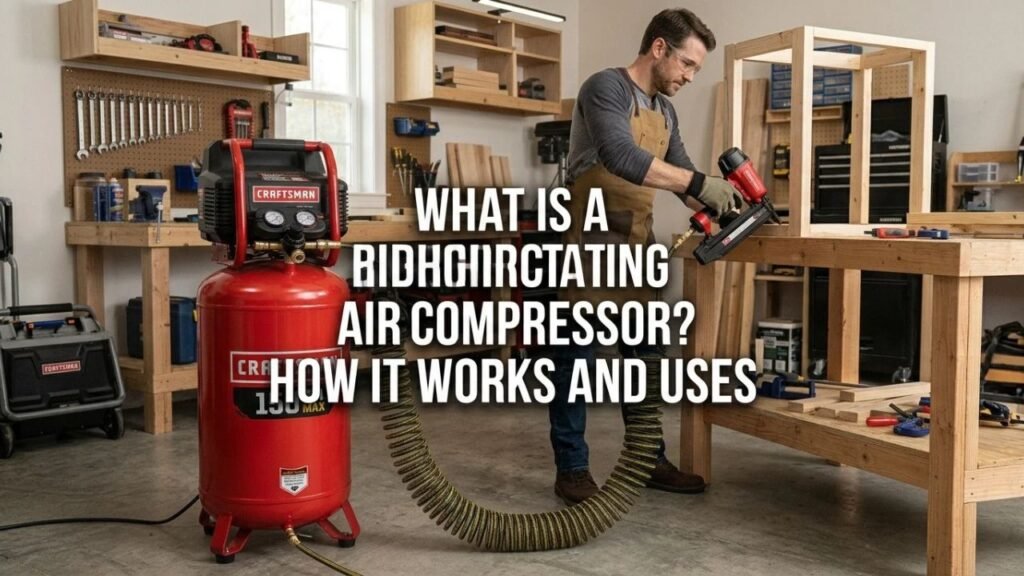
A reciprocating compressor is a positive-displacement compressor.
Positive displacement means the machine traps a fixed amount of air and then reduces the volume of the trapped air to increase its pressure.
Atlas Copco compares the piston compressor’s basic action to a bicycle pump: a crankshaft and connecting rod move a piston through a cylinder, creating the intake and compression cycles.
Intake Stroke
The cycle begins as the piston moves downward inside the cylinder.
This creates a pressure difference between the cylinder and outside atmosphere.
The intake valve opens, allowing air to enter the cylinder.
An air filter normally sits ahead of the intake to reduce dirt and debris entering the pump.
Once the piston reaches the bottom of its stroke, the intake valve closes.
Compression Stroke
The crankshaft then pushes the piston upward.
With the valves closed, the trapped air has less space available.
Its volume decreases and pressure rises.
The compressor continues squeezing the air until cylinder pressure becomes high enough to open the discharge valve.
Discharge Stroke
The compressed air passes through the discharge valve and leaves the cylinder.
Depending on the compressor design, it may go:
- Directly to the receiver tank
- Through an intercooler into a second compression stage
- Into a compressed-air piping system
A pressure switch monitors receiver pressure on many tank-mounted compressors.
When tank pressure reaches the compressor’s cut-out point, the motor stops.
As air is used and pressure falls to the cut-in point, the motor starts again.
The Cycle Repeats Continuously While the Pump Runs
The piston repeats this movement many times per minute.
The actual pump speed depends on the model and drive system.
Some compressors use a direct-drive motor, while others use belts and pulleys to turn the pump at a different speed from the electric motor.
Key Takeaway: A reciprocating compressor draws air into a cylinder, traps it, reduces its volume with a piston, and pushes the compressed air into a tank or air system.
Main Parts of a Reciprocating Air Compressor
The basic mechanical design is fairly straightforward, which is one reason piston compressors remain common.
Cylinder
The cylinder forms the chamber where compression takes place.
The piston moves inside it.
Some compressors have one cylinder, while others use two or more cylinders.
Cylinder construction varies between aluminum, cast iron, and other materials depending on the compressor class.
Piston
The piston moves back and forth inside the cylinder.
Its downward movement draws air in.
Its upward movement compresses the trapped air.
Piston rings or sealing components help control air leakage between the piston and cylinder wall.
Crankshaft and Connecting Rod
The electric motor or engine rotates the crankshaft.
The connecting rod transfers that rotation to the piston and changes rotary motion into reciprocating motion.
This repeating piston movement is where the term reciprocating comes from.
Intake and Discharge Valves
These valves control the direction of airflow.
The intake valve allows air into the cylinder during the intake stroke.
The discharge valve opens when cylinder pressure becomes high enough for compressed air to leave.
Many piston compressors use automatic valves that open and close according to pressure differences rather than an external mechanical actuator. Atlas Copco notes that self-acting valves are common in reciprocating compressor designs.
Air Filter
The intake filter reduces dirt entering the compressor.
A dirty filter can restrict incoming air and reduce pump output.
It should be inspected and serviced according to the compressor manual.
Receiver Tank
Tank-mounted compressors store compressed air in a receiver.
The tank gives the system a reserve of air and reduces how often the pump has to respond to every small air demand.
A larger tank does not increase the pump’s actual CFM.
Pressure Switch
The pressure switch controls automatic motor cycling.
It shuts the compressor off at cut-out pressure and starts it again after pressure falls to cut-in pressure.
Safety Relief Valve
The relief valve protects the tank and system against excessive pressure.
It should never be plugged, adjusted casually, or replaced with an incorrectly rated valve.
Key Takeaway: The piston, cylinder, crankshaft, valves, air filter, tank, and pressure controls work together to convert motor rotation into stored compressed air.
Single-Stage vs Two-Stage Reciprocating Air Compressors
One of the main ways piston compressors are classified is by the number of compression stages.
Single-Stage Reciprocating Compressor
A single-stage compressor compresses the air to its final pressure in one compression stage.
Air enters the cylinder, is compressed by the piston, and then goes to the receiver.
Quincy’s current single-stage models commonly operate in roughly the 110–145 PSI range, depending on the model.
Single-stage compressors are common for:
- Home garages
- Portable compressors
- Woodworking
- Tire inflation
- Nail guns
- Small repair shops
- Light pneumatic tools
They are often smaller and less expensive than two-stage machines.
Two-Stage Reciprocating Compressor
A two-stage compressor compresses the same air twice.
The first, larger piston compresses incoming air to an intermediate pressure.
The air then travels through an intercooler before entering a smaller second-stage cylinder.
The second piston raises it to the final pressure.
Quincy describes two-stage piston compressors as commonly reaching pressures around 175 PSI, though industrial reciprocating machines can be designed for much higher pressures.
Why the Air Is Cooled Between Stages
Compressing air creates heat.
An intercooler between compression stages removes part of that heat before the air enters the second cylinder.
Cooling makes the second compression stage easier on the equipment and helps control discharge temperature.
Which One Is Better?
Single-stage models are usually a good fit when moderate pressure and intermittent use are enough.
Two-stage models make more sense for:
- Higher-pressure work
- Larger automotive shops
- Manufacturing
- Multiple pneumatic tools
- Higher daily air demand
- Larger receiver systems
A two-stage compressor should not be chosen simply because it has two cylinders. Some single-stage machines also use multiple cylinders operating in parallel.
Check the manufacturer’s description to confirm the actual compression design.
Key Takeaway: Single-stage compressors perform one compression cycle, while two-stage units compress the air again in a second cylinder to reach higher pressure.
Oil-Lubricated vs Oil-Free Reciprocating Compressors
Piston compressors are also available in lubricated and oil-free designs.
Oil-Lubricated Reciprocating Compressor
An oil-lubricated pump uses compressor oil to reduce friction and wear.
Depending on the design, lubrication may use:
- Splash lubrication
- Pressure lubrication
Quincy offers both splash-lubricated and pressure-lubricated reciprocating systems in its current piston compressor range.
Oil-lubricated designs are common in:
- Automotive shops
- Large garages
- Commercial workshops
- Industrial plants
- Heavy-duty stationary compressors
They require oil checks and periodic oil changes.
Small amounts of lubricant can also migrate into the compressed-air stream, so downstream filtration may be needed for applications requiring cleaner air.
Oil-Free or Oil-Less Reciprocating Compressor
Oil-free designs avoid using oil in the compression chamber.
They commonly use permanently lubricated bearings, specialized coatings, or low-friction materials.
Ingersoll Rand currently offers oil-less reciprocating compressors specifically for applications that need compressed air without oil introduced by the compression process.
Oil-free piston compressors are common for:
- Portable home compressors
- Trim work
- Dental and laboratory applications
- Certain production processes
- Applications where oil contamination is undesirable
Does Oil-Free Mean No Maintenance?
No.
An oil-free compressor eliminates routine pump-oil service, but other parts still need attention.
Maintenance may include:
- Air-filter replacement
- Tank draining
- Valve inspection
- Belt inspection on belt-driven units
- Cooling-system cleaning
- Fastener checks
- Moisture-control service
Key Takeaway: Oil-lubricated piston compressors use lubricant in the pump and suit many heavy-duty applications, while oil-free designs reduce oil contamination and routine oil service.
Reciprocating Air Compressor vs Rotary Screw Compressor
Both produce compressed air, but their operating styles are different.
| Feature | Reciprocating compressor | Rotary screw compressor |
| Compression method | Piston moving in cylinder | Rotating screw elements |
| Air delivery | Pulsating compression cycles | Smoother continuous production |
| Best use | Intermittent or varied demand | Long continuous demand |
| Common locations | Garages, shops, small plants | Factories, production facilities |
| Initial cost | Often lower | Often higher |
| High-pressure capability | Strong | Depends on design |
| Maintenance style | Piston, valve, ring service | Screw element, separator, lubricant system |
| Noise/vibration | Often higher | Often smoother |
Reciprocating Compressors Suit Intermittent Work
A piston compressor works well when air demand stops and starts.
Examples include a repair shop where an impact wrench runs briefly, a nailer fires intermittently, or tires are inflated between other jobs.
Quincy describes reciprocating compressors as especially suited to intermittent applications and high-pressure requirements.
Rotary Screw Compressors Suit Long Run Times
Rotary screw machines are commonly chosen when a facility needs a steady compressed-air supply for long operating periods.
Instead of a piston moving back and forth, two rotating screw elements reduce trapped air volume continuously.
A fabrication plant running pneumatic machinery throughout a shift may favor that type of compressor.
Not Every Reciprocating Compressor Has a Low Duty Cycle
Many small piston compressors are intended for intermittent duty.
Large industrial reciprocating compressors can be different.
For example, Quincy’s QR-25 line includes reciprocating machines rated for 100% duty cycle in selected configurations.
So compressor type alone does not define duty cycle.
Key Takeaway: Piston compressors are common for stop-and-start air demand, while rotary screw machines are often chosen for steady production use, though industrial piston designs can also support continuous duty.
Advantages of a Reciprocating Air Compressor
Good High-Pressure Capability
Piston compression is well suited to producing substantial pressure.
Two-stage and multistage reciprocating compressors can reach pressures higher than typical portable shop compressors.
Quincy currently offers industrial reciprocating designs extending as high as 500 psig in parts of its QR-25 range.
Wide Range of Sizes
Reciprocating compressors can be tiny portable machines or large stationary industrial systems.
That makes the basic design suitable for very different users.
Good for Intermittent Air Demand
A piston compressor can shut down when the tank reaches pressure and restart when needed.
This suits garages and workshops where tools are not consuming air continuously.
Straightforward Mechanical Design
Piston compressors have been used for many years, and their basic mechanical layout is widely understood.
Valves, belts, filters, rings, and other wear parts can often be serviced or replaced.
Lower Entry Cost in Many Sizes
Small and medium reciprocating compressors often cost less upfront than industrial rotary screw systems with comparable intended applications.
That is one reason they remain common in home and commercial workshops.
Disadvantages of a Reciprocating Air Compressor
More Noise and Vibration
The piston repeatedly changes direction inside the cylinder.
Valves open and close rapidly, and the crank mechanism creates vibration.
Small direct-drive units can be particularly noticeable indoors.
Pulsating Air Production
Compression occurs in individual piston strokes rather than as one perfectly continuous flow.
The receiver tank smooths this pulsation before air reaches the tool.
Heat Generation
Air temperature rises during compression.
High-pressure and multistage systems use cooling methods to control temperature.
Intermittent-Duty Limits on Many Portable Models
A small piston compressor may need rest periods.
Running a compressor beyond its rated duty cycle can increase temperature and shorten component life.
Check the manual rather than assuming every reciprocating compressor can run continuously.
More Routine Service on Lubricated Units
Oil-lubricated models require pump-oil maintenance.
Belts, filters, valves, and other components can also need periodic inspection.
Where Are Reciprocating Air Compressors Used?
Piston compressors cover a wide range of jobs.
Common uses include:
- Automotive repair
- Tire shops
- Home garages
- Woodworking
- Construction
- Pneumatic nailers
- Impact wrenches
- Painting
- Equipment maintenance
- Small manufacturing plants
- Engine starting
- Gas processing
- High-pressure industrial service
Quincy identifies automotive shops, home garages, maintenance departments, and small workshops among typical single-stage applications.
The U.S. Department of Energy also describes compressed air as widely used for pneumatic tools, spray equipment, material handling, controls, and industrial processes.
A single compressor may support several tools as long as its airflow capacity meets the combined demand.
How Much PSI Can a Reciprocating Compressor Produce?
There is no single pressure rating.
Pressure depends on the pump design and number of stages.
As broad examples:
- Small portable piston compressors: often around 120–150 PSI maximum
- Single-stage shop compressors: commonly around 110–145 PSI
- Two-stage shop compressors: commonly around 175 PSI
- Specialized industrial piston compressors: can operate far above those ranges
Quincy’s current piston lineup illustrates this range, from single-stage models around 110–145 PSI to industrial reciprocating products designed for much higher pressure.
Higher maximum PSI does not automatically mean a compressor can run a larger air tool.
You also need enough CFM.
How to Size a Reciprocating Air Compressor
Check Tool CFM
CFM tells you how much air a tool consumes.
Find the manufacturer’s airflow specification for your highest-demand pneumatic tool.
Common high-demand tools include:
- Sanders
- Grinders
- Spray guns
- Large impact wrenches
- Sandblasting equipment
A small compressor may have enough PSI but not enough CFM for these tools.
Check Required PSI
Match the compressor to the tool’s operating pressure.
Many general pneumatic tools operate around 90 PSI, but actual specifications vary.
Do not use maximum tank pressure as the tool setting.
Check Tank Size
The receiver provides stored air.
A larger tank can support short bursts for longer before the pump needs to replenish the pressure.
It does not raise continuous pump output.
Check Duty Cycle
Duty cycle indicates how long the compressor can operate within a given time period without exceeding its intended operating conditions.
This is especially relevant if you plan to run:
- Spray equipment
- Sanders
- Grinders
- Production tools
Account for Multiple Tools
If several tools will operate at the same time, their airflow demand needs to be considered together.
A one-person home garage has different requirements from a four-bay repair shop.
Key Takeaway: Size a piston compressor from required CFM and PSI first, then choose tank capacity and duty cycle that fit how long and how often the tools will run.
Reciprocating Air Compressor Maintenance
Check or Change Compressor Oil
Oil-lubricated pumps need the correct compressor oil.
Check level and service intervals in the manual.
Do not substitute automotive engine oil unless the manufacturer specifically permits it.
Drain the Receiver Tank
Compression creates moisture.
Water condenses inside the receiver and should be drained regularly.
Leaving moisture inside can promote internal tank corrosion.
Keep the Intake Filter Clean
A clogged intake filter makes it harder for the pump to draw air.
Inspect it at the interval specified by the manufacturer and replace it when required.
Inspect Belts
Belt-driven models need correct belt tension and condition.
Look for:
- Cracking
- Glazing
- Fraying
- Loose tension
Disconnect power and depressurize the machine before removing guards.
Check for Air Leaks
Leaks make the compressor cycle more often and waste stored air.
Inspect fittings, hoses, couplers, drains, and piping.
U.S. Department of Energy resources identify compressed-air leaks as a major source of wasted compressor energy in industrial systems.
Keep Cooling Surfaces Clear
Compression generates heat.
Keep cooling fins, fan passages, and ventilation openings free of dust and debris.
Key Takeaway: Regular oil service where applicable, tank draining, filter care, leak repair, belt inspection, and cooling-system cleaning can extend piston-compressor life.
Is a Reciprocating Compressor Good for a Home Garage?
Yes.
A reciprocating compressor is one of the most practical designs for a home garage because home air demand is usually intermittent.
You may use compressed air for:
- Tire inflation
- Blow guns
- Brad nailers
- Impact wrenches
- Ratchets
- Small paint jobs
- General repair work
A small 6-gallon portable model may cover inflation and nailers.
A larger 20- to 30-gallon compressor provides more reserve for automotive work.
A 60-gallon single-stage or two-stage unit is more appropriate when you regularly use higher-CFM pneumatic equipment.
The correct size depends much more on tool airflow than on tank gallons alone.
Is a Reciprocating Compressor Good for Industrial Use?
Yes, particularly where air demand is intermittent or high pressure is required.
Large piston compressors are used in areas such as:
- Manufacturing
- Process plants
- High-pressure air systems
- Engine starting
- Gas handling
- Maintenance facilities
Rotary screw compressors tend to dominate many continuous plant-air applications because of their operating characteristics, but heavy-duty reciprocating machines still have a place where pressure, serviceability, or operating pattern favors piston compression.
DOE materials list reciprocating, rotary screw, and centrifugal machines among the main industrial compressor categories.
Conclusion
What is a reciprocating air compressor? It is a positive-displacement compressor that uses one or more pistons moving inside cylinders to draw in atmospheric air, reduce its volume, and discharge it at higher pressure.
Single-stage versions compress air once and suit many home, garage, and small-shop jobs. Two-stage versions compress the air twice and are commonly chosen when higher pressure or heavier service is required. Both oil-lubricated and oil-free designs are available.
For buying one, focus on CFM at the pressure your tools require, then look at tank size, maximum PSI, duty cycle, power supply, and maintenance requirements. A properly sized piston compressor can be a strong choice for everything from nail guns and tire work to large industrial compressed-air systems.
FAQs About Reciprocating Air Compressors
Is a Reciprocating Compressor the Same as a Piston Compressor?
Yes. The terms are commonly used interchangeably. The name comes from the piston moving back and forth, or reciprocating, inside the cylinder as the crankshaft turns.
What Is the Main Use of a Reciprocating Air Compressor?
They are commonly used where compressed air is needed intermittently, such as garages, automotive shops, woodworking shops, maintenance facilities, construction work, and smaller industrial systems. Specialized piston compressors also serve high-pressure industrial applications.
What Is the Difference Between Single-Stage and Two-Stage Reciprocating Compressors?
A single-stage compressor raises the air to final pressure in one compression stage. A two-stage unit compresses the air once, cools it, then sends it to a second cylinder for further compression. Two-stage machines usually support higher final pressures.
Is a Reciprocating Compressor Oil-Free?
It can be. Both oil-lubricated and oil-free reciprocating compressors are available. Oil-lubricated models use compressor oil to reduce pump wear, while oil-free versions use materials and bearing designs that keep oil out of the compression chamber.
Are Reciprocating Air Compressors Good for Continuous Use?
Many portable piston compressors are intended for intermittent operation, so their duty-cycle rating should be checked. Some industrial reciprocating compressors are specifically designed and rated for continuous-duty operation.
Which Is Better, Reciprocating or Rotary Screw?
A reciprocating compressor is often a good choice for intermittent air demand, high-pressure applications, home garages, and smaller shops. Rotary screw machines are commonly chosen when a facility needs a steady supply of compressed air for long operating periods.
How Much Pressure Does a Reciprocating Compressor Make?
Pressure depends on the design. Single-stage shop compressors commonly operate around 110–145 PSI, two-stage models often reach around 175 PSI, and specialized industrial piston compressors can produce substantially higher pressures.
How Long Does a Reciprocating Air Compressor Last?
Service life varies with construction, operating hours, duty cycle, maintenance, temperature, and air cleanliness. Regular lubrication where required, tank draining, clean intake filters, leak repairs, and proper operating pressure can reduce premature wear.