
Can You Lay a Vertical Air Compressor on Its Side for Transport?
You can sometimes place a vertical air compressor on its side temporarily for transportation, but you generally should not operate or store it that way. Oil-lubricated compressors need extra caution because pump oil can migrate into the cylinder, intake, discharge line, or other areas when the machine is tipped over.
Vertical compressors are designed to stand upright. The tank feet, pump lubrication system, motor mounting, drain location, and cooling arrangement all assume the compressor will remain in its normal vertical position during operation.
For can you lay a vertical air compressor on its side, transportation is the main situation where it may be acceptable. The tank should be fully depressurized, the compressor should be secured against movement, and the manufacturer’s transport instructions should take priority.
The second common question, can you lay down a stand up air compressor, has a similar answer. Laying it down briefly may be possible, but oil-lubricated models should be returned upright and allowed to sit before startup so displaced oil can drain back into the pump crankcase.
Oil-free compressors are generally less sensitive to oil migration because they do not have an oil-filled pump crankcase. They can still suffer damage from an unsupported motor, broken fittings, damaged gauges, bent guards, or impact during transportation.
If the compressor cannot be transported upright, protecting its pump, motor, valves, pressure switch, regulator, and drain fittings becomes just as important as protecting the tank itself.
Can You Lay a Vertical Air Compressor on Its Side?
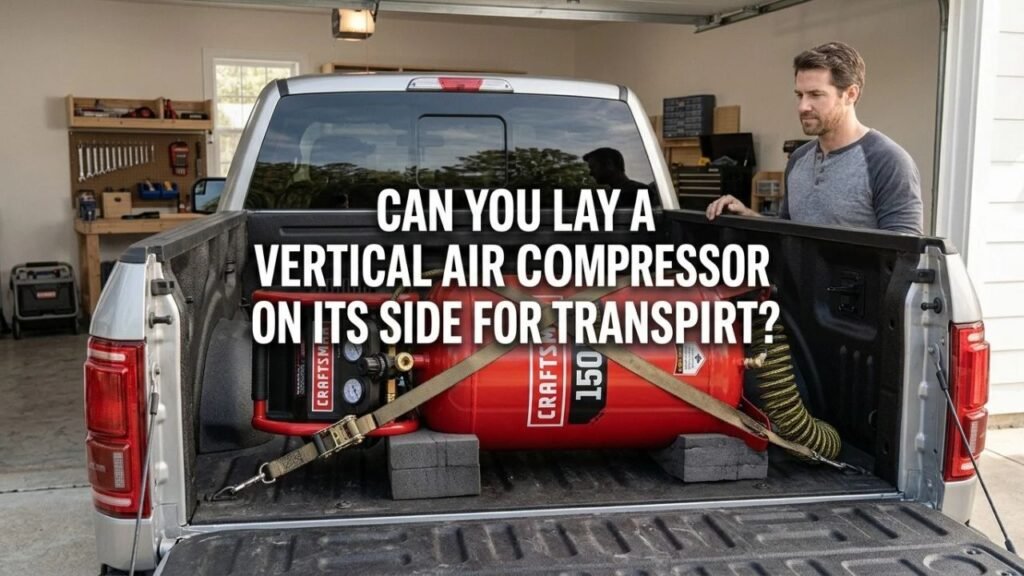
Sometimes, but only for temporary handling or transportation when the machine cannot remain upright.
Do Not Operate It on Its Side
A vertical compressor should normally be operated upright.
Running it horizontally can affect:
- Pump lubrication
- Cooling airflow
- Tank drainage
- Vibration control
- Safety-valve orientation
- Motor and pump loading
Its feet and mounting system are also designed to support the compressor vertically.
Temporary Transport May Be Possible
If the compressor manual does not prohibit it, laying the unit down for a short trip may be possible.
Before doing so:
- Shut it off.
- Unplug or disconnect power.
- Drain tank pressure.
- Drain condensate.
- Secure loose accessories.
- Protect gauges and fittings.
- Strap the compressor securely.
Manufacturer Instructions Come First
Some compressors have specific transport restrictions.
A warranty may also exclude damage caused by improper transportation.
Check the exact model manual before tipping a large stationary compressor.
Key Takeaway: A vertical compressor may sometimes be transported on its side, but it should normally be operated upright and handled according to the manufacturer’s instructions.
Can You Lay Down a Stand Up Air Compressor?
A stand-up compressor is another name people use for a vertical-tank compressor.
The same precautions apply.
The Tank Can Physically Be Horizontal
The steel receiver itself does not immediately become unsafe merely because it is horizontal and depressurized.
The concern is the equipment attached to it.
That can include:
- Pump
- Motor
- Pressure switch
- Regulator
- Gauges
- Drain valve
- Belt guard
- Air filter
These components may be vulnerable when the machine is resting on its side.
Weight Distribution Changes
A large upright compressor can weigh several hundred pounds.
Once it is placed sideways, the machine may rest on parts never intended to carry its weight.
That can damage:
- Belt guards
- Motor mounts
- Pump components
- Plumbing
- Wheels
- Valve assemblies
Use blocking or padding so the tank shell and intended structural areas carry the load rather than fragile components.
Never Lay Down a Pressurized Compressor
Release all stored pressure first.
A compressed-air receiver contains substantial stored energy.
Transportation is safer when the tank pressure is completely relieved.
Key Takeaway: A stand-up compressor can sometimes be laid down for transport, but it must be depressurized and supported so fragile components are not carrying the machine’s weight.
Why Oil-Lubricated Compressors Should Stay Upright
Oil migration is the main concern with an oil-filled reciprocating compressor.
Oil Can Leave the Crankcase
When the compressor is tipped over, pump oil can move into areas where it does not normally belong.
Possible paths include:
- Cylinder
- Intake passage
- Air filter
- Breather
- Discharge side
Oil Can Enter the Cylinder
If enough oil reaches the compression chamber, the pump may be difficult to turn at startup.
In an extreme case, incompressible liquid in the cylinder can create mechanical stress.
This is one reason an oil-lubricated compressor should never be started immediately after it has been transported on its side.
Oil Can Reach the Air Filter
Some compressor pumps have crankcase breathers positioned near the intake system.
Tipping may allow oil to wet:
- Filter element
- Intake housing
- Breather system
This can create smoke, oil carryover, or poor airflow when restarted.
Crankcase Oil Level Can Become Misleading
If you check the sight glass immediately after standing the compressor back up, oil may still be distributed throughout the pump.
Give it time to settle before judging the level.
Key Takeaway: Oil-filled compressors need to remain upright because tipping can move lubricating oil into the cylinder, intake, breather, or discharge system.
What About an Oil-Free Vertical Air Compressor?
Oil-free compressors eliminate the crankcase-oil problem, but they are not automatically safe to transport in any position.
No Pump Oil to Spill Internally
An oil-free pump uses materials and designs that do not require an oil reservoir.
That means you do not have to worry about crankcase oil flooding the cylinder.
Other Components Can Still Be Damaged
Laying an oil-free compressor down can put pressure on:
- Regulator
- Gauges
- Motor cover
- Cooling fan
- Electrical box
- Drain valve
- Handle
Protect these parts with padding and proper support.
Cooling Orientation Still Matters
Do not assume an oil-free compressor can be operated horizontally.
The motor and pump cooling system is designed around the compressor’s normal orientation.
Operate it only as intended by the manufacturer.
Key Takeaway: Oil-free compressors are less sensitive to being tipped during transport, but they still need protection from impact and should normally be operated upright.
Can You Transport a Vertical Air Compressor on Its Side?
Yes, in some cases, but transporting it upright is preferable whenever practical.
Upright Transport Is Best
Keeping the compressor upright avoids:
- Oil migration
- Component loading
- Plumbing stress
- Gauge damage
It also keeps the machine in the orientation it was designed to handle.
Measure the Vehicle First
Before tipping the compressor, check whether it can fit upright in:
- Pickup
- Trailer
- Cargo van
- Box truck
Removing detachable handles or accessories may provide enough clearance without laying the entire unit down.
Secure the Compressor
A tall compressor can become unstable during braking or cornering.
Use properly rated tie-down straps.
Secure the unit to strong anchor points.
Do not depend on:
- Rope tied loosely around the tank
- Other cargo holding it in place
- Its own wheels
Protect the Pump
If horizontal transportation is necessary, position the machine according to the manufacturer’s preferred side if one is specified.
Support the tank securely so the pump and motor are not resting directly on the vehicle floor.
Key Takeaway: Upright transport is preferable, but temporary side transport may be possible if the compressor is depressurized, supported correctly, and securely restrained.
How to Prepare a Vertical Air Compressor for Side Transport
Preparation reduces the chance of mechanical damage.
Step 1: Turn the Compressor Off
Move the power switch to OFF.
Step 2: Disconnect Power
For an electric compressor:
- Unplug portable models.
- Disconnect hardwired units properly before moving.
A hardwired stationary compressor may require a qualified person to disconnect the electrical supply.
Step 3: Release Tank Pressure
Drain stored compressed air.
Do not move a large pressurized receiver unnecessarily.
Step 4: Drain Condensation
Open the receiver drain and remove accumulated water.
This reduces weight slightly and prevents water from moving through the tank while it is being tilted.
Step 5: Check Pump Oil
For an oil-lubricated compressor, note the proper oil level before transport.
Some manufacturers may recommend draining pump oil before moving the machine horizontally.
Follow the manual if it specifies this step.
Step 6: Remove Loose Accessories
Take off anything that can fall or break, such as:
- Air hose
- Filters
- Removable regulator accessories
- Loose fittings
- Tools stored on the machine
Step 7: Protect Gauges and Controls
Pad vulnerable components.
Do not allow the machine to rest on its:
- Pressure switch
- Gauges
- Regulator
- Safety valve
Step 8: Lower It Carefully
Large compressors can be top-heavy.
Use enough people or proper lifting equipment.
Do not try to catch a falling compressor by hand.
Step 9: Support the Tank
Use blocks, padding, or a cradle so the compressor cannot roll.
Avoid crushing:
- Drain valve
- Pump guard
- Motor cover
- Plumbing
Step 10: Strap It Down
Secure it in multiple directions so it cannot:
- Slide
- Roll
- Bounce
- Rotate
Key Takeaway: Fully depressurize and drain the compressor, protect its controls, support the tank rather than fragile components, and secure the unit firmly before transportation.
How Long Should a Compressor Sit Upright After Being on Its Side?
Oil-lubricated compressors should be allowed to stand upright before startup.
Give Oil Time to Return
After horizontal transportation, place the compressor in its normal position.
Oil that migrated into the pump needs time to drain back toward the crankcase.
A conservative approach is to let it sit for several hours, and overnight is preferable if it was completely horizontal for a long trip.
If the manufacturer specifies a different waiting period, follow that instruction.
Inspect the Air Filter
Check for oil contamination.
If the filter is oil-soaked, do not simply start the compressor and hope it clears itself.
Clean or replace components as required.
Check the Oil Level
After the machine has remained upright long enough for the oil to settle, check:
- Sight glass
- Dipstick
- Fill indicator
Add or remove oil only according to the pump specification.
Rotate the Pump if Appropriate
On a belt-driven compressor, some service procedures may allow checking that the pump turns freely with power disconnected.
Do not place your hands near belts or pulleys unless the machine is fully isolated from power and the manufacturer’s procedure permits it.
Key Takeaway: Let an oil-lubricated compressor remain upright for several hours after side transport, preferably longer after an extended trip, then inspect the oil level and intake before startup.
What Happens If You Start an Oil Compressor Immediately After Laying It Down?
Several problems can occur.
Oil Smoke
Oil that entered the cylinder or intake can be carried into the compressed-air stream.
You may see or smell:
- Oil mist
- Smoke
- Burning-oil odor
Hard Starting
Excess oil in the cylinder can resist piston movement.
The motor may:
- Struggle
- Hum
- Trip overload protection
Excessive Oil Carryover
Oil can travel into:
- Discharge pipe
- Receiver tank
- Air lines
This is especially undesirable for:
- Painting
- Pneumatic controls
- Clean-air applications
Pump Damage
Attempting to compress liquid can place abnormal stress on:
- Connecting rod
- Valves
- Piston
- Crankshaft
Do not repeatedly attempt to start a compressor that suddenly binds after being transported horizontally.
Key Takeaway: Starting an oil-filled compressor too soon after tipping can cause hard starting, oil carryover, smoke, and potentially damaging hydraulic stress inside the pump.
Should You Drain the Oil Before Laying a Compressor Down?
For some oil-lubricated compressors, draining the pump oil before extended horizontal transport is the safest option.
Check the Manual First
The manufacturer may specify:
- Whether oil should be drained
- Which side the compressor may rest on
- Refill quantity
- Approved oil type
Draining Oil Reduces Migration Risk
Removing the oil prevents it from running into the cylinder or breather.
This can be helpful for:
- Long-distance moves
- Shipping
- Extended side storage
Refill Before Startup
If oil is drained, clearly mark the compressor so nobody starts it empty.
Running an oil-lubricated pump without oil can cause rapid damage.
Key Takeaway: Draining pump oil can reduce risk during long horizontal transport, but do it only according to the compressor manufacturer’s procedure and refill it before operation.
Can You Store a Vertical Air Compressor on Its Side?
Generally, no.
Long-term storage should normally be upright.
Oil Can Remain Displaced
An oil-lubricated pump lying sideways for weeks or months may keep oil against seals, breathers, and passages not intended for prolonged immersion.
The Tank Drain Will Not Work Normally
Vertical tanks place the drain at their lowest point.
On the side, condensate may collect somewhere else inside the receiver.
This prevents complete drainage.
Components May Carry Weight
Long-term horizontal storage can leave:
- Guard
- Motor mount
- Pump
- Fittings
under unusual mechanical loads.
Tank Shape Does Not Make Side Storage Useful
A vertical tank is designed to save floor space while standing upright.
Store it in the orientation for which its base and feet were built.
Key Takeaway: Side placement may be acceptable briefly during transportation, but a vertical compressor should normally be stored upright.
Can You Operate a Vertical Air Compressor Horizontally?
Normally, no.
Lubrication May Fail
On an oil-filled pump, internal oil distribution depends on normal orientation.
Operating sideways can starve some components while flooding others.
Condensate Cannot Drain Correctly
Water falls to the lowest part of the tank.
The factory drain may no longer be the lowest point when the receiver is horizontal.
Cooling Can Change
Motor and pump airflow may not function as intended.
Vibration Loads Change
The tank feet and frame are designed around vertical operation.
Horizontal operation may transfer vibration into:
- Plumbing
- Motor mounts
- Pump brackets
Safety Components Were Positioned for Upright Use
Do not redesign the operating orientation without manufacturer approval.
Key Takeaway: Transport orientation and operating orientation are different—temporary side transport may be possible, but a vertical compressor should normally run upright.
Can Laying a Compressor Down Damage the Tank?
Simply turning a depressurized receiver on its side does not usually damage a sound steel tank.
Damage can occur during handling.
Denting the Receiver Is Serious
A large compressor falling from a truck or forklift can dent the tank.
Do not continue using a receiver with significant physical damage without proper evaluation.
Do Not Lift From Small Fittings
Never use:
- Pressure switch piping
- Safety valve
- Regulator
- Drain
as lifting points.
Avoid Dragging the Tank
Dragging can damage:
- Coating
- Welded feet
- Drain valve
- Tank surface
External damage and corrosion deserve attention because a pressure vessel stores substantial energy during use.
What Side Should an Air Compressor Be Laid On?
There is no universal correct side.
The answer depends on component placement.
Avoid the Pump-Oil Side When Possible
On oil-lubricated units, some orientations may make oil migration worse than others.
The manufacturer may specify a preferred side.
Keep Controls Upward
Whenever possible, keep these away from the floor:
- Pressure switch
- Gauges
- Regulator
- Safety valve
- Air intake
Protect the Motor and Pump
Do not let the entire compressor weight rest on the motor housing or pump.
Support the Receiver
Use padded blocks around strong portions of the tank or frame.
If the manual gives no guidance, upright transport remains the safest choice.
How to Move a Large Vertical Air Compressor Safely
Large stationary units require more planning than portable compressors.
Know the Weight
A 60- or 80-gallon vertical compressor can weigh several hundred pounds.
Do not estimate by appearance.
Use Proper Equipment
Depending on the machine, moving equipment may include:
- Appliance dolly
- Engine hoist
- Forklift
- Pallet jack
- Trailer winch
Use lifting points approved for the compressor.
Remove Bolts Carefully
Stationary compressors may be anchored to a floor.
Disconnect:
- Power
- Hard air piping
- Anchors
before trying to move the machine.
Keep the Center of Gravity Controlled
A vertical compressor is top-heavy because the pump and motor are mounted above the tank.
Keep people away from its fall path.
Key Takeaway: Large vertical compressors are top-heavy and heavy enough to cause serious injury, so use rated lifting equipment rather than relying on manual lifting alone.
Common Mistakes When Laying Down an Air Compressor
Most transport problems are preventable.
Leaving Pressure in the Tank
Depressurize it first.
Starting Immediately After Transport
Oil-filled units need settling time.
Letting It Rest on the Gauges
Support the tank properly.
Failing to Secure It
An unrestrained compressor can become dangerous cargo during sudden braking.
Forgetting to Drain Condensate
Water can move through the receiver and plumbing during transport.
Assuming Oil-Free Means Damage-Proof
Oil-free pumps still have fragile mechanical and electrical components.
Operating the Compressor on Its Side
Transportation does not mean the compressor is designed for horizontal operation.
Key Takeaway: Depressurize, drain, support, secure, and return the compressor upright before operation; oil-free designs still require careful handling.
Conclusion
For can you lay a vertical air compressor on its side, the answer is sometimes yes for temporary transportation, but upright transport is preferable. The compressor should be fully depressurized, drained, protected from impact, and secured so it cannot roll or slide.
For can you lay down a stand up air compressor, oil-lubricated models need the most caution. Tipping can allow pump oil to migrate into the cylinder, intake, breather, or discharge system. After the move, place the compressor upright and give the oil several hours to settle before checking the level and starting the machine.
Oil-free compressors do not have the same crankcase-oil concern, but their gauges, regulator, motor, fittings, and frame can still be damaged if they carry the machine’s weight during transport.
Do not operate or store a vertical compressor horizontally unless the manufacturer specifically approves that orientation. When in doubt, keep it upright and use a vehicle or trailer with enough height to transport it safely.
FAQs About Laying a Vertical Air Compressor on Its Side
Can I transport a vertical air compressor laying down?
Sometimes. Fully depressurize and drain it first, protect the pump and fittings, and secure it firmly. Check the exact model manual because some manufacturers require upright transportation.
Will laying an air compressor on its side ruin it?
Not necessarily. Brief side transport may cause no damage when done properly. Oil-lubricated compressors carry greater risk because oil can migrate into the cylinder, intake, or breather.
How long should an air compressor sit after being on its side?
For an oil-lubricated unit, allow several hours upright before startup, with overnight being a cautious choice after prolonged horizontal transportation. Follow a manufacturer-specified waiting period if one is provided.
Can you run a vertical air compressor on its side?
Normally, no. Pump lubrication, cooling, condensate drainage, mounting, and safety components are designed around upright operation.
Can an oil-free air compressor be laid on its side?
It is generally less sensitive to temporary tipping because it has no oil-filled pump crankcase. Protect its motor, gauges, regulator, fittings, and drain, and operate it upright unless its manual states otherwise.
Should I drain compressor oil before transporting it sideways?
It may be appropriate for some oil-lubricated compressors, especially for long-distance transport. Check the manufacturer’s procedure first, and never start the compressor until it has been refilled with the correct oil.
Can a 60-gallon air compressor be transported on its side?
It may be possible if the manufacturer permits it, but a 60-gallon unit is heavy and top-heavy. Depressurize it, drain moisture, protect components, use suitable lifting equipment, and secure the receiver firmly.
Can I store a stand-up air compressor horizontally?
Long-term horizontal storage is generally not recommended. Store a vertical compressor upright so its pump, motor, tank drain, feet, and lubrication system remain in their intended orientation.