What Is a Pancake Air Compressor? Uses, Benefits, and Limitations
A pancake air compressor is a portable compressor built around a short, round, flat air tank that resembles a pancake. Most models are compact, stable, and easy to carry, making them a good match for tire inflation, brad and finish nailers, staplers, blow guns, and other jobs that use air intermittently.
The tank shape is what gives this compressor its name. Instead of using a long horizontal tank or tall vertical tank, the tank sits low and wide underneath the motor and pump.
Many popular pancake compressors use a 6-gallon tank, a 120V electric motor, and an oil-free pump. Current 6-gallon examples from Porter-Cable and DeWalt deliver about 2.6 SCFM at 90 PSI, showing the type of airflow commonly available in this class.
For anyone asking what is a pancake air compressor, the main point is that it is designed around portability and intermittent air use rather than continuous high-CFM work. Tank pressure may be high, but airflow capacity is usually modest compared with larger shop compressors.
That makes pancake models popular for home garages, woodworking, trim work, tire inflation, and small repair jobs. Their compact footprint also makes them easier to store on a shelf or carry between job sites.
The tank shape does not determine motor power, maximum PSI, noise, or CFM by itself. Two pancake compressors can look almost identical while having different pressure ratings, recovery speeds, motor current, and noise levels.
The sections below explain how pancake compressors work, common tank sizes, suitable air tools, limitations, PSI versus CFM, advantages, disadvantages, and how they compare with other compressor designs.
What Is a Pancake Air Compressor?
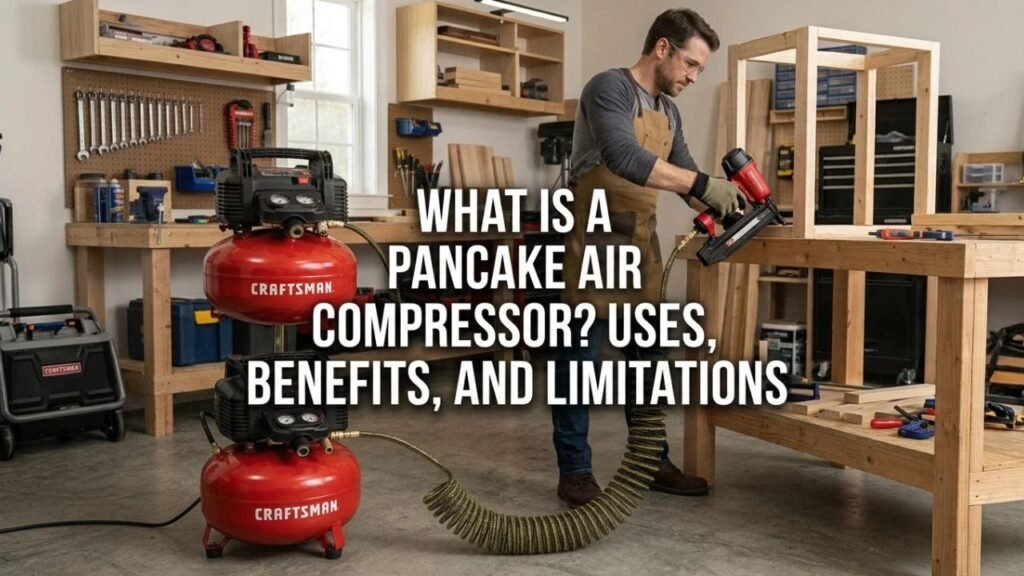
A pancake compressor is a portable reciprocating air compressor with a low, round storage tank positioned beneath the motor and pump.
The tank usually has a broad diameter and short height. This creates a low center of gravity and a compact package.
Why Is It Called a Pancake Compressor?
The name comes entirely from the tank shape.
Viewed from the side, the tank looks short and flattened rather than long like a horizontal compressor tank.
The pump, motor, gauges, regulator, handle, and quick-connect fittings are commonly mounted above the tank.
This layout gives the compressor a small footprint without making it unusually tall.
Common Pancake Compressor Size
The 6-gallon pancake compressor is one of the most common configurations.
Smaller and larger versions also exist, so “pancake” describes the shape rather than one exact tank capacity.
A current Porter-Cable C2002, for example, uses a 6-gallon pancake tank, 150 PSI maximum tank pressure, 2.6 SCFM at 90 PSI, and weighs about 30 pounds.
A DeWalt DWFP55126 also uses a 6-gallon tank and produces 2.6 SCFM at 90 PSI, but its rated cut-out pressure is approximately 165 PSI.
Those differences show why tank shape alone does not tell you the compressor’s full performance.
Key Takeaway: A pancake compressor gets its name from its flat, round tank; 6-gallon oil-free units are common, but pressure and airflow vary by model.
How Does a Pancake Air Compressor Work?
A pancake compressor works like other small reciprocating electric compressors.
The motor drives a pump that pulls outside air into a cylinder and compresses it into the tank.
The Pump Compresses Air Into the Tank
When you turn the compressor on, the electric motor starts the pump.
The pump draws air through an intake filter and compresses it into the storage tank.
Tank pressure rises until it reaches the pressure switch’s cut-out setting.
The motor then shuts off automatically.
Stored Air Supplies the Tool
Compressed air leaves the tank through the regulator and outlet fitting.
You connect an air hose to the quick coupler and set the regulator to the pressure needed by your tool.
As the tool consumes air, tank pressure drops.
Once pressure falls to the compressor’s cut-in setting, the motor starts again and refills the tank.
The Regulator Controls Tool Pressure
Tank pressure and tool pressure are not the same thing.
A compressor may store 150 PSI in its tank while sending only 90 PSI through the outlet regulator.
That lets the compressor store more air while still supplying the correct pressure to the connected tool.
Never set outlet pressure above the tool manufacturer’s rating.
Key Takeaway: The pump fills the pancake tank, the pressure switch controls motor cycling, and the regulator reduces stored pressure to the level required by the air tool.
What Are Pancake Air Compressors Used For?
Pancake compressors work best with tasks that consume air in short bursts rather than continuously.
That makes them especially well suited to fastening and inflation.
Brad and Finish Nailers
Pneumatic nailers use a short burst of compressed air each time the trigger is pulled.
They do not normally require a constant stream of high-volume air.
This makes brad nailers, finish nailers, and many framing or roofing nailers a good match for a small portable compressor.
Campbell Hausfeld lists fastening and woodworking among common compressor uses and includes brad, finish, roofing, and framing nailers among tools that can work with portable compressor systems when airflow requirements match.
Staplers
Pneumatic staplers work much like nailers.
Each shot consumes a relatively small amount of stored air, giving the compressor time to recover between cycles.
A pancake compressor is a common choice for upholstery, trim, cabinet, and light construction work.
Tire Inflation
A pancake compressor can inflate:
- Car tires
- Motorcycle tires
- Bicycle tires
- Trailer tires
- Lawn-equipment tires
- Sports equipment
Use a tire inflator with a reliable pressure gauge.
For vehicle tires, inflate to the vehicle manufacturer’s specified cold pressure rather than automatically using the maximum pressure printed on the tire sidewall.
Blow Guns
A blow gun can work well for short cleaning bursts.
Long, continuous blowing uses air much faster and may cause tank pressure to fall while the compressor runs.
Wear eye protection and never direct compressed air toward skin or another person.
Airbrushes
Many pancake compressors have enough airflow for airbrush use, though noise and pressure control should be considered.
A moisture separator may also be useful when clean, dry air matters.
Light Intermittent Air-Tool Use
Some impact wrenches, ratchets, and similar tools can operate from a pancake compressor for short bursts.
The tank may provide enough stored air for a few seconds of work even when the compressor cannot continuously supply the tool’s full CFM demand.
That does not make a small pancake compressor the best match for repeated automotive shop use.
Key Takeaway: Pancake compressors are strongest at tire inflation, nailers, staplers, airbrushes, blow guns, and other jobs that use compressed air intermittently.
What Tools Should You Not Run From a Pancake Compressor?
The main limitation is airflow.
Many small pancake compressors cannot continuously supply enough CFM for tools that consume air every second they are running.
Dual-Action Sanders
Air sanders can consume substantial airflow for long periods.
A typical small pancake compressor may start the tool using stored tank air, but pressure will fall quickly.
The compressor then runs continuously while the sander slows down.
Campbell Hausfeld lists dual-action, high-speed, jitterbug, and straight-line sanders among tools not recommended for certain smaller compressor systems.
Die Grinders
A die grinder needs steady airflow while the trigger is held.
A small tank may provide a short burst, followed by a long recovery period.
That makes the setup frustrating for grinding jobs that last more than a few seconds.
Cutoff Tools
Pneumatic cutoff wheels often need considerable CFM.
A pancake compressor may lack the pump output required for sustained operation.
Large Spray Guns
Automotive paint guns and other high-volume spray equipment can need far more airflow than a typical pancake compressor produces.
Tank pressure may initially look adequate, but the pressure can fall while spraying because the pump cannot replenish air fast enough.
Sandblasting Equipment
Sandblasting can consume a large volume of compressed air.
Small pancake compressors are generally poor matches for this work.
A larger compressor with substantially more CFM and tank capacity is usually needed.
Key Takeaway: High-air-demand tools such as sanders, grinders, cutoff tools, large spray guns, and sandblasters usually need more CFM than a typical pancake compressor can provide.
Pancake Air Compressor PSI vs CFM
PSI and CFM describe different parts of compressor performance.
This distinction is one of the biggest sources of confusion when choosing a compressor.
What PSI Means
PSI means pounds per square inch.
It measures air pressure.
A compressor rated for 150 or 165 PSI can store air at high pressure in its tank, but that does not tell you how quickly it can replace the air used by a tool.
What CFM Means
CFM means cubic feet per minute.
SCFM is a standardized airflow measurement used for comparing compressor output under stated conditions.
CFM tells you how much air the compressor can deliver.
For air-tool compatibility, the compressor’s SCFM at the tool’s operating pressure often matters more than maximum tank PSI.
Why a High-PSI Pancake Compressor Can Still Be Too Small
Consider a compressor rated at:
- 165 PSI maximum tank pressure
- 2.6 SCFM at 90 PSI
The 165 PSI rating gives the tank a useful air reserve.
The 2.6 SCFM figure tells you the pump’s airflow capacity around a common air-tool pressure.
A tool needing 6 SCFM at 90 PSI will consume air more quickly than that compressor can replenish it.
The tool may work briefly from stored air, then lose speed or power.
Key Takeaway: PSI describes pressure, while CFM describes airflow; CFM is often the deciding specification for matching a pancake compressor to an air tool.
Advantages of a Pancake Air Compressor
The pancake layout offers several practical advantages for portable work.
Easy to Carry
Many models weigh around 30 pounds, though actual weight varies.
A handle mounted over the center of the tank makes the compressor relatively easy to move from a garage to a vehicle or job site.
Stable Tank Design
The wide tank provides a low base.
Rubber feet commonly support the compressor and reduce movement and vibration.
Porter-Cable specifically describes its pancake tank as providing stability.
Compact Storage
A pancake compressor does not take up much floor space.
The motor and controls sit above the tank rather than extending far outward.
This shape works well in small garages, trailers, vans, or home workshops where storage space is limited.
Usually Oil-Free
Many modern pancake models use an oil-free pump.
That means there is no crankcase oil level to check or change.
Oil-free does not mean maintenance-free in every respect. The tank still needs draining, the intake should remain clean, and hoses and fittings require inspection.
Good for Nailers and Inflation
These jobs fit the strengths of a small compressor.
They need pressure and short bursts of air rather than continuous high-volume airflow.
Standard Household Power
Many pancake compressors use a 120V motor designed for common U.S. receptacles.
The electrical circuit still needs to meet the compressor manual.
A motor can draw substantial current during startup, so sharing a circuit with other heavy loads can cause breaker trips.
Key Takeaway: Pancake compressors combine portability, stability, compact storage, and enough air for common intermittent tasks such as nailing and tire inflation.
Disadvantages of a Pancake Air Compressor
The same compact size that makes a pancake compressor convenient also creates limitations.
Limited Airflow
This is the main drawback.
Many 6-gallon pancake compressors deliver only a few SCFM at 90 PSI.
That is plenty for many nailers but not enough for continuous pneumatic sanding, grinding, or painting.
Small Air Reserve
A 6-gallon tank does not hold as much usable compressed air as a 20-, 30-, or 60-gallon tank.
High-demand tools can deplete it quickly.
Frequent Motor Cycling
A small tank fills relatively quickly, but it also empties quickly.
During jobs that use a moderate amount of air, the motor may cycle often.
Frequent cycling adds noise and may become annoying in an indoor shop.
Noise Can Still Be High
“Pancake” does not mean “quiet.”
A DeWalt 6-gallon pancake model is rated around 78.8 dBA in one published manual, showing that a portable compressor can still be quite noticeable indoors.
If noise is a major concern, compare published dBA ratings rather than assuming a small compressor will be quiet.
Not Ideal for Large Shops
A busy automotive or fabrication shop normally needs more airflow, a larger tank, and a compressor designed for longer run periods.
A pancake model is better as a portable secondary compressor than as the main air source for multiple high-demand tools.
Key Takeaway: The main tradeoffs are limited CFM, a small air reserve, frequent cycling, and noise during jobs that demand more air.
Pancake Compressor vs Hot Dog Compressor
Both designs are common portable compressors.
The main difference is tank shape.
| Feature | Pancake Compressor | Hot Dog Compressor |
| Tank shape | Short and round | Long and cylindrical |
| Stability | Broad, low base | Depends on frame and feet |
| Footprint | Compact | Longer |
| Portability | Usually good | Usually good |
| Common size | Often around 6 gal | Varies widely |
| Air output | Depends on pump | Depends on pump |
| Tool compatibility | Depends on CFM | Depends on CFM |
A hot dog compressor uses a horizontal cylindrical tank.
The longer shape may fit better against a wall or in a vehicle, while a pancake tank takes up less length.
Neither shape automatically produces more CFM.
Compare actual compressor specifications instead of choosing only by tank style.
Pancake Compressor vs Twin-Stack Compressor
A twin-stack compressor uses two small tanks stacked or mounted together.
Twin-stack units are common on construction sites and can be built around heavier pumps and frames.
The two tanks give the compressor a different footprint and may allow manufacturers to package more storage into a compact frame.
A pancake model can be easier to carry in one hand and often has fewer protruding parts.
Again, tank layout alone does not determine performance.
A strong twin-stack model may provide far more CFM than a basic pancake compressor, while another may have similar output.
Check:
- SCFM at 90 PSI
- Maximum PSI
- Tank gallons
- Weight
- Noise rating
- Duty cycle
- Motor amperage
Pancake Compressor vs Larger Vertical Compressor
A vertical compressor gives up portability in exchange for tank volume and, often, greater pump capacity.
Pancake Compressor Is Better For
- Moving between locations
- Tire inflation
- Nailers
- Staplers
- Small workshops
- Occasional DIY work
- Easy storage
Larger Vertical Compressor Is Better For
- Repeated impact-tool use
- Pneumatic sanders
- Die grinders
- Painting
- Automotive work
- Higher-CFM tools
- Longer operating sessions
Campbell Hausfeld currently advises that small 1–6 gallon tanks are suitable for jobs such as tire inflation and brad nailing, while continuous tools such as sanders and paint sprayers are better served by larger compressors around 20 gallons or more.
Key Takeaway: Pancake compressors favor portability and intermittent work, while larger vertical compressors are better suited to jobs demanding greater air storage and pump output.
Is a Pancake Air Compressor Good for Car Tires?
Yes.
Tire inflation is one of the jobs a pancake compressor handles well.
Even a small pancake compressor can normally supply much more pressure than a passenger-car tire requires.
Connect a tire inflator to the compressor hose and adjust the regulated outlet pressure as needed.
Use the vehicle’s recommended cold tire pressure from the door-jamb placard.
Do not confuse the compressor’s 150 or 165 PSI tank rating with the pressure the tire should receive.
The main downside is portability compared with a dedicated 12V inflator. A pancake compressor normally needs access to 120V power.
For garage use, that is rarely a problem.
Is a Pancake Air Compressor Good for Impact Wrenches?
It depends on the impact wrench and how you plan to use it.
An impact wrench works in short bursts, so the stored air inside a 6-gallon tank may run it briefly.
The limitation appears during repeated use.
If the wrench requires 5 SCFM at 90 PSI and your compressor produces only 2.6 SCFM at 90 PSI, the tank loses air faster than the pump replaces it.
You will need recovery pauses.
For occasional lug-nut removal, that may be acceptable.
For continuous automotive repair, a larger compressor is a better match.
Is a Pancake Air Compressor Good for Nail Guns?
Yes. Nail guns are one of the strongest applications for pancake compressors.
A nailer consumes a small burst of air per fastener.
The compressor then has time to replace that air between shots.
A 6-gallon unit can commonly handle:
- Brad nailers
- Finish nailers
- Staplers
- Many roofing nailers
- Many framing nailers
Actual nailer consumption and firing rate still matter.
Rapid production framing can use air much faster than occasional DIY nailing.
How to Choose a Pancake Air Compressor
Do not shop from maximum PSI alone.
Start with the air tools you plan to use.
Check SCFM at 90 PSI
Most pneumatic-tool ratings give airflow near 90 PSI.
Compare the compressor’s SCFM rating with the tool requirement.
For frequent use, having some airflow capacity above the tool’s demand reduces recovery delays.
Check Tank Capacity
A larger tank stores more compressed air.
It can extend short tool runs before the motor needs to recover.
A bigger tank does not increase the pump’s continuous SCFM.
Check Maximum PSI
Higher tank pressure stores more usable compressed air in the same tank volume.
That can improve runtime between pump cycles.
It still does not replace sufficient CFM for a continuous-use tool.
Check Noise
Look for an actual dBA specification.
If the compressor will run inside a garage, house, or occupied work area, a lower noise rating can make a big difference.
Check Weight
A compressor called portable may still be uncomfortable to carry repeatedly.
Compare weight if you plan to move it between jobs.
Check Number of Couplers
Some models provide two regulated air outlets.
That can be handy for two nailers, though both tools still share the same pump output and tank.
Key Takeaway: Choose a pancake compressor from SCFM, tank size, noise, weight, pressure, and tool demand rather than from maximum PSI alone.
How to Maintain a Pancake Air Compressor
Many pancake compressors are oil-free, but they still need basic maintenance.
Drain condensation from the tank according to the owner’s manual. Compressed air naturally produces moisture, and water sitting inside a steel tank can contribute to corrosion.
Keep the intake openings clean and do not cover the motor or pump while it is operating.
Inspect the power cord, hose, couplers, regulator, and safety valve for damage.
If the compressor begins taking much longer to fill the tank, check for air leaks, an open drain valve, a clogged intake, or pump wear.
Never drill, weld, or patch a damaged pressure tank.
A tank with serious rust, deformation, or structural damage needs proper service or replacement.
Conclusion
For what is a pancake air compressor, it is a compact portable compressor named for its flat, round air tank. Most popular models are built for easy transport, stable placement, and short-demand tasks rather than continuous high-airflow work.
A 6-gallon oil-free model is a common choice for nailers, staplers, tire inflation, airbrushes, and occasional blow-gun use. Current examples around this size often produce roughly 2.6 SCFM at 90 PSI, though specifications differ from one compressor to another.
The biggest limitation is airflow. High maximum PSI does not mean the compressor can continuously operate sanders, grinders, large spray guns, or other high-CFM tools.
I would choose a pancake compressor for portable DIY, trim, woodworking, and garage inflation jobs. For long-running pneumatic tools, a larger compressor with substantially more SCFM is the better fit.
FAQs About Pancake Air Compressors
Why is it called a pancake air compressor?
The name comes from the storage tank. It is short, wide, and round, giving it a shape that resembles a pancake. The motor, pump, gauges, and regulator normally sit above the tank.
Is a 6-gallon pancake compressor big enough?
A 6-gallon model is large enough for many nailers, staplers, tire inflation jobs, airbrushes, and short blow-gun use. It may be too small for continuous sanders, grinders, large paint guns, or other tools with high CFM requirements.
How much PSI does a pancake compressor have?
It depends on the model. Current portable pancake compressors commonly have maximum tank-pressure ratings around 150–165 PSI, though lower and higher ratings exist. Set outlet pressure according to the connected tool rather than using maximum tank pressure automatically.
Can a pancake compressor run an impact wrench?
It can run some impact wrenches for short periods using stored tank air. If the wrench needs more CFM than the compressor produces, pressure will fall and you will need to wait for the tank to recover. A larger compressor works better for repeated impact-wrench use.
Can a pancake air compressor inflate car tires?
Yes. Tire inflation is a good application for a pancake compressor. Use a tire inflator and follow the vehicle manufacturer’s recommended cold tire pressure. The compressor’s maximum PSI is not the correct tire pressure.
Are pancake air compressors oil-free?
Many modern pancake compressors use oil-free pumps, but the tank shape does not require an oil-free design. Check the specific model. An oil-free unit does not need crankcase oil changes, though it still needs tank draining and general inspection.
Are pancake air compressors loud?
Some are. Tank shape does not control noise. A small pancake model can still produce sound in the upper 70-dBA range, while quieter compressors use slower pumps, better isolation, or other noise-control features. Compare the published dBA rating before buying.
Is a pancake compressor better than a regular air compressor?
It is better when portability, compact storage, tire inflation, and intermittent pneumatic work are the main goals. A larger vertical or horizontal compressor is better when your tools require high continuous airflow or long operating periods.