
What Type of Air Compressor Is the Quietest? Best Designs Compared
The quietest air compressors are usually low-speed scroll compressors or specially designed low-RPM piston compressors with vibration isolation and sound-reducing components. For small home and garage units, ultra-quiet piston compressors can operate around 55–65 dB. For larger continuous-duty systems, enclosed scroll and rotary screw compressors are usually quieter than conventional reciprocating units.
Air compressors create noise from several sources at once: the motor, pump, cooling fan, intake pulses, vibration, and compressed-air movement. Reducing compressor noise therefore requires more than simply covering the motor with a case.
For small portable compressors, manufacturers have developed slow-running piston pumps that operate at much lower RPM than traditional direct-drive pancake compressors. Current California Air Tools models, for example, list noise ratings around 60 dB while running their motors at roughly 1,400–1,680 RPM.
If you are asking what type of air compressor is the quietest, the answer changes with compressor size. A quiet 1 HP garage compressor and a 30 HP industrial compressor use very different pump designs, yet both can be engineered for low sound levels.
Noise also matters for hearing protection. NIOSH uses 85 dB(A) as its recommended 8-hour occupational noise exposure limit and advises hearing precautions when sound reaches or exceeds that level.
A compressor running near 60 dB can therefore feel dramatically different from a traditional unit producing noise in the 80-dB range. Sound measurement methods and distances can vary among manufacturers, so dB figures are best used as a strong comparison clue rather than a perfect apples-to-apples test.
Which Type of Air Compressor Is the Quietest?
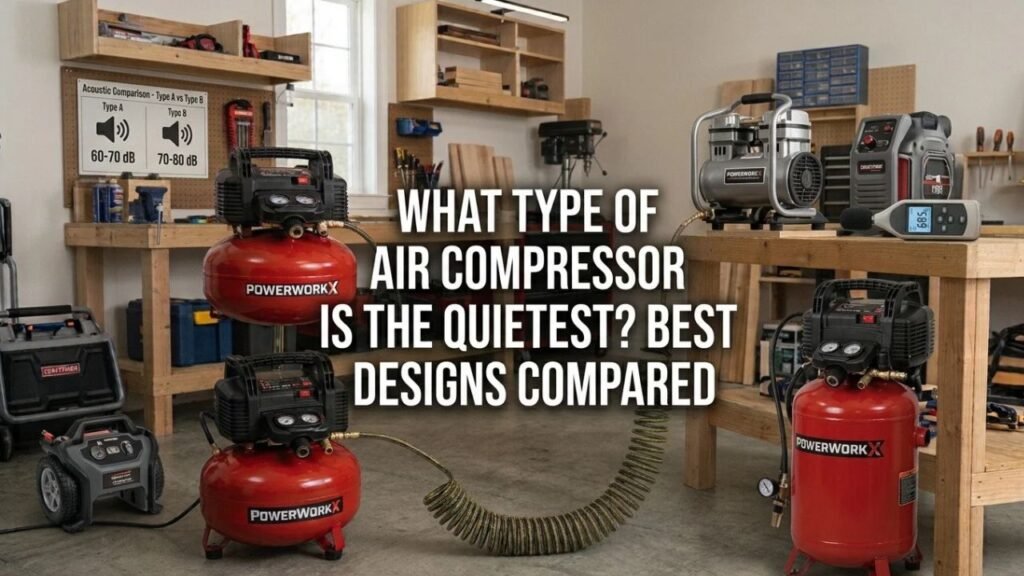
For pure mechanical quietness, scroll compressors are among the quietest compressor designs, especially in enclosed stationary systems.
For small portable compressors, a purpose-built low-RPM quiet piston compressor can be just as attractive because it offers low noise at a much lower purchase price.
Scroll Air Compressors
A scroll compressor uses two spiral-shaped scroll elements.
One remains stationary while the other moves in an orbital pattern. Air becomes trapped between the scrolls and is gradually compressed toward the center.
There are no reciprocating pistons moving rapidly up and down.
That gives scroll compressors several noise advantages:
- Low vibration
- Smooth compression
- Few moving parts
- No piston slap
- No connecting-rod reversal at high speed
- Low pulsation compared with many piston pumps
Oil-free scroll compressors are commonly used where low noise and clean air are valuable, including laboratories, dental facilities, medical environments, and indoor production areas.
Their main drawback is price. Scroll compressors are generally much more expensive than small piston compressors.
Low-RPM Quiet Piston Compressors
A normal piston compressor does not have to be loud.
Modern quiet piston compressors lower pump and motor speed and use vibration-damping mounts, quieter intake systems, and improved pump designs.
Small models can reach published ratings around 56–65 dB.
California Air Tools currently lists several 1 HP compressors at 60 dB, including models producing around 2.2–3.0 CFM at 90 PSI.
This design is often the best answer for someone who needs a quiet compressor for:
- Home garage
- Trim carpentry
- Woodworking
- Tire inflation
- Indoor renovation
- Nail guns
- Airbrush work
- Light pneumatic tools
Enclosed Rotary Screw Compressors
Rotary screw compressors use two intermeshing rotors rather than pistons.
Compression is continuous instead of occurring in repeated piston strokes.
This creates smoother airflow and less pulsating mechanical noise.
Large rotary screw compressors are commonly fitted with acoustic enclosures that contain much of the pump and motor noise.
They are a strong choice for:
- Manufacturing
- Auto shops
- Production facilities
- Large woodworking operations
- Continuous compressed-air demand
A screw compressor usually makes more sense when the air requirement is too high for a small quiet piston unit.
Traditional Reciprocating Compressors
Standard high-speed reciprocating compressors are usually the loudest of these common designs.
Noise comes from:
- Pistons changing direction
- Intake pulses
- Valve movement
- Fast motor speed
- Pump vibration
- Cooling airflow
Oil-lubricated belt-drive reciprocating compressors can be much quieter than small direct-drive pancake compressors, especially when the pump operates at low RPM.
Key Takeaway: Scroll compressors are among the quietest mechanical designs, low-RPM piston compressors are often the quietest practical choice for home use, and enclosed rotary screw compressors work well when quiet operation and high airflow are both needed.
Quietest Air Compressor Types Compared
| Compressor Type | Typical Noise Character | Best Use | Air Capacity | Cost |
| Scroll | Very smooth and low vibration | Dental, laboratory, indoor commercial | Medium to high | High |
| Ultra-quiet low-RPM piston | Very quiet for portable size | Home, garage, carpentry | Low to medium | Low to medium |
| Enclosed rotary screw | Smooth and subdued | Commercial and industrial | High | High |
| Belt-drive piston | Moderate | Garage and shop | Medium to high | Medium |
| Direct-drive pancake | Usually loud | Portable DIY work | Low | Low |
| Gas-powered piston | Usually loud | Outdoor jobsite | Medium to high | Medium |
The actual dB number can differ greatly within each category.
A well-designed piston compressor may be quieter than a poorly enclosed screw compressor.
Why Are Scroll Air Compressors So Quiet?
Scroll technology reduces several noise sources found in reciprocating pumps.
Compression Is Smooth
A piston compressor repeatedly draws air in, compresses it, and pushes it out.
These pressure pulses create sound.
A scroll unit compresses air through a smoother orbital motion, reducing pulsation.
There Are Fewer Moving Parts
A scroll design does not need the same piston, connecting rod, crankshaft, and valve arrangement found in a conventional reciprocating compressor.
Fewer rapidly reversing components mean less mechanical vibration.
They Can Operate Without Oil
Many scroll systems are oil-free.
This is one reason they are common in places that need clean compressed air.
Oil-free operation by itself does not make a compressor quiet, but scroll technology combines clean air with low vibration.
Sound Enclosures Work Well
Stationary scroll compressor packages can be completely enclosed.
Since the mechanical noise is already relatively smooth, acoustic insulation can reduce the remaining sound further.
Key Takeaway: Scroll compressors stay quiet because they compress air with smooth orbital movement, produce little vibration, and work well inside sound-reducing enclosures.
Are Rotary Screw Compressors Quieter Than Piston Compressors?
In larger compressor sizes, usually yes.
Rotary screw technology is built around continuous rotation rather than reciprocating piston movement.
Screw Rotors Produce Smooth Compression
The two rotors turn continuously.
There is no piston reaching top dead center, stopping, changing direction, and accelerating again.
That reduces mechanical pulsation.
Industrial Units Are Usually Enclosed
A commercial rotary screw compressor commonly arrives inside a cabinet.
The enclosure helps contain:
- Airend noise
- Motor noise
- Cooling-fan noise
- Intake noise
A bare reciprocating compressor mounted on a receiver has much less acoustic isolation.
Screw Compressors Suit Continuous Air Demand
A screw compressor is often selected for tools and machinery that use air for long periods.
Examples include:
- CNC equipment
- Production air tools
- Manufacturing machines
- Multiple shop workstations
- Continuous pneumatic systems
For a homeowner running a nail gun, buying a rotary screw unit solely for lower noise would usually be excessive.
Key Takeaway: Rotary screw compressors are commonly quieter than conventional piston compressors at commercial sizes, especially because their smooth-running airends are normally housed inside acoustic cabinets.
What Makes an Ultra-Quiet Piston Compressor Different?
The term “quiet compressor” does not describe a separate compression principle.
Most small quiet compressors are still reciprocating piston machines.
Their lower sound comes from design changes.
Lower Motor and Pump RPM
Motor speed has a large influence on sound.
Many ordinary portable compressors operate at relatively high RPM.
Quiet models often slow the motor and pump considerably.
California Air Tools, for example, lists certain quiet models with motor speeds around 1,400–1,680 RPM and noise ratings near 60 dB.
Lower speed can reduce:
- Mechanical noise
- Intake noise
- Vibration
- Heat
- Wear rate
Vibration Isolation
Rubber feet and motor mounts prevent vibration from transferring directly into:
- Tank
- Frame
- Concrete floor
- Workbench
A vibrating floor can act like a large speaker and make the compressor seem much louder.
Quiet Intake Design
The intake is one of the loudest parts of a piston compressor.
A larger intake filter or silencer can reduce the sharp pulsing sound created each time the piston draws air.
Dual-Piston Pumps
Some quiet compressors use two cylinders or dual-piston systems designed to move the required air at lower pump speed.
This allows the compressor to maintain usable CFM without spinning as quickly.
Key Takeaway: Quiet piston compressors reduce sound mainly through slower pump speeds, vibration control, quieter intake systems, and pump designs that maintain airflow without high RPM.
Are Oil-Lubricated Compressors Quieter Than Oil-Free Compressors?
Not automatically.
Older compressor advice often suggests that oil-lubricated pumps are always quieter, but modern quiet-compressor designs have changed that comparison.
Oil-Lubricated Belt-Drive Compressors Can Be Very Quiet
A large belt-driven pump running slowly can have a deep, relatively subdued sound.
Oil provides lubrication between moving components, and the belt separates motor vibration from the pump.
These compressors work well in garages where:
- Higher CFM is needed
- Portability is less important
- Routine oil maintenance is acceptable
Modern Oil-Free Compressors Can Also Be Quiet
Several of the quietest small portable compressors are oil-free.
The key is their low pump speed and noise-control design rather than the absence of oil.
Current 1 HP California Air Tools oil-free models list 60-dB ratings, showing that an oil-free piston compressor does not have to be loud.
High-Speed Oil-Free Compressors Can Be Loud
Basic pancake and hot-dog compressors often use small, fast direct-drive pumps.
These can create a sharp, high-frequency sound.
That is the source of the idea that oil-free automatically means noisy.
The real difference is usually design and RPM, not oil alone.
Key Takeaway: Oil-lubricated pumps can be quiet, but modern low-RPM oil-free compressors can also reach very low noise levels. Pump speed and construction matter more than lubrication type alone.
How Quiet Is a Quiet Air Compressor?
Decibels use a logarithmic scale.
A small numerical difference can represent a noticeable sound-energy change.
Around 55–60 dB
This is exceptionally quiet for a portable shop compressor.
It can feel closer to normal conversation than to a traditional compressor.
Some compact quiet compressors are advertised in this range.
Around 60–70 dB
This is a strong target for:
- Indoor workshops
- Attached garages
- Carpentry
- Residential use
Many compressors marketed as ultra-quiet fall here.
Around 70–80 dB
This range is still much easier to tolerate than some old high-speed compressors.
Larger quiet compressors may fall into this group because moving more air requires bigger motors, fans, and pumps.
For example, California Air Tools lists a larger 4 HP, 60-gallon compressor at 75 dB while producing 10.6 CFM at 90 PSI.
Above 80 dB
Many conventional portable compressors can become tiring to work near for extended periods.
NIOSH identifies 85 dB(A) as its recommended 8-hour occupational exposure limit.
Hearing protection may still be sensible below that point if other tools in the workspace increase total noise.
Does Tank Size Affect Air Compressor Noise?
Tank size has little direct effect on how loud the pump is.
It changes how often the pump needs to run.
Larger Tank Means Longer Rest Periods
A larger receiver stores more compressed air.
For intermittent work, the compressor may:
- Fill the tank.
- Shut off.
- Remain silent while stored air is used.
- Restart after pressure drops.
This can make a larger-tank compressor feel quieter during a job even if its running dB level is unchanged.
Bigger Tank Does Not Reduce Pump Sound
When the compressor actually starts, the pump produces the same basic amount of noise.
A large tank is therefore not a substitute for a quiet pump.
Continuous Tools Reduce the Benefit
Air sanders, grinders, and spray guns consume large volumes of air.
The compressor may run frequently regardless of tank size.
For those tools, low operating noise and adequate CFM matter more than adding tank capacity.
Key Takeaway: A larger tank does not make the pump quieter, but it can increase silent periods between compressor cycles when tools use air intermittently.
Does a Smaller Air Compressor Mean Less Noise?
Not always, but the lowest published dB ratings often come from small units.
Small motors and pumps simply move less air.
That makes noise easier to control.
A tiny quiet compressor may be perfect for:
- Airbrush
- Brad nailer
- Pin nailer
- Tire inflation
It can be a poor match for:
- Impact wrench used repeatedly
- Air sander
- Die grinder
- Large spray gun
Do not choose a 56-dB compressor if it lacks the CFM your tools require.
A slightly louder compressor that keeps up with the tool can be less annoying than an undersized compressor that runs nearly nonstop.
What Is the Quietest Compressor for a Home Garage?
For most home garages, a low-RPM oil-free or belt-drive piston compressor is the practical choice.
Light Garage Work
For:
- Tire inflation
- Nailers
- Blow gun
- Small pneumatic tools
look for:
- Approximately 55–65 dB
- 1–2 HP
- Enough CFM for the tools
- 4–10 gallon tank
Automotive Work
If you plan to run:
- Impact wrench
- Air ratchet
- Air hammer
a larger quiet piston compressor around 10–20 gallons may provide a better balance.
Prioritize CFM at 90 PSI.
Sanding and Painting
Continuous tools need much more air.
A larger belt-drive piston or enclosed rotary screw compressor may make more sense.
The quietest tiny compressor will not compensate for insufficient airflow.
Key Takeaway: For most garages, a low-RPM quiet piston compressor offers the best balance of noise, cost, portability, and airflow.
What Is the Quietest Compressor for Indoor Use?
Scroll compressors are an excellent option when low noise is more important than purchase price.
They are common in places where conversations and indoor working conditions matter.
Examples include:
- Dental offices
- Laboratories
- Medical settings
- Electronics work
- Indoor production
- Specialty workshops
For normal DIY use, a 55–65 dB piston compressor costs much less and is easier to move.
How to Choose a Quiet Air Compressor
Do not buy from the word “quiet” on the label alone.
Check the Published dB Rating
A lower number generally means less noise.
For a home shop, below 70 dB is a good starting target.
Around 60 dB is excellent for a portable compressor.
Check How the Sound Was Measured
Manufacturers do not always use the same measurement distance or test method.
A compressor measured from farther away will appear quieter.
Use published ratings as comparison data, not laboratory-perfect rankings.
Check CFM at 90 PSI
Noise means little if the compressor cannot run your tools.
Compare the compressor output with your highest-demand pneumatic tool.
Check Pump RPM
Low-speed pumps are often quieter.
A motor operating around 1,400–1,700 RPM can produce a much softer sound than a high-speed direct-drive design.
Check Duty Cycle
A quiet compressor that must rest frequently may not suit continuous work.
High-demand users should consider a compressor designed for longer run periods.
Look for Vibration Control
Useful features include:
- Rubber isolation feet
- Flexible connections
- Low-speed pump
- Acoustic enclosure
- Intake silencer
Consider Where It Will Sit
Sound becomes more noticeable in:
- Small rooms
- Concrete garages
- Corners
- Areas with hard walls
Reflected sound can make the same compressor appear louder than it does outdoors.
Key Takeaway: Choose from dB level, CFM at working pressure, pump speed, duty cycle, and installation environment rather than selecting from noise claims alone.
How Can You Make an Existing Air Compressor Quieter?
You may not need to replace the compressor.
Several changes can reduce perceived noise.
Add Anti-Vibration Pads
Rubber isolation pads beneath the compressor can reduce vibration entering the floor.
Do not use an unstable soft surface that allows the compressor to move.
Move It Farther Away
Increasing distance is one of the simplest noise-control methods.
A longer properly sized air hose is usually preferable to a long undersized electrical extension cord.
Add an Intake Silencer
The intake can create a loud pulsing sound.
A compressor-approved intake muffler may reduce it.
Do not restrict airflow with homemade filters that the pump was not designed to use.
Build a Ventilated Compressor Enclosure
A sound-reducing cabinet can lower noise, but the compressor still needs cooling air.
Never seal a compressor inside an airtight box.
Excess heat can shorten:
- Motor life
- Pump life
- Capacitor life
Keep combustion-engine compressors outdoors rather than enclosing them indoors.
Tighten Loose Components
Rattling guards, handles, wheels, and brackets can add a surprising amount of sound.
Disconnect power and release tank pressure before servicing the compressor.
Key Takeaway: Vibration isolation, distance, intake noise control, and a correctly ventilated enclosure can make an existing electric compressor noticeably quieter.
Quiet Air Compressor vs. Silent Air Compressor
“Silent” is mainly a marketing description.
An air compressor cannot be truly silent while:
- Motor turns
- Pump compresses air
- Cooling fan moves air
- Valves operate
A compressor sold as silent may simply have a very low dB rating.
For shopping purposes, ignore descriptive labels and compare the published sound-pressure number.
A 58-dB model is likely to be quieter than a similar 75-dB unit when measurements were performed under comparable conditions.
Conclusion
For what type of air compressor is the quietest, scroll compressors are among the quietest mechanical designs because they produce smooth compression with little vibration. They are an excellent fit for stationary indoor applications where noise and clean air matter.
For home garages and portable use, a low-RPM ultra-quiet piston compressor is usually the better choice. Models around 55–65 dB provide a large reduction in noise without the price of an industrial scroll system.
For high-CFM commercial work, an enclosed rotary screw compressor combines smoother operation with much greater continuous airflow than small quiet piston units.
Do not choose by noise level alone. Check CFM at the pressure your tools require, duty cycle, tank size, electrical supply, and pump speed. The quietest compressor that cannot keep up with your tools will spend more time running and may end up being less pleasant to use.
FAQs About the Quietest Air Compressor Types
What type of air compressor makes the least noise?
Scroll compressors are among the least noisy designs because they use smooth orbital compression and produce little vibration. For small portable machines, purpose-built low-RPM piston compressors can also reach very low sound levels.
Is a scroll compressor quieter than a rotary screw compressor?
It can be, especially at smaller and medium capacities. Both designs can be very quiet when enclosed. Scroll compressors have very low vibration, while rotary screw compressors are more common when large amounts of continuous air are required.
Are oil-free air compressors quieter?
Not automatically. Some high-speed oil-free compressors are loud, while modern low-RPM oil-free designs can operate near 60 dB. Pump speed and noise-control design matter more than the presence of oil.
Are belt-drive air compressors quieter than direct-drive compressors?
They often are. Belt-drive systems can run the pump at lower RPM and isolate some motor vibration. A slow belt-driven lubricated compressor usually sounds softer than a small high-speed direct-drive compressor.
Is 60 dB quiet for an air compressor?
Yes. Around 60 dB is very quiet for a portable air compressor. Current ultra-quiet models are sold with ratings around this level, though manufacturer test distances and methods can differ.
Is a pancake air compressor quiet?
Traditional pancake compressors are often relatively loud because they use high-speed direct-drive pumps. Quiet pancake-style models exist, so check the actual dB rating rather than tank shape.
What is a good dB rating for a quiet air compressor?
Below 70 dB is a good target for garage and indoor work. Around 55–65 dB is excellent for a small portable compressor, provided it also supplies enough CFM for the intended tools.
What is the quietest compressor for air tools?
For nailers, inflation, and light shop work, a low-RPM quiet piston compressor is usually the practical choice. Continuous high-CFM tools may require a larger enclosed rotary screw or slow-speed belt-drive compressor instead.