
What Can You Do With a Pancake Air Compressor? Uses & Limits
A pancake air compressor is best for light, intermittent air jobs such as running nail guns and staplers, inflating tires, filling sports equipment, using a blow gun, and powering small pneumatic tools for short periods. Its compact tank makes it portable, but limited airflow makes it a poor match for sanders, grinders, and full-size spray guns that need continuous air.
Most pancake compressors use an oil-free pump and a compact horizontal tank, commonly around 6 gallons. That design keeps the machine easy to carry between a garage, jobsite, driveway, and home workshop.
A typical 6-gallon unit may store 150 PSI or more while delivering only around 2.5–3.0 SCFM at 90 PSI. This difference matters because maximum tank pressure does not tell you how long an air tool can run. SCFM is the specification that tells you how much air the compressor can keep supplying.
For workplace cleaning applications in the United States, OSHA requires compressed air used for cleaning to be reduced below 30 PSI under the specified conditions and used with proper chip guarding and protective equipment. Compressed air should never be directed at your skin or clothing.
If you are wondering what can you do with a pancake air compressor, think of jobs that use air in short bursts. Nailers, tire inflators, staplers, and short blow-gun tasks are strong matches. Tools that consume air continuously will usually drain the small tank faster than the pump can refill it.
Below are the jobs a pancake compressor handles well, the ones it can manage with limits, and the tools that usually need a larger compressor.
What Can You Do With a Pancake Air Compressor?
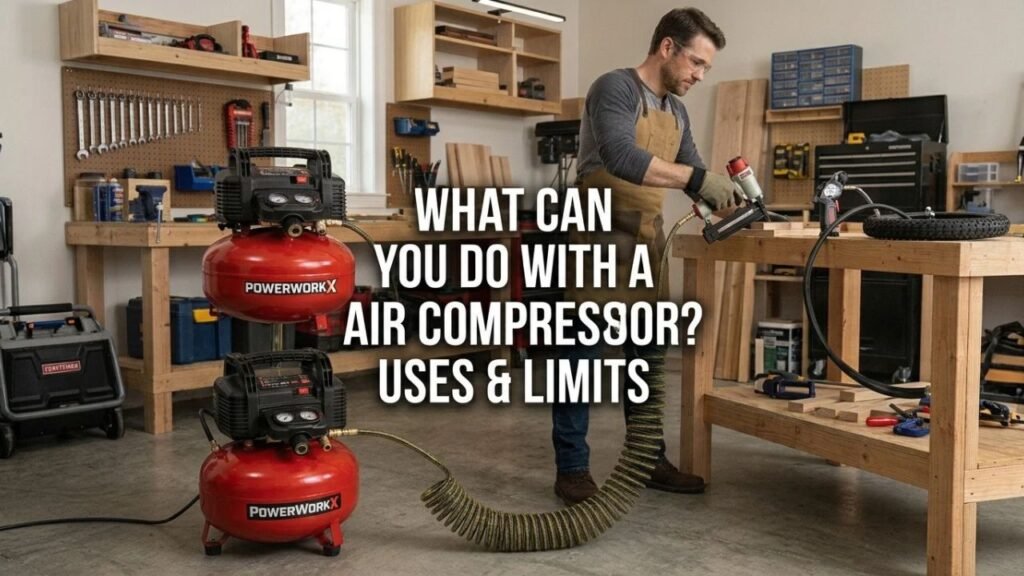
A pancake compressor works best when the tool uses compressed air for a few seconds at a time and then pauses.
That pause gives the pump time to refill the tank.
Run Brad Nailers
A brad nailer is one of the best tools to pair with a pancake compressor.
Brad nailers use a small amount of air for each shot and spend most of their time idle between fasteners.
Common projects include:
- Installing trim
- Attaching decorative molding
- Building small cabinets
- Furniture assembly
- Installing thin wood panels
- Craft projects
A small pancake compressor can usually fire many brads before pressure drops enough to restart the motor.
Run Finish Nailers
Finish nailers are also a good match.
They require more air per shot than small brad nailers, but the demand is still intermittent.
You can use one for:
- Baseboards
- Door trim
- Window casing
- Crown molding
- Cabinet work
- Stair trim
Set the compressor regulator within the nailer’s specified pressure range rather than sending full tank pressure to the tool.
Run Framing Nailers
Many pancake compressors can operate a framing nailer for normal intermittent work.
A framing nailer uses more air than a brad or finish nailer, so the compressor may cycle more frequently.
For occasional framing, fencing, decking, or repair work, a 6-gallon pancake compressor is often practical.
Rapid production nailing with several workers can exceed the compressor’s airflow capacity.
Run Pneumatic Staplers
Air staplers use relatively little air per cycle.
A pancake compressor can work well for:
- Upholstery
- Light woodworking
- Sheathing
- Insulation fastening where the tool is approved
- Cabinet backing
- Craft work
Check the stapler’s operating-pressure range before setting the regulator.
Key Takeaway: Nailers and staplers are among the best pancake-compressor applications because they consume air in short bursts and allow the tank to recover between shots.
Inflate Car and Truck Tires
Tire inflation is another strong use for a pancake compressor.
The tank stores enough air to add pressure quickly to most passenger-vehicle tires.
Check Tire Pressure Before Adding Air
Use an accurate tire-pressure gauge.
For normal passenger vehicles, use the recommended cold tire pressure listed on the vehicle placard, often found around the driver’s door opening.
Do not automatically inflate to the maximum number printed on the tire sidewall.
Use a Tire Chuck
A basic setup includes:
Compressor → air hose → tire chuck or inflator
An inflator with a built-in gauge makes it easier to add air in controlled amounts.
Large Tires Take Longer
A pancake compressor can inflate light-truck, trailer, and some off-road tires, but larger tire volume means more compressor run time.
Filling a large tire from completely flat is very different from adding 3–5 PSI during routine maintenance.
Do Not Depend on Tank PSI Alone
A 150-PSI compressor does not automatically inflate tires faster than every 125-PSI model.
Pump airflow also controls refill speed.
Key Takeaway: Pancake compressors work well for routine tire inflation, though large tires and completely flat tires require more pump run time.
Inflate Sports Equipment and Household Items
The compressor can also replace a hand pump for many common inflation jobs.
With the correct adapter, you can fill:
- Basketballs
- Footballs
- Soccer balls
- Bicycle tires
- Wheelbarrow tires
- Lawn-equipment tires
- Air mattresses
- Pool toys
Use very low pressure for items such as balls and inflatables.
A compressor can supply far more pressure than these items can safely hold.
A regulator, accurate gauge, and proper inflation needle or nozzle are important.
Large inflatable mattresses and pool toys may also be faster with a high-volume, low-pressure inflator because a compressor is designed to produce pressure rather than huge amounts of free airflow.
Use a Blow Gun for Light Cleaning
A blow gun connected to a pancake compressor is useful for short cleaning tasks.
Possible jobs include:
- Clearing sawdust from equipment
- Blowing debris from small parts
- Cleaning workbench surfaces
- Drying some non-sensitive components
- Clearing dust from accessible shop areas
Do not direct compressed air into:
- Your eyes
- Ears
- Mouth
- Skin
- Clothing while being worn
Compressed air can drive particles into the body and create serious injury.
For covered U.S. workplace cleaning, OSHA’s compressed-air rules require pressure at the cleaning nozzle to meet the applicable 30-PSI limitation and require protective measures.
Short Blasts Work Best
A pancake compressor can supply a strong burst of air, but holding a blow gun open continuously can drain the tank quickly.
You may notice:
- Strong airflow at first.
- Tank pressure begins dropping.
- Compressor starts.
- Airflow weakens if use exceeds pump output.
Pause and let the compressor recover if needed.
Key Takeaway: A pancake compressor is useful for short blow-gun cleaning jobs, but continuous blowing can exceed its pump capacity quickly.
Can You Use a Pancake Compressor With an Impact Wrench?
Sometimes, but this is where compressor limits become more noticeable.
Impact wrenches can require significantly more airflow than nailers.
Short Bursts May Work
An impact wrench operates intermittently, so a pancake compressor may provide enough stored air for a few short bursts.
This can work for jobs such as:
- Removing a few lug nuts
- Small repair jobs
- Occasional fastener removal
The tank may need time to recover between fasteners.
Check the Tool’s SCFM Rating
Suppose the compressor delivers around 2.6 SCFM at 90 PSI and the impact wrench is rated around 5 SCFM or more.
The tool can temporarily draw from stored tank air, but the pump cannot replace that air as fast as the wrench consumes it.
Pressure will fall during extended use.
A Larger Hose May Reduce Pressure Loss
A restrictive hose or fitting makes the situation worse.
For higher-flow pneumatic tools, 3/8-inch air hose often produces less pressure drop than a long 1/4-inch hose.
The tool manual should guide the hose size and working pressure.
Key Takeaway: A pancake compressor may run an impact wrench in short bursts, but frequent automotive work generally calls for more SCFM and a larger compressor.
Can You Run an Air Ratchet?
An air ratchet usually needs continuous airflow while its motor turns.
That makes it harder on a small compressor than a nail gun.
A pancake unit may run an air ratchet for short tasks, but you may experience:
- Frequent compressor cycling
- Falling tool speed
- Tank pressure dropping
- Waiting for recovery
For occasional bolts in tight areas, it may be usable.
For repeated mechanical work, a larger compressor with more airflow is more suitable.
Can You Use a Pancake Compressor for Painting?
Small paint jobs are possible with the correct spray equipment, but a standard full-size spray gun often asks for more air than a pancake compressor can continuously deliver.
Airbrush Work Is a Better Match
Airbrushes use relatively little air.
A pancake compressor can supply plenty of pressure for many airbrush applications, though its noise and large tank may be more than an airbrush user wants.
Add:
- Regulator
- Moisture separator
- Suitable air hose
Clean, dry air matters for coating quality.
Small Touch-Up Guns May Work
Some low-air-consumption touch-up spray guns may work for small projects.
Compare the gun’s required SCFM with the compressor’s output at the required pressure.
Do not compare only PSI.
Full-Size HVLP Guns Usually Need More Air
Many full-size automotive and woodworking spray guns consume substantially more air than a pancake compressor supplies continuously.
The result can be:
- Pressure drop
- Poor spray pattern
- Uneven atomization
- Compressor running continuously
- Long pauses between passes
A larger compressor is usually a better choice for painting whole vehicles, cabinets, or large furniture pieces.
Key Takeaway: Airbrushes and some small touch-up guns can work with a pancake compressor, but full-size spray guns commonly require more sustained airflow.
Can You Use a Pancake Compressor for a Plasma Cutter?
It depends on the plasma cutter.
Plasma cutting requires clean, dry compressed air at a specified pressure and flow rate.
Some compact plasma cutters need modest airflow that a stronger pancake compressor may supply for short cuts.
Other machines require much more CFM.
If compressor output falls below the plasma cutter’s requirement, you may experience:
- Cutting interruptions
- Poor cut quality
- Low-pressure warnings
- Excess compressor run time
Moisture control also matters because water in the air supply can affect consumables and cutting performance.
Compare the compressor’s delivered SCFM with the plasma cutter’s stated requirement before connecting them.
Can You Blow Out Sprinklers With a Pancake Compressor?
A pancake compressor usually lacks the sustained CFM needed to clear a large irrigation system properly.
This is a common place where PSI creates confusion.
A small compressor may reach 100 PSI or more, yet still provide only 2–3 SCFM.
Sprinkler blowout often requires much higher airflow to push water through long pipe runs and multiple sprinkler heads.
Small Zones May Be Different
A very small irrigation zone may respond to repeated tank charges, but that does not make a pancake compressor ideal for the job.
Using repeated high-pressure bursts is not a substitute for the airflow the irrigation system requires.
Never exceed the irrigation-system pressure limit just because airflow is low.
Key Takeaway: Pancake compressors can create enough pressure for irrigation piping, but their limited CFM usually makes them a poor choice for full sprinkler-system winterization.
What Tools Are Poor Matches for a Pancake Air Compressor?
Continuous-air tools are the main limitation.
The compressor may start the tool but cannot maintain its required airflow.
Air Sanders
Pneumatic orbital and dual-action sanders can use large amounts of air continuously.
A small tank drains quickly, forcing the compressor to run almost nonstop.
The sander then slows as pressure falls.
For regular sanding, use a larger high-CFM compressor or an electric sander.
Die Grinders
Die grinders are also high-air-demand tools.
They may require many times the airflow a typical pancake compressor produces.
A pancake unit may spin the grinder briefly but will struggle with sustained grinding.
Air Grinders and Cut-Off Tools
These tools use continuous compressed air at high speed.
They are not a good match for most small pancake units.
Large Spray Guns
Full-size paint guns often require steady airflow for a consistent spray pattern.
A small compressor can struggle to maintain that airflow.
Sandblasters
Sandblasting consumes a large volume of compressed air.
Even small blasting guns can overwhelm a pancake compressor during continuous work.
Continuous Blow Guns
A blow gun looks simple but can consume a surprising amount of air when held open.
A small compressor is far better for short cleaning bursts than several minutes of uninterrupted blowing.
Key Takeaway: Sanders, grinders, sandblasters, full-size spray guns, and other continuous-air tools usually need far more CFM than a pancake compressor can supply.
Understanding PSI, SCFM, and Tank Size
These three specifications tell you different things.
PSI
PSI measures air pressure.
A pancake compressor may be rated for:
- 125 PSI
- 150 PSI
- 165 PSI
- Another maximum pressure
Higher tank pressure stores more compressed air in the same tank volume, but it does not prove the pump has high airflow.
SCFM
SCFM measures delivered airflow.
This is one of the most important specifications for matching pneumatic tools.
For example, a compressor producing roughly 2.6 SCFM at 90 PSI will work best with tools that require that amount or less during normal operation.
Intermittent tools can temporarily exceed pump output because the tank supplies reserve air.
Tank Gallons
Tank size tells you how much storage volume the compressor has.
A 6-gallon tank provides more reserve air than a 1-gallon tank, but tank size does not tell you how fast the pump refills it.
A larger tank delays pressure drop. A larger pump restores pressure faster.
Key Takeaway: PSI measures pressure, SCFM measures pump airflow, and gallons measure storage. SCFM is usually the key specification for deciding which air tools the compressor can run.
Why Pancake Compressors Are Good for Nail Guns
Nail guns show exactly why a small compressor can perform well despite modest SCFM.
A nail gun uses a quick pulse of air, then consumes almost nothing until the next fastener.
The compressor has time between shots to replace the air.
This makes a pancake compressor useful for:
- Trim carpentry
- Framing repairs
- Roofing with a suitable nailer
- Cabinet installation
- Baseboards
- Crown molding
- Door casing
Some pancake compressors have two air outlets, allowing two nailers to be connected.
If both users fire rapidly, tank pressure may fall faster and the motor will run more often.
Can a Pancake Compressor Be Used Around the Garage?
Yes. Garage work is one of its strongest roles.
Useful jobs include:
- Tire inflation
- Blowing light debris from parts
- Running nailers
- Inflating bicycle tires
- Filling small pneumatic tires
- Short impact-wrench use
- Operating selected low-CFM tools
Its small footprint also makes storage easier than with a vertical 20-, 30-, or 60-gallon compressor.
For serious pneumatic automotive work involving grinders, sanders, ratchets, and impact tools throughout the day, a larger unit makes more sense.
How Long Can a Pancake Air Compressor Run?
Check the compressor’s duty-cycle specification.
Duty cycle describes how long the machine is intended to run during a given period.
A compressor should not automatically be operated continuously just because the motor continues running.
If your tool consumes more air than the pump can make, the compressor may stay on for long periods.
Watch for:
- Excess heat
- Thermal overload trips
- Failure to reach pressure
- Unusual smell
- Abnormal noise
Give the machine the rest periods called for by its manual.
What Pressure Should You Set for Different Jobs?
The compressor regulator should match the connected tool or accessory.
Never use maximum tank pressure automatically.
| Job | Pressure Approach |
| Tire inflation | Use vehicle tire placard and accurate gauge |
| Brad nailer | Use nailer manufacturer’s operating range |
| Finish nailer | Use tool specification |
| Framing nailer | Use tool specification |
| Blow gun | Use lowest suitable pressure and applicable safety limits |
| Airbrush | Use airbrush/material specification |
| Impact wrench | Use tool specification |
| Stapler | Use manufacturer operating range |
If a nail is not driving deeply enough, do not immediately exceed the tool’s rated pressure. Adjust depth control and check tool condition first.
Why Choose a Pancake Compressor?
The design has several practical advantages.
Easy to Carry
Many 6-gallon pancake compressors weigh roughly 30–40 pounds.
A top handle makes them practical to move around a house or jobsite.
Small Storage Footprint
The tank is short and wide rather than tall.
It can fit:
- Under some benches
- On garage shelving rated for the weight
- In a work van
- In a small workshop corner
Oil-Free Operation
Many pancake compressors use oil-free pumps.
That means no routine pump-oil changes.
You still need to drain tank condensation, inspect the air filter, and maintain hoses and fittings.
Good Match for Intermittent Tools
For nailers and inflation, carrying a large stationary compressor is unnecessary.
A pancake model provides enough stored air for these tasks while staying portable.
When Should You Buy a Larger Compressor Instead?
Move to a larger compressor if your tools frequently consume more air than the pancake compressor can deliver.
Signs include:
- Compressor runs nearly nonstop
- Tool speed repeatedly falls
- Outlet pressure drops during use
- You spend more time waiting for the tank than working
- Thermal overload trips
- Planned tools require much more SCFM
A larger tank alone does not fix inadequate pump output permanently.
For continuous pneumatic sanding, grinding, blasting, and spray painting, prioritize SCFM output and duty cycle rather than tank size alone.
Pancake Air Compressor Safety Tips
Compressed air stores substantial energy even in a small tank.
Use the compressor according to its manual.
Wear eye protection during inflation, cleaning, and pneumatic-tool work.
Never:
- Direct compressed air at your body
- Exceed a hose or tool pressure rating
- Modify the safety relief valve
- Weld or drill an air receiver
- Operate with damaged hoses
- Bypass guards
- Leave tank moisture unmanaged
- Use an electrical compressor in wet conditions
Drain condensate according to the compressor instructions.
Water left inside a steel tank contributes to internal corrosion over time.
Conclusion
What can you do with a pancake air compressor? Quite a lot, as long as the job uses air intermittently. Pancake compressors are excellent for brad nailers, finish nailers, staplers, framing nailers, tire inflation, sports equipment, and short blow-gun jobs.
They can also run some impact wrenches, air ratchets, airbrushes, small spray guns, and other pneumatic tools for limited periods when the tool’s airflow requirement is close enough to the compressor’s output.
Their main weakness is continuous airflow. Air sanders, grinders, large spray guns, sandblasters, and other high-CFM equipment can empty a small pancake tank much faster than its pump can refill it.
I would match tools by SCFM at the required PSI, not by the compressor’s maximum PSI alone. If your work centers on intermittent tools and portability matters, a pancake compressor is one of the most practical small-compressor designs.
FAQs About Pancake Air Compressor Uses
Can a Pancake Air Compressor Inflate Car Tires?
Yes. Tire inflation is one of the best uses for a pancake compressor.
Use an inflator and accurate gauge, and fill the tire to the pressure specified on the vehicle’s tire-information placard.
Can a Pancake Compressor Run a Framing Nailer?
Yes, many pancake compressors can run a framing nailer because the tool consumes air in short bursts.
Rapid production nailing may cause frequent compressor cycling, especially when several nailers are connected.
Can a Pancake Air Compressor Run an Impact Wrench?
It can run some impact wrenches for short bursts.
A typical impact wrench may consume more SCFM than the compressor pump supplies, so the tank can empty quickly during repeated use.
Can You Paint a Car With a Pancake Compressor?
A standard pancake compressor is generally too small for painting an entire car with a full-size spray gun.
Many automotive spray guns need higher sustained airflow than a small pancake pump provides. Small touch-up guns and airbrushes are more realistic matches.
Can a Pancake Compressor Run an Air Sander?
Most pneumatic sanders need far more continuous airflow than a pancake compressor provides.
The sander may run briefly, then slow as tank pressure falls. An electric sander or larger high-SCFM compressor is a better setup.
Is a Pancake Compressor Good for Home Use?
Yes. Its portability and compact size make it well suited to home garages and DIY projects.
Tire inflation, trim work, stapling, light cleaning, and small repair jobs fit its strengths well.
What Size Pancake Compressor Is Best for General Use?
A 6-gallon model is a common all-around size because it gives more reserve air than very small 1- or 2-gallon compressors while remaining portable.
Compare SCFM, noise, maximum pressure, weight, and the airflow requirements of your planned tools before choosing a model.