
What Type of Air Compressor Do I Need? Types, CFM, and PSI Guide
Choose an air compressor by starting with the air tools you plan to run. Match the compressor’s SCFM at the required PSI to the tool’s air demand, then consider how long the tool runs, tank size, portability, power supply, noise, and pump design. For many homeowners, a 6- to 20-gallon electric compressor covers common jobs.
Tank gallons are easy to compare in a store, but tank size is not the main measure of compressor capability. A 20-gallon machine with a weak pump may run an air sander worse than a smaller compressor with much higher SCFM output.
Ingersoll Rand recommends beginning compressor sizing with CFM and PSI rather than horsepower, then checking which tools will operate at the same time and how long they run. That approach works for home garages as well as larger shops.
For U.S. energy context, the Department of Energy notes that more than 80% of the energy put into many compressed-air systems is lost as heat. Buying a much larger machine than the work calls for can therefore increase electricity use without improving the jobs you actually perform.
For what type of air compressor do I need, a pancake or small portable compressor suits inflation and nailers, a 10- to 30-gallon unit suits mixed garage work, a 60-gallon belt-drive machine fits many high-air-demand automotive tools, and a rotary-screw compressor is aimed more at continuous commercial air use.
The exact answer still comes from the tool specifications. A 1/2-inch impact wrench may use around 4 CFM on one model, while a large air sander can need 10, 15, 20, or even more CFM. Tool manufacturer data should always take priority over generic charts.
The sections below show how to choose by job, SCFM, PSI, tank size, duty cycle, pump style, voltage, and portability.
What Type of Air Compressor Do I Need for Common Jobs?
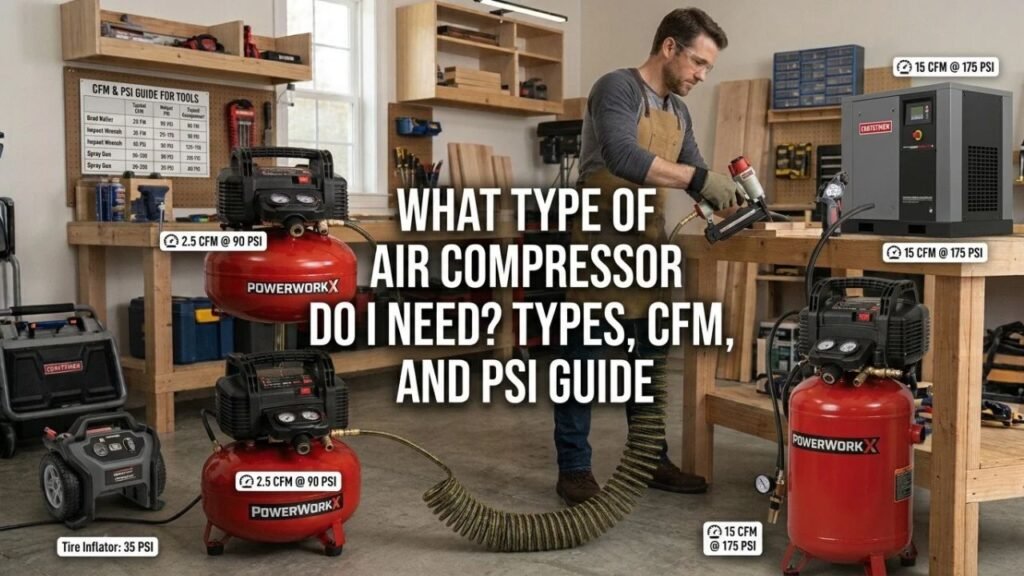
The easiest way to narrow the choice is to start with the work you actually plan to do.
Tire Inflation and Occasional Blow-Off
For passenger-car tires, bicycle tires, sports equipment, and short blow-gun use, a small portable compressor is usually enough.
Good choices include:
- 1- to 6-gallon portable compressor
- Pancake compressor
- Hot-dog compressor
- Small oil-free unit
You do not need a 60-gallon shop compressor just to top off tires.
A current 6-gallon CRAFTSMAN pancake model, for example, supplies 2.6 SCFM at 90 PSI and stores air at up to 150 PSI. That is representative of the type of compressor commonly used for inflation, nailers, and short bursts of air.
Brad Nailers, Finish Nailers, and Staplers
Pneumatic nailers consume air in short bursts.
A 2- to 6-gallon portable compressor is often enough for:
- Brad nailers
- Finish nailers
- Staplers
- Light trim work
These tools do not usually need large continuous airflow, so portability often matters more than a large tank.
A pancake compressor is especially convenient because it is compact, stable, and easy to carry between rooms or jobsites.
Framing and Roofing Nailers
A 4- to 10-gallon compressor usually gives more reserve air for faster fastening work.
One nailer can often run from a small compressor, but rapid firing may make a very small pump cycle frequently.
If two workers will use nailers at the same time, add the air demand of both tools before sizing the compressor.
Ingersoll Rand advises adding the CFM requirements of tools that actually run together rather than sizing from just one tool.
Impact Wrenches and General Automotive Work
For occasional tire rotation, brake work, and short impact-wrench bursts, a 10- to 20-gallon compressor can work well if its SCFM matches the wrench.
A common 1/2-inch Ingersoll Rand 231C impact wrench, for example, lists average air consumption of 4.2 CFM and 10 CFM under load at 90 PSI. That difference shows why checking the actual tool specification matters.
For frequent automotive work, a 20- to 30-gallon compressor with stronger pump output is more comfortable because the compressor spends less time recovering.
Die Grinders and Air Sanders
These tools are much harder on a compressor.
Ingersoll Rand’s automotive air-consumption chart lists examples such as:
- Die grinder: about 5 CFM
- Orbital body sander: about 10 CFM
- Vertical disc sander: about 20 CFM
The same chart includes some sanding tools with even higher air demand.
For regular sanding or grinding, a 60-gallon belt-drive compressor producing roughly 10 CFM or more at 90 PSI is often a better starting point than a small portable unit.
Spray Painting
Paint guns vary greatly.
Some touch-up guns may need only a few CFM, while production spray guns can need much more. Ingersoll Rand’s automotive chart lists one production spray-gun example at about 8 CFM and an undercoating gun at 19 CFM.
For small parts or touch-up work, a 20- to 30-gallon compressor may be enough if the gun has low air demand.
For full-car painting, a 60- or 80-gallon compressor with strong continuous airflow is the safer direction.
Painting also calls for good moisture control, filtration, and often additional air drying.
Sandblasting
Sandblasting consumes large amounts of air continuously.
A small compressor may blast for a few seconds, then pressure falls rapidly.
For meaningful blasting work, look toward:
- 60- to 80-gallon reciprocating compressor
- High-output two-stage compressor
- Rotary-screw compressor for frequent commercial use
The blast nozzle size has a huge effect on air demand, so size from the blast equipment specification rather than from tank gallons.
Key Takeaway: Small compressors fit inflation and nailers; mixed garage work usually calls for more SCFM and tank capacity; sanders, paint guns, and blasting equipment need much stronger continuous airflow.
Start With SCFM, Not Tank Gallons
SCFM is one of the most useful specifications on an air compressor.
It tells you how much air the pump can deliver at a stated pressure.
What SCFM Means
SCFM means standard cubic feet per minute.
It describes air volume.
A compressor may be labeled:
5.0 SCFM at 90 PSI
That means it can supply about 5 standard cubic feet of air per minute under the specified test conditions while delivering 90 PSI.
California Air Tools explains that CFM represents the air volume needed to operate a pneumatic tool, while PSI represents pressure.
Match SCFM at the Same PSI
Do not compare:
- Tool requirement at 90 PSI
- Compressor output at 40 PSI
Those are different operating points.
If your tool needs 5 CFM at 90 PSI, check the compressor’s rating at 90 PSI.
Air output normally falls as operating pressure rises.
DEWALT’s published compressor data shows this clearly. One model is rated at 5.0 SCFM at 90 PSI and 4.9 SCFM at 100 PSI, while a smaller model falls from 1.0 SCFM at 40 PSI to 0.75 SCFM at 90 PSI.
Give Yourself Airflow Margin
A compressor that exactly matches the tool rating may spend most of its time running.
Quincy Compressor recommends choosing roughly 30% to 50% more CFM than the highest tool requirement and adding the CFM of tools that will operate at the same time.
If your tool needs 5 CFM at 90 PSI, a compressor rated around 6.5 to 7.5 CFM at 90 PSI gives more breathing room than a unit rated at exactly 5 CFM.
That extra output also accounts for minor leaks and pressure losses through hoses, filters, regulators, and fittings.
Key Takeaway: Match the compressor’s SCFM rating to the tool at the same PSI and aim for some airflow margin rather than sizing at the exact minimum.
How Much PSI Do You Need?
PSI means pounds per square inch and describes air pressure.
Most air tools do not need the compressor’s maximum tank pressure.
Many Air Tools Run Near 90 PSI
Ingersoll Rand notes that many common pneumatic tools operate around 90 PSI.
Examples can include:
- Impact wrenches
- Ratchets
- Air hammers
- Die grinders
- Sanders
The exact operating pressure comes from the tool manual.
Higher Maximum Tank PSI Gives More Stored Air
A compressor rated to 150, 175, or 200 PSI can store more compressed air in the same tank than a lower-pressure design.
That does not mean your 90 PSI impact wrench should receive 175 PSI.
The regulator reduces tank pressure to the pressure required by the tool.
Do Not Buy by Maximum PSI Alone
A 200 PSI compressor producing 2.5 SCFM at 90 PSI is still a low-airflow compressor.
A 135 PSI compressor producing 12 SCFM at 90 PSI may run demanding tools far better.
For tool use, SCFM at operating pressure deserves more attention than the highest number printed on the tank.
How Big of an Air Compressor Tank Do You Need?
Tank size controls how much compressed air is stored between pump cycles.
It does not determine how much air the pump can continuously produce.
1 to 6 Gallons
Best for:
- Inflation
- Brad nailers
- Staplers
- Finish nailers
- Portable jobsite work
These tanks fill quickly and are easy to carry.
They run out of stored air quickly with grinders, impact tools, or blow guns used continuously.
8 to 20 Gallons
A good range for:
- Home garage work
- Tire service
- Short impact-wrench use
- Air ratchets
- Small paint jobs
- General DIY work
A 20-gallon compressor is often a good compromise for someone who wants portability plus more reserve air than a pancake compressor.
20 to 30 Gallons
Useful for more frequent garage work.
This size can support:
- Impact tools
- Air hammers
- Intermittent grinding
- Moderate spray work
- Longer blow-gun use
Pump output still matters more than tank size.
60 Gallons
A 60-gallon stationary compressor is a strong home-shop choice for users who regularly run:
- Die grinders
- Sanders
- Larger impact wrenches
- Paint guns
- Multiple pneumatic tools
These machines often use oil-lubricated belt-drive pumps and 240V power.
80 Gallons and Larger
An 80-gallon tank makes sense for:
- Full automotive shops
- Heavy fabrication
- Long sanding sessions
- Painting
- Blasting
- Several pneumatic tools
Campbell Hausfeld gives a general tank-sizing rule of roughly two to five gallons of storage for each CFM of compressor output, with larger storage ratios favored for continuous-draw tools.
Key Takeaway: Small tanks favor portability, while large tanks reduce rapid cycling and provide more stored air; pump SCFM still sets long-term tool performance.
Oil-Free vs. Oil-Lubricated Air Compressor
Both styles have a place.
The better choice depends on how often you use the compressor and how much portability and maintenance matter.
Oil-Free Compressor
Oil-free compressors are common in smaller portable machines.
Good points include:
- Less routine maintenance
- No pump-oil changes
- Easy transport
- Good for nailers and inflation
- Often lower purchase price
They are a good fit for homeowners and occasional users.
Many small pancake compressors use oil-free pumps, including the current CRAFTSMAN 6-gallon model.
Oil-Lubricated Compressor
Oil-lubricated piston compressors are common in larger belt-drive machines.
They are often preferred for:
- Frequent garage use
- Longer run periods
- Higher-output pumps
- Stationary shop installations
They require oil checks and oil changes.
A belt-drive oil-lubricated compressor is often the direction I would take for a serious home garage where air tools are used every week.
Key Takeaway: Oil-free compressors suit portability and light maintenance, while oil-lubricated belt-drive machines make more sense for frequent shop use.
Single-Stage vs. Two-Stage Air Compressor
The terms refer to how the compressor raises air pressure.
Single-Stage Compressor
A single-stage piston compressor compresses air to final pressure in one compression stage.
This design is common in:
- Portable compressors
- Home-garage units
- Many 20- to 60-gallon compressors
For ordinary 90 PSI pneumatic tools, a good single-stage unit may be all you need.
Two-Stage Compressor
A two-stage piston compressor compresses the air once, cools it, then compresses it again to a higher pressure.
These machines are common in:
- Larger shops
- High-pressure applications
- Heavy automotive work
- Commercial use
A two-stage compressor is worth considering if you need higher pressure, greater shop capacity, or longer daily run time.
Do not buy a two-stage model simply because it sounds more advanced. If you mostly inflate tires and use a nailer, the extra size and cost provide little benefit.
Key Takeaway: Single-stage compressors cover most home and light-shop jobs; two-stage machines fit larger, higher-pressure, heavier-use systems.
Reciprocating vs. Rotary-Screw Compressor
This distinction matters most once air use becomes frequent or commercial.
Reciprocating Piston Compressor
A piston compressor is the familiar style used in most home garages.
It works well for air demand that rises and falls during the day.
Good uses include:
- DIY shops
- Auto repair
- Woodworking
- Tire work
- Intermittent pneumatic tools
They are available from tiny portable units to large two-stage stationary machines.
Rotary-Screw Compressor
Rotary-screw compressors are aimed at long periods of steady airflow.
They are common in:
- Production shops
- Manufacturing
- Commercial body shops
- Facilities with constant pneumatic demand
They cost much more than typical homeowner compressors but are better suited to long daily run cycles.
For occasional home use, a rotary-screw machine is usually unnecessary.
Key Takeaway: Piston compressors fit intermittent home and shop air demand; rotary-screw machines make more sense where compressed air runs for long periods every day.
Portable vs. Stationary Compressor
Portability affects much more than convenience.
Choose Portable If You Need Air in Different Locations
Portable compressors are good for:
- Construction
- Trim work
- Roofing
- Tire inflation
- Mobile repairs
- Small workshops
Pancake, hot-dog, twin-stack, and wheeled horizontal tanks fall into this group.
Choose Stationary for High-Air-Demand Shop Work
Stationary compressors usually offer:
- Larger tanks
- Higher SCFM
- Larger pumps
- 240V motors
- Better support for continuous-demand tools
They need permanent floor space and suitable electrical service.
If sanding, painting, or grinding is part of your regular routine, stationary equipment usually makes more sense than carrying around a small portable compressor.
Electric vs. Gas-Powered Air Compressor
For most home garages, electric is the better choice.
Electric Compressor
Electric models are suited to:
- Garages
- Workshops
- Indoor work areas
- Fixed shop installations
They produce no engine exhaust and are usually easier to start and maintain.
Gas-Powered Compressor
Gas-engine compressors are useful where electricity is unavailable.
Common uses include:
- Construction sites
- Farm work
- Roadside service
- Remote locations
A gas engine produces carbon monoxide, so it should not be operated inside a garage or other enclosed space.
If a wall outlet or proper 240V circuit is available, an electric compressor is usually the simpler shop option.
What Type of Air Compressor Do I Need for a Home Garage?
For a basic home garage, a 10- to 20-gallon electric compressor producing at least 4 to 6 SCFM at 90 PSI is a useful starting range.
It can handle many jobs such as:
- Tire inflation
- Impact wrench use in bursts
- Air ratchet use
- Blow gun
- Nailers
- Small pneumatic accessories
For frequent die-grinder, sander, paint-gun, or larger impact-wrench work, move toward a 30- to 60-gallon compressor with substantially higher SCFM.
A serious automotive garage with regular sanding and painting is often better served by a 60- or 80-gallon 240V belt-drive compressor.
Do not treat these gallon ranges as rules. Check the tool with the greatest SCFM demand and size from that specification.
A Simple Air Compressor Sizing Formula
You can narrow the size in a few minutes.
- List every pneumatic tool you plan to use.
- Write down each tool’s required SCFM and PSI.
- Identify which tools may run at the same time.
- Add the SCFM of simultaneous tools.
- Add roughly 30% to 50% airflow margin.
- Choose a compressor that meets that SCFM at the required PSI.
- Pick tank size based on how continuously the tools run.
Quincy recommends the same general approach, including 30% to 50% added CFM above the highest demand and adding tool airflow when several lines operate together.
Example
Suppose your most demanding tool needs:
6 CFM at 90 PSI
Adding 30%:
6 × 1.30 = 7.8 CFM
A compressor rated around 8 CFM at 90 PSI would be a better target than one rated at exactly 6 CFM.
If you also plan to run another 4 CFM tool at the same time, the calculation begins with 10 CFM before adding margin.
Key Takeaway: Add the real simultaneous tool demand, include airflow margin, and compare the result with the compressor rating at the same PSI.
Air Compressor Buying Mistakes to Avoid
Many disappointing compressor purchases come from comparing the wrong specifications.
Avoid these mistakes:
- Buying by tank gallons alone
- Buying by maximum PSI alone
- Comparing compressor SCFM at 40 PSI with tool demand at 90 PSI
- Choosing only by horsepower
- Ignoring duty cycle
- Forgetting voltage requirements
- Ignoring hose and fitting restrictions
- Buying too little airflow for sanders or paint guns
- Buying a huge stationary compressor for inflation only
- Assuming every impact wrench uses the same amount of air
- Ignoring noise in an attached garage
- Forgetting moisture control for painting
Ingersoll Rand specifically warns that horsepower is not the best starting point because compressors with similar horsepower can deliver different airflow.
Air Compressor Safety Basics
Compressed air stores a large amount of energy.
Keep the factory safety valve, pressure switch, tank rating, and guards intact.
OSHA requires covered air receivers to have a visible pressure gauge and spring-loaded safety valve, and it requires accumulated liquid to be drained frequently from receivers.
For workplace cleaning, OSHA also requires compressed air to remain below 30 PSI under static conditions and calls for protective equipment and chip guarding. Compressed air should never be used to clean a person’s body or clothing.
Drain condensation according to the compressor manufacturer’s instructions and never raise pressure beyond the tank’s rating.
Conclusion
For what type of air compressor do I need, start with the highest-air-demand tool you plan to run and find its required SCFM and PSI. Then size the compressor with some extra airflow rather than choosing from tank gallons, horsepower, or maximum PSI alone.
A 2- to 6-gallon portable compressor is usually enough for nailers and inflation. A 10- to 30-gallon unit is a good fit for mixed home-garage use. Regular sanding, grinding, painting, and other high-air-demand jobs point toward a 60- or 80-gallon belt-drive compressor.
Oil-free machines suit light portable work, while oil-lubricated belt-drive units fit frequent garage use. Single-stage compressors cover most home applications, two-stage machines suit heavier high-pressure work, and rotary-screw compressors are mainly aimed at steady commercial air demand.
The best purchase is the compressor that supplies enough SCFM at your required working pressure without running constantly. Check the tool data first, add airflow margin, then choose the tank, pump type, voltage, and portability that fit the way you work.
FAQs About Choosing the Right Air Compressor
What Size Air Compressor Is Best for Home Use?
A 6- to 20-gallon compressor covers many household jobs such as inflation, nailers, blow guns, and light pneumatic tools. For frequent automotive work, a 20- to 30-gallon unit with stronger SCFM output gives more flexibility.
What Size Air Compressor Do I Need for an Impact Wrench?
Check the exact wrench specification. Some 1/2-inch impact wrenches average around 4 CFM at 90 PSI, while larger models use much more. A compressor rated several CFM above the tool requirement gives better recovery.
What Size Air Compressor Do I Need for Painting?
Small touch-up guns may work with moderate airflow, while full-size spray guns can require 8 CFM or much more. For full-car painting, a 60- or 80-gallon compressor with strong continuous output is commonly a better choice.
Is a 20 Gallon Air Compressor Big Enough?
Yes for many home garages. A 20-gallon compressor can run impact tools in bursts, inflate tires, power nailers, and handle many general tasks if the pump supplies enough SCFM. Continuous sanders and large paint guns may outrun it.
Is a 60 Gallon Air Compressor Too Big for Home Use?
Not if you regularly use grinders, sanders, paint guns, or other air-hungry tools. For simple tire inflation and occasional nailing, a 60-gallon machine takes more space and electrical capacity than needed.
Is Higher PSI Better on an Air Compressor?
Not automatically. Higher tank PSI stores more air, but tool performance depends heavily on SCFM at working pressure. A lower-maximum-pressure compressor with much higher airflow may run pneumatic tools better.
Is SCFM More Important Than Horsepower?
For tool matching, yes. Ingersoll Rand recommends beginning with required CFM and PSI because horsepower alone does not show how much usable air the compressor delivers.
Should I Buy an Oil-Free or Oil-Lubricated Air Compressor?
Choose oil-free for portability, simple maintenance, nailers, inflation, and light home use. Choose an oil-lubricated belt-drive compressor for frequent garage work, longer run times, and larger stationary installations.