
How to Choose a Belt Sander: Size, Power, Features & Buying Tips
Choose a belt sander based first on the work you plan to do, then compare belt size, speed control, motor output, weight, dust collection, tracking, and power source. A 3 × 21-inch variable-speed model is a versatile starting point for general woodworking, while wider 4 × 24-inch machines favor faster stock removal on large surfaces.
Belt sanders remove material much faster than orbital or finishing sanders. That makes them useful for leveling rough boards, stripping paint, smoothing glued panels, removing old finishes, and correcting uneven surfaces. The same aggressive cutting action also makes an oversized or overly fast machine harder to control on delicate work.
Current handheld models cover several formats. Home Depot’s U.S. belt-sander category includes 3 × 18, 3 × 21, 3 × 24, and 4 × 24-inch machines, along with narrow band files and stationary belt sanders. Features commonly listed include variable speed, dust collection, tool-free belt changes, lock-on switches, and two-hand grips.
For how to choose a belt sander, begin with belt width and the size of the workpiece. Then decide how much speed control you need, how long you expect to sand at one time, and if portability is more useful than unlimited corded runtime.
Dust collection deserves real attention. U.S. NIOSH research on horizontal belt sanding found that an improved ventilation setup reduced wood-dust emissions into the workroom by more than 75%. The study involved stationary industrial belt sanders, but it shows why dust extraction should be treated as a real buying feature rather than an afterthought.
Comfort matters too. Many handheld belt sanders weigh roughly 9 to 13 pounds, and that weight is moving across the workpiece while the belt pulls the tool forward. Balance, handle position, trigger feel, and tracking behavior can matter just as much as the motor rating during a long sanding session.
How to Choose a Belt Sander for Your Work
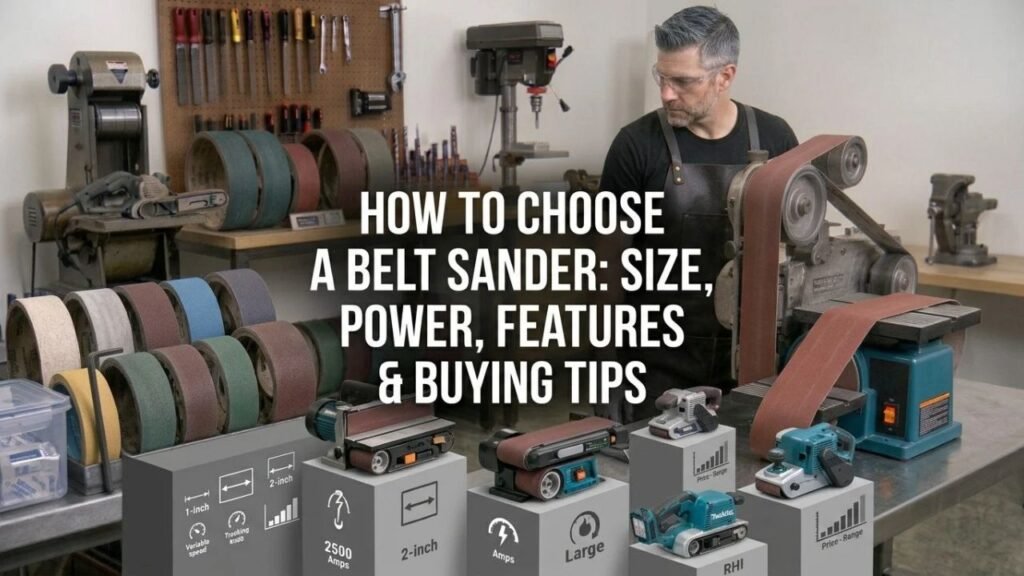
Start by deciding what you expect the machine to do most often.
For General Woodworking
A 3 × 21-inch handheld belt sander is a strong all-around format for jobs such as:
- Flattening boards
- Removing finish
- Smoothing glued panels
- Leveling joints
- Working on furniture parts
- Sanding doors
- Preparing rough lumber
The belt is wide enough to cover useful surface area without making the machine as bulky as many 4-inch models.
Makita’s current 9903 is one example of the format: it uses a 3 × 21-inch belt, weighs 9.5 pounds, and has a variable belt-speed range of 690 to 1,440 feet per minute.
For Large Flat Surfaces
A 4 × 24-inch belt sander removes material across a wider path.
This format suits jobs such as:
- Large tabletops
- Wide panels
- Deck boards
- Doors
- Floor-related work
- Heavy stock removal
The extra width can make it easier to keep large areas flat, but the tool is generally larger and can remove material very quickly.
Makita’s current 9403 uses an 11-amp motor, a 4 × 24-inch belt, a fixed 1,640-foot-per-minute belt speed, and weighs 12.6 pounds.
For Tight Areas
A narrow belt file is better than a full-size belt sander for:
- Inside corners
- Narrow edges
- Metal fabrication
- Weld cleanup
- Small contours
- Tight spaces
Current narrow belt tools may use belts around 3/8 or 1/2 inch wide rather than 3 or 4 inches.
They are specialty tools rather than replacements for a wide handheld sander.
For Stationary Work
If the goal is shaping small parts rather than moving a tool across a large board, consider a stationary belt sander.
A bench or floor model works well for:
- Edge shaping
- Small furniture parts
- Metal shaping
- Knife work
- Repetitive shop sanding
In that setup, the sanding belt stays in one position while you move the workpiece.
Key Takeaway: A 3 × 21-inch handheld model suits many woodworking jobs, a 4 × 24-inch machine favors large-surface stock removal, and narrow or stationary sanders serve more specialized work.
Choose the Right Belt Size
Belt dimensions are normally listed as width × length.
A 3 × 21-inch sander therefore uses a belt that is 3 inches wide and 21 inches around.
3 × 18-Inch Belt Sanders
A 3 × 18-inch machine tends to have a more compact footprint.
It is useful where:
- Portability matters
- Workpieces are smaller
- Storage space is limited
- You want easier handling
Milwaukee’s current cordless 3 × 18-inch model, for example, uses belts in that exact size and includes variable speed from 750 to 1,350 surface feet per minute.
3 × 21-Inch Belt Sanders
The 3 × 21 format sits in the middle of the handheld range.
It provides a good balance of:
- Sanding area
- Belt availability
- Control
- Weight
- Stock-removal speed
Current corded and cordless machines are widely available in this size. DEWALT’s DCW220 is one present-day cordless example using a 3 × 21-inch belt.
3 × 24-Inch Belt Sanders
A longer 3-inch belt offers more belt surface and a longer tool body.
The format works well for users who want 3-inch width with a larger sanding platform.
Makita currently sells a 3 × 24-inch model alongside its 3 × 21 and 4 × 24 machines.
4 × 24-Inch Belt Sanders
This is the large traditional handheld format.
Choose it when fast material removal on broad surfaces matters more than compact size.
A wide belt can be harder to use on small parts and near detailed features, so buying the largest model is not always the best strategy.
Key Takeaway: Belt width influences coverage and control, while belt length affects the machine’s overall format and abrasive surface area. Match the size to the surfaces you sand most often.
Check Motor Power and Belt Speed
Belt size tells only part of the story.
The motor must keep the abrasive moving under load.
Corded Motor Amps
Corded handheld sanders often advertise motor current in amps.
Current products show how wide the range can be. Home Depot presently lists examples from 6-amp 3 × 18-inch machines to an 11-amp 4 × 24-inch Makita.
A higher amp rating can indicate a motor designed for heavier loads, but amps alone do not tell you how the sander will feel or how fast it removes stock.
Also compare:
- Belt speed
- Electronic speed control
- Tool weight
- Belt width
- Cooling
- Gear and drive design
Belt Speed
Belt speed may be listed in:
- Feet per minute
- Surface feet per minute
- FPM
- SFM
Higher speed generally means faster material removal with the same abrasive and pressure.
For example, Makita’s 9403 runs a 4-inch belt at 1,640 feet per minute, while its variable-speed 9903 ranges from 690 to 1,440 feet per minute.
Speed alone should not decide the purchase. Control can matter more for furniture, veneer, paint removal, or heat-sensitive materials.
Constant-Speed Electronics
Some sanders use electronics to maintain belt speed as load increases.
That can make the tool feel more consistent when moving from light passes to heavier stock removal.
This is more useful during demanding work than an impressive no-load speed that falls sharply as soon as the abrasive contacts wood.
Key Takeaway: Compare motor rating and belt speed together. For heavy removal, look for a motor that holds speed under load rather than focusing on one large specification.
Decide if Variable Speed Is Worth Paying For
Variable speed is one of the most useful belt-sander features.
Lower Speed Gives More Control
Slowing the belt can help with:
- Veneered surfaces
- Paint removal
- Softwoods
- Delicate edges
- Metal work
- Heat-sensitive material
- Final passes before changing to another sander
A lower setting reduces the rate at which mistakes happen.
Higher Speed Removes Material Faster
Higher belt speed works well for:
- Rough lumber
- Flattening
- Removing heavy finish
- Leveling high spots
- Coarse-grit sanding
You still need to keep the tool moving.
Holding a belt sander in one place can create a low spot surprisingly fast.
Current Speed Ranges Vary
Makita’s 3 × 21-inch 9903 provides 690-1,440 ft./min., while Milwaukee’s cordless 3 × 18-inch model ranges from 750-1,350 SFM. DEWALT’s current 3 × 21-inch cordless model uses a variable trigger plus a 25-position speed dial.
A fixed-speed sander can still be a good option for rough work if the speed matches the jobs you plan to do.
Key Takeaway: Variable speed is worth prioritizing if one sander will handle both aggressive stock removal and more controlled sanding tasks.
Corded vs Cordless Belt Sander
Both types are now common in the U.S. market.
Corded Belt Sander
Corded models make sense for:
- Long sanding sessions
- Workshop use
- Large panels
- Deck work near power
- Repeated stock removal
Main advantages include unlimited runtime from the outlet and no battery cost.
The cord can catch on corners or drag across the workpiece, so cord placement is worth checking before purchase.
Cordless Belt Sander
Cordless models are useful for:
- Jobsite work
- Outdoor projects
- Doors already installed
- Work far from outlets
- Quick sanding jobs
Modern cordless sanders can provide strong cutting performance, but belt sanding places a heavy load on batteries.
Check:
- Battery voltage
- Recommended battery capacity
- Tool weight with battery
- Battery price
- Charger availability
- Compatibility with batteries you already own
A bare-tool price can look attractive until a large battery and charger are added.
Choose Around Runtime
If sanding will continue for long periods at a workbench, corded power is hard to beat.
If mobility matters more and you already own batteries in the same system, cordless can be much more convenient.
Key Takeaway: Corded sanders favor long uninterrupted work, while cordless models trade runtime for easier movement and jobsite use.
Pay Attention to Weight and Balance
Belt sanders are heavier than many orbital sanders.
That weight can work both for and against you.
More Weight Can Aid Flat Sanding
A heavier sander can let the machine’s own mass provide much of the downward force.
You should not need to push hard.
Excess hand pressure can:
- Slow the belt
- Increase heat
- Wear belts faster
- Create uneven sanding
Too Much Weight Can Become Tiring
A 12-pound machine feels very different from a 9-pound one when sanding:
- Vertical doors
- Walls
- Edges
- Overhead areas
- Small workpieces
Current examples illustrate the range. Makita lists its 3 × 21-inch 9903 at 9.5 pounds and its 4 × 24-inch 9403 at 12.6 pounds.
Check Handle Placement
Look for:
- Large front handle
- Comfortable rear grip
- Space for gloves
- Natural wrist angle
- Two-hand control
- Easy trigger reach
If possible, handle the sander before buying it. A tool that looks compact online may feel nose-heavy or awkward in your hands.
Key Takeaway: Weight can stabilize a sander on horizontal surfaces, but balance and handle position become more important during long sessions or vertical sanding.
Check Belt Tracking and Belt Changes
A belt that repeatedly walks sideways can turn a simple sanding job into constant adjustment.
Automatic Tracking
Some modern sanders automatically keep the belt centered during normal operation.
Makita’s 9903 uses an auto-tracking system, while Milwaukee’s M18 model combines automatic tracking with a manual tool-free tracking adjustment.
Manual Tracking Knob
Manual tracking is not necessarily a disadvantage.
A well-designed adjustment knob lets you center different belt brands quickly.
Check that the control can be reached without awkward disassembly.
Tool-Free Belt Release
A lever-operated tension release makes belt changes much quicker.
This matters if you regularly move through several grits during the same job.
DEWALT and Milwaukee both currently list tool-free belt-change systems on their cordless models.
Key Takeaway: Look for stable tracking, easy manual correction, and a quick belt-release lever, mainly if you change grits often.
Do Not Ignore Dust Collection
Belt sanding can produce large amounts of dust in a short time.
Dust Bag
A built-in bag is convenient for short jobs.
Its limitations are capacity and filtration.
Large sanding jobs can fill a small bag quickly.
Vacuum Port
A vacuum or dust-extractor connection is much better for extended indoor work.
DEWALT states that its current DCW220 can reach up to 95% dust collection in the company’s specified test setup using its compatible vacuum, battery, and 80-grit abrasive. That figure should not be assumed for every wood, abrasive, vacuum, or hose arrangement.
Check Hose Compatibility
Before buying, look at:
- Port diameter
- Included adapter
- Vacuum compatibility
- Swivel movement
- Hose position
A hose that points directly into your working hand or constantly pulls the tool sideways can become annoying.
Wood Dust Is a Health Issue
NIOSH identifies belt-sanding wood dust as a source of exposure associated with respiratory and other health problems and recommends controlling dust at the source.
Use eye protection and suitable respiratory protection where the dust exposure calls for it, even if the sander has a dust bag.
Key Takeaway: A good vacuum connection is one of the most useful features for indoor sanding because belt sanders remove enough material to generate dust quickly.
Look for Flush-Sanding Capability
Some belt sanders can sand close to a wall or inside edge using the nose or side of the housing.
This feature matters for:
- Floors near walls
- Installed doors
- Large panels with raised edges
- Cabinet work
- Deck structures
Makita lists flush-to-wall sanding from the nose and side on several current belt-sander models.
If your work regularly involves corners and edges, examine how close the belt actually reaches to the housing.
Match the Sander to the Sanding Belts You Can Buy
A belt sander is only useful if abrasives are easy to obtain.
Before buying, check the local and online availability of:
- Belt size
- Grit range
- Belt backing
- Abrasive material
- Pack sizes
- Price per belt
Coarse Grit
Typical coarse grits such as 40 or 60 are used for:
- Fast leveling
- Heavy finish removal
- Rough lumber
- Paint stripping
They can leave deep scratches.
Medium Grit
Around 80-120 grit suits many general leveling and preparation tasks.
Many new belt sanders ship with an 80-grit belt, including several current Makita and DEWALT models.
Fine Grit
Finer belts can refine the surface, but a belt sander is rarely the best final-finishing tool.
For fine furniture surfaces, switching to a random orbital or finishing sander after the belt-sanding stage often gives better control over scratch patterns.
Key Takeaway: Check belt availability before selecting an uncommon size, and expect to use the belt sander mainly for shaping, leveling, and initial sanding rather than the final finish.
Choose Features Based on the Jobs You Do
Not every extra feature deserves extra money.
Features Worth Prioritizing for General Woodworking
Look first for:
- 3 × 21-inch belt
- Variable speed
- Reliable tracking
- Tool-free belt change
- Good dust port
- Two-hand grip
- Comfortable balance
Features for Heavy Stock Removal
Prioritize:
- Wider belt
- Strong motor
- High belt speed
- Constant-speed control
- Large front handle
- Strong dust extraction
- Durable platen
Features for Jobsite Use
Look for:
- Cordless power
- Battery compatibility
- Manageable weight
- Tool-free changes
- Lock-on control
- Dust bag plus vacuum option
Features for Furniture Work
Prioritize:
- Variable speed
- Good balance
- Predictable trigger
- Accurate tracking
- Flush sanding
- Strong dust pickup
A very aggressive fixed-speed 4 × 24-inch machine may be more tool than you want for delicate furniture panels.
Key Takeaway: Buy features that solve your common sanding problems rather than paying for specifications you rarely use.
Common Belt Sander Buying Mistakes
Buying the Largest Sander Available
A bigger sanding area means faster removal, but it also means more weight and less control on small pieces.
Choosing by Motor Amps Alone
Amps do not describe the entire sanding system.
Compare belt speed, size, control, weight, and how well the machine maintains speed under load.
Skipping Variable Speed
Fixed speed works for rough work, but variable speed broadens the range of materials and tasks one machine can handle.
Ignoring Dust Extraction
A dust bag may look sufficient in the store and prove frustrating during a long indoor job.
Check vacuum connectivity before buying.
Forgetting Abrasive Cost
A cheap sander using hard-to-find belts can cost more to operate than a slightly more expensive model using a common belt size.
Buying a Belt Sander for Finish Sanding
Belt sanders excel at rapid material removal.
If your main goal is a smooth final finish with little risk of gouging, a random orbital or finishing sander may fit the work better.
Key Takeaway: Avoid choosing solely by size, amps, or price; balance cutting speed with control, dust collection, abrasive availability, and the type of sanding you actually do.
Belt Sander Buying Checklist
Before purchasing, verify:
- Belt dimensions
- Corded or cordless design
- Motor or battery platform
- Belt-speed range
- Variable-speed control
- Tool weight
- Front-handle comfort
- Belt-tracking system
- Tool-free belt change
- Dust bag
- Vacuum port and adapter
- Flush-sanding clearance
- Lock-on switch
- Abrasive availability
- Warranty
- Parts availability
For stationary models, also examine:
- Table size
- Table adjustment
- Belt angle
- Dust port
- Motor horsepower
- Stand or bench mounting
- Fence
- Belt-change access
A short specification checklist makes it much easier to compare models that initially look similar.
Conclusion
For how to choose a belt sander, start with the surfaces and materials you sand most often. A 3 × 21-inch variable-speed handheld model is a versatile size for general woodworking, while 4 × 24-inch machines favor broad surfaces and rapid stock removal. Compact 3 × 18-inch models put more emphasis on handling and portability.
Next, compare belt speed, motor performance, dust extraction, weight, tracking, belt-change design, and corded versus cordless operation. Do not let maximum speed or motor amps dominate the decision if the machine is uncomfortable or poorly matched to the work.
A belt sander should remove material at a rate you can control. For many users, good balance, variable speed, common abrasive sizes, stable tracking, and a usable vacuum connection matter more over time than one oversized specification.
FAQs About Choosing a Belt Sander
What size belt sander is best for general woodworking?
A 3 × 21-inch handheld belt sander is a versatile choice for many woodworking jobs. It offers more sanding area than compact 3 × 18-inch machines while remaining easier to handle than many 4 × 24-inch sanders.
Is a 3 × 18 or 3 × 21 belt sander better?
A 3 × 18-inch sander favors compact size and portability. A 3 × 21-inch model gives a longer sanding platform and is a common general-purpose format. Choose 3 × 18 for tighter work and easier handling, or 3 × 21 for broader everyday woodworking.
Is a 4 × 24 belt sander too big for home use?
Not necessarily. It works well for doors, tabletops, decks, and other broad surfaces. It may feel heavy and aggressive on smaller furniture parts. Makita’s current 4 × 24-inch 9403 weighs 12.6 pounds, illustrating the extra mass found in some large handheld models.
Should I buy a variable-speed belt sander?
Variable speed is a strong feature if you work on different materials or want more control. Lower speed is useful for delicate surfaces and finish removal, while higher speed favors rapid stock removal. Current models offer wide speed ranges rather than only one fixed rate.
Is a corded or cordless belt sander better?
Corded models suit long sanding sessions because they do not depend on battery runtime. Cordless models are easier to move around jobsites and outdoor projects. Battery cost, battery weight, and expected sanding duration should be part of the comparison.
How many amps should a belt sander have?
There is no single amp rating that fits every job. Current corded handheld models include roughly 6-amp compact units and 11-amp large 4 × 24-inch machines. Compare amps with belt width, belt speed, tool weight, and intended workload rather than treating amps as the sole measure.
Do I need dust collection on a belt sander?
Yes, especially for indoor woodworking or long sanding sessions. Belt sanders generate wood dust quickly. NIOSH identifies horizontal belt sanding as a substantial source of wood dust and has documented major reductions in airborne dust when better source extraction is used.