
How Much Does It Cost to Charge a Drill Battery? Full Guide
Cordless drills are convenient because you can work almost anywhere without dragging an extension cord around, but every rechargeable battery eventually has to go back on the charger. That naturally raises a simple question: how much electricity does a drill battery actually use, and does frequent charging noticeably affect your electric bill?
For most homeowners, the answer is reassuring. The electricity needed to recharge a cordless drill battery is very small compared with appliances such as air conditioners, electric heaters, dryers, or even many household electronics. In many cases, fully charging a typical drill battery costs well under a few cents.
Exactly how much does it cost to charge a drill battery depends mainly on the battery’s voltage and amp-hour capacity, the efficiency of the charger, and your local electricity rate. A compact 12-volt battery generally costs less to recharge than a large 18-volt or 20V MAX high-capacity battery simply because it stores less energy.
The good news is that you can estimate the cost yourself with a few numbers printed directly on the battery and your electric bill. This guide explains the calculation in plain English, gives practical examples for common cordless drill batteries, and shows how battery size, charger efficiency, charging frequency, and standby power affect the real cost.
Read More: how to charge a cordless drill without a charger
How Much Does It Cost to Charge a Drill Battery?
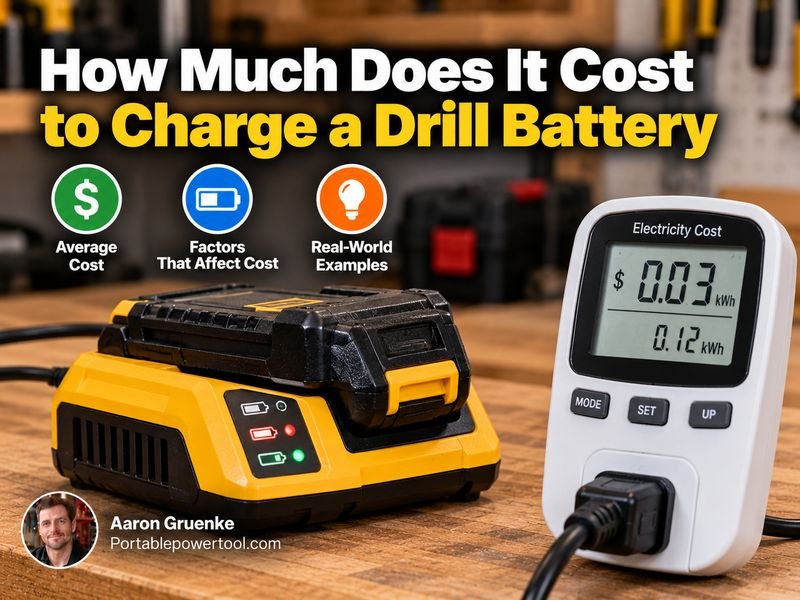
Charging a typical cordless drill battery generally costs less than 1 to a few cents per full charge, depending on battery capacity and your electricity price.
For example, if electricity costs $0.15 per kilowatt-hour (kWh), a charger that draws 0.05 kWh to refill a smaller battery would cost:
0.05 kWh × $0.15 = $0.0075
That is only 0.75 cent.
A larger battery that requires about 0.10 kWh from the wall would cost:
0.10 kWh × $0.15 = $0.015
That equals 1.5 cents.
These are examples rather than universal prices. The actual amount depends on the battery and charger.
Even if you charge a cordless drill battery several times per week, the electricity cost is normally a very small part of owning and operating the tool.
How to Calculate the Cost of Charging a Drill Battery
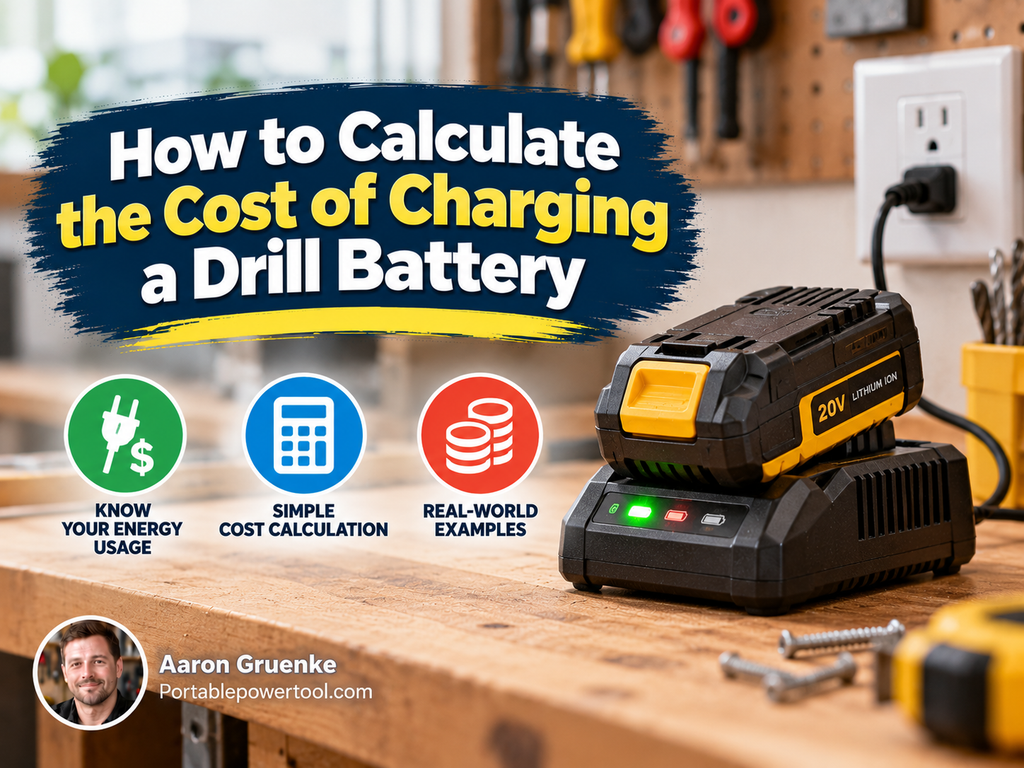
You can estimate charging cost using a simple formula:
Battery energy in watt-hours ÷ 1,000 × electricity price per kWh
Battery energy can be estimated with:
Voltage × amp-hours = watt-hours
For example, consider an 18V, 4Ah battery.
18 × 4 = 72 watt-hours
Convert watt-hours to kilowatt-hours:
72 ÷ 1,000 = 0.072 kWh
At an electricity rate of $0.15 per kWh:
0.072 × $0.15 = $0.0108
That is approximately 1.08 cents of energy stored in the battery.
However, the charger consumes somewhat more electricity than the battery ultimately stores because charging is not 100% efficient.
Allow for Charger Losses
Some electricity becomes heat in the charger, battery cells, and electronic circuitry.
A simple practical estimate is to increase the theoretical battery-energy figure by roughly 10% to 30% when making a rough household calculation.
If the battery stores 72 Wh, for example, the charger might need somewhere around 80 to 95 Wh from the outlet depending on the charging system and conditions.
The exact efficiency varies between chargers, battery chemistry, temperature, state of charge, and charging speed.
Drill Battery Charging Cost Examples
The following examples assume an electricity price of $0.15 per kWh and include a modest allowance for charging losses.
| Battery Size | Approx. Stored Energy | Approx. Wall Energy | Approx. Cost per Charge |
| 12V 2Ah | 24 Wh | 30 Wh | $0.0045 |
| 12V 4Ah | 48 Wh | 60 Wh | $0.009 |
| 18V 2Ah | 36 Wh | 45 Wh | $0.0068 |
| 18V 4Ah | 72 Wh | 90 Wh | $0.0135 |
| 18V 5Ah | 90 Wh | 110 Wh | $0.0165 |
| 18V 8Ah | 144 Wh | 175 Wh | $0.0263 |
| 18V 12Ah | 216 Wh | 260 Wh | $0.039 |
Even a large battery in this example costs only a few cents to recharge completely.
Your actual cost may be higher or lower depending on your electricity rate and charger.
What Do Voltage and Amp-Hours Mean?
Understanding two battery specifications makes the cost calculation much easier.
Voltage
Voltage, shown as V, represents the electrical potential of the battery system.
Common cordless tool platforms include:
- 12V
- 18V
- 20V MAX
- 24V
- 36V
- 40V and higher
Drills are commonly found in 12V and 18V-class systems.
You may also see batteries advertised as 20V MAX. In many lithium-ion tool systems, 20V MAX describes the battery’s maximum voltage when fully charged, while its nominal operating voltage is around 18V.
For energy calculations, the manufacturer’s watt-hour rating is preferable when it is printed on the battery.
Amp-Hour Capacity
Amp-hours, abbreviated Ah, describe battery capacity.
A 5Ah battery contains more energy than a 2Ah battery of the same voltage.
Therefore, the 5Ah battery normally takes more electricity to recharge.
For example:
18V × 2Ah = 36 Wh
18V × 5Ah = 90 Wh
The 5Ah battery stores about 2.5 times as much energy as the 2Ah battery at the same voltage.
Look for the Watt-Hour Rating First
Many modern lithium-ion batteries have a Wh rating printed directly on the label.
If watt-hours are already listed, you do not need to calculate them from voltage and amp-hours.
Suppose the battery says:
90 Wh
Convert that to kilowatt-hours:
90 ÷ 1,000 = 0.09 kWh
Then multiply by your electricity rate.
If your rate is $0.20/kWh:
0.09 × $0.20 = $0.018
That means the theoretical energy stored costs approximately 1.8 cents.
After accounting for charging losses, the amount taken from the outlet will be slightly higher.
How Much Does Charging a Drill Battery Cost Per Year?
Annual charging cost depends mostly on how often you use the drill.
Consider an 18V 5Ah battery that takes approximately 0.11 kWh from the outlet for a full recharge.
At $0.15/kWh, one complete charge costs approximately:
0.11 × $0.15 = $0.0165
That is 1.65 cents.
If you fully recharge it twice per week:
104 charges × $0.0165 = $1.72 per year
If you charge it every day:
365 × $0.0165 = $6.02 per year
Real-world numbers could differ because batteries are not always completely discharged before charging.
For a homeowner who occasionally uses a drill for repairs and DIY projects, annual charging electricity expense can therefore be extremely small.
What Affects Drill Battery Charging Cost?
Several factors influence how much electricity the charger actually uses.
Battery Capacity
Capacity is one of the biggest factors.
A large 8Ah battery stores considerably more energy than a compact 2Ah battery, so it normally requires more electricity for a complete recharge.
Battery State of Charge
A battery that is still 70% charged needs much less energy than one that is nearly empty.
The calculated cost of a “full charge” usually assumes the battery starts close to discharged.
Charger Efficiency
No battery charger transfers every watt from the electrical outlet directly into the battery.
Power is consumed by:
- Charger electronics
- Battery management circuitry
- Heat production
- Cooling fans on some chargers
- Energy conversion losses
More efficient charging systems waste less electricity.
Electricity Rate
Electricity prices vary significantly by location, utility company, rate plan, and time of use.
Use the cost per kilowatt-hour shown on your own electricity bill for the best estimate.
Battery Temperature
Lithium-ion battery management systems may alter charging behavior when batteries are particularly hot or cold.
If you have just used a drill heavily, allowing the battery to return to an appropriate charging temperature can help the charger operate as designed.
Follow the battery manufacturer’s recommended temperature range.
Does a Fast Charger Cost More to Use?
A fast charger generally draws more power at one moment, but that does not necessarily mean it uses dramatically more total energy.
This distinction is important.
Power is measured in watts.
Energy is measured in watt-hours or kilowatt-hours.
A charger that draws 200 watts for 30 minutes may consume roughly the same amount of energy as one drawing 100 watts for an hour, ignoring efficiency differences.
Therefore, the higher wattage printed on a fast charger should not be interpreted as the cost of an entire charging cycle.
What matters to your electric bill is the total amount of kilowatt-hours consumed over time.
Does Leaving a Drill Battery Charger Plugged In Waste Electricity?
Modern electronic chargers can consume a small amount of standby power even when they are not actively charging a battery.
The exact amount depends on the charger design.
For one charger, standby electricity usually represents a minor expense. However, a workshop with numerous chargers permanently connected can use more electricity over an entire year.
If the manufacturer’s instructions allow it, unplugging chargers when they are not needed eliminates standby consumption.
Do not disconnect or store batteries in ways that conflict with the manufacturer’s charging and storage recommendations.
Does Leaving the Battery on the Charger Increase the Cost?
Once a modern lithium-ion battery reaches full charge, its charging system generally reduces or stops active charging rather than continuously forcing maximum power into the cells.
However, some energy may still be consumed by:
- Charger electronics
- Monitoring circuits
- Indicator lights
- Cooling systems
- Periodic maintenance functions
Therefore, leaving a battery connected indefinitely can use slightly more electricity than removing it after charging is complete.
Electricity cost is not the only consideration. Follow the tool manufacturer’s instructions regarding whether batteries should remain on the charger for long periods.
Lithium-Ion vs. Older Drill Batteries
Most current cordless drills use lithium-ion batteries, but older cordless tools may use nickel-cadmium or nickel-metal hydride batteries.
Lithium-Ion
Lithium-ion batteries are popular because they provide:
- High energy density
- Relatively low self-discharge
- Good power-to-weight ratio
- No need for routine full discharge before recharging
Electronic battery-management systems also help control charging conditions.
Nickel-Cadmium
Older NiCd batteries are heavier and use different charging technology.
A charger designed for lithium-ion batteries should never automatically be assumed compatible with a NiCd battery, or vice versa.
Always use a charger approved for the battery pack.
Can a Kill-A-Watt Meter Measure the Exact Charging Cost?
Yes. A plug-in electricity meter is one of the easiest ways to measure actual charger consumption.
Connect the meter to the wall outlet, plug the charger into the meter, and charge the battery.
The meter can show how many kilowatt-hours were consumed during the session.
Then calculate:
Measured kWh × electricity price = charging cost
For example, if the meter records:
0.085 kWh
and electricity costs:
$0.18/kWh
then:
0.085 × $0.18 = $0.0153
The charge cost was approximately 1.53 cents.
This method automatically includes charger inefficiency because you are measuring electricity drawn from the outlet rather than merely calculating the battery’s theoretical storage capacity.
Is Charging Cordless Tool Batteries Expensive?
For ordinary household use, no.
Cordless power-tool batteries store relatively small amounts of energy compared with major appliances.
For perspective, an 18V 5Ah drill battery stores around 90 Wh, or 0.09 kWh.
Large household appliances can consume several kilowatt-hours during operation, while a cordless drill battery requires only a fraction of one kilowatt-hour.
For most drill owners, replacement batteries, tools, drill bits, and other accessories will cost far more over time than the electricity used for charging.
Can You Reduce Drill Battery Charging Costs?
Because charging costs are already very low, there is usually little reason to aggressively optimize them.
Still, sensible habits can prevent unnecessary electricity use.
- Use the correct manufacturer-approved charger.
- Disconnect unused chargers if appropriate.
- Avoid charging batteries unnecessarily when they are already nearly full.
- Store batteries according to manufacturer recommendations.
- Keep batteries away from excessive heat.
- Replace damaged or malfunctioning chargers.
- Avoid using adapters or charging equipment not approved for the battery.
Battery longevity is usually financially more important than saving a fraction of a cent during an individual charge.
Why Battery Lifespan Matters More Than Charging Cost
The electricity required for a recharge is inexpensive, but cordless-tool batteries themselves can be relatively costly.
That means protecting the battery from unnecessary damage can have a much larger financial effect than reducing charging electricity.
Common good practices include avoiding:
- Excessive heat
- Physical damage
- Water exposure
- Incorrect chargers
- Long-term storage in unsuitable conditions
- Repeated severe overloading
Modern battery packs contain protective electronics, but they should still be used according to manufacturer instructions.
A battery that lasts longer can save much more money than attempting to reduce electricity use by tiny amounts.
FAQs About How Much Does It Cost to Charge a Drill Battery
How Much Does It Cost to Charge an 18V Drill Battery?
An 18V drill battery will typically cost somewhere from less than one cent to several cents per complete charge, depending primarily on its amp-hour capacity and your electricity rate.
For example, an 18V 2Ah battery contains approximately 36 Wh, while an 18V 8Ah battery contains approximately 144 Wh. The larger battery therefore requires significantly more electricity.
How Much Electricity Does a Cordless Drill Charger Use?
Electricity consumption varies by charger and battery.
A small battery may require only a few hundredths of a kilowatt-hour per charge, while a larger tool battery may require one or two tenths of a kilowatt-hour.
Check the battery’s watt-hour rating and measure actual wall consumption if you need a precise number.
How Much Does It Cost to Charge a 20V Drill Battery?
It depends heavily on capacity.
A 20V MAX battery labeled 2Ah stores much less energy than a 5Ah or 8Ah pack.
For many common cordless-drill batteries, a complete recharge will still cost only around a cent or a few cents at normal household electricity rates.
Does a Drill Charger Use a Lot of Electricity?
No. A cordless drill charger generally uses relatively little electricity compared with major household appliances.
Even repeated charging often adds only a small amount to annual electricity consumption.
Is It Cheaper to Charge a Drill Battery at Night?
Only if your electric utility uses a time-of-use rate plan that charges less during off-peak hours.
If your electricity price is the same throughout the day, charging at night will normally cost the same as charging during the daytime.
How Do I Find My Electricity Cost per kWh?
Look at your electric utility bill for the rate expressed in cents per kilowatt-hour or dollars per kilowatt-hour.
If your bill includes several separate energy charges, taxes, or delivery fees, calculating your effective total rate from the bill can provide a more realistic estimate.
Does a Bigger Drill Battery Cost More to Charge?
Yes.
At the same voltage, a battery with more amp-hours stores more energy.
For example, an 18V 6Ah battery requires roughly three times as much stored energy as an 18V 2Ah battery when both are charged from nearly empty.
Is It Expensive to Charge Multiple Power-Tool Batteries?
Usually not for normal household or DIY use.
Even several batteries may consume only a fraction of a kilowatt-hour per charging cycle. Professional shops charging many large packs every day will use more electricity, but battery charging is still generally modest compared with larger shop equipment.
Conclusion
So, how much does it cost to charge a drill battery? For most common cordless drill batteries, a complete recharge generally costs less than one cent to only a few cents, depending on battery capacity, charger efficiency, and your electricity rate.
To estimate the cost, find the battery’s watt-hour rating or multiply voltage by amp-hours, convert watt-hours to kilowatt-hours, and multiply that number by your electricity price. Add a small allowance for charger losses if you want a more realistic estimate.
For most homeowners, drill-battery charging has almost no noticeable effect on the monthly electric bill. Proper charging, safe storage, and protecting the battery from heat and damage are usually far more important than trying to save fractions of a cent on individual charging cycles.