How to Attach a Drain Snake to a Drill Safely and Correctly
A stubborn sink, shower, or tub clog does not always require a plumber or an expensive powered drain machine. In some cases, a manual drain snake that is specifically designed for drill operation can be connected to a cordless or corded drill, allowing the drill to rotate the cable while you guide it through the drain. This can make clearing hair, soap buildup, and other soft blockages much faster than turning the snake by hand.
However, learning how to attach a drain snake to a drill involves more than simply clamping any drain cable into a drill chuck. Some drain snakes are made to work with drills and include a drive shaft, hex adapter, or drill-compatible mechanism.
Others are designed only for manual use and should not be powered by a drill. Using the wrong type can damage the snake, kink the cable, harm the drainpipe, or cause the rotating cable to twist unexpectedly.
The drill itself also needs to be used carefully. Drain snakes generally work best at low speed with controlled torque. Running a cable too fast can cause it to whip, bind, coil inside the drum, or wrap around an obstruction. You also need to feed the cable gradually instead of trying to force it through a clog.
This guide explains how to identify a drill-compatible drain snake, connect it correctly, set up your drill, feed and retrieve the cable, avoid common mistakes, and recognize situations where a powered drain snake is not the right solution.
How to Attach a Drain Snake to a Drill
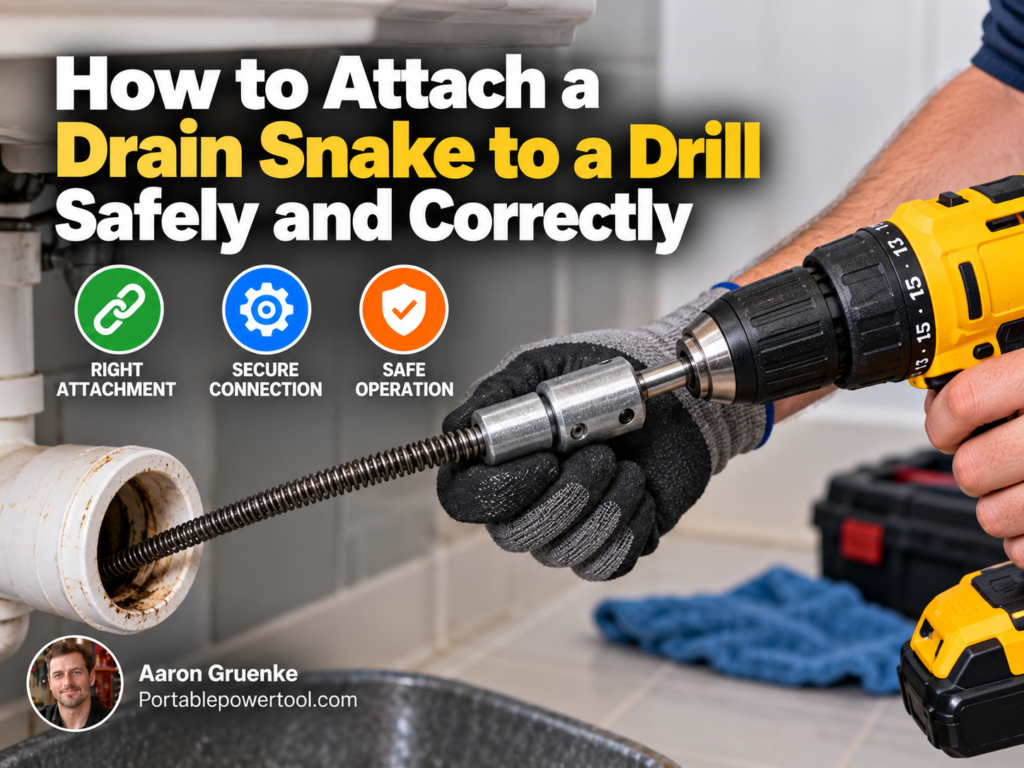
To attach a drain snake to a drill, first confirm that the snake is designed for drill-powered operation. Locate the snake’s drive shaft, hex shank, or drill adapter, insert it fully into the drill chuck, and tighten the chuck securely.
Set the drill to a low-speed setting before operating the snake.
A typical setup follows these steps:
- Confirm that the drain snake supports drill operation.
- Remove or expose the snake’s drill-drive shaft if required.
- Open the drill chuck.
- Insert the drive shaft or adapter straight into the chuck.
- Tighten the chuck firmly.
- Select low speed or low gear.
- Feed the cable into the drain before applying power.
- Run the drill slowly while controlling the cable.
Never attach a drill directly to the flexible cable unless the drain snake manufacturer specifically designed the cable or attachment for that purpose.
Make Sure Your Drain Snake Is Drill Compatible
Not every plumbing snake can safely be connected to a drill.
Many small handheld drum augers are available in two general designs.
Manual-Only Drain Snakes
A manual drain snake is rotated using a hand crank or handle.
Its cable, drum, bearings, and internal mechanism may not be designed for the speed or torque produced by a power drill.
Adding a homemade drill connection to a manual-only snake can damage the tool.
Drill-Powered or Hybrid Drain Snakes
A drill-compatible drain snake is built so the drum or cable can be rotated by either:
- A hand crank
- A power drill
- A built-in drill adapter
- A hex-shaped drive shaft
These models usually provide specific operating instructions regarding drill speed, direction, and cable feeding.
Check the manufacturer’s instructions before connecting a drill.
What Part of the Drain Snake Goes Into the Drill?
The part that connects to the drill is generally a solid drive shaft or hex adapter, not the flexible drain cable.
The exact design varies.
Some drum augers have a short shaft extending from the rear of the housing. Others have an adapter near the crank assembly.
The drill chuck clamps onto this solid drive point.
If you cannot clearly identify a drill connection, do not assume the flexible cable itself should be placed in the chuck.
Check the product manual or manufacturer instructions first.
What Type of Drill Should You Use?
A standard variable-speed drill is usually suitable for a small drill-compatible drain snake.
The most useful features are:
- Variable-speed trigger
- Low-speed gearbox
- Good torque control
- Forward and reverse operation
- Comfortable two-handed control
A cordless drill is convenient because you do not have an electrical cord near wet plumbing fixtures.
If using a corded drill, keep the cord, plug, extension connections, and electrical supply away from water.
Use Low Speed
Drain cleaning does not require high drill speed.
A snake cable needs controlled rotation so it can work through bends and engage the blockage without becoming unstable.
Running the drill too fast increases the risk of:
- Cable whipping
- Cable kinking
- Cable tangling inside the drum
- Drain damage
- Loss of control
- Excessive wear on the snake
If your drill has two gears, the lower-speed setting is usually the better starting point for a compatible drain snake.
Always follow the snake manufacturer’s stated speed limits if provided.
How to Connect the Drain Snake Step by Step
1. Prepare the Work Area
Clear items from underneath or around the sink, tub, or drain.
Have old towels or a bucket nearby because the cable may pull dirty water and debris back out of the drain.
Wear eye protection and suitable work gloves recommended for drain-cleaning tasks.
2. Inspect the Drain Snake
Check the cable before use.
Do not operate a snake with:
- Severe kinks
- Broken strands
- Damaged fittings
- Cracks in the drum
- Loose components
A damaged cable is more likely to bind or fail under power.
3. Find the Drill Adapter
Locate the manufacturer’s intended drill connection.
It may look like a short round or hexagonal metal shaft extending from the back of the snake.
4. Open the Drill Chuck
Rotate the drill chuck until its jaws are wide enough to accept the snake’s drive shaft.
If you have a keyless chuck, open it by hand.
5. Insert the Adapter
Push the drain snake’s drive shaft fully into the chuck.
Keep it centered.
A poorly centered adapter can wobble when the drill starts rotating.
6. Tighten the Chuck
Tighten the chuck securely around the drive shaft.
If your drill uses a keyed chuck, tighten it according to the drill manufacturer’s instructions.
Give the connection a gentle pull to make sure the adapter is securely held.
7. Select Low Gear
Put the drill in its lower-speed range if available.
Use a conservative trigger speed when starting.
8. Feed Cable Into the Drain
Push several inches of cable into the drain manually before turning on the drill.
This helps guide the cable and prevents the exposed portion from whipping.
How to Operate the Drain Snake With a Drill
Once the snake is connected, the objective is to rotate the cable slowly while feeding it deeper into the pipe.
Do not simply hold the trigger continuously.
Use short, controlled bursts when necessary.
Feed the Cable Gradually
Guide the cable into the drain as it rotates.
Do not leave a long section of unsupported cable between the drum and drain opening.
Excess exposed cable can bend, loop, or whip.
Keep the Cable Under Control
Keep your hands in the recommended operating positions.
Never grab a rapidly spinning exposed cable with bare hands.
Drain-cleaning cable can twist suddenly if the cutter or tip catches something inside the pipe.
Stop if the Cable Binds
If the drill suddenly slows or the cable stops moving forward, release the trigger.
Do not continue applying more torque.
The cable may have:
- Reached the clog
- Hit a pipe bend
- Become tangled
- Caught on an obstruction
A few controlled movements are better than forcing the cable deeper.
How Do You Know When the Snake Reaches the Clog?
You will often notice increased resistance.
The cable may stop advancing easily or feel different through the tool.
At that point, rotate the cable slowly while applying gentle forward pressure.
You may need to move the snake backward slightly and then forward again.
The goal is usually to break through, pull out, or loosen the obstruction rather than aggressively drill through it.
Should the Drill Be in Forward or Reverse?
Use the direction recommended by the drain snake manufacturer.
For many drain snakes, normal forward rotation is used during most of the cleaning process.
Reverse may occasionally help free a cable, but prolonged reverse operation can be inappropriate for some cable or drum designs.
Do not repeatedly switch directions at high speed.
If the cable becomes seriously stuck, stop the drill and follow the manufacturer’s cable-recovery procedure.
How Much Cable Should You Feed Into the Drain?
Feed only as much cable as necessary to reach the obstruction.
Small handheld drain snakes are usually intended for relatively short household drain lines rather than long building sewer mains.
The length you need depends on where the clog is located.
If you have inserted nearly the full cable length and cannot reach the blockage, the clog may be farther down the plumbing system.
A larger drain-cleaning machine or professional plumber may be more appropriate.
Can You Use a Drill Snake Through a Sink Drain?
Yes, a small drill-compatible drain snake can often be used for a sink drain, depending on the pipe design and clog location.
However, sometimes the easiest access is not through the sink opening.
For bathroom sinks, removing the P-trap may provide more direct access to the drain line.
Before removing plumbing components, place a bucket underneath to catch water.
Avoid damaging delicate sink finishes with the cable.
Can You Use It in a Bathtub or Shower?
Drill-compatible snakes are commonly used for hair clogs in tub and shower drains.
Whenever possible, access the drain according to the fixture design.
For example, some bathtub clogs may be easier to reach through the overflow opening rather than forcing the cable through certain drain assemblies.
Hair and soap buildup are common causes of these blockages.
Keep the Drill and Battery Away From Water
Drain cleaning involves wet environments, so electrical safety matters.
Keep the drill as dry as practical.
Do not:
- Set the drill in standing water
- Allow water to enter the drill housing
- Handle electrical plugs with wet hands
- Use damaged extension cords
- Place cord connections on a wet floor
A cordless drill reduces some cord-related hazards but still needs to be kept dry.
Do Not Use Excessive Drill Torque
A more powerful setting is not necessarily better.
If the cable becomes stuck, a high-torque drill can twist the drain snake violently or damage the cable.
Use controlled power and stop immediately when unusual resistance appears.
If your drill has a clutch and the snake manufacturer permits its use, a moderate setting may help limit transmitted torque. Follow the instructions for both tools.
Common Mistakes When Attaching a Drain Snake to a Drill
Putting the Flexible Cable Directly in the Chuck
Only do this if the manufacturer specifically designed the system that way.
Normally, the drill connects to a dedicated drive shaft.
Using a Manual-Only Snake With a Drill
A drain snake that was not built for powered operation may fail when exposed to drill torque.
Running the Drill at Full Speed
High speed provides little advantage and may make the cable harder to control.
Leaving Too Much Cable Exposed
Keep the drum close enough to the drain opening that the cable remains controlled.
Forcing the Cable Around a Bend
Pipe elbows can feel similar to a clog.
Use gentle movement rather than trying to power through every point of resistance.
Continuing When the Cable Is Binding
A binding cable needs less torque, not more.
Release the trigger and assess the situation.
Can a Drill-Powered Drain Snake Damage Pipes?
It can if used incorrectly.
Aggressive cable operation can damage some plumbing systems, particularly pipes that are already deteriorated or fragile.
Extra caution may be necessary with:
- Older plumbing
- Corroded metal pipes
- Fragile fittings
- Damaged drain lines
- Pipes with unknown condition
The cable should travel through the drain without being violently forced.
If you suspect the plumbing is damaged, professional inspection may be safer.
What Clogs Can a Small Drain Snake Clear?
A small household drain snake is most useful for relatively localized obstructions such as:
- Hair
- Soap buildup
- Soft organic debris
- Minor sludge accumulation
A basic snake may not solve problems caused by:
- Tree roots
- Collapsed pipes
- Heavy mineral buildup
- Major grease blockages
- Foreign objects
- Main sewer line problems
Repeated clogs can also indicate a larger plumbing issue rather than a simple obstruction.
Clean the Drain Snake After Use
Drain cables can carry dirty water, hair, grease, and other debris.
After use, follow the manufacturer’s cleaning instructions.
Typically, this includes cleaning debris from the cable and allowing components to dry before storage.
Do not store a wet steel cable for long periods if corrosion is a concern.
Inspect the cable for new kinks or damage before putting it away.
When Should You Call a Plumber Instead?
A drill-powered snake is useful for many ordinary household clogs, but it has limitations.
Professional help may be appropriate if:
- Several fixtures are backing up at once
- Sewage is coming back through drains
- The clog keeps returning
- The cable repeatedly becomes stuck
- You suspect tree roots
- The pipe may be damaged
- The blockage is beyond the snake’s reach
Multiple clogged fixtures can indicate a problem in a larger branch drain or main sewer line.
FAQs About How to Attach a Drain Snake to a Drill
Can I attach any drain snake to a drill?
No. Only use a drill with a drain snake that is designed or approved for powered operation.
A manual-only snake may not tolerate drill speed or torque.
Do I put the drain snake cable directly into the drill chuck?
Usually not.
Most drill-compatible snakes provide a dedicated drive shaft or adapter that fits into the drill chuck.
Follow the specific design of your drain snake.
What drill speed should I use with a drain snake?
Use a slow, controlled speed.
High drill speed can increase the chance of cable whipping, binding, or damage.
Always follow the drain snake manufacturer’s speed recommendations.
Can I use an impact driver with a drain snake?
Do not use an impact driver unless the drain snake manufacturer specifically approves it.
Impact mechanisms deliver repeated torque pulses that may damage a drain snake designed for smooth drill rotation.
A variable-speed drill is usually the appropriate tool.
Can a cordless drill power a drain snake?
Yes, if the drain snake is designed for drill operation.
A variable-speed cordless drill is convenient for household drain-cleaning work because it offers controlled speed without a power cord near the drain.
Why does my drain snake keep twisting?
The cable may be encountering a blockage, pipe bend, or excessive resistance.
You may also be running the drill too fast or leaving too much cable exposed.
Stop the drill and correct the problem before continuing.
Should I push the drain snake while the drill is spinning?
Feed the cable gradually according to the manufacturer’s instructions.
Apply only light, controlled pressure. Do not force a rapidly rotating cable deeper when it is resisting movement.
What should I do if the drain snake gets stuck?
Release the drill trigger immediately.
Do not increase speed or torque. Follow the snake manufacturer’s procedure for reversing or retrieving a stuck cable.
If the cable cannot be removed safely, a plumber or drain-cleaning professional may be needed.
Conclusion
Knowing how to attach a drain snake to a drill starts with using a drain snake that is actually designed for drill-powered operation. Connect the drill chuck to the snake’s dedicated drive shaft or adapter, tighten it securely, and operate the system at a slow, controlled speed.
Keep the cable supported, feed it gradually, and stop immediately if it begins binding or twisting. Avoid forcing the snake or using excessive drill torque, especially in older or potentially damaged plumbing.
With the correct equipment and careful technique, a drill-compatible drain snake can be a useful tool for clearing many common household sink, shower, and tub clogs.