How to Attach a Circular Saw Blade to a Drill Safely
A drill is designed primarily to rotate drill bits, drivers, sanding accessories, and other attachments along a straight axis. Because of that, it may seem logical that a small circular cutting blade could also be mounted in the chuck. In fact, specialized drill-mounted saw blade attachments and mandrels do exist. However, that does not mean an ordinary circular saw blade should simply be clamped into a drill.
Learning how to attach a circular saw blade to a drill safely starts with understanding the difference between a purpose-built drill attachment and an improvised setup. A standard circular saw has a blade guard, a rigid base plate, a side handle or dedicated grip, and a motor designed to control the forces created by a spinning blade. A handheld drill usually lacks those protections.
Mounting the wrong blade or using an unsuitable adapter can allow the blade to loosen, wobble, bind in the material, or kick the drill sideways. Large circular saw blades are especially unsuitable because their diameter creates much greater cutting force and leverage than a drill is designed to handle.
If you have a small cutting accessory specifically rated by its manufacturer for use with a drill, installation normally involves securing the blade to its matching arbor or mandrel, inserting the mandrel shaft into the drill chuck, and tightening everything according to the attachment manufacturer’s instructions.
This guide explains that process, the equipment involved, compatibility issues, important safety limits, and when a proper circular saw, rotary tool, or other cutting tool is the better choice.
How to Attach a Circular Saw Blade to a Drill
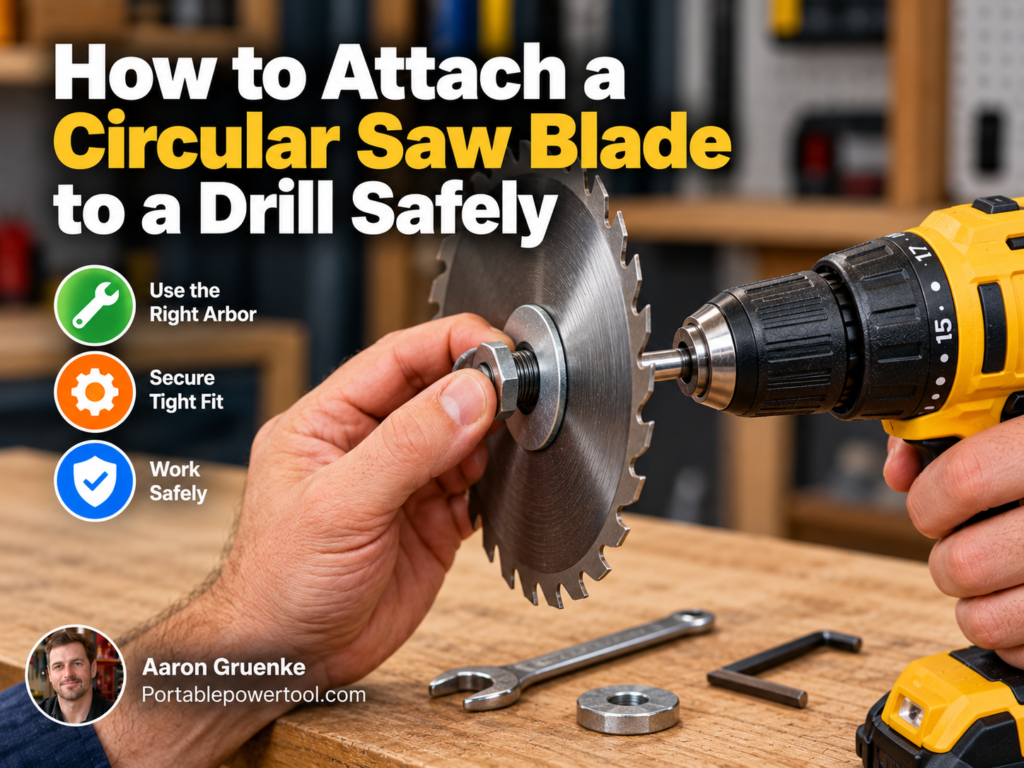
To attach a circular saw blade to a drill, use only a small saw blade or cutting-disc system specifically designed and rated for drill use. The blade must be mounted on its matching arbor, mandrel, or blade adapter before the adapter shaft is secured in the drill chuck.
Do not place the center hole of a standard circular saw blade directly into a drill chuck, and do not improvise an arbor from bolts, washers, or unrelated hardware.
A compatible setup normally consists of:
- A drill
- A manufacturer-rated saw blade attachment
- The correct arbor or mandrel
- Matching washers or flanges
- A retaining screw or nut
- Appropriate eye and face protection
Before installation, disconnect the drill from power or remove its battery.
1. Confirm That the Blade Is Designed for Drill Use
Check the packaging or manufacturer’s instructions for the blade and adapter.
The accessory should specify compatible:
- Tool type
- Blade diameter
- Arbor size
- Shaft diameter
- Maximum RPM
- Materials that can be cut
Do not assume that a blade is suitable merely because its arbor hole fits an available adapter.
A normal 6-1/2-inch or 7-1/4-inch circular saw blade, for example, is intended for a circular saw rather than a handheld drill.
2. Disconnect the Drill
For a cordless drill, remove the battery.
For a corded drill, unplug it.
The drill should not be able to start while you are installing the cutting attachment.
3. Mount the Blade on the Correct Arbor
A drill-compatible miniature saw blade usually attaches to a dedicated arbor.
Depending on the design, the arbor may include:
- A center shaft
- Inner flange
- Outer flange
- Retaining screw
- Retaining nut
Place the blade between the flanges exactly as specified by the attachment manufacturer.
The flanges help keep the blade centered and prevent unnecessary wobbling.
4. Check Blade Direction
Some cutting blades have an arrow showing their intended rotation direction.
The blade must rotate in the direction specified by its manufacturer.
If the accessory is directional, compare the blade arrow with the intended rotation of the drill before tightening it.
5. Secure the Blade to the Arbor
Tighten the retaining screw or nut according to the attachment instructions.
The blade should sit:
- Flat
- Centered
- Securely clamped
- Free from visible damage
Do not use damaged, bent, cracked, or heavily worn blades.
Avoid overtightening small components unless the manufacturer specifically requires it.
6. Insert the Arbor Into the Drill Chuck
Open the drill chuck enough to accept the arbor shaft.
Insert the shaft deeply enough for the chuck jaws to grip a substantial portion of it.
Keep the shaft straight and centered.
Do not clamp onto threaded portions unless the adapter is specifically designed that way.
7. Tighten the Chuck Securely
For a keyless chuck, tighten the chuck firmly by hand.
For a keyed chuck, tighten it according to the drill manufacturer’s instructions and remove the chuck key before operating the drill.
Make sure all chuck jaws grip the arbor evenly.
8. Check for Wobble Before Cutting
With the drill still disconnected from power, rotate the attachment gently by hand where safe to do so.
The blade should remain reasonably centered.
Visible side-to-side movement may indicate:
- Incorrect installation
- Bent arbor
- Damaged blade
- Dirt between mounting surfaces
- Poor-quality adapter
- Incorrect arbor size
Do not operate a visibly wobbling cutting blade.
Can You Put a Regular Circular Saw Blade on a Drill?
Generally, you should not mount a standard circular saw blade on a handheld drill.
Circular saw blades are designed for tools that provide several important controls that a drill normally does not have.
A circular saw typically includes:
- Retractable blade guard
- Rigid shoe or base plate
- Purpose-designed bearings
- Stable two-hand control
- Correct arbor and flange system
- Motor characteristics suited to sawing
- Blade-position control
A drill provides rotational power but does not reproduce the complete safety and support system of a circular saw.
Even if you find an adapter that physically connects a large blade to a drill, physical fit alone does not make the combination safe.
Why a Circular Saw Blade on a Drill Can Be Dangerous
A cutting blade behaves differently from a normal drill bit.
A drill bit cuts primarily at its tip while remaining mostly centered in the hole. A circular blade cuts around its outer edge, sometimes several inches away from the drill’s rotational axis.
That creates greater leverage.
Kickback
Kickback can occur when a spinning blade catches or becomes pinched in the material.
Instead of continuing to rotate freely, the blade may transfer that force into the tool.
A proper circular saw is designed to be held and guided with those forces in mind. A handheld drill is much harder to control when a side-mounted blade suddenly binds.
No Blade Guard
Most drills provide no guard around a saw blade.
That leaves a large portion of the cutting edge exposed.
A proper saw encloses part of the blade and uses a movable lower guard to cover much of the remaining cutting edge.
Blade Wobble
A poorly matched adapter may allow the blade to run off-center.
At higher RPM, even a small alignment problem can produce significant vibration.
Wobble reduces cutting accuracy and increases stress on:
- Blade
- Arbor
- Chuck
- Drill bearings
Adapter Failure
Cheap or improvised adapters may loosen during operation.
Never substitute a random bolt, nut, or washer arrangement for a manufacturer-designed saw blade arbor.
What Type of Saw Blade Can Be Used With a Drill?
If you want a drill-powered cutting accessory, look for a system specifically marketed and rated for that purpose.
Common examples include small:
- Mini saw blades
- Cutting discs
- Abrasive cutoff wheels
- Rotary cutting attachments
These are usually much smaller than conventional circular saw blades.
The product should clearly identify compatible tools and operating speeds.
Mini Circular Saw Blade Attachments
Some small toothed blades are supplied with a mandrel that can fit a drill chuck.
Depending on their design, they may be intended for light cutting of materials such as:
- Thin wood
- Plastic
- Soft materials
- Light craft stock
Their cutting capacity is usually limited.
They should not be treated as replacements for full-size circular saws.
Abrasive Cutting Discs
Small abrasive cutting wheels may also use a drill-compatible mandrel.
These accessories work differently from toothed circular saw blades and may be intended for materials such as thin metal.
Again, the attachment’s RPM rating and tool compatibility must be followed.
Understanding the Arbor or Mandrel
The arbor, sometimes called a mandrel, connects the cutting accessory to the drill.
One end fits into the drill chuck. The other end holds the blade.
A typical arbor contains a shoulder or flange that keeps the blade centered.
Using the correct arbor matters because an incorrectly sized center connection can allow the blade to shift.
Arbor Hole Size
The hole in the middle of a saw blade is called the arbor hole.
The mounting hardware must match this hole correctly.
Never enlarge a blade’s arbor hole or force an incompatible adapter through it.
Check the Maximum RPM
Every rotating cutting accessory has a maximum operating speed.
Never exceed it.
The drill’s no-load RPM should be within the safe operating range specified for the blade and adapter.
For example, a drill might have:
- Multiple mechanical gears
- Variable trigger speed
- Electronic speed control
Choose a speed that falls within the accessory manufacturer’s limits.
Maximum allowable RPM does not necessarily mean that maximum RPM is the ideal cutting speed.
Should You Use Forward or Reverse?
Use the rotation direction specified for the particular cutting attachment.
Many toothed blades are designed to cut in one direction.
Running them backward can reduce cutting performance and may create undesirable forces.
Do not reverse a blade simply because it seems easier to control.
Follow the accessory manufacturer’s directional markings and instructions.
How to Use a Drill-Mounted Cutting Blade More Safely
Even a purpose-designed attachment requires careful handling.
Secure the Workpiece
Never hold a small workpiece in one hand while cutting it with a spinning blade in the other.
Use appropriate clamps or another secure workholding method.
The workpiece should not be able to rotate, shift, or lift unexpectedly.
Use Both Hands When the Tool Allows It
A side handle can improve control if your drill is designed to accept one.
However, adding a handle does not make a drill equivalent to a circular saw.
Wear Eye Protection
Cutting can throw:
- Chips
- Dust
- Broken abrasive particles
- Small pieces of material
Wear appropriate safety glasses. Additional face protection may be appropriate for some cutting operations.
Keep Hands Out of the Cutting Path
Think about where the blade will travel if:
- It slips
- The workpiece moves
- The blade exits the cut
- The tool kicks sideways
Never position your fingers in that path.
Do Not Force the Blade
Let the cutting edge do the work.
Excessive pressure can:
- Overload the drill
- Increase heat
- Bend the arbor
- Cause binding
- Stall the motor
If the attachment struggles significantly, use a more appropriate cutting tool.
What Materials Can a Drill-Mounted Saw Blade Cut?
That depends entirely on the blade.
A small wood-cutting blade cannot automatically be used for metal simply because it fits the same arbor.
Likewise, an abrasive metal-cutting wheel may be inappropriate for wood.
Check the manufacturer’s material rating.
The accessory may be designed for:
- Wood
- Plastic
- Aluminum
- Thin sheet metal
- Fiberboard
- Craft materials
Material thickness also matters.
A drill-mounted attachment intended for thin stock should not be forced through thick lumber.
Circular Saw Blade vs. Drill-Mounted Saw Attachment
| Feature | Circular Saw | Drill-Mounted Attachment |
| Blade guard | Yes | Often limited or absent |
| Base plate | Yes | Usually no |
| Designed for long straight cuts | Yes | Generally no |
| Cutting depth control | Yes | Limited |
| Large blade support | Yes | No |
| Best use | General sawing | Light specialty tasks |
| Tool stability | High when properly used | More limited |
| Typical blade size | Larger | Much smaller |
For most woodworking jobs, a proper circular saw is the more appropriate option.
Better Alternatives to Putting a Saw Blade on a Drill
Before buying a drill adapter, consider what kind of cut you actually need.
Circular Saw
Use a circular saw for:
- Straight cuts through lumber
- Sheet goods
- Plywood
- Construction materials
It provides a guarded blade and a base that rides along the material.
Jigsaw
A jigsaw is useful for:
- Curves
- Cutouts
- Short straight cuts
- Thin boards
- Plywood
It is often much easier to control than an improvised drill-based cutting setup.
Rotary Tool
A rotary tool can be useful for small cutting jobs and detailed work.
It uses compact cutting accessories specifically designed for high-speed rotary operation.
Oscillating Multi-Tool
An oscillating tool works well for:
- Flush cuts
- Small openings
- Remodeling work
- Trimming wood or plastic
Because its blade oscillates rather than continuously rotates, it behaves very differently from a circular blade.
Reciprocating Saw
For rough cutting, demolition, pipes, and awkward locations, a reciprocating saw may be a better choice.
Common Mistakes to Avoid
Several mistakes make drill-mounted cutting accessories considerably more dangerous.
Installing a Full-Size Circular Saw Blade
Do not mount a normal large circular saw blade to a handheld drill.
Use the cutting tool the blade was designed for.
Using a Homemade Adapter
Bolts, stacks of washers, and improvised nuts are not substitutes for a properly engineered arbor.
Ignoring RPM Ratings
An accessory may fail if operated above its rated speed.
Using the Wrong Blade for the Material
A wood blade, metal wheel, and plastic-cutting accessory can have very different designs.
Cutting an Unsecured Workpiece
The workpiece can catch the blade and move unexpectedly.
Clamp the material securely whenever appropriate.
Removing Safety Guards From Other Tools
Do not remove a guard from a grinder, circular saw, or other cutting tool simply to make an accessory fit.
What If the Blade Keeps Coming Loose?
Stop using the attachment immediately.
A blade that repeatedly loosens may indicate:
- Incorrect arbor
- Missing flange
- Wrong retaining hardware
- Incorrect installation direction
- Damaged threads
- Poor-quality adapter
- Excessive vibration
Do not solve the problem by simply applying extreme tightening force.
Verify that every part is compatible and installed according to its instructions.
Can a Drill Replace a Circular Saw?
For general sawing, no.
A drill can power certain small cutting accessories, but it does not provide the same control, guarding, support, or cutting capacity as a circular saw.
If you regularly need to cut boards, plywood, or construction lumber, use a tool designed for sawing.
A drill-mounted attachment makes more sense for occasional light-duty work where the accessory manufacturer specifically approves drill use.
FAQs About How to Attach a Circular Saw Blade to a Drill
Do You Need an Adapter to Put a Saw Blade on a Drill?
Yes. A drill-compatible cutting blade generally requires a proper arbor or mandrel.
The blade itself should also be specifically approved for use with that type of adapter and tool.
Never clamp an ordinary circular saw blade directly into the drill chuck.
Can I Use a 7-1/4-Inch Circular Saw Blade on a Drill?
A standard 7-1/4-inch circular saw blade should be used in a compatible circular saw, not a handheld drill.
Its size, cutting forces, guarding requirements, and mounting system are designed around a circular saw.
Can a Drill Cut Wood With a Saw Blade Attachment?
A drill may cut thin or light wood with a small, manufacturer-approved saw attachment.
For normal boards, lumber, plywood, and repeated cuts, a circular saw, jigsaw, or another dedicated saw is generally safer and more effective.
Can You Attach a Metal Cutting Blade to a Drill?
Some small metal-cutting discs are made for use with drill-compatible mandrels.
Only use an accessory if its manufacturer specifically approves the combination.
Check the material rating and maximum RPM before use.
Why Does My Drill-Mounted Blade Wobble?
Possible causes include a bent arbor, incorrectly mounted blade, mismatched arbor hole, damaged blade, loose chuck, or poor-quality adapter.
Do not continue using the blade until the cause of the wobble has been corrected.
Can I Make My Own Circular Saw Blade Adapter?
A homemade adapter is not recommended.
A rotating saw blade requires accurate centering, secure clamping, suitable materials, and hardware designed to handle rotational forces.
Use a purpose-built, manufacturer-rated adapter instead.
Is a Drill Saw Attachment Good for Cutting Plywood?
Small drill-mounted blades may handle some thin plywood, depending on their specifications, but they are generally not ideal for long or accurate sheet cuts.
A circular saw or jigsaw provides better support and control.
What Is the Safest Way to Cut With a Drill?
Use only attachments explicitly designed for your drill and follow their operating instructions.
For jobs that require a large exposed cutting blade, use a dedicated saw rather than trying to convert the drill into one.
Conclusion
Knowing how to attach a circular saw blade to a drill is mainly about knowing what should—and should not—be connected to the tool. A standard full-size circular saw blade should not be mounted to a handheld drill simply with an improvised adapter.
If a small saw blade attachment is specifically designed for drill use, install it using the correct arbor or mandrel, disconnect the drill before assembly, confirm the blade’s direction and RPM rating, tighten the mounting components properly, and inspect the attachment for wobble before use.
For larger, deeper, or repeated cuts, a dedicated circular saw, jigsaw, rotary tool, or other purpose-built cutting tool provides better control and protection. Choosing the correct tool is usually safer and produces a cleaner, more predictable result.