
How to Hang Cordless Drills: Safe and Easy Storage Ideas
Cordless drills are easy to leave on a workbench, shelf, or garage floor after a project, but that habit can quickly create clutter and make your tools harder to find. Hanging them on a wall, pegboard, cabinet, or dedicated tool rack keeps them visible, organized, and within easy reach while freeing valuable bench space.
Learning how to hang cordless drills is fairly simple, but the best method depends on where you store your tools, how many drills and drivers you own, and whether you want a permanent or adjustable setup. A single drill may only need a sturdy hook or holster, while several drills are usually easier to organize with a purpose-built rack or a simple DIY wooden holder.
The most important part is making sure the storage system can safely support the drill’s weight. Heavy drills should be mounted into wall studs, solid wood, or suitable wall anchors rather than relying on weak fasteners. Batteries can also add considerable weight, so the rack, hooks, and mounting hardware need to be rated for the full load.
This guide explains how to hang cordless drills using several practical methods, how to build a simple DIY drill holder, where to place batteries and chargers, and how to avoid common storage mistakes.
How to Hang Cordless Drills Safely
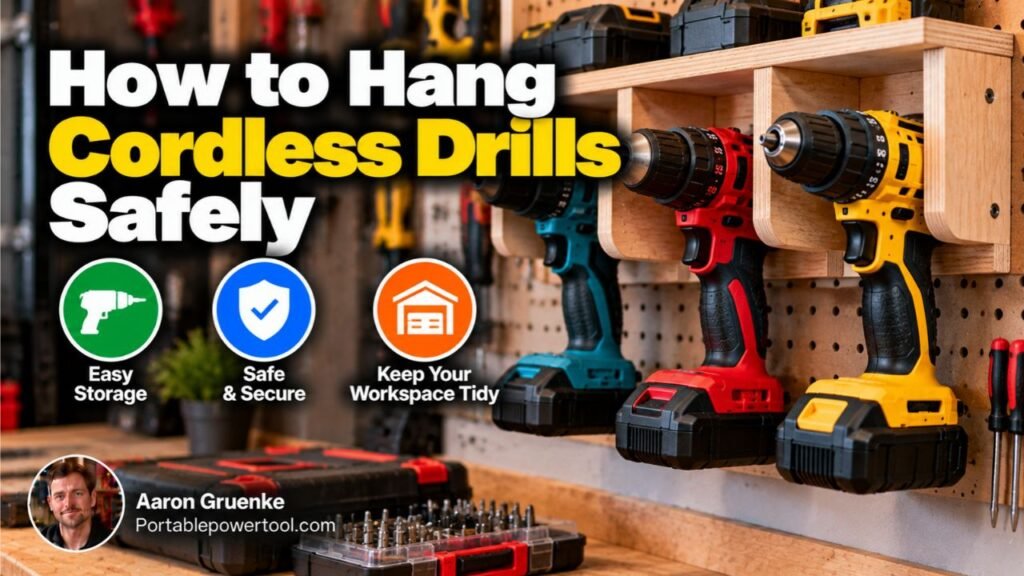
The easiest way to hang cordless drills is to use a wall-mounted drill rack, heavy-duty hook, pegboard holder, or DIY wooden shelf with slots that support the drill just below the chuck or handle.
For most garages and workshops, a dedicated drill rack provides the cleanest setup. Mount the rack securely to wall studs or another strong surface, then slide each drill into its individual slot.
A basic installation usually involves:
- Choose a dry, convenient wall location.
- Decide how many drills and drivers you need to store.
- Find wall studs or select suitable anchors.
- Mount the rack, hooks, or pegboard securely.
- Check that the holder can support the tool’s weight.
- Hang the drills so they cannot easily fall.
- Store batteries and chargers nearby if desired.
Before placing expensive power tools on any wall-mounted system, test the rack by pulling down gently and checking that the fasteners remain secure.
Why Hang Cordless Drills Instead of Storing Them on a Bench?
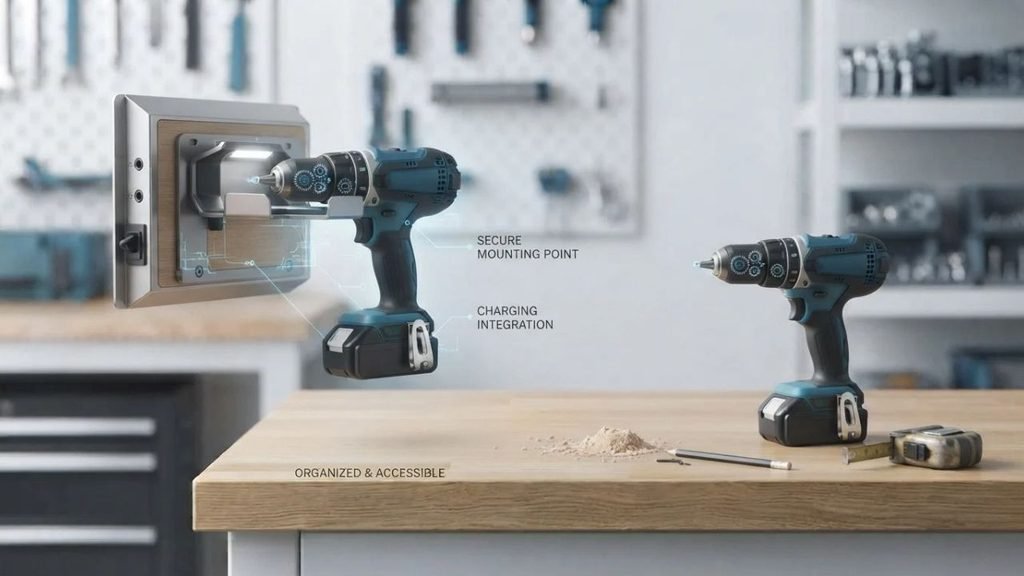
Wall storage makes better use of vertical space.
A drill rack can help keep your workbench available for actual projects instead of turning it into permanent tool storage.
Hanging drills can also make it easier to:
- Find the correct tool quickly
- Keep drills separated from loose hardware
- Prevent tools from being knocked off a bench
- Organize multiple drills and impact drivers
- Keep accessories close together
- Reduce workshop clutter
A well-organized drill station can also include batteries, chargers, bits, screws, and other frequently used accessories.
Best Ways to Hang Cordless Drills
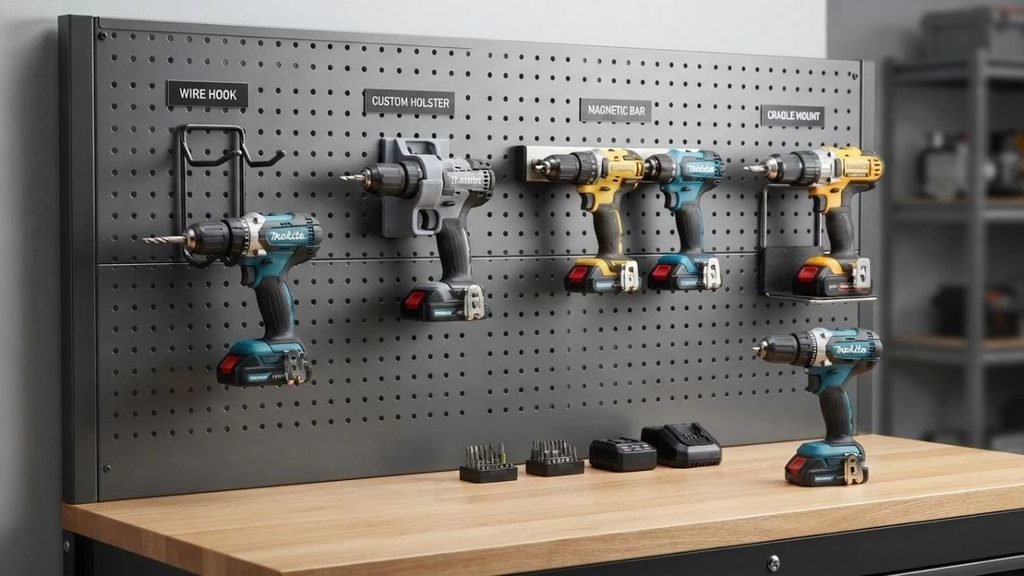
There is no single storage method that works for every workshop. The following options cover most home garages and tool areas.
Wall-Mounted Cordless Drill Rack
A cordless drill rack is one of the most convenient options if you own several drills or impact drivers.
These racks usually have multiple open slots. The drill handle slides into the slot while the wider body rests above the opening.
Some models also include shelves for:
- Batteries
- Chargers
- Drill bits
- Driver bits
- Small accessories
Mounting everything together creates a dedicated charging and storage station.
DIY Wooden Drill Holder
A wooden drill holder is inexpensive and easy to customize.
You can build one using plywood or solid lumber and create U-shaped slots wide enough for the drill handles.
A typical DIY holder consists of:
- A horizontal bottom board
- Several drill slots
- Side supports
- A back panel
- Optional upper shelf
The drills slide into the slots and hang vertically.
This design works particularly well when you have tools from different brands because you can customize each slot width.
Heavy-Duty Utility Hooks
For one or two drills, you may not need a full storage rack.
A pair of sturdy utility hooks can support a drill by the handle or body, depending on the drill’s shape.
Make sure the hooks:
- Are rated for sufficient weight
- Have enough depth to keep the drill secure
- Are attached to a strong surface
- Do not press against the trigger
Rubber-coated hooks can help protect the drill housing from scratches.
Pegboard Drill Holders
A pegboard system provides flexible tool storage.
You can install specialized drill holders or arrange heavy-duty pegboard hooks to support the tool.
Pegboards are useful because you can rearrange the layout whenever your tool collection changes.
However, not all pegboards are equally strong.
Heavy cordless drills should be used with:
- Strong pegboard material
- Proper wall spacing
- Locking hooks
- Appropriate mounting hardware
Thin pegboard with lightweight hooks may not safely support a large drill with a battery attached.
Slatwall or French Cleat System
A French cleat or slatwall system is a good choice for workshops where storage layouts change frequently.
With a French cleat system, horizontal wooden strips are mounted securely to the wall. Tool holders can then be hung anywhere along the cleats.
This makes it easy to move:
- Drill racks
- Battery shelves
- Charger stations
- Bit organizers
- Tool bins
French cleats are especially popular for custom workshop storage because they are strong and adaptable when built correctly.
Under-Shelf Drill Holders
You can also hang drills beneath an existing shelf.
An under-shelf holder uses slots or brackets attached to the bottom of a shelf so drills hang vertically underneath.
This can make excellent use of otherwise unused space.
Check that the shelf itself is securely mounted before adding the extra weight.
How to Build a Simple DIY Cordless Drill Holder
A basic wooden rack can be made with common workshop materials.
Materials You May Need
Depending on the design, you may use:
- 3/4-inch plywood
- Wood screws
- Wood glue
- Drill and drill bits
- Jigsaw or circular saw
- Measuring tape
- Square
- Sandpaper
- Stud finder
- Mounting screws
The exact dimensions should be based on your tools rather than a universal measurement.
Step 1: Measure Your Drill Handles
Measure the narrowest section of each drill handle where it will rest inside the rack.
Different brands can have noticeably different handle sizes.
Allow enough clearance for the tool to slide in and out easily without being loose enough to fall.
Step 2: Plan the Number of Slots
Decide how many tools you want the rack to hold.
Leave enough space between slots so neighboring drills do not collide.
Remember that large batteries may extend outward or sideways and require additional clearance.
Step 3: Mark the Slot Locations
Lay out each slot evenly on the board.
A U-shaped slot works well for many cordless drills because the handle passes through while the wider upper body remains supported.
Step 4: Cut the Slots
Drill a hole near the closed end of each slot and use a jigsaw to cut from the front edge toward the hole.
This creates a rounded end that can reduce stress concentrations in the wood.
Sand all cut edges smooth.
Step 5: Add Supports
Attach side panels or braces beneath the slotted board.
A back panel can make the rack easier to mount securely.
Use wood glue and screws if appropriate for your design.
Step 6: Mount the Rack
Whenever possible, drive mounting screws through the rack and directly into wall studs.
If studs are not available in the required locations, use wall anchors that are properly rated for the combined weight of the rack and tools.
Step 7: Test the Rack
Before loading all your tools, apply moderate downward pressure to the rack.
Check for:
- Movement
- Loose screws
- Cracking wood
- Flexing
- Weak mounting points
Only hang the drills after confirming that the rack is stable.
Should You Hang Cordless Drills With Batteries Attached?
You generally can hang a cordless drill with the battery attached if the rack is designed to support the total weight.
Keeping the battery attached makes the tool ready to use immediately.
However, storing batteries separately can have advantages.
Separate storage may:
- Reduce weight on the rack
- Keep batteries organized by size
- Make charging easier
- Allow inspection of battery condition
- Reduce accidental trigger activation
If you hang drills with batteries installed, make sure nothing in the rack presses against the trigger.
Where Should You Store Cordless Drill Batteries?
Battery packs are best stored in a cool, dry location away from excessive heat, moisture, and direct sunlight.
A shelf near the drill rack works well.
You can also use dedicated battery holders that secure each pack individually.
Avoid storing batteries where:
- Metal objects can contact the terminals
- Water can reach them
- They may fall onto a concrete floor
- Temperatures become extremely hot
- They can be physically damaged
Battery contacts should remain protected from accidental short circuits.
Can You Mount the Battery Charger Near the Drill Rack?
Yes. Many people create a combined cordless tool charging station.
A wall-mounted station can include:
- Drill rack
- Battery shelf
- Battery chargers
- Power strip
- Bit storage
- Small accessory bins
If you mount chargers permanently, leave enough ventilation around them according to the manufacturer’s instructions.
Avoid covering charger vents or packing chargers tightly together where heat cannot escape.
Electrical cords should also be routed so they do not hang across work areas or create trip hazards.
How High Should You Hang Cordless Drills?
There is no required height, but the tools should be easy to reach without stretching or crouching.
For most workshops, somewhere between waist and shoulder height works well.
Consider placing:
- Frequently used drills at easy hand level
- Batteries directly above or beside them
- Less-used accessories on higher shelves
- Chargers close to an electrical outlet
Avoid mounting heavy tools overhead where dropping one could cause injury.
How to Find Wall Studs for a Drill Rack
A drill rack loaded with several cordless tools can become fairly heavy.
Mounting into wall studs provides a strong attachment.
A stud finder is the easiest way to locate studs behind drywall.
You can also sometimes identify studs by:
- Electrical outlet locations
- Wall construction patterns
- Careful tapping
- Small test holes in appropriate areas
Once you locate the studs, mark their centers before installing the rack.
Use screws long enough to pass through the rack and drywall and penetrate the wooden stud adequately.
Can You Hang Cordless Drills on Drywall?
Yes, but the rack should not rely on drywall alone.
Drywall is not designed to support significant concentrated tool weight without proper fasteners.
The best approach is to mount the rack directly into studs.
If that is not possible, use appropriately rated drywall anchors or toggle bolts according to the wall construction and expected load.
Remember to calculate the combined weight of:
- Rack
- Drills
- Impact drivers
- Batteries
- Chargers
- Accessories
A rack that feels light when empty can become much heavier after everything is installed.
How Much Weight Does a Cordless Drill Rack Need to Hold?
The required capacity depends on how many tools you are storing.
A compact cordless drill with a small battery may weigh only a few pounds, while a heavy-duty drill with a large battery can weigh considerably more.
Add together the approximate weight of all tools and accessories that will be supported by the rack.
Then choose mounting hardware with a reasonable safety margin above that load.
Do not assume every wall hook, screw, or anchor can support power tools.
Check the manufacturer’s weight rating whenever possible.
Should Drills Hang Vertically or Horizontally?
Either position can work if the holder supports the drill securely.
Vertical Storage
Vertical storage is common because it:
- Saves horizontal space
- Makes the handle easy to grab
- Works well with slotted racks
- Allows several drills to sit side by side
Horizontal Storage
Horizontal racks may work better when:
- Vertical clearance is limited
- Drills are unusually large
- Tools have awkward battery shapes
The main concern is preventing the tool from slipping or falling.
Protect the Trigger While the Drill Is Hanging
The drill trigger should not be pressed while the tool is stored.
If the battery remains installed, place the forward/reverse selector in its center lock position if your drill uses that feature.
This usually locks the trigger and helps reduce accidental activation.
Still, do not rely on the lock alone.
Make sure the storage rack itself does not contact or press the trigger.
Remove Long Drill Bits Before Hanging the Tool
It is usually better to remove long bits, hole saws, and other large accessories before hanging a drill.
Long bits can:
- Stick into walkways
- Catch clothing
- Bend
- Damage nearby tools
- Create an eye or puncture hazard
Small driver bits can sometimes remain installed if they do not create a hazard, but removing accessories generally makes storage safer and cleaner.
Keep Heavy Drills Lower Than Lightweight Tools
If you have multiple tool racks, place heavier drills at a comfortable lower level.
This reduces the consequences if a tool is dropped.
Lightweight accessories and storage bins can go higher.
Large rotary hammers, right-angle drills, and other heavy tools may be better stored on a shelf rather than hanging from a basic drill rack.
Best Layout for Multiple Cordless Tools
If you own several tools, organize them by function.
One practical arrangement is:
Upper shelf: Chargers and batteries
Middle section: Drills and impact drivers
Lower section: Bits and accessories
Another option is to group tools by battery platform.
For example, keep each manufacturer’s compatible:
- Batteries
- Chargers
- Drills
- Impact drivers
together in one area.
This can make it easier to grab the correct battery quickly.
Keep Drill Bits Near the Drill Rack
A drill storage system becomes more useful when bits are stored nearby.
You can add:
- Magnetic bit strips
- Small bins
- Drill index holders
- Bit cases
- Pegboard hooks
- Small shelves
Keep frequently used bits at eye or hand level.
Specialty bits can be stored farther away.
Common Mistakes When Hanging Cordless Drills
Mounting the Rack Only to Drywall
Several drills can place substantial weight on a rack.
Whenever practical, fasten the rack into wall studs.
Using Lightweight Hooks
Small decorative hooks are not designed for power tools.
Use hardware rated for the expected load.
Making DIY Slots Too Wide
If the slot is much wider than the drill handle, the tool may tilt or fall through.
Measure first.
Making Slots Too Narrow
A tight slot can scratch the tool, catch on the battery, or make removal difficult.
Allow a small amount of clearance.
Ignoring Battery Size
Some large batteries extend farther than the drill body.
Leave enough space between neighboring tools.
Hanging Drills Overhead
Avoid storing heavy drills directly above areas where people regularly stand or work.
Leaving Large Bits Installed
Long accessories create unnecessary hazards in crowded workshops.
Can You Hang a Drill by Its Belt Clip?
A drill’s belt clip can support the tool during normal intended use, but it is usually better to use a storage system specifically designed to hold drills.
Belt clips can vary in size, orientation, and strength.
Repeatedly hanging a heavy drill from a narrow improvised hook may also concentrate force on a small part of the tool.
A proper drill rack supports the tool more securely.
Can You Use Magnetic Tool Holders?
Magnetic holders can be useful for small metal tools, sockets, and bits, but they are generally not the best primary support for a cordless drill.
Cordless drills contain plastic housings, batteries, and components that may not provide a suitable magnetic attachment point.
Use a mechanical rack, hook, or holder instead.
Magnetic strips are better suited to storing drill bits and driver accessories near the drill station.
Can You Hang Cordless Drills in a Garage?
Yes, a garage is one of the most common places for drill storage.
However, consider temperature and humidity.
Very hot, freezing, or damp conditions may not be ideal for lithium-ion batteries.
If your garage experiences extreme temperatures, you may prefer to store the drills on the garage wall while keeping battery packs indoors in a more moderate environment, following manufacturer recommendations.
How to Organize Drill Storage in a Small Workshop
Small shops benefit most from vertical storage.
Use wall space above:
- Workbenches
- Tool cabinets
- Storage carts
A compact drill station can often fit in an area only a few feet wide.
You can also use the underside of a shelf for drills while using the shelf surface for chargers and batteries.
The goal is to use several levels of storage without making tools difficult to reach.
How to Maintain a Wall-Mounted Drill Rack
Inspect the rack occasionally, especially if you frequently remove and replace heavy tools.
Check:
- Mounting screws
- Wall anchors
- Wood joints
- Hooks
- Pegboard connections
- Cracks
- Loose hardware
Tighten fasteners if needed.
If a wooden rack starts splitting around the slots or mounting points, repair or replace the damaged section before continuing to use it.
FAQs About How to Hang Cordless Drills
What is the easiest way to hang cordless drills?
A wall-mounted drill rack with individual slots is usually the easiest solution for several drills.
For one drill, a sturdy utility hook or purpose-built drill holder may be sufficient.
Can I hang cordless drills with the battery installed?
Yes, provided the storage rack is strong enough to support the combined weight.
Make sure nothing presses the trigger and consider placing the direction switch in its center lock position.
Can I make a drill holder from plywood?
Yes. Plywood is commonly used for DIY drill racks.
A board approximately 3/4 inch thick can work well for many designs when it is properly supported and securely mounted.
Should I mount a drill rack into studs?
Whenever possible, yes.
Wall studs usually provide a stronger mounting point than drywall alone, especially when the rack will hold several power tools and batteries.
Can I use pegboard to hang cordless drills?
Yes, provided the pegboard and hooks are strong enough for the load.
Use heavy-duty or locking hooks rather than lightweight general-purpose pegboard hooks.
Is it safe to hang drills upside down?
Yes, if the holder securely supports the drill and prevents it from falling.
Many commercial and DIY drill racks store drills vertically with the handle hanging downward.
Should drill batteries be stored on the charger?
Follow the battery and charger manufacturer’s recommendations.
Many modern charging systems manage charging automatically, but long-term battery storage conditions vary between brands and battery technologies.
A dedicated nearby battery shelf can make storage easier.
Where should I hang drills in a garage?
Choose a dry wall area that is easy to reach and away from vehicle doors, water sources, excessive heat, and heavily traveled pathways.
Mounting the rack near your workbench is often convenient.
Conclusion
Learning how to hang cordless drills can make even a small garage or workshop noticeably easier to use. A wall-mounted drill rack, DIY wooden holder, pegboard system, French cleat, or sturdy utility hook can keep your tools accessible while freeing up valuable bench and shelf space.
Whatever storage method you choose, make sure the rack and mounting hardware can support the full weight of the drills, batteries, and accessories. Mount heavy racks into wall studs whenever practical, keep triggers protected, remove long accessories before storage, and inspect the rack periodically for loose hardware.
A simple, securely mounted drill station can keep your cordless tools organized, protected, and ready whenever your next project begins.