
How to Oil a Cordless Drill Safely: Simple Maintenance Guide
A cordless drill needs surprisingly little routine lubrication. Most modern drills have sealed motor bearings and factory-lubricated gearboxes, so pouring oil into the housing is usually unnecessary and can actually cause problems. In many cases, the only part a homeowner may occasionally need to lubricate is the drill chuck, especially if its jaws feel stiff, rusty, or difficult to open and close.
If you are learning how to oil a cordless drill, the key is knowing exactly where lubricant belongs and where it does not. Applying too much oil can attract dust, contaminate the chuck, reach electrical components, or make the drill harder to control. Using the wrong lubricant can also damage plastic, rubber seals, or internal grease.
The correct maintenance method depends on the drill design. Some manufacturers specify that their cordless drills require no regular lubrication at all, while others may allow a small amount of light machine oil on the chuck or recommend servicing the gearbox only during professional repair.
This guide explains how to lubricate a cordless drill safely, what type of oil to use, how to clean and maintain the chuck, why you generally should not oil the motor or gearbox yourself, and how to recognize when a drill needs professional service rather than more lubricant.
How to Oil a Cordless Drill Correctly
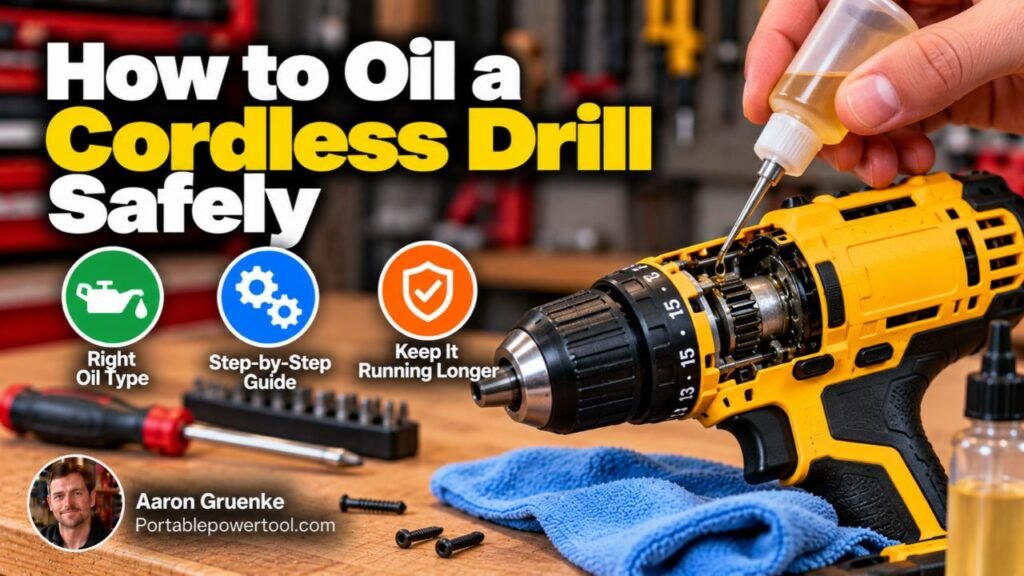
To oil a cordless drill, remove the battery, clean dust and debris from the chuck, and apply only a very small amount of light machine oil or manufacturer-approved lubricant to the moving chuck components if lubrication is recommended. Rotate the chuck several times to distribute the oil, then wipe away all excess.
Do not pour oil into the motor vents, gearbox, trigger, battery contacts, or drill housing.
For most cordless drills, routine lubrication involves only the chuck.
A simple process is:
- Remove the battery.
- Clean the chuck thoroughly.
- Open the chuck jaws.
- Apply one or two small drops of suitable lubricant if needed.
- Open and close the chuck repeatedly.
- Wipe away excess oil.
- Reinstall the battery and test the drill.
Always check the drill manufacturer’s maintenance instructions before lubricating any part.
Do Cordless Drills Actually Need Oil?
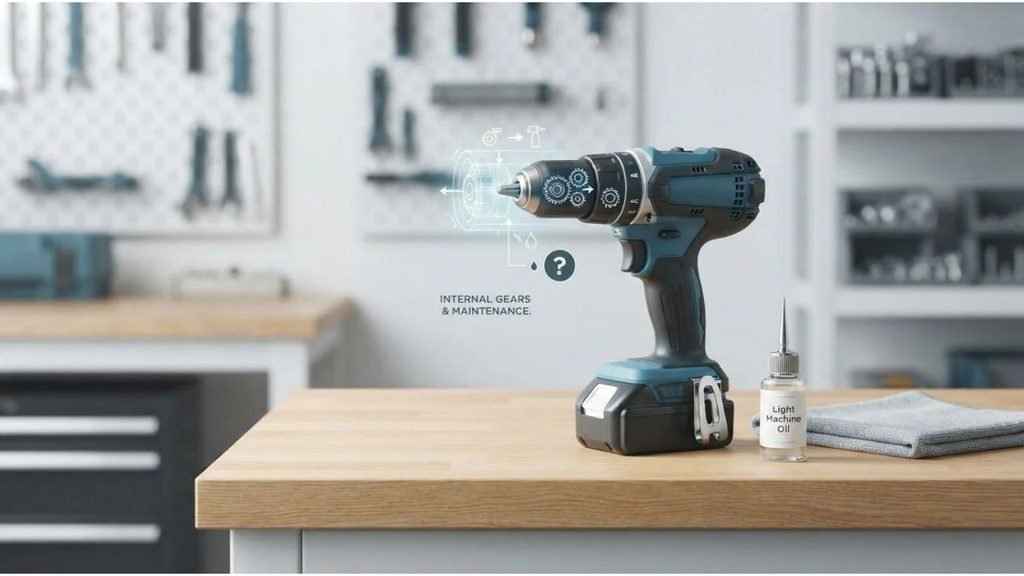
Most modern cordless drills do not require regular oiling in the way that older mechanical tools sometimes did.
The internal components are commonly lubricated during manufacturing.
These parts may include:
- Gear train
- Bearings
- Clutch components
- Spindle
- Motor bearings
Internal gears are usually lubricated with grease rather than liquid oil because grease stays in place better under load.
That means adding liquid oil through ventilation openings is not an appropriate way to lubricate the internal mechanism.
The part most likely to benefit from occasional lubrication is the chuck.
What Part of a Cordless Drill Can Be Oiled?
The chuck is the adjustable mechanism at the front of the drill that grips drill bits and driver accessories.
It contains moving jaws and internal threads.
Over time, the chuck can accumulate:
- Sawdust
- Drywall dust
- Metal particles
- Masonry dust
- Rust
- General workshop debris
This contamination can make the jaws difficult to move.
A very small amount of lubricant can help after the chuck has been cleaned.
Keyless Chuck
Most modern cordless drills use a keyless chuck.
You rotate the outer sleeve by hand to open or close the jaws.
If the chuck becomes stiff, a small amount of appropriate lubricant on the moving jaw area can sometimes restore smoother operation.
Keyed Chuck
Some older or specialty drills use a keyed chuck.
These can also require occasional cleaning and light lubrication around the jaw mechanism.
Do not over-lubricate the gear teeth where the chuck key engages.
What Oil Should You Use on a Cordless Drill?
Use a light lubricant that is compatible with the drill and recommended by the manufacturer.
For chuck maintenance, commonly appropriate choices may include:
- Light machine oil
- Tool oil
- A manufacturer-approved chuck lubricant
A small precision-oiler bottle works well because it makes it easier to apply only a drop or two.
Avoid assuming that thicker oil is better.
Heavy oil can trap abrasive dust and turn it into a dirty paste inside the chuck.
Can You Use WD-40 on a Cordless Drill?
Standard WD-40 can help displace moisture and loosen some stuck components, but it is not always the best choice as the primary long-term lubricant for a drill chuck.
If a chuck is dirty or lightly rusted, an appropriate cleaning or penetrating product may help loosen it. After cleaning, a light machine oil or lubricant recommended by the manufacturer may provide better lasting lubrication.
Do not spray large amounts of any aerosol product into the drill.
Overspray can travel into:
- Motor vents
- Electrical switches
- Battery contacts
- Plastic components
Apply lubricant precisely rather than saturating the tool.
Step-by-Step: How to Oil a Cordless Drill Chuck
1. Remove the Battery
Always remove the battery before cleaning or lubricating the drill.
This prevents the chuck from accidentally rotating while your fingers are near it.
Do not rely only on placing the trigger lock in the center position.
Removing the battery is safer.
2. Remove the Drill Bit
Take any drill bit, driver bit, or attachment out of the chuck.
Open the jaws completely.
This exposes more of the chuck mechanism and makes cleaning easier.
3. Clean Loose Dust and Debris
Before adding oil, remove as much contamination as possible.
Use:
- A clean brush
- Dry cloth
- Soft detailing brush
If you use compressed air, use it cautiously and avoid forcing debris deeper into the drill housing.
Keep the drill pointed so loosened debris falls away from the tool rather than toward the motor vents.
4. Inspect the Chuck
Look at the jaws and surrounding mechanism.
Check for:
- Rust
- Chipped jaws
- Bent components
- Metal shavings
- Heavy dirt
- Uneven jaw movement
If the chuck is physically damaged, oil will not fix the underlying problem.
A severely worn or damaged chuck may need replacement.
5. Apply a Small Amount of Oil
Place approximately one small drop of lubricant near each moving chuck jaw, or apply only the amount specified by the drill manufacturer.
You do not need to fill the chuck with oil.
More lubricant does not mean better lubrication.
The objective is to leave a very thin film on the moving surfaces.
6. Work the Chuck Open and Closed
Rotate the chuck sleeve several times.
Open the jaws completely, then close them again.
Repeat this movement several times.
This distributes the lubricant through the moving mechanism.
Do not power the drill during this step.
7. Wipe Away Excess Lubricant
Use a clean cloth to remove oil from the outside of the chuck and jaws.
Excess oil can collect dust and transfer onto drill bits or workpieces.
The chuck should feel smooth without appearing wet or dripping.
8. Reinstall the Battery and Test the Drill
After cleaning away all excess lubricant, reinstall the battery.
Run the drill briefly without a bit installed.
Listen for unusual sounds and check that the chuck opens and closes normally.
If the chuck still binds badly, the problem may be mechanical rather than lubrication-related.
How Often Should You Oil a Cordless Drill?
There is no universal oiling schedule for every cordless drill.
For many homeowners, the chuck may require lubrication only occasionally—or possibly never—if it remains clean and operates smoothly.
Consider cleaning and lightly lubricating the chuck when:
- The jaws feel stiff.
- The chuck is difficult to open.
- The chuck is difficult to tighten.
- Light rust appears.
- The drill has been exposed to heavy dust.
- The tool has been stored for a long period.
Routine over-lubrication is unnecessary.
If the chuck works smoothly, leaving it alone is often the best approach.
Should You Oil the Drill Motor?
Generally, no.
Modern cordless drill motors are not designed to be lubricated by pouring oil through the ventilation slots.
The motor may use sealed or internally lubricated bearings.
Putting oil into the motor area can:
- Attract dust
- Contaminate electrical components
- Damage brushes on brushed motors
- Reach switches
- Coat internal electronics
- Create odors or smoke
Brushless drills contain electronic control components that should also remain free of oil.
If the motor bearings become noisy or worn, proper repair usually requires disassembly and replacement or professional servicing.
Should You Oil the Drill Gearbox?
Not with ordinary liquid oil unless the manufacturer specifically instructs you to do so.
Cordless drill gearboxes commonly use gear grease.
Grease is thicker than oil and stays on the gears as they rotate under load.
Typical internal gearbox components may include:
- Planetary gears
- Ring gears
- Spindle gears
- Bearings
- Clutch components
If the gearbox has lost lubrication, correcting the problem usually requires opening the drill housing.
That is a more advanced repair.
For an ordinary homeowner, internal gearbox servicing is best done according to the manufacturer’s service procedure or by a qualified repair technician.
Oil vs. Grease in a Cordless Drill
Oil and grease perform similar basic functions but behave differently.
| Lubricant | Common Use | Characteristics |
| Light machine oil | Chuck and small external moving parts | Thin and easy to apply |
| Gear grease | Internal gearbox | Thick and stays on gears |
| Penetrating oil | Loosening rusted parts | Thin and designed to penetrate |
| General spray lubricant | Cleaning or light lubrication in some situations | Application depends on product |
Do not substitute one lubricant for another without checking compatibility.
A drill gearbox designed for grease should not simply be filled with machine oil.
Why Too Much Oil Can Be a Problem
Over-lubricating a drill can cause more problems than it solves.
Excess oil can attract:
- Sawdust
- Sand
- Metal particles
- Concrete dust
- Drywall powder
Those particles can mix with lubricant and create an abrasive paste.
That contamination can accelerate wear inside the chuck.
Excess lubricant can also migrate toward areas where oil should not be present.
Use the smallest amount necessary.
How to Lubricate a Stiff Drill Chuck
If the chuck is difficult to turn, do not immediately apply a large amount of oil.
Start with cleaning.
Open the jaws as far as possible and remove visible debris.
Then apply a very small amount of lubricant to the moving sections.
Work the chuck slowly.
If it begins moving more easily, continue opening and closing it until the movement becomes smooth.
If the chuck remains stuck, do not use extreme force.
The internal mechanism may be:
- Rusted
- Cross-threaded
- Damaged
- Packed with debris
- Mechanically worn
In that situation, replacing the chuck may be the better solution.
How to Deal With a Rusty Drill Chuck
Light surface rust can sometimes be cleaned before lubrication.
Remove loose rust carefully with an appropriate cleaning method that will not damage the chuck.
After the surface is clean and dry, apply a very light coating of suitable oil to the moving metal surfaces.
Heavy corrosion is different.
If rust has damaged the jaws, threads, or chuck body, replacement may be necessary.
Rust prevention is generally easier than rust repair.
Store the drill in a dry location and avoid putting it away wet.
Do Not Oil the Battery Terminals
Battery terminals should remain clean and dry.
Do not apply machine oil, penetrating oil, grease, or general-purpose lubricant to the electrical contacts unless the manufacturer specifically calls for a particular electrical contact product.
Oily battery terminals can:
- Collect dirt
- Reduce electrical contact quality
- Contaminate the charger
- Transfer lubricant into the battery interface
If the terminals are dirty, clean them according to the manufacturer’s instructions.
Always remove the battery first.
Do Not Pour Oil Into the Ventilation Slots
The ventilation openings allow cooling air to pass through the drill.
They are not lubrication ports.
Pouring or spraying oil through these slots may contaminate the:
- Motor
- Electronics
- Trigger switch
- Internal wiring
- Cooling passages
If you hear internal squealing, grinding, or bearing noise, adding oil through the vents is not a proper repair.
Investigate the source of the noise instead.
How to Maintain a Cordless Drill Without Over-Oiling
Lubrication is only one small part of cordless drill maintenance.
Good maintenance also includes keeping the tool clean.
Clean Dust From the Housing
Wipe the drill after dusty work.
Pay particular attention to ventilation openings.
Do not allow fine drywall, masonry, or sawdust to accumulate around the cooling vents.
Keep the Chuck Clean
Remove metal chips and dust before they become packed around the jaws.
This can prevent stiffness and reduce the need for lubrication.
Inspect the Battery Interface
Keep the battery rails and electrical contacts clean.
Do not use the drill if the battery connection is visibly burned, melted, or badly damaged.
Check the Chuck Regularly
Make sure all three jaws move evenly.
Uneven movement can indicate mechanical wear or internal damage.
Store the Drill in a Dry Area
Moisture encourages rust.
Avoid leaving cordless tools exposed to rain, condensation, or damp storage conditions.
Signs Your Drill Needs More Than Lubrication
Oil will not solve every drill problem.
The drill may need repair if you notice:
- Grinding sounds from the gearbox
- Significant spindle wobble
- Excessive vibration
- Chuck jaws moving unevenly
- Burning smell
- Smoke
- Gear slipping
- Repeated clutch malfunction
- Motor screeching
- Excessive heat
- Chuck that will not tighten
Do not keep adding lubricant in an attempt to hide mechanical symptoms.
A worn bearing, damaged gear, or broken chuck needs repair or replacement.
Can You Grease the Internal Gears Yourself?
It is technically possible to service the internal gears of some cordless drills, but it is not the same as routine maintenance.
The drill housing usually must be opened.
That can expose:
- Gears
- Wiring
- Trigger assemblies
- Springs
- Electronic boards
- Clutch components
Incorrect reassembly can damage the drill.
Too much grease can also create drag or migrate into areas where it does not belong.
If the manufacturer provides a service procedure and you have the necessary repair experience, internal gearbox servicing may be possible.
Otherwise, professional service is usually the safer option.
Common Mistakes When Oiling a Cordless Drill
Using Too Much Oil
A drill chuck needs very little lubricant.
Flooding the mechanism attracts dirt and creates unnecessary mess.
Oiling the Motor Through the Vents
Vent holes are for cooling, not lubrication.
Oil can damage electrical and electronic components.
Using Heavy Automotive Oil
Engine oil and other heavy lubricants are usually unnecessary for a drill chuck.
Use the lubricant specified by the manufacturer.
Lubricating Before Cleaning
Oil applied over dust and metal particles can create abrasive sludge.
Clean first and lubricate afterward.
Leaving Oil on the Chuck Jaws
Excess oil can reduce grip and contaminate drill bits.
Wipe the jaws after lubrication.
Working With the Battery Installed
Always remove the battery before putting your fingers near the chuck.
When Professional Service Makes Sense
A simple stiff chuck usually does not require professional repair.
However, servicing may be worthwhile when:
- Internal gears are noisy.
- The spindle has excessive play.
- The gearbox becomes unusually hot.
- The drill has been submerged or heavily exposed to moisture.
- Grease is leaking from the housing.
- The chuck cannot be removed normally.
- The drill is still under warranty.
- Internal disassembly would require specialized tools.
Check the warranty before opening the drill housing.
Unauthorized disassembly may affect warranty coverage on some tools.
FAQs About How to Oil a Cordless Drill
Does a cordless drill need regular oiling?
Usually not. Most modern cordless drills have internally lubricated gears and sealed components.
Occasional light lubrication of the chuck may be useful if it becomes stiff or develops light rust.
Where do you put oil on a cordless drill?
If lubrication is recommended, apply a very small amount to the moving parts of the chuck.
Do not put oil into ventilation slots, battery contacts, the trigger, or other electrical areas.
What is the best oil for a cordless drill chuck?
A light machine oil or lubricant specifically recommended by the drill manufacturer is generally appropriate.
Always check the tool manual when possible.
Can I spray WD-40 into my cordless drill?
Do not spray large quantities into the drill housing.
Products designed to loosen rust or displace moisture may sometimes be useful around an external chuck, but they should not be allowed to flood the motor or electrical components.
Should I grease my cordless drill gears?
Internal drill gears normally use grease, but adding or replacing that grease typically requires disassembling the tool.
For routine homeowner maintenance, the gearbox generally should remain closed unless the manufacturer provides service instructions.
Why is my cordless drill chuck hard to turn?
The chuck may contain dust, metal shavings, rust, or damaged internal components.
Clean it first, then apply a small amount of suitable lubricant if recommended.
Can oil damage a cordless drill?
Yes. Excessive or incorrectly applied oil can attract dirt and contaminate electrical parts, battery contacts, switches, or internal components.
Use lubricant sparingly and only where appropriate.
How often should I lubricate the chuck?
There is no fixed schedule for every drill.
Lubricate only when the chuck begins to feel stiff, after cleaning significant contamination, or when the manufacturer recommends maintenance.
Conclusion
Knowing how to oil a cordless drill mainly means knowing when not to use oil. Most modern cordless drills have factory-lubricated internal gears and sealed components that do not require routine homeowner lubrication.
If the chuck becomes stiff, remove the battery, clean the mechanism, apply only a tiny amount of light machine oil or manufacturer-approved lubricant, work the jaws open and closed, and wipe away the excess.
Avoid pouring oil into the motor vents, gearbox, trigger, or battery contacts. If the drill makes grinding noises, overheats, develops excessive play, or continues to operate poorly after basic maintenance, the problem is more likely mechanical and should be repaired rather than treated with additional lubricant.