
What Size Air Compressor for Finish Nailer? Complete Guide
A finish nailer does not need a large air compressor because it uses compressed air only for a brief moment each time you fire a nail. That makes finish nailers much easier to power than high-demand pneumatic tools such as sanders, grinders, or impact tools.
For most DIY trim and woodworking projects, a small 2- to 6-gallon portable air compressor is enough to run a pneumatic finish nailer comfortably. Even some 1-gallon compressors can operate a finish nailer for occasional use, provided they supply the nailer’s required pressure and enough airflow to recover between shots.
When deciding what size air compressor for finish nailer work, tank capacity is only part of the answer. You also need to check the compressor’s CFM or SCFM rating at 90 PSI, maximum pressure, recovery speed, and how quickly you expect to fire nails.
A homeowner installing baseboards one nail at a time needs much less compressor capacity than a contractor working quickly through an entire house. This guide explains the practical compressor sizes for finish nailers, what CFM and PSI mean, whether pancake compressors are sufficient, and how to choose a setup that will not constantly struggle to keep up.
What Size Air Compressor for Finish Nailer Work?
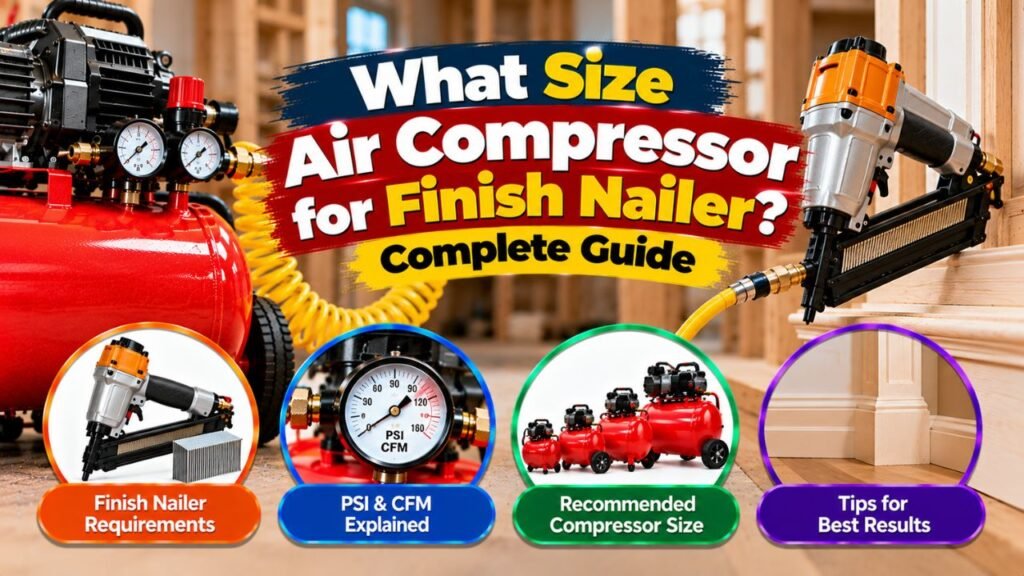
For most pneumatic finish nailers, a 2- to 6-gallon compressor producing roughly 2 CFM or more at 90 PSI is a practical choice.
A smaller compressor may also work because finish nailers use relatively little air per shot.
A useful general guide is:
| Compressor Size | Finish Nailer Use | Best For |
| 1 gallon | Usually workable for light use | Small repairs and occasional nails |
| 2–3 gallons | Good | DIY trim and small projects |
| 6 gallons | Excellent for most users | Baseboards, casing, molding, regular use |
| 10+ gallons | More than typically necessary | Multiple air tools or frequent shop use |
| 20+ gallons | Usually unnecessary for nailer alone | Larger pneumatic tool setups |
The nailer’s own specifications should always take priority because air requirements vary among models.
Why Finish Nailers Need So Little Air
A pneumatic finish nailer stores compressed air inside the compressor tank and uses a small burst each time the trigger is activated.
Unlike an air grinder or sander, the nailer is not consuming air continuously.
A finish nailer normally works like this:
- Compressor fills the tank.
- You press the nailer against the workpiece.
- Pulling the trigger releases a short burst of compressed air.
- The air drives the nail.
- The compressor replaces the small amount of air that was used.
Because there is usually a pause between nails, the compressor has plenty of opportunity to recover.
This is why even compact portable compressors can run finish nailers effectively.
How Many Gallons Do You Need for a Finish Nailer?
Tank capacity determines how much compressed air the compressor can store.
For finish-nailer work, you generally do not need a large tank.
1-Gallon Compressor
A 1-gallon compressor can often operate a finish nailer for:
- Furniture repairs
- Small molding jobs
- Crafts
- Occasional trim installation
Its main limitation is recovery frequency.
The motor may cycle frequently if you fire many nails quickly.
A 1-gallon model is therefore better for light, intermittent work than continuous professional use.
2- to 3-Gallon Compressor
A 2- or 3-gallon compressor provides a useful balance between portability and air storage.
It is suitable for many tasks including:
- Door casing
- Window trim
- Crown molding
- Baseboards
- Cabinet work
For a homeowner or occasional DIY user, this size can be completely adequate.
6-Gallon Compressor
A 6-gallon pancake compressor is one of the most practical choices for finish nailers.
It usually provides enough stored air for repeated nailing while still being portable enough to move around a house or jobsite.
A 6-gallon compressor is a strong choice if you plan to use:
- Finish nailer
- Brad nailer
- Pin nailer
- Stapler
- Framing nailer for intermittent work
You may also be able to run more than one nailer from the same compressor, depending on the compressor’s airflow and how quickly the tools are used.
Is a 6-Gallon Air Compressor Enough for a Finish Nailer?
Yes. A 6-gallon compressor is generally more than sufficient for a single finish nailer.
Finish nailers consume air intermittently, so a typical 6-gallon portable compressor can recover easily during normal trim work.
The compressor motor may run occasionally as tank pressure falls, but that is normal.
A 6-gallon unit is especially useful for projects such as:
- Installing baseboards throughout a house
- Door and window casing
- Crown molding
- Cabinet trim
- Stair trim
- Furniture assembly
For many users, there is little reason to buy a much larger compressor solely for finish-nailer use.
Is a 3-Gallon Compressor Enough for a Finish Nailer?
Yes, in most cases.
A 3-gallon compressor can usually run a finish nailer effectively because the nailer uses only a small amount of air with each shot.
The main difference compared with a 6-gallon compressor is that the smaller tank may cause the compressor motor to cycle more frequently.
For occasional home improvement work, that usually is not a problem.
Will a 1-Gallon Air Compressor Run a Finish Nailer?
Often, yes.
A 1-gallon compressor can work if it provides the required PSI and enough airflow.
However, expect:
- More frequent compressor cycling
- Slower recovery during rapid nailing
- Less stored air
- Greater dependence on compressor output
For installing a small section of molding, this may be perfectly acceptable.
For an all-day trim project, a larger tank is more convenient.
What CFM Does a Finish Nailer Need?
CFM, or cubic feet per minute, measures how much air a compressor can deliver.
Compressor manufacturers often provide an airflow rating at a particular pressure, such as:
2.6 SCFM at 90 PSI
The exact air requirement of a finish nailer varies by model, but finish nailers generally have relatively low average airflow needs because they do not operate continuously.
A compressor capable of around 2 CFM at 90 PSI is generally a comfortable starting point for one finish nailer.
Many small compressors produce enough air for this application.
Always compare the compressor’s rated airflow with the nailer manufacturer’s requirement.
CFM Matters More Than Tank Size
A large tank does not necessarily mean a compressor can produce air quickly.
For example, imagine two compressors:
- Compressor A: 6-gallon tank with strong CFM output
- Compressor B: 10-gallon tank with weak CFM output
Compressor B initially has more stored air, but Compressor A may recover faster.
For intermittent nailers, both tank size and airflow matter, but CFM tells you how quickly the compressor can replace the air being used.
This becomes more important if you fire nails rapidly or operate multiple pneumatic tools.
What PSI Does a Finish Nailer Need?
Many pneumatic finish nailers operate somewhere around 70 to 120 PSI, although the exact recommended range varies by model.
You should never simply set the compressor to maximum pressure.
Instead:
- Check the nailer’s operating-pressure specification.
- Adjust the compressor regulator.
- Start near the lower end of the recommended range.
- Test the nailer on scrap material.
- Increase pressure gradually if nails are not driven deeply enough.
Using excessive pressure can increase wear and may drive nails too deeply.
Tank Pressure vs. Regulated Pressure
These two readings are easy to confuse.
Tank Pressure
This is the pressure stored inside the compressor receiver.
The compressor may store air at a considerably higher pressure than your nailer actually needs.
Outlet Pressure
The regulator controls the pressure being sent through the hose to the nailer.
For example, the tank might contain 150 PSI while the regulator supplies only 90 PSI to the tool.
The nailer cares about the regulated outlet pressure, not the maximum tank pressure.
15-Gauge vs. 16-Gauge Finish Nailer Compressor Requirements
Finish nailers commonly use either 15-gauge or 16-gauge nails.
Both generally work well with small portable compressors.
15-Gauge Finish Nailer
A 15-gauge finish nailer fires thicker nails and is commonly used for:
- Heavy trim
- Door casing
- Crown molding
- Stair work
It may consume somewhat more air per shot than smaller nailers, but a typical 3- to 6-gallon compressor is still usually sufficient.
16-Gauge Finish Nailer
A 16-gauge finish nailer is popular for:
- Baseboards
- Window trim
- Interior molding
- Cabinet work
Its low intermittent air demand makes it particularly well suited to small portable compressors.
Finish Nailer vs. Brad Nailer Air Requirements
A brad nailer usually fires thinner 18-gauge fasteners.
Because its driving mechanism is smaller, it generally requires very little compressed air.
Both finish and brad nailers can usually run from the same portable compressor.
A 6-gallon pancake compressor is typically capable of handling either tool comfortably in normal DIY use.
Finish Nailer vs. Framing Nailer Compressor Size
A framing nailer fires much larger nails than a finish nailer.
Although framing nailers are still intermittent tools, they generally consume more air per shot.
That means compressor recovery becomes more important when firing nails rapidly.
If you want one compressor that can handle:
- Brad nailer
- Finish nailer
- Framing nailer
a 6-gallon compressor with adequate CFM is generally more versatile than a very small 1-gallon model.
Can a Pancake Compressor Run a Finish Nailer?
Yes.
A pancake compressor is one of the most popular compressor styles for pneumatic nailers.
Its flat round tank provides:
- Good stability
- Compact storage
- Easy portability
- Enough air for intermittent tools
A typical 6-gallon pancake compressor is an excellent match for finish-nailer work.
Many contractors use this style specifically for trim and fastening tools.
Can a Hot-Dog Compressor Run a Finish Nailer?
Yes.
A hot-dog compressor uses a horizontal cylindrical tank rather than the flat pancake shape.
Performance depends on the actual specifications rather than tank shape.
If the compressor supplies the required PSI and CFM, it can run a finish nailer regardless of whether the tank is:
- Pancake
- Hot dog
- Twin stack
- Vertical
Choose the design that fits your portability and storage needs.
Does Compressor Horsepower Matter?
Horsepower tells you something about the compressor motor but is not the most useful specification when matching a compressor to a nailer.
Focus primarily on:
- CFM or SCFM at 90 PSI
- Tank capacity
- Maximum pressure
- Duty cycle
- Recovery rate
Two compressors advertised with similar horsepower may provide different actual airflow.
What Hose Size Should You Use?
Finish nailers do not require extremely large air hoses.
A 1/4-inch air hose is commonly suitable for portable nailer setups.
It offers several benefits:
- Lightweight
- Flexible
- Easy to move around trim work
- Low burden on the nailer
Long hoses and restrictive fittings can create some pressure loss.
If you use a particularly long hose, verify that the nailer still receives adequate pressure while operating.
Does Hose Length Affect a Finish Nailer?
Yes, although the effect is usually modest for typical home-shop setups.
A very long or narrow hose creates more pressure drop than a shorter hose.
You may notice problems such as:
- Nails not fully driven
- Inconsistent nail depth
- Slow tool response
Before increasing compressor pressure dramatically, check:
- Hose condition
- Fittings
- Regulator setting
- Leaks
The problem may be restricted airflow rather than insufficient compressor capacity.
Why Won’t My Finish Nailer Drive Nails Fully?
The compressor is not always the problem.
Possible causes include:
- Outlet pressure set too low
- Air leak
- Long or restrictive hose
- Damaged fitting
- Nailer depth adjustment set incorrectly
- Internal nailer seal problem
- Incorrect fasteners
- Low compressor tank pressure
Start by checking the nailer’s recommended operating pressure and depth adjustment.
Increasing pressure beyond the manufacturer’s maximum is not the solution.
Can One Compressor Run Two Finish Nailers?
Yes, provided the compressor can recover fast enough for the combined demand.
Two workers firing finish nailers occasionally may operate successfully from a good portable compressor.
Two people firing rapidly and continuously will increase air demand.
When sizing a compressor for multiple tools, add their expected air requirements and provide some extra capacity.
For professional multi-user setups, a larger tank and higher CFM compressor can reduce motor cycling and pressure drop.
Do You Need a 20-Gallon Compressor for a Finish Nailer?
No, not if the finish nailer is the only reason you are buying the compressor.
A 20-gallon compressor will certainly run a finish nailer, but much of its capacity would be unnecessary for that tool alone.
A larger compressor makes more sense if you also use high-demand pneumatic equipment such as:
- Impact wrench
- Air ratchet
- Die grinder
- Air sander
- Spray equipment
For trim nailers alone, portability usually provides more value than a large tank.
What Size Compressor Is Best for DIY Finish Work?
For a homeowner, a 3- to 6-gallon portable compressor is usually the sweet spot.
A 6-gallon model offers especially good versatility because it can often handle several types of pneumatic nailers while remaining portable.
Look for:
- At least enough CFM for your nailer
- Adjustable pressure regulator
- Easy-to-read gauges
- Suitable maximum pressure
- Portable design
- Reasonable noise level
A quieter compressor may be worth considering if you plan to work indoors for long periods.
What Size Compressor Is Best for Professional Trim Work?
Professional trim carpenters may prefer greater compressor capacity because productivity matters more.
A compressor with:
- Good recovery speed
- Strong CFM output
- 4- to 6-gallon or larger tank
- Multiple hose outlets where needed
can reduce interruptions.
However, excessively large stationary compressors are rarely necessary simply to run finish nailers.
Portable jobsite compressors remain popular because nailers have relatively modest air requirements.
Should You Buy a Bigger Compressor for Future Tools?
Possibly.
If you plan to add pneumatic tools later, size the compressor for the most demanding tool you expect to use.
A finish nailer requires comparatively little air.
An air sander, grinder, or paint spray gun may require several times more airflow.
Buying a compressor based only on the finish nailer could leave you with insufficient capacity later.
Consider your future tool list before choosing.
Common Mistakes When Choosing a Compressor for a Finish Nailer
Looking Only at Gallons
Tank capacity is useful, but airflow is equally important.
Check CFM.
Ignoring the Nailer PSI Rating
Do not assume every nailer uses the same pressure.
Follow the tool manufacturer’s specification.
Buying an Oversized Compressor
A huge compressor adds:
- Cost
- Weight
- Storage requirements
without providing much benefit for a single finish nailer.
Buying Based Only on Maximum PSI
Maximum tank pressure does not tell you how quickly the compressor can produce air.
Look at the CFM rating at 90 PSI.
Running Pressure Too High
More pressure does not automatically produce better nailing.
Use the lowest pressure that consistently drives the fastener to the proper depth within the nailer’s specified range.
Safety Tips for Using a Finish Nailer With an Air Compressor
Wear safety glasses when operating a pneumatic nailer.
Finish nails can:
- Deflect off hard material
- Follow wood grain
- Exit unexpectedly through the side of trim
Keep your free hand away from the nail path.
Disconnect the air hose before:
- Clearing a jam
- Performing maintenance
- Making certain adjustments
- Leaving the tool unattended
Never point the nailer at yourself or another person.
Check the hose and fittings for damage before pressurizing the system.
Use the nailer’s manufacturer-recommended pressure range rather than exceeding it to compensate for a mechanical problem.
FAQs About What Size Air Compressor for Finish Nailer
Is a 2-gallon air compressor enough for a finish nailer?
Yes, a 2-gallon compressor can usually run a finish nailer for normal DIY use if it supplies the required PSI and CFM.
It may cycle more frequently than a larger compressor during rapid nailing.
Is a 3-gallon compressor enough for a 16-gauge finish nailer?
Usually, yes.
A 16-gauge finish nailer has relatively low intermittent air demand, making a 3-gallon compressor suitable for many trim projects.
Is a 6-gallon pancake compressor good for a finish nailer?
Yes.
A 6-gallon pancake compressor is one of the most practical choices for finish nailers because it provides good air capacity while remaining portable.
How many CFM does a finish nailer require?
The exact requirement varies by model.
Finish nailers generally have low average air consumption, and a compressor producing around 2 CFM at 90 PSI is sufficient for many single-nailer applications.
Always check the nailer’s specifications.
How much PSI do I need for a finish nailer?
Many pneumatic finish nailers operate somewhere around 70–120 PSI, but the correct range depends on the model.
Start within the manufacturer’s recommended range and adjust the regulator as needed.
Will a small portable air compressor run a finish nailer?
Yes.
Because finish nailers use air intermittently rather than continuously, compact portable compressors are usually well suited to them.
Can I use a 20-gallon compressor with a finish nailer?
Yes.
A 20-gallon compressor will easily operate most finish nailers, but that much tank capacity is usually unnecessary unless you also use higher-demand pneumatic tools.
What is more important for a finish nailer, CFM or gallons?
Both matter, but they describe different things.
Gallons determine stored air capacity, while CFM determines how quickly the compressor can replenish the air.
For finish nailers, a modest tank combined with adequate CFM usually works very well.
Conclusion
The practical answer to what size air compressor for finish nailer work is that you do not need a large compressor. Finish nailers use only a brief burst of air with each shot, so a compact portable unit can supply enough air for most trim projects.
A 2- to 3-gallon compressor is generally adequate for occasional DIY work, while a 6-gallon pancake compressor is an excellent all-around choice for baseboards, crown molding, door casing, cabinets, and regular finish carpentry. Even a 1-gallon compressor may work for light use if its PSI and CFM ratings meet the nailer’s requirements.
Tank size should not be your only consideration. Check the nailer’s required PSI, compare its airflow needs with the compressor’s CFM or SCFM rating at 90 PSI, and consider how quickly you plan to fire nails. For most homeowners and trim carpenters using one finish nailer, a portable 3- to 6-gallon compressor with adequate airflow provides the best balance of performance, portability, and recovery without paying for more compressor than the job actually requires.