
Do All Nail Guns Need Air Compressor? Types and Power Options
No, not all nail guns need an air compressor. Pneumatic nail guns require compressed air, but cordless battery-powered, gas-powered, and some electric nail guns operate without a separate compressor.
If you are wondering do all nail guns need air compressor power, the answer depends on the type of nail gun you own or plan to buy. Traditional pneumatic nailers connect to a compressor with an air hose, but modern cordless nail guns can drive nails using batteries, fuel cells, or internal mechanical systems.
For homeowners and DIY users, a compressor-free nailer can be convenient because there is no hose or compressor to move around. Professional contractors, however, often still use pneumatic nail guns because they can be lighter in the hand, fire quickly, and work efficiently during repetitive nailing jobs.
Neither design is automatically better for everyone. The right choice depends on the type of work, number of nails you need to drive, portability, tool weight, maintenance, and cost.
Do All Nail Guns Need Air Compressor Power?
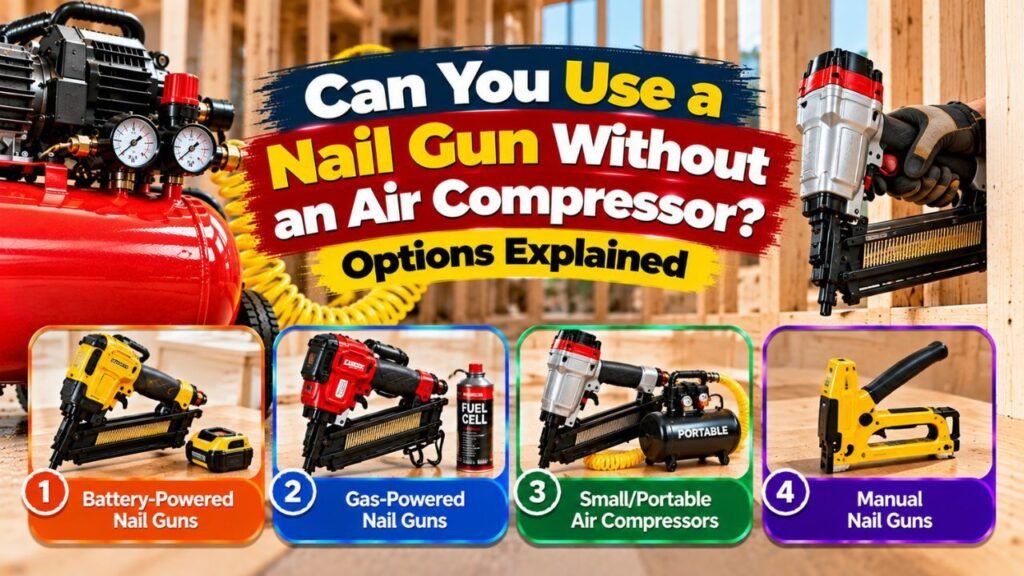
No. Only pneumatic nail guns need an external air compressor.
Nail guns generally fall into several power categories:
- Pneumatic nail guns
- Cordless battery-powered nail guns
- Gas or fuel-cell nail guns
- Electric nail guns
A pneumatic nailer uses compressed air supplied through a hose. A cordless nailer has its own onboard power source, so no external compressor is required.
This means you can use many modern nail guns almost anywhere without carrying a compressor or dealing with an air hose.
How Does a Pneumatic Nail Gun Work?
A pneumatic nail gun uses compressed air to move an internal piston or driver blade.
When you pull the trigger and activate the tool’s safety mechanism, compressed air enters the firing system and drives the piston rapidly downward. The driver pushes a nail out of the magazine and into the workpiece.
The air compressor then replenishes the compressed air stored in its tank.
A typical pneumatic setup consists of:
Air compressor → air hose → nail gun
The compressor supplies the pressure and airflow needed to cycle the tool.
Which Nail Guns Need an Air Compressor?
Most nail guns described as pneumatic require an air compressor.
Common examples include pneumatic versions of:
Brad Nailers
Brad nailers usually drive thin 18-gauge fasteners and are commonly used for trim, molding, and light woodworking.
Pneumatic brad nailers need an air compressor, although battery-powered versions are widely available.
Finish Nailers
Finish nailers typically drive larger nails than brad nailers and are useful for baseboards, door trim, window trim, cabinets, and similar work.
A pneumatic finish nailer needs compressed air, while a cordless finish nailer does not.
Framing Nailers
Framing nailers drive larger fasteners into structural lumber.
Many professional framing nailers are pneumatic, but cordless framing nailers are also common.
Roofing Nailers
Many roofing nailers are pneumatic because roofing work may involve driving a very large number of nails quickly.
Cordless roofing options also exist, but pneumatic models remain common.
Flooring Nailers
Some flooring nailers use compressed air to drive flooring fasteners.
Manual and other powered designs are also available, so the specific model determines whether a compressor is necessary.
Which Nail Guns Do Not Need an Air Compressor?
Several types of nail guns are designed to work without an external compressor.
Cordless Battery-Powered Nail Guns
A battery-powered nail gun uses a rechargeable battery to power its firing mechanism.
Depending on the tool, the battery may operate:
- A flywheel
- A spring mechanism
- A motor-driven compression system
- Another internal energy-storage mechanism
You simply install the battery and load the correct fasteners.
No air hose or separate compressor is required.
Battery nailers are available in many categories, including brad, finish, framing, and pin nailers.
Gas or Fuel-Cell Nail Guns
Some cordless nailers use a small fuel cell combined with a battery.
The fuel provides energy for the driving cycle, while the battery operates ignition or electronic components.
These tools became popular for applications where contractors wanted cordless operation without carrying a compressor.
They require replacement fuel cells in addition to battery charging.
Electric Nail Guns
Some nailers and staplers plug directly into an electrical outlet.
These tools do not require an air compressor.
Corded electric nailers are usually more common in lighter-duty fastening applications than heavy structural framing.
Their advantage is simple power availability without batteries or compressed air, but the electrical cord still limits movement.
Pneumatic vs. Cordless Nail Guns
The choice between pneumatic and cordless nailers involves several practical tradeoffs.
| Feature | Pneumatic Nail Gun | Cordless Nail Gun |
| External compressor | Required | Not required |
| Air hose | Required | No |
| Portability | Lower | Higher |
| Tool weight | Often lighter | Usually heavier |
| Rapid repetitive firing | Excellent | Depends on model |
| Setup time | Higher | Lower |
| Battery charging | No | Yes |
| Compressor maintenance | Yes | No |
| Best for large repetitive jobs | Excellent | Good to excellent |
| Best for quick small jobs | Good | Excellent |
A pneumatic tool may be more convenient once a compressor system is already set up, while a cordless nailer is often faster to grab for a quick repair or trim job.
Why Do Pneumatic Nail Guns Still Use Compressors?
Cordless technology has improved greatly, but pneumatic nailers still offer important advantages.
One is tool weight. Because much of the power system remains outside the nail gun, the handheld tool can often be lighter than a cordless equivalent.
That difference becomes noticeable when driving hundreds or thousands of nails.
Pneumatic nailers can also deliver fast repetitive firing without waiting for an onboard mechanism to recharge between shots.
For a contractor already using an air compressor for several pneumatic tools, connecting a nail gun may be simple and economical.
Why Choose a Nail Gun Without a Compressor?
The biggest advantage is portability.
A cordless nail gun eliminates:
- Compressor setup
- Air hoses
- Extension cords for the compressor
- Tank recovery concerns for light work
This can be useful when installing a few pieces of trim in different rooms, working on a ladder, making repairs away from electrical power, or moving frequently around a job site.
For homeowners who do not already own an air compressor, buying one cordless nailer may also be simpler than purchasing a compressor, hose, fittings, and pneumatic tool.
Is a Cordless Nail Gun as Powerful as a Pneumatic Nail Gun?
Modern cordless nailers can provide enough power for many professional applications, including framing and finish work.
However, performance varies by model.
A cordless framing nailer designed for structural work can drive much larger fasteners than a small cordless brad nailer.
Likewise, a professional pneumatic framing nailer has much greater fastening capability than a small pneumatic pin nailer.
The power source alone does not determine capability.
You should compare:
- Supported nail length
- Nail gauge or diameter
- Intended material
- Driving-depth adjustment
- Firing rate
- Manufacturer specifications
Are Battery Nail Guns Good?
Yes. Battery nail guns are particularly useful when convenience and mobility matter.
They work well for tasks such as:
- Interior trim
- Baseboards
- Crown molding
- Cabinet installation
- Fencing
- Framing with suitable models
- Small repairs
Their main disadvantages are additional weight, battery dependence, and sometimes higher purchase cost.
A battery nailer may also have a slight delay between shots depending on its firing mechanism.
For occasional work, those disadvantages are often minor.
Are Pneumatic Nail Guns Better?
They can be better for certain workloads.
A pneumatic nailer is often a strong choice when you need:
- Fast repetitive firing
- Long work sessions
- Lightweight handheld tools
- Several pneumatic tools from one compressor
- High-volume production work
However, you also need to manage the compressor and hose.
For someone installing a small amount of trim around a house, a cordless nailer may be more convenient even if the pneumatic version is lighter.
What Size Air Compressor Does a Nail Gun Need?
If you choose a pneumatic nailer, you do not necessarily need a huge compressor.
Many nail guns use relatively small amounts of air because they consume air only when firing.
A portable pancake compressor is commonly used with brad and finish nailers and may also support certain framing applications.
The important specifications are:
- Required operating PSI
- Tool air consumption
- Compressor CFM output
- Tank size
- Frequency of firing
Always compare the nail gun manufacturer’s requirements with the compressor’s rated output.
Does Tank Size Matter for Nail Guns?
Yes, but nail guns generally do not require continuous airflow like sanders or grinders.
A larger tank stores more compressed air, which means you can often fire more nails before the compressor motor needs to recover.
However, tank size does not determine compressor performance by itself.
A compressor also needs enough CFM to replenish the air you use.
For occasional trim work, a small tank can be perfectly adequate.
High-speed framing or roofing work may benefit from greater compressor capacity.
How Much PSI Does a Nail Gun Need?
The required pressure depends on the nailer.
Many pneumatic nailers operate within a range commonly found on portable compressors, but the exact requirement should come from the tool manufacturer.
Never increase air pressure beyond the nail gun’s rated maximum simply because nails are not driving deeply enough.
If performance is poor, check:
- Compressor pressure
- Hose restrictions
- Fastener size
- Tool condition
- Depth adjustment
- Material hardness
Excessive pressure can damage the tool and create unsafe operation.
Can You Use a Nail Gun Without an Air Compressor?
Yes, if the nail gun is designed for cordless or electric operation.
You cannot normally take a pneumatic nail gun and use it without compressed air.
A pneumatic nailer depends on air pressure to move its driving mechanism.
If you do not want to use a compressor, choose a nail gun specifically sold as:
- Battery-powered
- Cordless
- Fuel-powered
- Electric
Do not attempt to modify a pneumatic nail gun to operate from an incompatible power source.
Can You Use a Small Air Compressor With a Nail Gun?
Often, yes.
Nailers are among the easiest pneumatic tools for small compressors to operate because they use short bursts of air.
A compact compressor can be suitable for:
- Brad nailers
- Pin nailers
- Finish nailers
- Staplers
Whether it can keep up with a framing or roofing nailer depends on compressor output and how rapidly you work.
If you are firing nails continuously and the compressor cannot recover fast enough, tank pressure will drop.
Do Framing Nail Guns Need an Air Compressor?
Not all of them.
A pneumatic framing nailer needs a compressor.
A cordless framing nailer operates without one.
Cordless framing nailers are convenient for small framing jobs, repairs, punch-list work, and locations where setting up an air hose is inconvenient.
Pneumatic framing nailers remain popular for heavy repetitive framing because they can be lighter and fast when connected to an adequate compressor.
Do Brad Nailers Need an Air Compressor?
Only pneumatic models do.
Cordless battery-powered brad nailers are widely available and can operate independently.
For a homeowner installing baseboards or decorative trim, a cordless brad nailer may be particularly convenient because it requires almost no setup.
If you already own a compressor, a pneumatic brad nailer may be smaller, lighter, and less expensive.
Do Finish Nailers Need an Air Compressor?
Again, it depends on the power source.
Pneumatic finish nailers require compressed air.
Cordless finish nailers use batteries or another onboard power system.
Both can perform similar trim and finishing jobs when properly sized for the fastener and material.
Do Roofing Nail Guns Need an Air Compressor?
Many roofing nailers are pneumatic and therefore need a compressor.
Pneumatic systems are well suited to roofing because roofers may need to drive nails rapidly for long periods.
Cordless roofing nailers are also available, so a compressor is not universally required.
For high-volume professional roofing, consider firing speed, tool weight, battery runtime, and fastener capacity when choosing between them.
Do Flooring Nail Guns Need an Air Compressor?
Some do and some do not.
Pneumatic flooring nailers require compressed air.
Manual flooring nailers use physical striking force, typically from a mallet, and need no compressor.
Other powered flooring tools may use different mechanisms.
Check the specific flooring nailer’s power requirement rather than assuming every model is pneumatic.
Do Pin Nailers Need an Air Compressor?
Pneumatic pin nailers require a compressor, but battery-powered pin nailers are also available.
Pin nailers drive very small fasteners and are often used for delicate trim, moldings, and woodworking.
For occasional fine-finish work, a cordless model can be very convenient.
Is It Cheaper to Use a Pneumatic or Cordless Nail Gun?
It depends on what equipment you already own.
If you already have an appropriate compressor and hose, a pneumatic nail gun may be relatively inexpensive.
If you do not own a compressor, the total pneumatic setup may include:
Compressor + hose + fittings + nail gun
A cordless nailer usually costs more than the equivalent pneumatic tool by itself, but it does not require that additional air equipment.
Battery platform matters too. If you already own compatible batteries and chargers, purchasing a cordless bare tool can reduce the total cost.
Which Nail Gun Is Best for Beginners?
For many beginners, a cordless brad or finish nailer is convenient because setup is simple.
You install a charged battery, load the correct fasteners, set the depth, and begin working according to the manufacturer’s instructions.
A small pneumatic setup is also beginner-friendly and can be more economical if you want to use several air tools.
Your decision should be based on the projects you expect to do rather than assuming one technology is always easier.
Nail Gun Safety Still Matters Without a Compressor
A cordless nail gun is not less dangerous simply because it lacks an air hose.
All nail guns can cause serious puncture injuries.
Before using one:
- Read the manufacturer’s instructions.
- Wear appropriate eye protection.
- Keep your hands away from the fastening area.
- Disconnect the air supply or remove the battery before clearing jams.
- Use the correct fasteners.
- Never bypass the contact safety mechanism.
- Keep the tool pointed away from yourself and other people.
Some nailers can drive fasteners through a workpiece or cause a nail to deflect unexpectedly, so hand placement is especially important.
Common Misconceptions About Nail Guns and Compressors
One common misconception is that every professional nail gun must be pneumatic. Modern cordless framing, finish, brad, and pin nailers can handle professional work without an external compressor.
Another misconception is that cordless nailers are always weaker. Capability depends on the specific tool design rather than simply whether a battery or compressed air powers it.
It is also incorrect to assume that a large compressor is required for every pneumatic nail gun. Because nailers use short bursts of air, many can operate effectively from compact portable compressors.
FAQs About Do All Nail Guns Need Air Compressor
Do all nail guns need air compressor power?
No. Pneumatic nail guns need an air compressor, but battery-powered, fuel-cell, and electric nail guns operate without one.
Can you use a nail gun without a compressor?
Yes, as long as you buy a nail gun designed for cordless or electric operation. A pneumatic nail gun cannot normally operate without compressed air.
Are cordless nail guns as good as pneumatic nail guns?
Cordless nail guns can be excellent for both DIY and professional use. Pneumatic models often have advantages in weight and continuous high-speed fastening, while cordless models offer greater portability and faster setup.
Do brad nailers need an air compressor?
Pneumatic brad nailers do. Battery-powered brad nailers do not.
Do framing nailers need an air compressor?
Only pneumatic framing nailers require a compressor. Cordless framing nailers have their own onboard power systems.
Do finish nailers need an air compressor?
Pneumatic finish nailers require compressed air, while cordless battery-powered models do not.
Can a small pancake compressor run a nail gun?
Yes, many small pancake compressors are well suited to brad and finish nailers. Whether one can keep up with framing or roofing work depends on its CFM, pressure, tank capacity, and firing frequency.
Which is better for home use, pneumatic or cordless nail guns?
For occasional home projects, a cordless nail gun is often more convenient because there is no compressor or air hose to set up. If you already own a compressor or plan to use several pneumatic tools, a pneumatic nailer can be a cost-effective alternative.
Conclusion
The final verdict on do all nail guns need air compressor power is no. Only pneumatic nail guns require an external compressor and hose. Cordless battery-powered, fuel-cell, and electric nailers can drive fasteners without a separate air compressor.
For homeowners, DIY users, and jobs that require frequent movement, a cordless nail gun is often the easiest option because setup is minimal. For contractors performing high-volume framing, roofing, or repetitive fastening, pneumatic nailers can still be an excellent choice because they are often lighter, fast, and easy to run continuously when connected to a properly sized compressor.
The best nail gun is therefore not determined simply by whether it needs compressed air. Choose based on the type of nails, workload, portability, firing speed, tool weight, and equipment you already own.