
What Size Air Compressor for Floor Nailer? Complete Guide
Choosing the right compressor for a pneumatic flooring nailer is easier once you understand what the tool actually needs. Flooring nailers use short bursts of compressed air to drive cleats or staples into hardwood, so they do not consume air continuously like sanders, grinders, or spray guns.
For most DIY flooring projects, a 2- to 6-gallon air compressor that can deliver roughly 2 to 3 CFM at 90 PSI is usually enough for one pneumatic floor nailer. A 6-gallon pancake compressor is especially practical because it provides useful air reserve while remaining portable enough to move around a house or jobsite.
When deciding what size air compressor for floor nailer use, however, tank capacity is only part of the equation. You also need to check the nailer’s required PSI and SCFM/CFM. Many pneumatic flooring nailers operate somewhere around 70–120 PSI and use relatively little air per fastener, but exact requirements vary by model.
A compressor that is slightly larger than the nailer’s minimum requirement usually provides a more comfortable working experience because the motor will not have to cycle as frequently. On the other hand, buying a huge 20- or 30-gallon compressor simply to operate one flooring nailer is generally unnecessary.
This guide explains the right compressor tank size, CFM, PSI, hose size, and setup for hardwood and engineered-flooring nailers, plus what happens if your compressor is too small.
What Size Air Compressor for Floor Nailer?
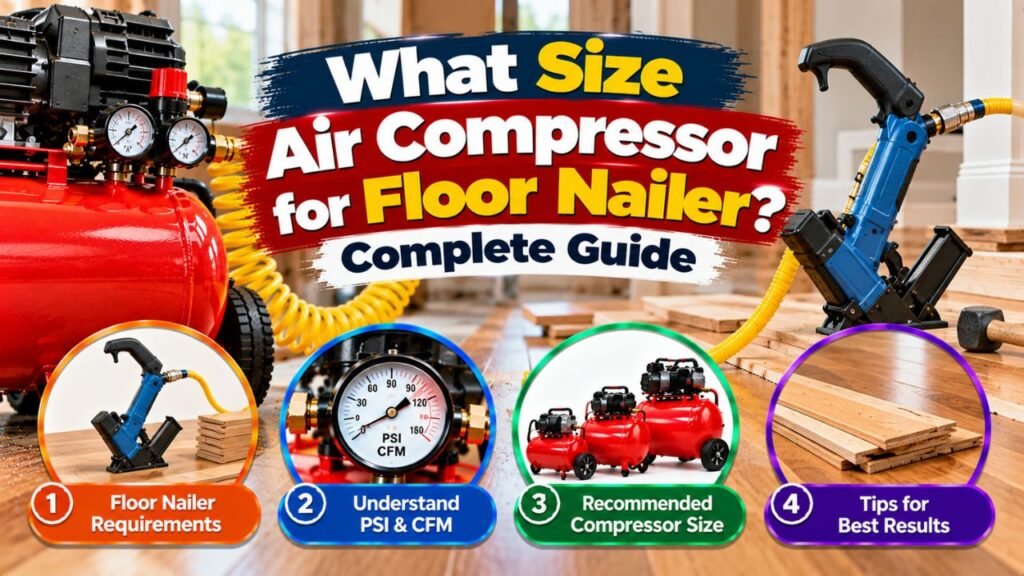
For a single pneumatic flooring nailer, a 4- to 6-gallon compressor producing around 2–3 CFM at 90 PSI is a strong all-around choice.
A smaller 1- or 2-gallon compressor can sometimes operate a floor nailer because the tool only uses a short burst of air each time it fires. However, the compressor may cycle frequently during a large flooring project.
A practical sizing guide is:
| Compressor Size | Suitable for Floor Nailer? | Best Use |
| 1 gallon | Sometimes | Small repairs and occasional fastening |
| 2 gallon | Yes, if CFM is sufficient | Small flooring projects |
| 3 gallon | Yes | DIY and light flooring work |
| 4 gallon | Yes | Most single-nailer projects |
| 6 gallon | Excellent | Hardwood flooring and regular DIY use |
| 8–10 gallon | More than enough | Long projects or additional pneumatic tools |
| 20+ gallon | Usually unnecessary for one nailer | Shop use and multiple air tools |
Always compare the compressor’s CFM at the required pressure with the specifications of your particular nailer.
How Much CFM Does a Floor Nailer Need?
CFM means cubic feet per minute. It describes how much compressed air a tool uses or a compressor can deliver.
Pneumatic flooring nailers are relatively low-CFM tools.
Many models need somewhere around:
1.5 to 2.5 SCFM at approximately 90 PSI
during normal use.
Because a flooring nailer does not run continuously, the compressor has time to refill its tank between groups of fasteners.
For comfortable operation, choosing a compressor that produces at least 20% to 30% more CFM than the tool’s stated requirement can provide useful reserve capacity.
For example, suppose your floor nailer requires:
2.2 CFM at 90 PSI
A compressor rated around:
2.8–3.0 CFM at 90 PSI
would provide a useful margin.
You do not need to dramatically oversize the compressor.
Why CFM Matters More Than Tank Size
People often shop for compressors by gallon capacity alone, but CFM is usually the more important specification when determining whether a compressor can keep up with an air tool.
Tank size tells you how much compressed air can be stored.
CFM tells you how quickly the compressor pump can replace the air being used.
For example, two compressors could both have 6-gallon tanks, but:
- Compressor A produces 1.5 CFM at 90 PSI.
- Compressor B produces 2.8 CFM at 90 PSI.
Compressor B can recover pressure significantly faster.
For a flooring nailer, both might operate the tool for a while because nailers have low air demand, but the higher-CFM compressor will usually cycle less and recover faster.
How Much PSI Does a Flooring Nailer Need?
Most pneumatic flooring nailers operate within a pressure range rather than requiring one exact pressure.
A common operating range is approximately:
70–120 PSI
Some models have narrower ranges, such as 70–100 PSI or 70–115 PSI.
Always follow the manufacturer’s rating for your nailer.
Start Toward the Lower End
You generally do not need to immediately run the nailer at maximum allowable pressure.
Start at a moderate pressure and test the tool on scrap flooring.
Increase pressure gradually until the cleat or staple is properly seated.
Using more pressure than necessary can:
- Drive fasteners too deeply
- Damage the tongue of the flooring
- Increase stress on the nailer
- Waste compressed air
Never exceed the nailer’s maximum operating pressure.
Is a 6-Gallon Air Compressor Enough for a Floor Nailer?
Yes. A 6-gallon pancake compressor is usually more than adequate for one flooring nailer, provided its CFM and pressure ratings meet the nailer’s requirements.
For most homeowners, a 6-gallon compressor offers an excellent balance between:
- Portability
- Air storage
- Recovery speed
- Price
- Versatility
It can also be useful for other low-to-moderate air-demand tools, such as:
- Brad nailers
- Finish nailers
- Pin nailers
- Staplers
- Tire inflators
- Blow guns
The compressor may cycle repeatedly during a large flooring installation, but that is normal as long as it remains within its rated duty cycle.
Is a 3-Gallon Air Compressor Enough for a Floor Nailer?
Usually, yes.
A 3-gallon compressor can operate many pneumatic flooring nailers if it produces sufficient CFM and pressure.
Because the tank is smaller, you should expect:
- More frequent motor cycling
- Faster pressure drop during rapid nailing
- Less stored air reserve
For a bedroom, hallway, or occasional DIY project, a 3-gallon unit can be perfectly workable.
For installing hardwood throughout an entire house, a 4- or 6-gallon compressor will generally be more convenient.
Can a 2-Gallon Air Compressor Run a Flooring Nailer?
Yes, many 2-gallon compressors can.
A flooring nailer uses air intermittently, which makes it much easier to run than continuous-use pneumatic tools.
A 2-gallon compressor may work well for:
- Repairs
- Small rooms
- Occasional flooring installation
- Engineered flooring
However, check the compressor’s 90-PSI CFM rating.
A small tank does not automatically mean the compressor lacks sufficient airflow.
Can a 1-Gallon Compressor Run a Floor Nailer?
Possibly.
A 1-gallon compressor with adequate pressure may fire a flooring nailer, particularly if you work slowly.
The limitation is air reserve.
After several fasteners, the pressure can fall enough to make the compressor restart.
This can become frustrating during a large installation.
A 1-gallon compressor is therefore better suited for:
- Small repairs
- A few replacement boards
- Light occasional use
For installing hundreds or thousands of square feet of flooring, a larger compressor is more practical.
Do You Need a 20-Gallon Compressor for Flooring?
No, not for one flooring nailer.
A 20-gallon compressor provides much more stored air than a flooring nailer normally requires.
It becomes useful if you also plan to operate tools such as:
- Impact wrenches
- Air ratchets
- Die grinders
- Air hammers
- Some spray equipment
For a flooring-only setup, a 4- or 6-gallon portable compressor is usually easier to move and store.
Why Flooring Nailers Need Less Air Than Many Air Tools
A flooring nailer only consumes air for a fraction of a second when it fires.
It does not need continuous airflow.
Compare that with a pneumatic grinder.
A grinder may consume air continuously as long as you hold the trigger, sometimes requiring several times more CFM than a nailer.
This makes nailers well suited to compact portable compressors.
The compressor tank stores enough air for several shots and then the motor replenishes the tank between fastening cycles.
Flooring Nailer vs. Finish Nailer Air Requirements
Both are relatively low-air-demand tools, but they serve different purposes.
A flooring nailer is designed to drive cleats or staples through the tongue of flooring boards, often when struck with a mallet.
A finish nailer drives smaller finish nails into trim, baseboard, molding, and similar materials.
Both can commonly be operated by small portable compressors.
| Tool | Typical Air Demand | Small Compressor Friendly? |
| Pin nailer | Very low | Yes |
| Brad nailer | Very low | Yes |
| Finish nailer | Low | Yes |
| Flooring nailer | Low | Yes |
| Framing nailer | Low to moderate | Usually |
| Impact wrench | Moderate to high | Depends |
| Air grinder | High continuous demand | Often needs larger compressor |
This is why you do not need a large shop compressor simply to install hardwood flooring.
Hardwood Flooring Nailer Compressor Requirements
Traditional hardwood flooring nailers commonly drive:
- 16-gauge cleats
- 15.5-gauge flooring staples
- Similar flooring fasteners
These tools can require more driving force than small brad nailers because they must drive relatively large fasteners through dense hardwood.
However, driving force is produced largely by air pressure, while overall compressor capacity determines how frequently the tool can fire before pressure drops.
For hardwood such as:
- Oak
- Maple
- Walnut
- Hickory
make sure the nailer receives the pressure its manufacturer specifies.
Do not compensate for an undersized compressor by exceeding the nailer’s maximum PSI.
What About Engineered Flooring?
Engineered flooring may use:
- Smaller flooring cleats
- Narrower staples
- Specialty flooring nailers
- Brad or finish nailers in certain installation areas
Some compact flooring nailers designed for thinner engineered flooring have even lower air requirements than full-size hardwood-flooring nailers.
Your flooring manufacturer should also specify the appropriate fastener type and installation method.
Using the wrong fastener can damage the tongue or compromise installation even when the compressor and nailer work correctly.
What Compressor Size for Two Flooring Nailers?
If two people will operate flooring nailers from one compressor, size the compressor based on their combined potential air demand.
For example, if each nailer requires approximately 2 CFM under its rated conditions, the system should have sufficient output and reserve to support both.
Because nailers operate intermittently, both will not necessarily fire continuously at exactly the same moment.
Still, for professional two-person flooring crews, a larger compressor can reduce:
- Pressure fluctuations
- Frequent cycling
- Recovery delays
An 8- to 15-gallon portable or contractor-style compressor with adequate CFM can be more comfortable than a small pancake unit for multiple simultaneous tools.
The actual compressor should be selected using the combined requirements of the nailers.
Can You Run a Floor Nailer and Finish Nailer Together?
Yes, if the compressor has sufficient capacity for both.
For example, one worker may install flooring with a flooring nailer while another installs trim with a finish nailer.
Because both tools use air intermittently, a reasonably sized portable compressor may support them.
However, compare the combined requirements with the compressor’s CFM rating.
If pressure falls repeatedly and fasteners stop seating consistently, the compressor may be too small for simultaneous use.
What Size Air Hose for a Floor Nailer?
A 1/4-inch air hose is commonly suitable for one flooring nailer.
Flooring nailers do not need the massive airflow required by high-CFM pneumatic equipment.
A quality 1/4-inch hose offers several advantages:
- Lightweight
- Easy to move around rooms
- Less tiring during long installations
- Sufficient airflow for most nailers
For long hose runs or multiple tools, a larger 3/8-inch hose may reduce pressure loss.
Always make sure fittings are appropriately rated for the compressor pressure.
Does Air Hose Length Affect a Flooring Nailer?
Yes.
Long hoses create additional resistance to airflow.
The effect may be minor with a low-CFM flooring nailer, but very long or undersized hoses can still contribute to pressure drop.
For indoor flooring installation, you may want the compressor outside the immediate work area to reduce noise.
In that situation, using a reasonably sized hose is better than running an extremely thin hose over a long distance.
Avoid unnecessarily restricting airflow with:
- Tiny fittings
- Damaged couplers
- Kinked hoses
- Partially blocked regulators
How to Set the Compressor Pressure for a Flooring Nailer
Do not simply turn the regulator to maximum pressure.
A better method is:
- Check the nailer’s operating PSI range.
- Connect the air hose securely.
- Start near the lower-to-middle part of the recommended range.
- Use a scrap piece of the actual flooring.
- Fire a test fastener.
- Check how deeply the cleat or staple is seated.
- Increase pressure gradually if needed.
- Stop once the fastener consistently seats correctly.
Wood density varies.
Hard maple or hickory may behave differently from softer species.
The nailer’s mallet strike can also influence operation on many flooring nailers.
Do You Need a Regulator?
Yes, the compressor should provide a way to regulate outlet pressure.
The tank itself may store air at a pressure much higher than the flooring nailer requires.
The pressure regulator reduces outlet pressure to an appropriate level for the tool.
For example, your compressor tank might contain well over 100 PSI while the nailer works best at a lower regulated pressure.
Never bypass pressure regulation to gain more driving power.
What Happens if the Compressor Is Too Small?
An undersized compressor may still fire the nailer initially because the tank contains stored air.
Problems appear as pressure drops.
Signs include:
- Fasteners stop seating fully
- Nail depth becomes inconsistent
- Compressor runs almost constantly
- Pressure gauge falls during repeated use
- You must pause for tank recovery
- Tool performance weakens as you work
If this occurs, first verify that:
- Regulator is adjusted correctly
- Hose is not restricted
- Compressor tank is fully charged
- No major air leak exists
If everything is functioning correctly, the compressor may simply lack sufficient output.
What Happens if the Compressor Is Too Large?
Generally, nothing problematic—as long as outlet pressure is regulated correctly.
A large compressor can safely operate a small flooring nailer because the regulator controls the pressure delivered to the tool.
For example, a large 60-gallon shop compressor may provide plenty of air for a flooring nailer.
However, buying such a large unit specifically for one nailer is unnecessary.
A bigger tank does not force extra air into the nailer as long as the system pressure is properly controlled.
Should You Buy an Oil-Free or Oil-Lubricated Compressor?
Either can run a flooring nailer.
Oil-Free Compressor
Oil-free pancake compressors are popular for flooring because they are:
- Portable
- Low maintenance
- Easy to transport
- Common in 4- to 6-gallon sizes
The main disadvantage can be noise, depending on the model.
Oil-Lubricated Compressor
Oil-lubricated compressors can offer:
- Quieter operation in some designs
- Good durability
- Smooth operation
However, they require periodic oil maintenance and may be heavier.
For an occasional flooring project, an oil-free portable compressor is often the most convenient choice.
Is a Quiet Air Compressor Worth It for Flooring?
It can be.
Hardwood installation may involve hundreds or thousands of fasteners, causing a small compressor to cycle repeatedly.
A quieter compressor can make indoor work significantly more comfortable.
This is particularly useful in:
- Occupied homes
- Apartments
- Remodels
- Long installation projects
Look at the compressor’s noise rating if indoor comfort matters to you.
Do not sacrifice required CFM simply to obtain a quieter unit.
Portable vs. Stationary Compressor for Flooring
A portable compressor is usually the better choice.
Flooring work moves from room to room, so portability matters.
A compact pancake or hot-dog-style compressor can be:
- Carried upstairs
- Moved between rooms
- Stored easily
- Used for other finish tools
A stationary compressor makes more sense if you already have a workshop air system with hoses reaching the job area.
How Often Will a Small Compressor Cycle?
That depends on:
- Tank volume
- Pump output
- How quickly you install flooring
- Nailer air consumption
- Cut-in and cut-out pressures
A 6-gallon compressor may restart several times during continuous flooring installation.
That is not necessarily a sign that it is undersized.
Compressors are designed to cycle.
The important question is whether the pump can restore pressure without exceeding its rated duty cycle or causing your nailer to lose performance.
Do You Need an Air Dryer for a Flooring Nailer?
For ordinary residential flooring work, a sophisticated refrigerated or desiccant dryer is generally unnecessary.
However, excessive water in compressed air is not desirable.
Basic good practices include:
- Drain the compressor tank regularly.
- Keep air hoses clean.
- Follow the nailer’s lubrication requirements.
- Use an inline moisture separator if conditions warrant it.
In very humid environments, more condensate can accumulate inside the compressor tank.
Does a Flooring Nailer Need Oil?
Some pneumatic flooring nailers require a few drops of pneumatic tool oil through the air inlet periodically.
Others are designed as oil-free tools.
Check the nailer’s manual.
Do not use ordinary compressor crankcase oil, engine oil, or gear oil as pneumatic tool lubricant unless the tool manufacturer specifically approves it.
Also remember that compressor oil and pneumatic tool oil serve different purposes.
Choosing a Compressor for Professional Flooring Work
A professional flooring installer may benefit from more compressor capacity than a homeowner.
A larger compressor offers:
- Faster recovery
- Less frequent cycling
- Support for multiple tools
- Better capacity for continuous daily work
A contractor might therefore prefer something larger than a basic pancake compressor even though the flooring nailer itself does not technically require it.
Professional sizing should account for every tool that may operate simultaneously.
Choosing a Compressor for DIY Flooring
For most DIY users, there is little reason to overcomplicate the decision.
A compressor with approximately:
- 4–6 gallon tank
- 2–3+ CFM at 90 PSI
- Maximum pressure comfortably above the nailer’s requirement
- Adjustable regulator
- Portable design
will cover many typical flooring-nailer applications.
A common 6-gallon pancake compressor is therefore one of the most versatile options.
Safety Tips When Using a Flooring Nailer and Compressor
Pneumatic flooring nailers can drive fasteners with significant force.
Basic safety practices include:
- Wear eye protection.
- Wear hearing protection when appropriate.
- Keep hands away from the fastener exit point.
- Disconnect the air hose before clearing jams.
- Do not exceed the nailer’s maximum PSI.
- Inspect hoses and fittings for damage.
- Use secure quick-connect fittings.
- Never point the nailer toward yourself or another person.
- Follow the flooring nailer’s trigger and actuation instructions.
- Depressurize equipment before performing repairs.
If your nailer uses a mallet-actuated mechanism, follow its manufacturer’s striking technique rather than modifying the tool.
Common Compressor Sizing Mistakes for Flooring Nailers
Choosing by Gallons Alone
Tank size matters, but CFM determines how quickly the compressor replaces used air.
Check both.
Assuming More PSI Means Better Performance
Increasing pressure above the nailer’s limit can damage the tool or flooring.
Use only the specified operating range.
Buying a Huge Compressor for One Nailer
A flooring nailer is a low-air-demand tool.
A portable compressor is usually sufficient.
Ignoring CFM at 90 PSI
Compressor advertisements may list displacement or other airflow figures.
For pneumatic-tool comparison, look for the actual SCFM or CFM rating at a specified pressure, commonly 90 PSI.
Using an Undersized Extension Cord
An electric compressor may experience voltage drop if connected through a long, undersized extension cord.
That can cause:
- Poor motor starting
- Overheating
- Reduced performance
Follow the compressor manufacturer’s extension-cord requirements. In many situations, using a longer air hose while keeping the electrical cord short is preferable.
FAQs About What Size Air Compressor for Floor Nailer
Is a 6-Gallon Air Compressor Big Enough for a Flooring Nailer?
Yes. A 6-gallon compressor with sufficient CFM at the nailer’s required pressure is usually an excellent choice for one pneumatic flooring nailer.
It provides enough stored air for repeated fastening while remaining portable.
Is a 3-Gallon Compressor Enough for Hardwood Flooring?
Usually, yes, if its airflow rating meets the nailer’s requirements.
The smaller tank may cause the compressor to cycle more frequently than a 6-gallon model.
How Many CFM Does a Flooring Nailer Need?
Many flooring nailers are relatively low-air-demand tools and may require roughly 1.5 to 2.5 CFM around 90 PSI.
Always check your particular nailer’s specifications because requirements vary between models.
How Many PSI Do I Need for a Flooring Nailer?
Many pneumatic flooring nailers operate somewhere around 70–120 PSI.
Use the range stated by the manufacturer and adjust the regulator only high enough to properly seat the fastener.
Can a Pancake Compressor Run a Floor Nailer?
Yes.
A 4- or 6-gallon pancake compressor is one of the most common and practical choices for a single flooring nailer.
Can I Use a 1-Gallon Compressor for a Floor Nailer?
Possibly, particularly for small repairs.
A 1-gallon compressor may fire the tool correctly but can cycle very frequently because it stores little air.
For larger flooring projects, a 4- or 6-gallon unit is more convenient.
What Size Air Hose Do I Need for a Flooring Nailer?
A 1/4-inch hose is normally adequate for one flooring nailer.
A 3/8-inch hose can be useful for long runs or systems supplying multiple tools.
Do I Need a 20-Gallon Compressor for Hardwood Flooring?
No.
A 20-gallon compressor can certainly operate a flooring nailer, but that much capacity is unnecessary if the nailer is your primary pneumatic tool.
A 4- to 6-gallon compressor is generally more practical for residential flooring installation.
Conclusion
For most people deciding what size air compressor for floor nailer use, a 4- to 6-gallon portable compressor delivering roughly 2–3 CFM at 90 PSI is the best overall choice. It provides enough airflow and stored air for one pneumatic hardwood flooring nailer without the size, weight, and expense of a large shop compressor.
A 2- or 3-gallon compressor can also handle many flooring nailers, particularly for smaller DIY projects, but it will usually cycle more frequently. A 6-gallon pancake compressor offers the better balance for larger rooms or full hardwood installations because it gives the nailer more air reserve while remaining easy to carry around the jobsite.
The final decision should be based on the nailer’s actual CFM and PSI specifications rather than tank gallons alone. Choose a compressor whose airflow rating meets or slightly exceeds the tool’s requirement, regulate pressure within the specified range, and use a suitable air hose. If those requirements are met, there is normally no need to buy a 20-gallon or larger compressor just to run a flooring nailer.