
Do All Brad Nailers Need Air Compressor? What Size to Use
No, not all brad nailers need an air compressor. Pneumatic brad nailers require compressed air, while cordless battery-powered and some electric brad nailers operate without a separate compressor. If you have a pneumatic model, a small 1- to 6-gallon compressor that can supply roughly 0.5–1.5 CFM at 90 PSI is usually enough for typical DIY brad-nailing work.
If you are asking do all brad nailers need air compressor power, the answer depends entirely on the type of nailer you own. Traditional pneumatic brad nailers connect to an air compressor through a hose, but modern cordless models use batteries and internal driving mechanisms instead. Electric corded models also exist, although they are less common than pneumatic and cordless designs.
For anyone using a pneumatic nailer, the next question is usually what size air compressor for brad nailer work is actually necessary. Fortunately, brad nailers are among the least air-hungry pneumatic tools. They use compressed air only for a fraction of a second each time you fire a nail, so even a compact pancake or hot-dog compressor can normally keep up with one brad nailer during trim, molding, cabinetry, and other light woodworking projects.
You do not need a huge 20-, 30-, or 60-gallon shop compressor just to operate a brad nailer. What matters more is whether the compressor can provide the nailer’s required PSI and CFM, how rapidly you plan to fire nails, and whether additional pneumatic tools will be used at the same time.
This guide explains which brad nailers require compressed air, what compressor size works best, how tank capacity and CFM affect performance, and how to choose a practical setup for home, woodworking, and professional trim work.
Do All Brad Nailers Need Air Compressor Power?
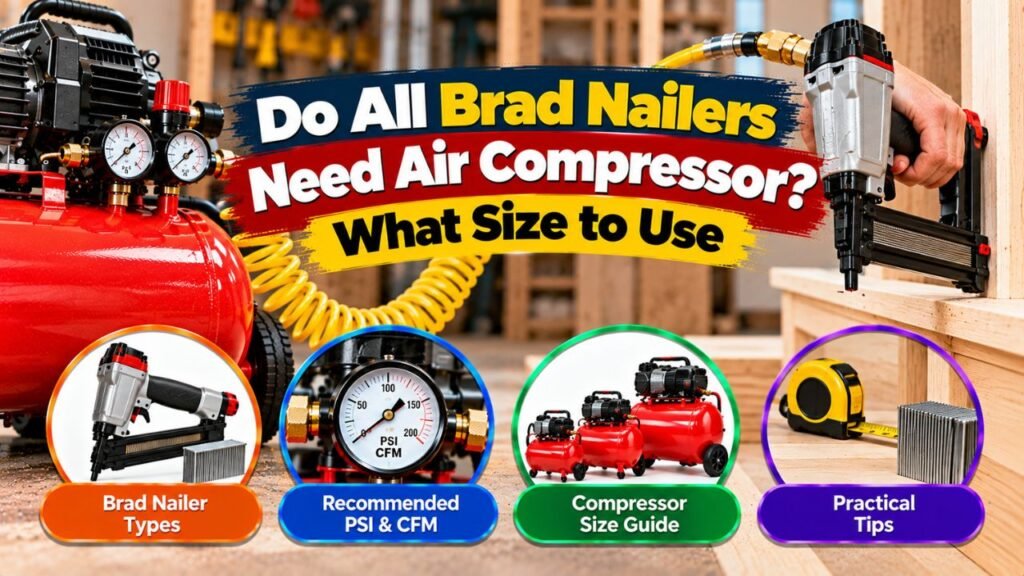
No, do all brad nailers need air compressor power has a simple answer: only pneumatic brad nailers require a separate air compressor.
Brad nailers generally fall into three categories:
- Pneumatic brad nailers
- Cordless battery-powered brad nailers
- Corded electric brad nailers
Each drives the same general type of thin finishing nail, but the power source is different.
Pneumatic Brad Nailer
A pneumatic nailer uses compressed air from a separate air compressor.
You need:
- Air compressor
- Air hose
- Appropriate fittings
- Brad nailer
This remains a popular setup because pneumatic nailers are:
- Lightweight
- Simple
- Fast
- Relatively inexpensive
- Capable of rapid repeated firing
Cordless Brad Nailer
A cordless brad nailer uses a rechargeable battery and internal mechanical or pneumatic mechanism.
No external air compressor is needed.
This eliminates:
- Air hose
- Compressor
- Extension cord
Cordless models are especially convenient for:
- Punch-list work
- Jobsite trim
- Small repairs
- Working in different rooms
- Locations without easy compressor access
The tradeoff is that cordless nailers are generally heavier because the battery and driving mechanism are built into the tool.
Corded Electric Brad Nailer
Some electric brad nailers plug directly into a household electrical outlet.
They also do not require an air compressor.
However, corded models are less common among professional trim carpenters than pneumatic or battery-powered nailers.
What Size Air Compressor for Brad Nailer Use?
For one pneumatic brad nailer, you generally do not need a large compressor.
A compressor with roughly:
- 1–6 gallon tank
- 90–150 PSI maximum pressure
- Around 0.5–1.5 CFM at 90 PSI or more
is usually sufficient for ordinary brad-nailing work.
A small 1-gallon compressor may operate a brad nailer for occasional work, while a 2- to 6-gallon compressor gives you more stored air and reduces how often the motor has to restart.
For most homeowners and DIY users, a 6-gallon pancake compressor provides an excellent balance of:
- Portability
- Air capacity
- Price
- Recovery time
- Versatility
It can usually handle a brad nailer easily and can also run many finish nailers, staplers, and inflation tools.
Quick Air Compressor Size Guide for Brad Nailers
| Compressor Size | Brad Nailer Suitability | Best Use |
| 1 gallon | Good for light use | Occasional repairs and a few nails |
| 2 gallon | Very good | Small trim and craft projects |
| 3 gallon | Very good | General home DIY |
| 4–6 gallon | Excellent | Trim, molding, cabinetry, frequent use |
| 8–10 gallon | More than enough | Multiple light pneumatic tools |
| 20+ gallon | Unnecessary for brad nailer alone | Larger shop and high-air-demand tools |
Tank size affects convenience more than whether the nailer can technically fire.
A brad nailer needs only a small pulse of air for each shot.
How Much CFM Does a Brad Nailer Need?
CFM means cubic feet per minute.
It measures how much air a compressor can deliver.
Brad nailers use relatively little air because they operate intermittently rather than consuming compressed air continuously.
A typical pneumatic brad nailer may require somewhere around 0.3–1 CFM during normal intermittent use, although exact requirements vary by tool and firing rate.
The compressor should provide some margin above the tool’s requirement.
For example, if your nailer requires approximately 0.5 CFM at 90 PSI, a compressor rated for 2.0 CFM at 90 PSI provides plenty of capacity for normal operation.
Always check the nailer’s manual because manufacturers may specify air consumption differently.
How Much PSI Does a Brad Nailer Need?
Most pneumatic brad nailers operate somewhere around:
60–120 PSI
A common working range is approximately:
70–100 PSI
The exact pressure depends on:
- Nail length
- Wood hardness
- Nailer design
- Desired nail depth
You should not automatically set the compressor to maximum pressure.
Start near the lower end of the manufacturer’s recommended range and adjust until the brad sits at the correct depth.
Too much pressure can:
- Drive nails too deeply
- Damage trim
- Leave larger marks
- Stress the nailer unnecessarily
Too little pressure may leave nail heads above the wood surface.
CFM vs PSI: Which Matters More?
Both matter, but they describe different things.
PSI
PSI measures pressure.
It tells you how strongly compressed air is being delivered.
CFM
CFM measures airflow volume.
It tells you how much compressed air the compressor can continuously provide.
A compressor may have a maximum rating of 150 PSI but still deliver relatively little CFM.
For a brad nailer, this usually is not a problem because the tool’s air demand is low.
For continuous tools such as sanders and grinders, however, CFM becomes much more critical.
Does Tank Size Matter for a Brad Nailer?
Yes, but less than many beginners assume.
The air tank stores compressed air.
A larger tank lets you fire more nails before the compressor motor needs to run again.
However, tank size does not determine how quickly the compressor can replace that air.
The compressor pump’s CFM rating determines recovery.
For a brad nailer:
- Small tank = compressor cycles more frequently
- Larger tank = longer intervals between cycles
Even a small tank can work because each nail uses only a small quantity of air.
Is a 1-Gallon Air Compressor Enough for a Brad Nailer?
Yes, for light and intermittent work.
A 1-gallon compressor can be a good option for:
- Crafts
- Small molding repairs
- Furniture projects
- Occasional trim installation
The downside is that the small tank holds relatively little air.
The compressor may cycle more frequently if you fire many nails quickly.
For larger projects, a 2- to 6-gallon compressor is more comfortable to use.
Is a 2-Gallon Air Compressor Enough for a Brad Nailer?
Yes.
A 2-gallon compressor is generally plenty for one brad nailer.
It offers more reserve air than a 1-gallon model while remaining lightweight and easy to transport.
For light woodworking and home improvement, a 2-gallon compressor can be an excellent choice.
Is a 3-Gallon Air Compressor Enough for a Brad Nailer?
Yes.
A 3-gallon compressor is more than adequate for most brad-nailing jobs.
It should comfortably handle:
- Baseboard trim
- Small crown molding
- Door casing
- Cabinet work
- Furniture assembly
provided its PSI and CFM ratings meet the nailer’s specifications.
Is a 6-Gallon Air Compressor Enough for a Brad Nailer?
Absolutely.
A 6-gallon pancake compressor is one of the most popular sizes for pneumatic nail guns.
For a brad nailer, it provides more air capacity than you normally need.
The additional reserve becomes useful if you also operate:
- Finish nailer
- Framing nailer
- Stapler
- Blow gun
- Tire inflator
A 6-gallon compressor is a good all-around choice for someone building a small collection of pneumatic tools.
Do You Need a 20-Gallon Compressor for a Brad Nailer?
No.
A 20-gallon compressor is unnecessary if a brad nailer is the only pneumatic tool you plan to use.
A larger compressor may make sense for a workshop that also operates:
- Impact wrenches
- Air ratchets
- Spray guns
- Die grinders
- Sanders
But the brad nailer itself does not require that much stored air.
Buying an oversized compressor solely for one brad nailer generally adds:
- Cost
- Weight
- Storage requirements
- Noise
without providing a major practical advantage.
Why Brad Nailers Use So Little Air
A brad nailer is an intermittent pneumatic tool.
It consumes air only when the trigger is activated.
Compare that with an air sander.
A sander may consume compressed air continuously for several minutes.
A brad nailer instead uses a brief burst to:
- Move the driver blade.
- Drive the nail.
- Reset the mechanism.
That short operating cycle is why small compressors can handle nailers surprisingly well.
What Is an 18-Gauge Brad Nailer?
Most brad nailers use 18-gauge brad nails.
The gauge refers to nail thickness.
An 18-gauge brad is thin compared with nails used in framing or heavier finish applications.
Brad nails are useful for:
- Small trim
- Decorative molding
- Cabinet trim
- Light furniture assembly
- Crafts
- Thin wood components
Their small diameter leaves a relatively tiny hole that is easy to fill.
Because driving an 18-gauge brad requires relatively little force compared with a framing nail, pneumatic brad nailers also use modest amounts of compressed air.
Brad Nailer vs Finish Nailer Air Requirements
Brad and finish nailers are similar, but finish nailers drive larger fasteners.
An 18-gauge brad nailer generally consumes less air than a 15- or 16-gauge finish nailer.
However, both remain relatively low-demand pneumatic tools.
A 6-gallon pancake compressor can commonly support either one for normal intermittent use.
Brad Nailer vs Framing Nailer Air Requirements
A framing nailer drives much larger nails.
It generally uses more air per shot than a brad nailer.
Even so, framing nailers still consume air intermittently and can often operate from portable compressors.
Rapid production framing can require better compressor recovery because workers may fire nails very quickly.
For a brad nailer, that level of air demand is rarely an issue.
How Fast Can You Fire a Brad Nailer With a Small Compressor?
That depends on:
- Tank size
- Compressor CFM
- Nailer air consumption
- Working pressure
- Firing rate
For normal trim installation, even a compact compressor can generally keep up.
If you fire nails extremely rapidly using bump-fire mode, pressure may eventually fall and the compressor will start recovering.
A larger tank and higher CFM rating allow more rapid continuous work.
What Happens if the Compressor Is Too Small?
An undersized compressor will not necessarily damage the nailer immediately.
Instead, you may notice:
- Compressor runs frequently
- Tank pressure drops quickly
- Nail depth becomes inconsistent
- Nails stop driving fully
- You have to wait for pressure recovery
If this happens regularly, the compressor is not supplying enough air for your firing rate.
Either slow down or use a compressor with greater CFM and tank capacity.
Can a Portable Tire Inflator Run a Brad Nailer?
Usually not.
A tire inflator and an air compressor are not necessarily interchangeable.
Many compact tire inflators:
- Have no storage tank
- Produce very low airflow
- Are designed only for inflation
- Do not have a regulated air-tool outlet
A brad nailer requires a controlled supply of compressed air at the appropriate working pressure.
Use an actual air compressor intended to operate pneumatic tools.
Oil-Free vs Oiled Compressor for Brad Nailer
Either can operate a pneumatic brad nailer.
For most homeowners, an oil-free compressor is the more convenient choice.
Advantages include:
- No compressor oil changes
- Easy portability
- Lightweight designs
- Less routine maintenance
- Many affordable pancake models
An oil-lubricated compressor also works perfectly well and may be preferable in a permanent shop where noise, durability, and long service life are priorities.
For a single brad nailer, lubrication type is much less important than CFM, PSI, size, and portability.
Do Pneumatic Brad Nailers Need Tool Oil?
Some pneumatic brad nailers require a few drops of pneumatic tool oil periodically.
Others are designed as oil-free tools.
This is separate from whether the air compressor itself uses oil.
You could have:
- An oil-free compressor
- Connected to a brad nailer that requires tool oil
The compressor and nailer have separate lubrication requirements.
Follow the nailer’s manual.
Do not assume compressor oil should be poured into the nailer.
What Size Air Hose for a Brad Nailer?
A 1/4-inch air hose is usually sufficient for a brad nailer because airflow requirements are low.
Common lightweight hoses work well for trim work because they are easier to move around rooms without dragging heavily across finished surfaces.
Larger 3/8-inch hoses are more useful for high-CFM tools but generally provide little benefit for a single brad nailer.
Make sure:
- Hose pressure rating exceeds compressor pressure
- Fittings match the tool
- Hose is free from cracks and damage
What Fittings Do You Need?
Most portable compressor and nailer setups use standard quick-connect fittings.
Common components include:
- Compressor coupler
- Air hose
- Male plug on hose
- Female coupler
- Male plug on nailer
Fitting standards vary, so make sure the plugs and couplers are compatible.
Air leaks around poorly matched fittings can cause unnecessary compressor cycling.
How to Connect a Brad Nailer to an Air Compressor
The basic process is simple.
1. Turn the Compressor On
Allow the receiver tank to reach its normal cut-out pressure.
2. Connect the Air Hose
Attach one end to the compressor outlet.
3. Set the Regulator
Adjust the outlet pressure to within the nailer’s recommended operating range.
4. Connect the Nailer
Attach the hose to the pneumatic brad nailer.
5. Test on Scrap Wood
Fire a few nails into scrap material similar to your project.
6. Adjust Pressure or Depth Control
If the brad sits too high, increase driving depth or pressure slightly within the approved range.
If it sinks too deeply, reduce depth or pressure.
Use the nailer’s built-in depth adjustment first when appropriate.
Should You Set the Compressor to Maximum PSI?
No.
The tank may store air at 120, 150, or more PSI, but the regulator controls what reaches the nailer.
Always stay within the tool manufacturer’s operating-pressure range.
Excess pressure does not make the nailer “better.”
It can:
- Increase wear
- Drive fasteners too deeply
- Damage trim
- Create additional recoil
- Exceed the tool’s pressure rating
Use only as much pressure as necessary for consistent fastening.
Cordless vs Pneumatic Brad Nailer
If you have not purchased a nailer yet, both types have advantages.
Pneumatic Brad Nailer Advantages
- Lightweight tool
- Usually lower initial nailer cost
- Fast firing
- Simple internal design
- Excellent for workshop use
Pneumatic Disadvantages
- Requires compressor
- Requires hose
- Compressor creates noise
- Setup takes more time
Cordless Brad Nailer Advantages
- No compressor
- No air hose
- Highly portable
- Fast setup
- Convenient for service work
Cordless Disadvantages
- Heavier
- Battery must remain charged
- Higher initial tool cost in many cases
- More complex internal mechanism
For frequent bench or shop use, pneumatic can be excellent.
For mobility, cordless is often more convenient.
Is Pneumatic or Cordless Better for Beginners?
Both can be beginner-friendly.
A cordless nailer removes the complexity of:
- Regulator settings
- Air hose
- Compressor maintenance
A pneumatic nailer is often lighter and can be very straightforward once the compressor is set up.
For a homeowner who already owns a suitable compressor, buying a pneumatic brad nailer is often economical.
If you do not own any pneumatic equipment and only need one nailer, a cordless model may avoid the expense and storage requirements of an entire air system.
Is a Pancake Compressor Good for Brad Nailer Work?
Yes.
A pancake compressor is one of the best general-purpose compressor designs for pneumatic nailers.
Common benefits include:
- Stable shape
- Compact footprint
- Easy portability
- Usually oil-free
- Enough stored air for nail guns
A 6-gallon pancake model is especially versatile.
It is larger than necessary for one brad nailer but leaves enough capacity for other pneumatic fastening tools you may buy later.
Is a Hot-Dog Compressor Good for Brad Nailers?
Yes.
A hot-dog compressor uses a horizontal cylindrical tank.
A 1- to 4-gallon model can be an excellent option for:
- Trim work
- Furniture projects
- Cabinet installation
- Repairs
They can be easier to carry than some larger pancake models.
Can One Compressor Run Two Brad Nailers?
Yes, if the compressor has enough airflow and the correct manifold setup.
Two nailers do not consume much air if both users fire slowly.
However, two workers rapidly firing fasteners can increase demand considerably.
Add together the approximate air requirements and choose a compressor with adequate CFM.
A larger tank can also reduce how often the compressor cycles.
What If You Want to Run Other Air Tools?
This is where buying decisions change.
If you plan to add:
- Impact wrench
- Air hammer
- Die grinder
- Sander
- Spray gun
do not size the compressor only for the brad nailer.
Size it for the highest-demand tool you realistically expect to use.
A 6-gallon compressor may be excellent for nailers but frustrating with a continuous pneumatic sander.
Planning ahead can prevent having to replace the compressor later.
Compressor Maintenance for Brad Nailer Users
Even if the brad nailer barely uses air, the compressor still needs maintenance.
For oil-free portable compressors:
- Drain tank moisture regularly.
- Keep intake filter clean.
- Inspect hoses.
- Repair leaks.
- Keep cooling vents clear.
- Follow duty-cycle limits.
For oil-lubricated compressors:
- Perform the same general maintenance.
- Check compressor oil.
- Change oil at the specified interval.
Water condensation occurs in both types.
Drain Tank Moisture Regularly
Compressed atmospheric air naturally creates condensation as it cools.
Water can collect inside the receiver tank.
Regular draining helps reduce internal tank corrosion.
For frequent use, draining after the work session is a good general practice unless the manufacturer specifies a different schedule.
Oil-free does not mean moisture-free.
Brad Nailer Safety Tips
Brad nails are thin, but a nailer can still cause serious puncture injuries.
Always:
- Wear eye protection.
- Keep fingers away from the firing area.
- Never point the nailer toward another person.
- Disconnect the air hose before clearing jams.
- Keep the trigger released while connecting air.
- Do not exceed maximum pressure.
- Inspect the tool before use.
- Follow the manufacturer’s firing-mode instructions.
Be especially careful near board edges.
A thin brad can follow wood grain, bend, and exit through the side of the workpiece unexpectedly.
Keep your free hand away from the possible fastener path.
Common Mistakes When Choosing a Compressor for a Brad Nailer
Buying Based Only on Tank Size
Tank size tells you stored-air capacity, not compressor output.
Check CFM.
Assuming Higher PSI Means Better Performance
The nailer only needs pressure within its specified operating range.
Buying an Oversized Compressor
A 60-gallon shop compressor is unnecessary for a single brad nailer.
Buying a Tiny Compressor Without Checking CFM
Most will work, but always verify the actual nailer’s requirements.
Ignoring Future Tools
If you intend to add high-air-demand tools, plan for them now.
Confusing a Tire Inflator With an Air Compressor
Many portable inflators cannot operate pneumatic nailers.
Forgetting the Air Hose and Fittings
A pneumatic setup requires compatible hoses, couplers, and plugs.
FAQs About Do All Brad Nailers Need Air Compressor
Do all brad nailers need an air compressor?
No.
Pneumatic brad nailers require compressed air, but cordless battery-powered and corded electric brad nailers do not require a separate compressor.
What size air compressor for brad nailer work is best?
For most users, a 2- to 6-gallon compressor is ideal.
A 6-gallon pancake compressor is especially versatile, although a 1-gallon unit may be enough for occasional light work.
Is a 1-gallon compressor enough for an 18-gauge brad nailer?
Yes, in many cases.
A 1-gallon compressor can supply an 18-gauge brad nailer for light, intermittent firing. It will simply cycle more frequently than a larger compressor.
Is a 6-gallon compressor too big for a brad nailer?
No.
It provides much more stored air than the nailer needs, but it remains a practical portable size and can support additional pneumatic tools.
How much PSI does a brad nailer need?
Many pneumatic brad nailers operate somewhere around 60–120 PSI, commonly using approximately 70–100 PSI depending on the material and nailer.
Always use the pressure range specified for your particular model.
How much CFM is needed for an 18-gauge brad nailer?
Brad nailers have low intermittent air consumption. A compressor producing roughly 1 CFM at 90 PSI or more is often enough, although a unit rated around 2 CFM or higher provides comfortable reserve capacity.
Check the manufacturer’s specification for the exact nailer.
Can a small portable compressor run a brad nailer?
Yes.
Brad nailers are among the easiest pneumatic tools for a small compressor to operate.
Can you use a brad nailer without an air compressor?
Yes, if you use a cordless battery-powered or electric brad nailer.
A pneumatic brad nailer cannot operate normally without a compressed-air source.
Conclusion
If you are asking do all brad nailers need air compressor power, the final answer is no. Only pneumatic brad nailers need a separate compressor. Cordless battery-powered and corded electric models can drive brads without an external air supply, making them attractive when portability and quick setup matter most.
For a pneumatic model, what size air compressor for brad nailer use is appropriate is much simpler than it is for high-demand air tools. Brad nailers consume only small bursts of compressed air, so a compact 1- to 6-gallon compressor with adequate pressure and roughly 0.5–1.5 CFM at 90 PSI is sufficient for most single-nailer applications. A 6-gallon pancake compressor is an especially practical all-around choice because it comfortably handles brad nailers while leaving room for finish nailers, staplers, and other light pneumatic tools.
The most important takeaway is not to buy a compressor based on tank size or maximum PSI alone. Check the nailer’s required CFM and operating PSI, consider how quickly you will fire nails, and think about any additional air tools you may use in the future.
For occasional home projects, a small oil-free compressor is usually all you need. For users who do not want to deal with a compressor, hose, regulator, and fittings at all, a cordless brad nailer is the simpler alternative. Either setup can work very well—the better choice depends on whether you prioritize a lightweight pneumatic tool and low tool cost or maximum portability and compressor-free operation.