
Can a Pancake Compressor Run Air Tools? Complete Air Tool Guide
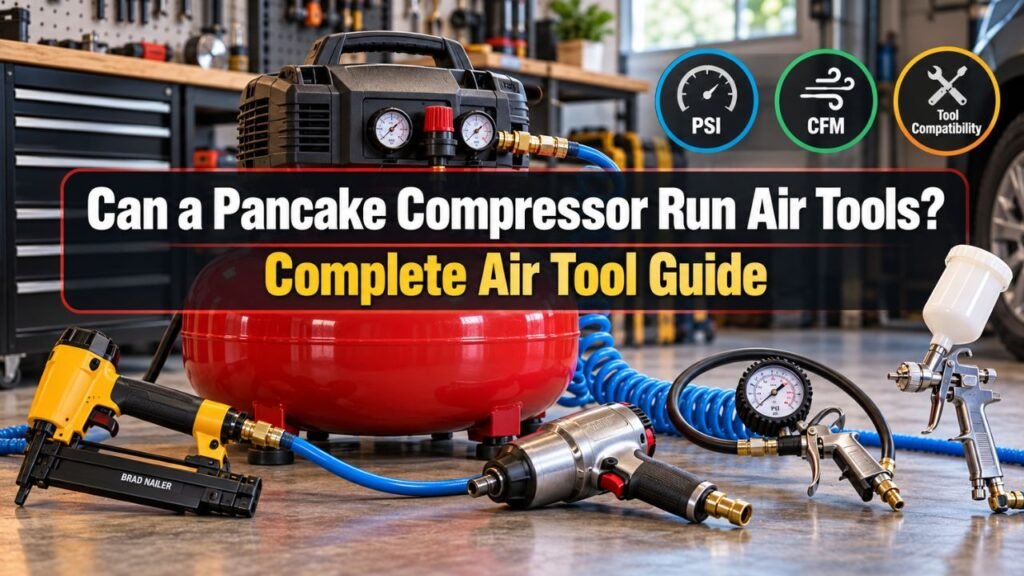
Yes, a pancake compressor can run air tools, but it works best with low-air-demand or intermittent tools such as brad nailers, finish nailers, pin nailers, staplers, tire inflators, and airbrushes. A typical small pancake compressor usually struggles with high-CFM or continuous-use tools such as grinders, sanders, large impact wrenches, sandblasters, and full-size paint guns.
The key limitation is not simply the pancake-shaped tank. It is usually airflow, measured in CFM or SCFM. Many popular 6-gallon pancake compressors produce roughly 2–3 SCFM at 90 PSI. That is plenty for tools that use a short burst of air and then stop, but it can be far below the airflow required by a tool that runs continuously.
Tank capacity matters too. A 6-gallon tank can temporarily supply more air than the compressor pump is producing, which is why an impact wrench or air ratchet may work for a few seconds even when its stated CFM requirement exceeds the compressor’s output. Once that stored air is depleted, however, pressure drops and you have to wait for the compressor to recover.
In this guide, I’ll explain which air tools a pancake compressor can realistically run, which tools are marginal or unsuitable, how CFM and PSI affect performance, whether a 6-gallon compressor can power impact wrenches and other automotive tools, and how to decide when you need a larger compressor.
Can a Pancake Compressor Run Air Tools Successfully?
A pancake compressor can run many pneumatic tools successfully when three conditions are met:
- The compressor can reach the tool’s required PSI.
- It can provide enough CFM or SCFM for the way the tool is used.
- The tool does not consume air continuously faster than the compressor can replace it.
The easiest tools for a pancake compressor are intermittent tools.
A brad nailer, for example, fires one fastener and then stops consuming air. The compressor has time to replenish the tank before the next series of shots.
A grinder works differently. Once you squeeze the trigger, it may consume several cubic feet of air every minute without stopping. A small compressor quickly runs through its stored air and falls behind.
That difference between intermittent and continuous air demand is more important than the physical size of the tool.
Typical 6-Gallon Pancake Compressor Capability
A common 6-gallon pancake compressor typically has specifications somewhere around:
- 6-gallon receiver tank
- Approximately 150–165 PSI maximum tank pressure
- Roughly 2–3 SCFM at 90 PSI
- 120-volt electric motor
- Oil-free pump
- Portable design
Exact specifications vary by model.
If your compressor produces 2.6 SCFM at 90 PSI, for example, a tool requiring 1–2 CFM is generally an easy match.
A tool requiring 4–5 CFM may work intermittently because the tank provides additional stored air.
A tool requiring 8–10 CFM continuously is a poor match because the compressor cannot replenish the tank quickly enough.
Key Takeaways:
- Pancake compressors are best for low-CFM and intermittent pneumatic tools.
- CFM is usually the main limitation, not maximum PSI.
- A tool can temporarily run even when its CFM requirement exceeds pump output because the tank supplies stored air.
- Continuous high-air-demand tools normally require a larger compressor.
Which Air Tools Can a Pancake Compressor Run?
The table below gives a practical overview.
| Air Tool | Typical Air Demand | Pancake Compressor Compatibility | Practical Verdict |
| Pin nailer | Very low | Excellent | Highly suitable |
| Brad nailer | Low | Excellent | Highly suitable |
| Finish nailer | Low | Excellent | Highly suitable |
| Framing nailer | Low to moderate, intermittent | Very good | Usually suitable |
| Roofing nailer | Moderate, intermittent | Good | Works for many jobs |
| Pneumatic stapler | Low | Excellent | Highly suitable |
| Tire inflator | Low | Excellent | Highly suitable |
| Airbrush | Very low | Excellent | Suitable with proper regulation |
| Blow gun | Varies | Good for short use | Avoid prolonged blowing |
| Air ratchet | Around 3–5 CFM | Marginal | Short bursts only |
| 1/2-inch impact wrench | Around 3–6 CFM average | Marginal | Occasional short bursts |
| Air hammer | Around 3–6+ CFM | Marginal | Limited use |
| Pneumatic drill | Moderate to high | Marginal/poor | Recovery pauses likely |
| Die grinder | High continuous demand | Poor | Larger compressor preferred |
| Angle grinder | High continuous demand | Poor | Not recommended |
| Orbital sander | High continuous demand | Poor | Not recommended |
| Full-size spray gun | Moderate/high continuous demand | Poor | Usually undersized |
| Sandblaster | Very high demand | Very poor | Not recommended |
These figures are general planning ranges. Always use the CFM and PSI requirements listed for your actual tool.
Nail Guns Are One of the Best Uses for a Pancake Compressor
Pancake compressors became popular partly because they are extremely well suited to pneumatic nailers.
Nail guns use compressed air differently from rotary pneumatic tools.
When you fire a nail, the tool uses a quick burst of compressed air. After firing, air consumption effectively stops until you pull the trigger again.
That gives the compressor time to recover.
Brad Nailer
A brad nailer is an excellent match.
These tools use small 18-gauge fasteners and relatively little air.
Even a compact pancake compressor normally has enough stored air to fire many brads before the motor needs significant recovery time.
Pin Nailer
A 23-gauge pin nailer needs even less air.
For trim, cabinetry, small woodworking projects, and finish work, a pancake compressor is more than adequate in most situations.
Finish Nailer
A 15- or 16-gauge finish nailer also works very well with a pancake compressor.
The fastener is larger than a brad, so each shot uses somewhat more air, but consumption is still intermittent.
Framing Nailer
A framing nailer is more demanding, but a pancake compressor can normally run one successfully.
The main limitation appears when firing rapidly for long periods.
If you are driving a few nails at a time, the compressor can usually keep up easily.
If you are bump-firing continuously during production framing, the compressor may run frequently and tank pressure can start falling.
Roofing Nailer
Roofing nailers can also work with a pancake compressor.
However, professional roofing involves extremely rapid repetitive firing. A small compressor may struggle to recover fast enough for a crew working continuously.
For one user doing repairs or smaller roofing projects, a pancake compressor is generally much more practical.
Key Takeaways:
- Nailers are among the best air tools for pancake compressors.
- Brad, pin, finish, and stapling tools normally require very little continuous airflow.
- Framing and roofing nailers can work, but rapid production use may outrun a small compressor.
- Intermittent air use is why nailers perform much better than grinders on the same compressor.
Can a Pancake Compressor Run an Impact Wrench?
Yes, a pancake compressor can run many impact wrenches temporarily, but it is not an ideal compressor for frequent impact-wrench use.
This answer sometimes causes confusion because people compare only tool CFM with compressor CFM.
Suppose your pancake compressor produces:
2.6 SCFM at 90 PSI
and your 1/2-inch impact wrench averages:
4–5 CFM at 90 PSI
The compressor pump cannot continuously produce air as quickly as the wrench can consume it.
However, the 6-gallon tank contains stored compressed air.
When you pull the trigger, the impact wrench draws from that reserve. For a short burst, it may work perfectly well.
As you continue using it, tank pressure falls.
Eventually:
- The wrench loses power.
- The compressor runs continuously.
- Recovery time increases.
- You have to pause before continuing.
Can It Remove Lug Nuts?
Often, yes.
A pancake compressor may be perfectly adequate if your routine looks like this:
- Charge the compressor fully.
- Loosen one lug nut for one or two seconds.
- Release the trigger.
- Move to the next nut.
- Allow occasional compressor recovery.
Impact wrenches are naturally intermittent, so this can work.
Problems occur when lug nuts are heavily rusted, severely overtightened, or require prolonged hammering.
Long trigger times consume much more air.
Is a Pancake Compressor Good for Regular Automotive Work?
I would not choose one specifically for frequent pneumatic automotive work.
If your garage regularly uses:
- 1/2-inch impact wrench
- Air ratchet
- Air hammer
- Die grinder
- Pneumatic drill
- Cut-off tool
a larger compressor makes much more sense.
For regular impact-wrench use, a compressor in the 20–30 gallon range with roughly 5–8 SCFM at 90 PSI is far more comfortable.
Can a Pancake Compressor Run an Air Ratchet?
An air ratchet typically requires more airflow than a pancake compressor can continuously provide.
Many fall somewhere around 3–5 CFM at approximately 90 PSI.
A typical small pancake compressor may only deliver around 2–3 SCFM.
You can still use the ratchet in short intervals.
This works reasonably well when removing a few already-loosened bolts.
It becomes frustrating when:
- Running long fasteners.
- Working continuously.
- Performing extended automotive repairs.
- Using the ratchet repeatedly without pauses.
If an air ratchet is one of your primary tools, I would prefer a compressor with higher continuous airflow.
Can a Pancake Compressor Run an Air Hammer?
An air hammer may work temporarily, but it is a relatively demanding tool for a small compressor.
Air hammers need a continuous stream of compressed air whenever the trigger is held.
You may get enough runtime for brief jobs such as:
- Knocking out a small pin.
- Breaking a stubborn component loose.
- Short chiseling operations.
For prolonged cutting, scraping, or hammering, tank pressure can drop quickly.
If you frequently use an air hammer for automotive or fabrication work, a larger compressor will provide much more consistent performance.
Can a Pancake Compressor Run a Die Grinder?
Technically, it may spin a die grinder.
Practically, I would not recommend the combination for serious work.
A pneumatic die grinder uses air continuously while running and often needs considerably more airflow than a pancake compressor can produce.
You may notice:
- Strong speed for the first few seconds.
- Rapid RPM loss.
- Constant compressor operation.
- Increasing recovery time.
- Poor cutting or grinding performance.
A die grinder benefits much more from a larger tank and higher-CFM pump.
For small garages limited to a pancake compressor, an electric or cordless die grinder is usually a better match.
Can a Pancake Compressor Run an Angle Grinder?
A pneumatic angle grinder is normally a poor choice for a pancake compressor.
Grinding requires sustained tool speed and torque.
If pressure drops, the grinder slows and becomes less effective.
Unlike a nail gun that uses one burst of air per shot, a grinder consumes air every second that it runs.
I would use a larger compressor for pneumatic grinding or choose an electric grinder instead.
Can a Pancake Compressor Run an Orbital Sander?
An air-powered orbital or dual-action sander is one of the worst matches for a small pancake compressor.
Sanders typically run for long periods without stopping.
This creates heavy continuous airflow demand.
A pancake compressor may run the sander briefly, but you are likely to spend more time waiting for the tank to recharge than sanding.
If pneumatic sanding is important, choose a substantially higher-CFM compressor.
For occasional DIY work, a corded or cordless electric sander is usually far more practical.
Can a Pancake Compressor Run a Paint Sprayer?
It depends heavily on the spray gun.
Some very small detail guns may be usable.
Most full-size automotive or woodworking spray guns require more continuous airflow than a pancake compressor can comfortably provide.
The problem is especially noticeable with HVLP spray equipment.
Although an HVLP gun may operate at relatively low pressure, it can require a large volume of air.
That is an important distinction:
Low PSI does not mean low CFM.
A pancake compressor can reach enough pressure easily, but it may not deliver enough continuous airflow.
What Happens When the Compressor Is Too Small?
During painting, you may experience:
- Falling pressure.
- Inconsistent spray pattern.
- Poor atomization.
- Changing fan shape.
- Uneven finish.
- Compressor running almost continuously.
For small touch-up work, a low-CFM detail spray gun can be workable.
For painting vehicles, large panels, cabinets, or other substantial projects, I would use a larger compressor.
Can a Pancake Compressor Run a Blow Gun?
Yes, but runtime makes a major difference.
A blow gun can consume a surprising amount of air when held open continuously.
Short bursts for:
- Cleaning a workbench.
- Blowing dust from equipment.
- Clearing small parts.
are normally no problem.
Holding the trigger continuously for several minutes can drain a 6-gallon tank quickly.
A properly designed safety nozzle should also be used rather than modifying the blow gun for unrestricted airflow.
Can a Pancake Compressor Inflate Car Tires?
Yes.
Tire inflation is one of the most practical jobs for a pancake compressor.
A typical car tire does not require continuous high CFM.
The compressor can easily reach common passenger-tire pressures.
It is also useful for:
- SUV tires.
- Light-truck tires.
- Bicycle tires with the correct adapter.
- Lawn equipment tires.
- Trailer tires.
- Sports equipment.
Larger tires simply take longer to fill.
Remember that the compressor’s 150-PSI or 165-PSI maximum tank rating does not mean you should inflate a tire anywhere near that pressure.
Always use the vehicle or tire application’s correct inflation specification.
Can a Pancake Compressor Run an Airbrush?
Yes. An airbrush is one of the easiest pneumatic devices for a pancake compressor to operate.
Airbrushes generally use low pressure and modest airflow.
A pancake compressor actually provides far more stored-air capacity than many dedicated airbrush compressors.
You will need a good regulator so the output can be reduced to the lower pressure required by the airbrush.
For painting applications, adding a moisture separator is also useful because compressed air can contain water vapor and condensate.
Why CFM Matters More Than Maximum PSI
A common compressor-shopping mistake is choosing the machine with the biggest PSI number.
Suppose a pancake compressor says:
165 PSI MAX
That sounds powerful.
But your air tool may operate at only 90 PSI.
What really determines whether the compressor can keep that tool running is how much airflow the compressor delivers at 90 PSI.
PSI Means Pressure
PSI stands for pounds per square inch.
Think of it as the force or pressure available inside the air system.
CFM Means Air Volume
CFM stands for cubic feet per minute.
It describes how much air flows.
A pneumatic tool can have plenty of pressure but still perform poorly because it is not receiving enough volume.
For example, an impact wrench may require approximately 90 PSI and several CFM.
A compressor that reaches 150 PSI but delivers only 2.5 SCFM at 90 PSI may still struggle.
SCFM vs. CFM
You will often see compressors rated in SCFM, meaning standard cubic feet per minute.
For normal tool matching, compare the compressor’s SCFM output with the tool manufacturer’s CFM or SCFM requirement at the specified pressure.
Do not compare:
CFM at 40 PSI
with
tool demand at 90 PSI
as though those were equivalent.
Use the rating at the closest matching pressure.
Key Takeaways:
- Maximum PSI tells you pressure capacity; CFM tells you how much usable airflow is available.
- A compressor can reach high PSI and still be too small for an air tool.
- Compare compressor output and tool consumption at approximately the same pressure.
- Continuous pneumatic tools depend much more heavily on compressor CFM.
How Tank Size Helps a Pancake Compressor Run Bigger Tools
The compressor tank acts as an air-storage reservoir.
This explains why a 6-gallon compressor can sometimes power a tool whose airflow requirement exceeds the pump’s continuous rating.
Imagine:
Tool demand = 5 CFM
Compressor output = 2.6 SCFM
The compressor is short by approximately 2.4 cubic feet per minute while the tool is operating.
Stored air in the tank temporarily supplies that difference.
Eventually, the reserve falls and the compressor cannot keep up.
Bigger Tank Does Not Mean Bigger Pump
This is another important distinction.
Adding a larger external tank can increase available stored air and extend short-term runtime.
It does not increase the compressor pump’s CFM.
Once the additional stored air is depleted, the same small pump still has to recharge everything.
For continuous tools, increasing pump capacity is more useful than simply increasing tank capacity.
How to Tell Whether Your Pancake Compressor Can Run a Tool
You can determine compatibility in a few simple steps.
1. Find Your Compressor’s SCFM Rating
Look at:
- Compressor data plate.
- Manual.
- Manufacturer specification sheet.
Find the rating at the pressure closest to the tool’s requirement.
For most shop tools, this is commonly the SCFM rating at 90 PSI.
2. Find the Air Tool’s CFM Requirement
Check the tool’s manual or specification label.
Do not assume every impact wrench, grinder, or nailer uses the same amount of air.
3. Compare the Numbers
If the compressor CFM equals or exceeds tool demand, the combination is usually much more suitable for extended use.
If tool demand is moderately higher than compressor output, intermittent operation may still work using stored tank air.
If tool demand is several times greater than compressor output, the combination is generally impractical.
4. Consider How Long You Hold the Trigger
This is critical.
A tool requiring 5 CFM for two-second bursts is much easier for a small compressor than a tool requiring 5 CFM continuously for five minutes.
5. Account for Multiple Tools
If two people use pneumatic tools at the same time, their air consumption can overlap.
A pancake compressor that easily runs one nailer may struggle when two high-cycle nailers are being used heavily.
What Size Air Hose Should You Use?
Air hose size can affect tool performance.
Many pancake-compressor kits use 1/4-inch hose, which is appropriate for:
- Nailers.
- Staplers.
- Inflation.
- Light blow-gun use.
Higher-flow automotive tools often benefit from 3/8-inch inside-diameter hose.
That includes many:
- Impact wrenches.
- Air ratchets.
- Air hammers.
- Grinders.
A restrictive hose or quick coupler creates pressure drop.
This can make an already small compressor appear even weaker.
Keep hose runs reasonably short and follow the air-tool manufacturer’s minimum hose-size recommendation.
Why Does My Air Tool Lose Power on a Pancake Compressor?
If the tool begins strong and weakens after several seconds, the most likely cause is insufficient sustained airflow.
Other possibilities include:
| Problem | Likely Cause |
| Tool starts strong, then slows | Tank is losing stored air faster than pump replaces it |
| Pressure falls when trigger is pulled | Compressor CFM is too low or airflow is restricted |
| Compressor never seems to stop | Tool demand is too high |
| Impact wrench feels unusually weak | Hose/coupler restriction or inadequate airflow |
| Nailer stops driving fully | Regulator pressure too low or compressor needs recovery |
| Tool remains weak with a full tank | Hose, regulator, coupler, lubrication, or tool problem |
| Excessive water at the tool | Tank needs draining or additional moisture control |
Do not compensate for poor airflow by raising pressure above the tool manufacturer’s maximum rating.
Fix the underlying restriction or use a compressor with more CFM.
Should You Buy a Pancake Compressor for Air Tools?
It depends on the tools you plan to use.
A Pancake Compressor Is a Good Choice If You Mainly Use:
- Brad nailers
- Pin nailers
- Finish nailers
- Framing nailers
- Roofing nailers
- Pneumatic staplers
- Tire inflators
- Airbrushes
- Blow guns in short bursts
For this type of work, the pancake design gives you useful advantages:
- Portable size
- Easy storage
- Standard household electrical power
- Low maintenance on oil-free models
- Enough air for intermittent tools
- Relatively low purchase cost
I Would Choose a Larger Compressor If You Mainly Use:
- Impact wrenches frequently
- Air ratchets regularly
- Air hammers
- Die grinders
- Angle grinders
- Pneumatic sanders
- Full-size paint guns
- Sandblasters
- Multiple air tools simultaneously
For these jobs, I would prioritize compressor CFM rather than portability.
My Recommendation
If your main jobs are nailing, inflating, stapling, and occasional short-burst pneumatic work, a pancake compressor is an excellent choice.
If you are building an automotive workshop around pneumatic tools, I would skip the pancake compressor as the primary air source and consider a 20–30 gallon or larger compressor with at least 5–8 SCFM at 90 PSI, depending on the tools.
For grinders, sanders, serious spray painting, or multiple simultaneous tools, you may need considerably more airflow.
Safety Tips for Running Air Tools From a Pancake Compressor
Compressed air stores considerable energy, so use the equipment according to manufacturer instructions.
Before connecting a tool:
- Check the hose for cuts, cracks, or damaged fittings.
- Confirm the tool’s maximum allowable pressure.
- Set the regulator to the recommended working pressure.
- Wear appropriate eye and hearing protection.
- Use impact-rated sockets with impact wrenches.
- Disconnect tools before maintenance when instructed.
- Drain moisture from the compressor tank as recommended.
- Never modify the pressure switch or safety valve.
- Do not exceed the compressor’s rated duty cycle.
Allow adequate ventilation around the compressor motor and pump.
If the compressor becomes unusually hot or repeatedly trips its thermal protection, stop using it and determine whether the workload exceeds its capabilities.
Important Tip: A compressor running continuously is not automatically unsafe, but a small compressor that is repeatedly pushed beyond its manufacturer’s duty-cycle limits can overheat and wear prematurely.
Key Takeaways:
- Use the regulator to supply the pressure specified for the tool rather than maximum tank pressure.
- Check hose size and couplers when a pneumatic tool feels weak.
- Do not try to solve low CFM by exceeding the tool’s pressure limit.
- For frequent high-demand pneumatic work, upgrading compressor capacity is better than constantly waiting for a pancake compressor to recover.
FAQs about Can a Pancake Compressor Run Air Tools
What air tools can a 6 gallon pancake compressor run?
A 6-gallon pancake compressor is well suited to brad nailers, pin nailers, finish nailers, framing nailers, staplers, tire inflators, airbrushes, and occasional blow-gun use.
It can also operate some impact wrenches, air ratchets, and air hammers for short periods, but recovery pauses are likely.
Can a pancake compressor run a 1/2-inch impact wrench?
Yes, for intermittent use.
A typical pancake compressor may produce less continuous airflow than a 1/2-inch impact wrench requires, but stored tank air can power short trigger bursts.
For frequent lug-nut or automotive work, a larger compressor is more practical.
Can a pancake compressor remove lug nuts?
It often can if paired with an efficient impact wrench and the lug nuts are not excessively seized.
Let the compressor fully charge before starting and use short trigger bursts.
If the tool loses power, allow tank pressure to recover.
Can a 6 gallon compressor run an air ratchet?
Yes, but usually with limitations.
Many air ratchets require more continuous airflow than a typical 6-gallon pancake compressor produces, so extended operation can result in pressure loss and recovery pauses.
Can you run a die grinder with a pancake compressor?
A die grinder may operate briefly, but I do not recommend a pancake compressor for regular pneumatic grinding.
Die grinders consume air continuously and quickly exhaust a small receiver.
Can a pancake compressor run a framing nailer?
Yes.
A framing nailer is one of the better matches because it uses compressed air intermittently.
For rapid production framing, compressor recovery can become a limitation.
Can a pancake compressor run two nail guns?
Potentially, yes.
Many pancake compressors have two outlets, and two low-air-demand nailers can operate from the same unit.
Whether the compressor keeps up depends on how rapidly both users fire.
Two users working continuously can exceed the recovery capability of a small compressor.
Can a pancake compressor run a spray gun?
Small detail spray guns may work.
Full-size spray guns often require too much continuous CFM for a pancake compressor to maintain consistent atomization.
Check the exact spray gun requirement before deciding.
Is a pancake compressor good for painting cars?
Generally, no.
Automotive spray painting requires sustained airflow and stable pressure across large areas.
A small pancake compressor is normally better suited to small touch-up work than full vehicle painting.
Can a pancake compressor run an orbital sander?
It can make the sander operate briefly, but it is generally not a practical combination.
Pneumatic sanders use large amounts of air continuously, so a pancake compressor quickly runs out of reserve capacity.
Can a pancake compressor run an air hammer?
Yes, for brief use.
For prolonged chiseling, cutting, or hammering, a larger compressor with higher CFM is much better.
Can a pancake compressor run a tire inflator?
Yes.
Tire inflation is one of the best applications for a pancake compressor.
Passenger-car tires, light-truck tires, bicycles, trailers, and lawn equipment can normally be inflated without difficulty, provided you use the correct target pressure.
Is a pancake compressor good for automotive tools?
It is useful for tire inflation, cleaning, and occasional short-burst pneumatic-tool use.
It is not my first choice as the main compressor for a garage that regularly uses impact wrenches, air ratchets, air hammers, die grinders, or sanders.
Is 2.6 SCFM enough for air tools?
It is enough for many intermittent tools such as nailers and staplers.
For an impact wrench or air ratchet, 2.6 SCFM may provide limited intermittent operation.
For grinders and sanders, it is generally too low for sustained performance.
Is 150 PSI enough for air tools?
Yes, in terms of available pressure for most common pneumatic hand tools.
However, maximum PSI alone does not determine compatibility.
You also need enough CFM at the tool’s specified operating pressure.
What is more important for air tools, PSI or CFM?
Both matter, but CFM is often the specification that limits a pancake compressor.
The compressor must reach the required pressure and supply enough airflow to maintain that pressure while the tool operates.
Can I add a bigger tank to a pancake compressor?
It is possible to add external air storage to some properly configured systems, but a larger tank does not increase pump CFM.
It gives you longer temporary runtime followed by a longer recharge period.
For high-demand tools, upgrading the compressor itself is usually the better solution.
How do I make my pancake compressor work better with air tools?
Start by using the correct regulator setting, minimizing unnecessary hose length, checking for leaks, and using an adequately sized hose and couplers.
Allow the tank to reach full pressure before starting demanding tools.
If the tool still consumes air faster than the compressor can provide it, the only meaningful long-term solution is greater compressor airflow.
Conclusion
So, can a pancake compressor run air tools? Yes—but its strengths are low-air-demand and intermittent pneumatic tools rather than equipment that requires continuous high airflow.
A typical 6-gallon pancake compressor is an excellent match for brad nailers, finish nailers, pin nailers, staplers, framing nailers, tire inflation, airbrushes, and similar tasks. It can also run an impact wrench, air ratchet, or air hammer for short periods by drawing on air stored in the tank.
The limitations become obvious with die grinders, angle grinders, orbital sanders, full-size spray guns, sandblasters, and other continuous-use tools. These tools can consume air far faster than a small pancake compressor can replace it.
My recommendation is to choose by SCFM at the tool’s operating PSI, not by maximum tank pressure or gallons alone. If your jobs mostly involve nailers and inflation, a pancake compressor is one of the most convenient compressor styles you can own. If pneumatic automotive tools, grinding, sanding, or painting are a major part of your work, moving to a larger, higher-CFM compressor will give you much better performance and far less waiting.