
What Happens If You Don’t Drain Air Compressor? Risks & Fixes
If you don’t drain an air compressor, water gradually collects inside the tank. Over time, that moisture can cause internal rust, contaminate your air lines and tools, reduce usable tank capacity, and eventually weaken the pressure vessel.
Understanding what happens if you don’t drain air compressor tanks is important because condensation is a normal part of compressing air. Every time your compressor pulls humid atmospheric air into the pump, some of that moisture eventually condenses into liquid water as the compressed air cools inside the receiver tank.
A small amount of water after one use may not seem serious. The problem develops when that water repeatedly remains at the bottom of the tank. Steel and moisture are a bad combination, especially when the inside surface is difficult to inspect. Corrosion can slowly develop without obvious signs from the outside.
Regularly draining the tank is therefore one of the simplest and most important air-compressor maintenance tasks. It helps protect the receiver, keeps water out of downstream equipment, and allows you to notice unusual amounts of condensate before they become a larger problem.
What Happens If You Don’t Drain Air Compressor?
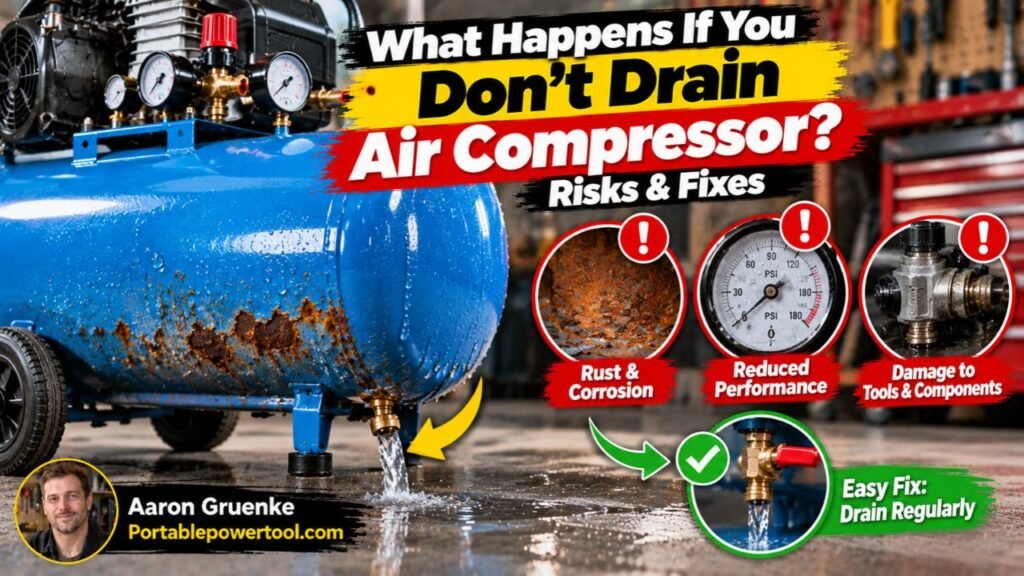
If you do not drain an air compressor tank, condensed water accumulates inside the receiver.
Over time, that can lead to:
- Internal tank corrosion
- Rust contamination in the drain water
- Moisture entering air hoses and tools
- Problems with spray painting
- Reduced usable tank volume
- Increased water in downstream filters
- Damage to pneumatic tools
- Frozen drain lines in cold conditions
- Eventual weakening of the tank in severe, long-term cases
The most serious concern is internal corrosion because an air receiver is a pressurized vessel.
You cannot normally see the bottom interior of the tank, which means corrosion may progress unnoticed.
Why Does Water Collect Inside an Air Compressor Tank?
Air always contains some amount of water vapor.
When the compressor draws atmospheric air into the pump, it compresses that air to a much higher pressure. Compression heats the air, but once the hot compressed air moves into the receiver tank, it begins cooling.
As the temperature drops, the air can no longer hold as much water vapor.
The excess moisture condenses into liquid and settles at the bottom of the tank.
The amount of water produced depends on:
- Ambient humidity
- Air temperature
- Compressor run time
- Tank temperature
- Compressor size
- Amount of air being compressed
- How frequently the compressor cycles
A compressor operating on a hot, humid summer day may collect significantly more water than the same compressor used briefly in cool, dry weather.
Internal Rust Is the Biggest Long-Term Concern
Most conventional air-compressor receiver tanks are made from steel.
When liquid water remains against steel for extended periods, corrosion can develop.
This rust usually begins on the inside where you cannot easily see it.
Over time, corrosion can:
- Pit the metal
- Thin the tank wall
- Produce rust flakes
- Damage the drain valve
- Reduce the structural integrity of the receiver
This does not mean a tank will suddenly fail because you forgot to drain it once.
The concern is repeated neglect over months or years.
Regular draining removes accumulated liquid and reduces the amount of time water sits against the bottom of the tank.
Can an Air Compressor Tank Rust From the Inside?
Yes.
Internal rust is one of the main reasons manufacturers instruct owners to drain accumulated condensate.
You may notice signs such as:
- Brown or orange drain water
- Rust particles coming from the drain
- A drain valve that becomes difficult to operate
- Heavy scale or debris at the drain opening
A small amount of discoloration does not automatically mean the tank is unsafe, but significant corrosion should not be ignored.
If you suspect severe tank deterioration, have the receiver inspected according to the compressor manufacturer’s recommendations.
Do not attempt to weld, patch, or modify a damaged pressure vessel unless the repair is performed by an appropriately qualified facility and permitted by the manufacturer and applicable requirements.
Does Water Reduce Air Compressor Tank Capacity?
Yes, although the effect is usually small at first.
Liquid water sitting at the bottom of the tank occupies physical space that would otherwise be available for compressed air.
A small amount of water may make little practical difference.
If a large quantity accumulates, however, the tank effectively has less usable air-storage volume.
That can contribute to:
- Shorter time between compressor cycles
- Reduced stored-air reserve
- More frequent motor operation
If substantial water comes out every time you finally open the drain, the compressor may need to be drained more often.
Water Can Enter Your Air Lines
Water does not always stay in the receiver tank.
Some moisture can travel downstream with the compressed air and enter:
- Hoses
- Regulators
- Filters
- Pneumatic tools
- Spray equipment
- Air manifolds
This becomes especially noticeable when the compressor is working hard and producing warm, moisture-laden air.
A tank drain helps remove bulk liquid, although it cannot remove all water vapor from compressed air.
For moisture-sensitive applications, additional air treatment may still be necessary.
What Happens to Air Tools If You Don’t Drain the Compressor?
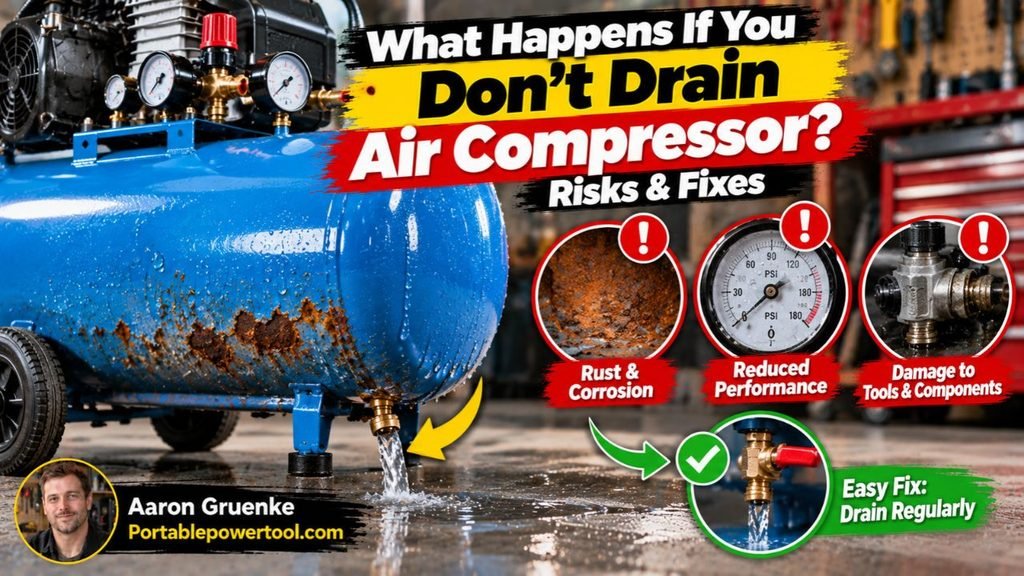
Excessive moisture can shorten the life of pneumatic tools.
Water entering an air tool can contribute to:
- Internal corrosion
- Rust
- Sticky mechanisms
- Lubricant contamination
- Premature wear
Tools such as impact wrenches, air ratchets, nailers, and pneumatic grinders contain internal metal components that perform best with clean, properly treated compressed air.
Draining the receiver is an important first step in moisture control.
A water separator, filter, or dryer may also be needed depending on the tool and operating environment.
Why Water Is a Problem When Spray Painting
Moisture is particularly undesirable in compressed-air painting.
If water travels through the hose and reaches the spray gun, it can contribute to finish problems such as:
- Poor adhesion
- Blushing or cloudiness
- Surface defects
- Contamination
- Uneven finish
Simply draining the compressor tank may not be enough for high-quality automotive or finishing work.
A proper painting setup often includes:
- Moisture separator
- Coalescing filter
- Air regulator
- Dryer when required
However, regularly draining the tank reduces the amount of liquid water the downstream system has to handle.
Can Water Damage an Air Compressor Pump?
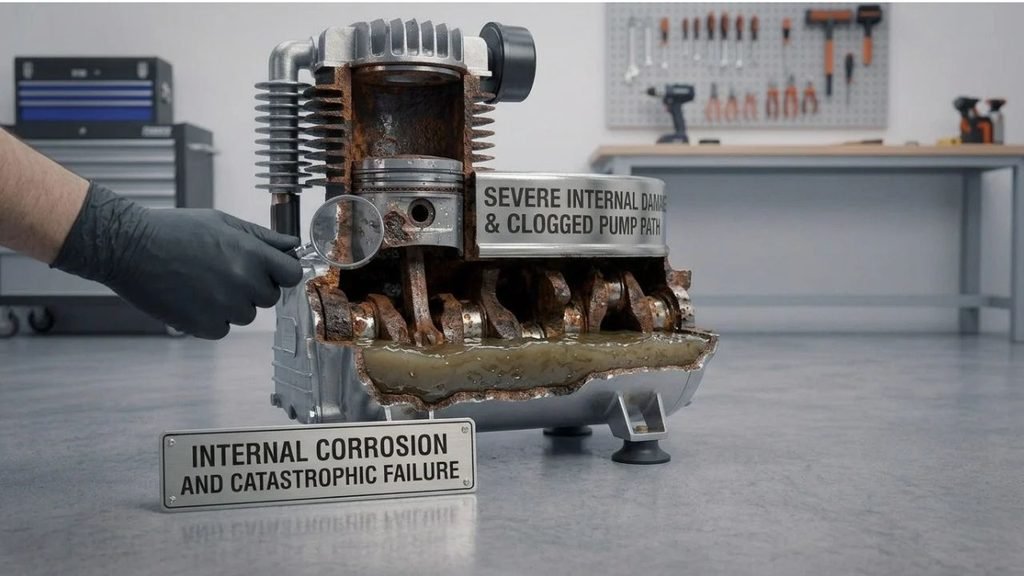
The water you drain from the receiver is mainly a tank and downstream-air issue rather than something that normally flows backward into the pump.
However, excessive moisture throughout an air system can contribute to corrosion and contamination in various components.
Keeping the entire compressor system dry where practical helps protect:
- Tank
- Drain valve
- Check valve
- Regulators
- Air lines
- Connected equipment
Proper drainage is one part of overall moisture management.
Can an Air Compressor Tank Explode From Not Being Drained?
Severe internal corrosion can weaken a pressure vessel, which is why tank maintenance should be taken seriously.
However, it would be misleading to say that failing to drain a compressor once will make the tank explode.
The real concern is long-term corrosion combined with continued pressurization.
If the tank becomes significantly thinned, deeply pitted, bulged, cracked, or otherwise damaged, it should be removed from service.
Never continue using a visibly compromised pressure vessel simply because it still holds pressure.
How Often Should You Drain an Air Compressor?
There is no universal interval for every compressor.
The manufacturer’s instructions should take priority.
For many portable and shop compressors, draining accumulated condensate after regular use or at the end of the workday is a common maintenance practice, particularly in humid conditions.
How often you need to drain depends on:
- Humidity
- Amount of use
- Tank size
- Compressor duty cycle
- Operating temperature
- Installation environment
A lightly used home compressor in a dry climate may produce relatively little water.
A busy shop compressor operating all day in humid weather may produce a considerable amount.
Should You Drain an Air Compressor After Every Use?
For many consumer compressors, draining after use is a simple and sensible habit.
It is especially useful when:
- The compressor ran for a long time.
- Weather is humid.
- A noticeable amount of condensate normally collects.
- The compressor will be stored for an extended period.
Always follow the manufacturer-specific draining procedure.
You generally do not need to dismantle anything; most compressors have a drain valve at or near the lowest part of the tank.
How to Drain an Air Compressor Safely
Exact procedures vary, so follow your compressor manual.
A typical process looks like this:
- Turn the compressor off.
- Disconnect electrical power when instructed by the manufacturer.
- Reduce tank pressure to the recommended level before opening the drain.
- Position the compressor as directed so condensate can reach the drain valve.
- Place a suitable container or absorbent material below the drain.
- Slowly open the drain valve.
- Allow water and air to escape.
- Close the valve after the tank has drained.
- Check the valve for leakage.
Be careful because pressurized air can force water and debris out rapidly.
Keep your face and eyes away from the discharge path.
Read Complete Guide: how to drain water from air compressor
Should You Completely Depressurize the Tank Before Draining?
Follow the manufacturer’s instructions.
Many drain procedures use a small amount of remaining tank pressure to help push condensate out of the receiver.
However, opening a drain valve at very high pressure can cause liquid and debris to discharge forcefully.
Do not improvise.
Use the pressure level and procedure specified for your compressor.
Why Does Dirty Brown Water Come Out of My Compressor?
Brown or reddish condensate usually indicates that water has contacted rust inside the tank or drainage system.
Some discoloration can develop over time in steel receivers.
If the drainage becomes heavily rust-colored or contains flakes and sediment, inspect the compressor more carefully.
You should also verify that:
- The drain opens fully.
- The tank is being drained frequently enough.
- The compressor is not showing external signs of corrosion.
- The receiver is still within any applicable inspection or service requirements.
Serious corrosion should be evaluated rather than ignored.
What If Nothing Comes Out of the Drain Valve?
If you expect water but nothing drains, several explanations are possible.
The tank may simply be dry.
Alternatively, the drain valve could be blocked by:
- Rust
- Scale
- Dirt
- Debris
Do not insert random metal objects into a pressurized receiver.
Safely depressurize the compressor according to the manual before inspecting or servicing a blocked drain valve.
A damaged or clogged drain may need replacement.
Manual Drain vs. Automatic Drain Valve
Some compressors require manual draining, while others use an automatic drain valve.
Manual Drain
A manual valve is simple and inexpensive.
The disadvantage is that someone must remember to open it regularly.
Automatic Drain
An automatic drain periodically discharges accumulated condensate without requiring the operator to manually open the valve each time.
Automatic drains can be useful for:
- Busy workshops
- Large stationary compressors
- Commercial systems
- Compressors used every day
The drain itself still requires inspection and maintenance because it can become clogged or fail.
Can You Leave the Drain Valve Open During Storage?
Some manufacturers may recommend storing a compressor with the tank depressurized and the drain arranged in a particular way, while others may provide different instructions.
Follow the owner’s manual.
Leaving a drain valve partially open while the compressor is operating is not appropriate because it creates a continuous air leak and forces the compressor to work unnecessarily.
For storage, the main goals are usually to remove condensate and avoid leaving the receiver unnecessarily pressurized when manufacturer guidance recommends otherwise.
Why Does My Compressor Produce So Much Water?
Large amounts of condensate do not necessarily indicate a compressor defect.
Common reasons include:
High Humidity
Humid air contains more water vapor.
The compressor therefore has more moisture to condense.
Long Run Time
The more air the compressor processes, the more moisture it can collect.
Hot Weather
Warm atmospheric air can carry substantial humidity.
As the compressed air later cools, more water can condense.
Large Air Demand
High-CFM tools make the compressor move more air through the system.
More processed air can mean more condensate.
For high-moisture environments, additional moisture-management equipment may be worthwhile.
Does an Oil-Free Air Compressor Still Need Draining?
Yes.
The term oil-free has nothing to do with water condensation in the receiver.
An oil-free compressor still pulls humid atmospheric air into the pump.
That water vapor can still condense inside the tank.
Therefore, oil-free compressors require tank drainage just like oil-lubricated compressors when they use a receiver tank.
Does a Pancake Compressor Need to Be Drained?
Yes, if it has a storage tank and the manufacturer instructs you to drain condensate.
Small pancake compressors frequently use oil-free pumps, but their steel tanks can still collect water.
Because these compressors are commonly used for nailers and portable jobs, they may experience changing temperatures and humidity that encourage condensation.
Locate the drain valve at the bottom of the tank and follow the manufacturer’s procedure.
Does Tank Size Affect How Much Water Collects?
Tank size affects storage volume, but the amount of water generated depends more strongly on how much humid air the compressor processes and how much cooling occurs.
A 60-gallon shop compressor running for hours may collect much more water than a 6-gallon compressor used for a few minutes.
However, even a small compressor can accumulate noticeable condensate in humid weather.
No tank size is automatically exempt from draining.
Will a Water Separator Replace Tank Draining?
No.
A water separator and a tank drain perform related but different jobs.
The tank drain removes liquid water that has collected inside the receiver.
A water separator removes some moisture and liquid from compressed air moving through the line.
You may need both.
Leaving water inside the tank because you installed an external separator does not protect the receiver from internal corrosion.
What About an Air Dryer?
An air dryer can significantly reduce moisture in compressed air, particularly for:
- Painting
- Industrial pneumatic systems
- Instrument air
- Moisture-sensitive processes
But an air dryer is not a reason to ignore receiver drainage.
Any condensate that reaches and settles inside a receiver should still be removed according to the system’s maintenance procedure.
Common Mistakes When Draining an Air Compressor
Waiting Until Water Reaches the Air Tools
If visible water is coming through the air hose, moisture management has already become poor.
Drain the tank routinely rather than waiting for symptoms.
Opening the Drain at Full Pressure
High pressure can spray water and debris forcefully.
Follow the manufacturer’s specified pressure for draining.
Forgetting the Tank Because the Compressor Is Oil-Free
Oil-free pumps still produce condensate.
Oil maintenance and water drainage are separate issues.
Ignoring Rusty Drain Water
A small amount of discoloration may not indicate immediate failure, but increasing rust or debris should be investigated.
Leaving a Blocked Drain Unrepaired
If the drain valve cannot release condensate, the tank cannot be maintained correctly.
Safely service or replace the valve.
How to Reduce Water in an Air Compressor System
You cannot completely prevent atmospheric moisture from entering the compressor, but you can manage it.
Useful steps include:
- Drain the receiver regularly.
- Install appropriate moisture separators.
- Use an aftercooler where required.
- Install a refrigerated or desiccant dryer for demanding applications.
- Keep air lines arranged to promote proper condensate drainage.
- Use downstream filters at point-of-use equipment.
For basic home use, regular tank draining and a simple moisture separator may be enough.
Professional painting and industrial applications may require a more sophisticated system.
FAQs About What Happens If You Don’t Drain Air Compressor
What happens if you never drain an air compressor tank?
Water continues accumulating inside the receiver.
Over time, this can cause internal corrosion, moisture contamination, reduced usable tank volume, and possible weakening of the pressure vessel.
How long can water stay in an air compressor tank?
There is no recommended period for deliberately leaving condensate in the tank.
Drain it according to the manufacturer’s maintenance schedule, with more frequent draining typically needed during heavy use or humid weather.
Does an air compressor need to be drained every day?
A compressor used daily may need daily draining, particularly if it produces noticeable condensate.
Follow the manufacturer’s recommendation and adjust maintenance frequency based on operating conditions.
Is water in an air compressor tank normal?
Yes.
Condensation is a normal result of compressing and cooling humid air.
The goal is not necessarily to prevent all water from forming but to remove it before it accumulates.
Will not draining an air compressor make it rust?
Yes, prolonged contact between condensate and a steel receiver can promote internal corrosion.
Regular drainage reduces this exposure.
Can water from the compressor damage air tools?
Yes.
Moisture can contribute to corrosion, lubricant contamination, and premature wear inside pneumatic tools.
Proper filtration and tool lubrication may also be needed.
Why is my compressor drain water rusty?
Rust-colored water usually means the condensate has contacted oxidized metal somewhere in the tank or drainage system.
Heavy rust, flakes, or signs of receiver deterioration warrant further inspection.
Do oil-free compressors need to be drained?
Yes.
Oil-free describes pump lubrication, not moisture control. Any compressor with a receiver tank can collect condensation and should be drained according to its maintenance instructions.
Conclusion
The final verdict on what happens if you don’t drain air compressor tanks is that the consequences become more serious the longer condensate is allowed to remain. At first, you may simply get water in the tank and air lines. Over time, that moisture can rust the receiver from the inside, contaminate pneumatic tools and paint equipment, reduce usable tank capacity, clog the drain, and contribute to deterioration of the pressure vessel.
For most owners, the solution is simple: drain accumulated condensate as often as the compressor manufacturer recommends, and drain more frequently when the compressor sees heavy use or operates in humid conditions. If you begin seeing large amounts of rusty water, flakes, a blocked drain, or signs of tank damage, stop treating it as routine condensation and have the receiver evaluated.
Regular tank drainage takes only a short time, but it protects one of the most important and safety-critical components of the compressor. It should be considered basic maintenance on any air compressor with a receiver tank, whether the pump is oil-lubricated or oil-free.