
How to Drain Water From Air Compressor: Complete Guide
Water inside an air compressor tank is normal. Compressing atmospheric air also concentrates the moisture already present in that air, and as the compressed air cools inside the receiver tank, some of that moisture condenses into liquid water.
If the water is not drained regularly, it can contribute to internal tank corrosion, send moisture through air lines, interfere with pneumatic tools, and create problems with painting or other applications that require dry compressed air.
Learning how to drain water from air compressor equipment is therefore one of the simplest and most important maintenance tasks for both portable and stationary compressors. In most cases, the process involves shutting the compressor off, reducing tank pressure to a safe level according to the manufacturer’s instructions, opening the drain valve at the lowest point of the receiver, and allowing accumulated water and moisture to escape.
The same basic process applies whether you are trying to remove water from an air compressor tank, drain moisture from a compressor after a workday, or reduce condensation before using air tools.
However, draining the tank only removes water that has already condensed inside the receiver. If you need consistently dry compressed air, especially for spray painting or sensitive pneumatic equipment, you may also need moisture separators, filters, aftercoolers, or an air dryer.
This guide explains how compressor moisture forms, how to drain the tank safely, how often to do it, what to do if the drain valve is clogged, and how to reduce water throughout the compressed-air system.
How to Drain Water From Air Compressor Tanks
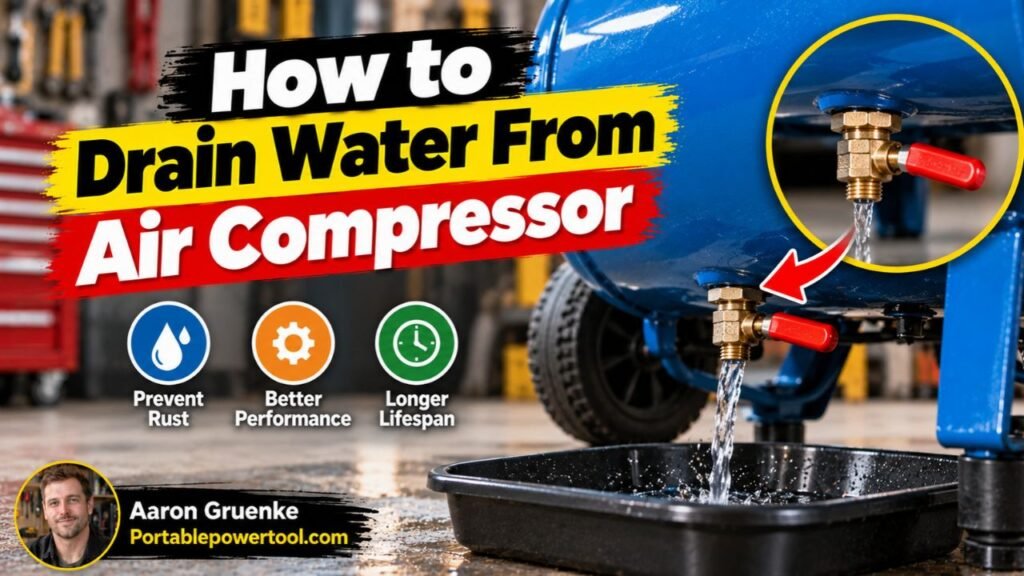
The basic procedure is to turn the air compressor off, disconnect power if appropriate, reduce tank pressure according to the manufacturer’s instructions, place the drain outlet where water can discharge safely, and open the tank drain valve located near the lowest point of the receiver.
A typical draining procedure looks like this:
- Turn off the air compressor.
- Disconnect the electrical power if required for maintenance.
- Allow the compressor and discharge tubing to cool if they are hot.
- Reduce tank pressure to the level recommended by the manufacturer.
- Locate the drain valve at the bottom of the receiver tank.
- Position the drain outlet over a suitable container or safe drainage area.
- Slowly open the drain valve.
- Allow water, moisture, and compressed air to escape.
- If necessary, slightly reposition a portable compressor so water reaches the drain.
- Close the drain valve after the tank has finished draining.
- Inspect the valve for leaks before operating the compressor again.
The exact procedure can vary by compressor, particularly with automatic drains or large stationary systems. Follow the owner’s manual whenever it gives model-specific instructions.
Why Does Water Collect in an Air Compressor?

Atmospheric air always contains some amount of water vapor.
The amount depends heavily on temperature and relative humidity.
When an air compressor pulls in atmospheric air and compresses it, the air becomes hot. As that compressed air later cools inside the receiver tank, it cannot hold all of the moisture in vapor form.
Some of the water vapor condenses into liquid.
That liquid collects at the bottom of the tank.
The process is similar to water forming on the outside of a cold drink, except the condensation occurs inside the compressed-air system.
Humid Weather Produces More Moisture
An air compressor used in a humid summer garage may collect significantly more water than the same compressor operating in cool, dry weather.
Moisture accumulation is influenced by:
- Relative humidity
- Ambient temperature
- Compressor run time
- Tank size
- Air consumption
- Compressor temperature
- Cooling conditions
Heavy compressor use can produce a surprising amount of condensate.
Where Is the Air Compressor Drain Valve?

The receiver drain is usually positioned at or very close to the lowest point of the air tank.
This location allows gravity to collect water near the valve.
Depending on the compressor, you may find:
- Petcock-style drain valve
- Quarter-turn ball valve
- Pull-ring drain
- Twist valve
- Automatic drain valve
- Electronic timed drain
On a horizontal compressor, the drain is usually underneath the center or lower portion of the tank.
On a vertical compressor, it is typically at the bottom of the receiver.
Do not confuse the tank drain with:
- Pressure relief valve
- Air outlet
- Regulator
- Pump oil drain
- Pressure switch connection
If you cannot identify the correct drain, consult the compressor manual before opening fittings.
Should You Drain the Tank Under Pressure?
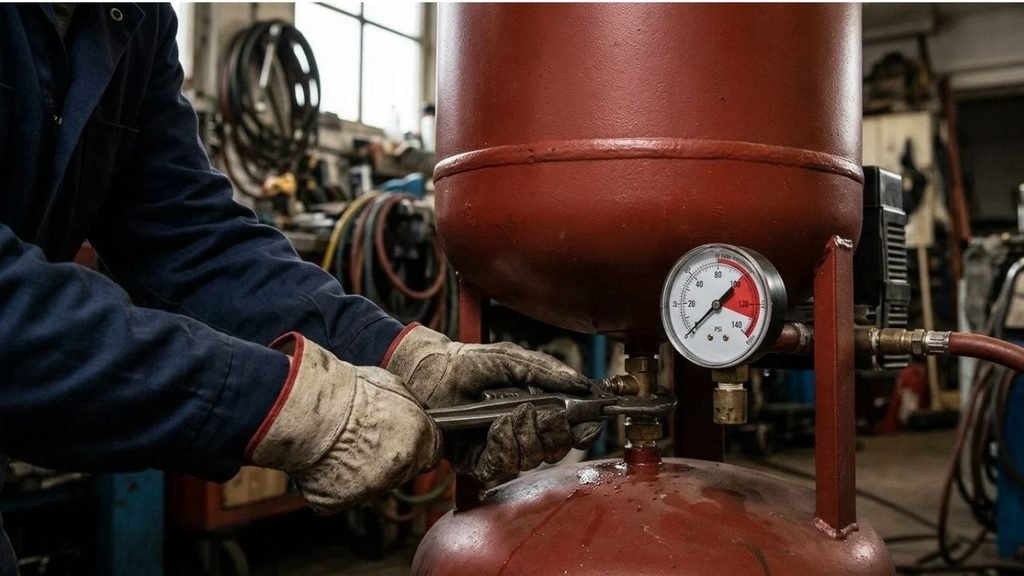
Some tank pressure helps push water out of the drain, but opening a drain valve with full receiver pressure can release air and water forcefully.
Manufacturers may specify a particular pressure range for draining.
Follow that recommendation.
A common maintenance approach is to reduce the receiver to a relatively low pressure and then carefully open the drain.
The drain should be opened gradually rather than suddenly.
Keep your:
- Face
- Hands
- Eyes
away from the discharge path.
Condensate can carry rust particles, compressor oil residue, and debris.
Should You Empty All the Air Before Draining Water?
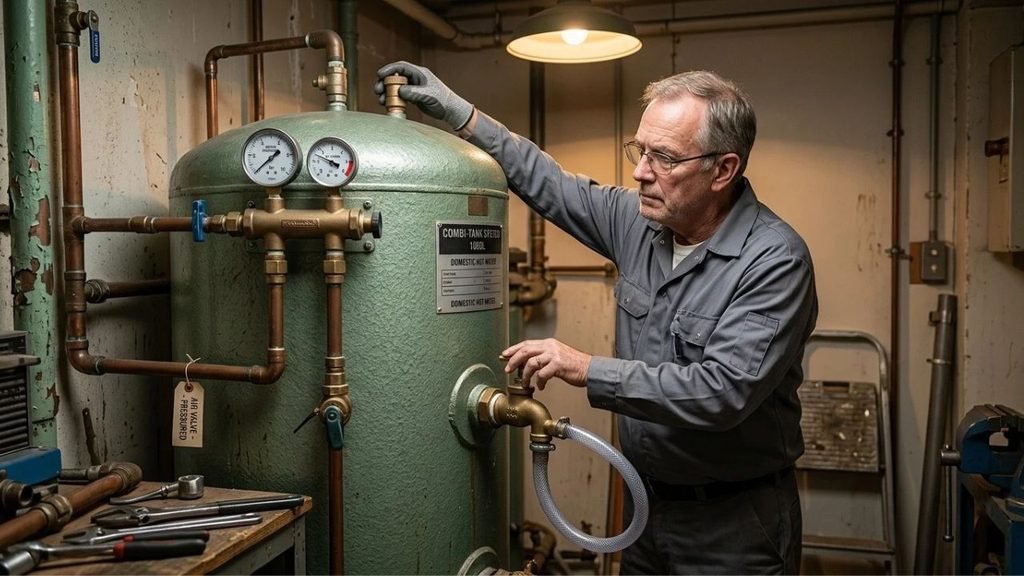
Not necessarily.
If all pressure is removed before the drain valve opens, there may be very little airflow available to push moisture and debris out.
On the other hand, you should not automatically open a small drain valve against maximum tank pressure.
Use the manufacturer’s specified draining procedure.
The goal is to have enough pressure to assist drainage without creating an unnecessarily forceful discharge.
Step-by-Step: Remove Moisture From an Air Compressor Tank
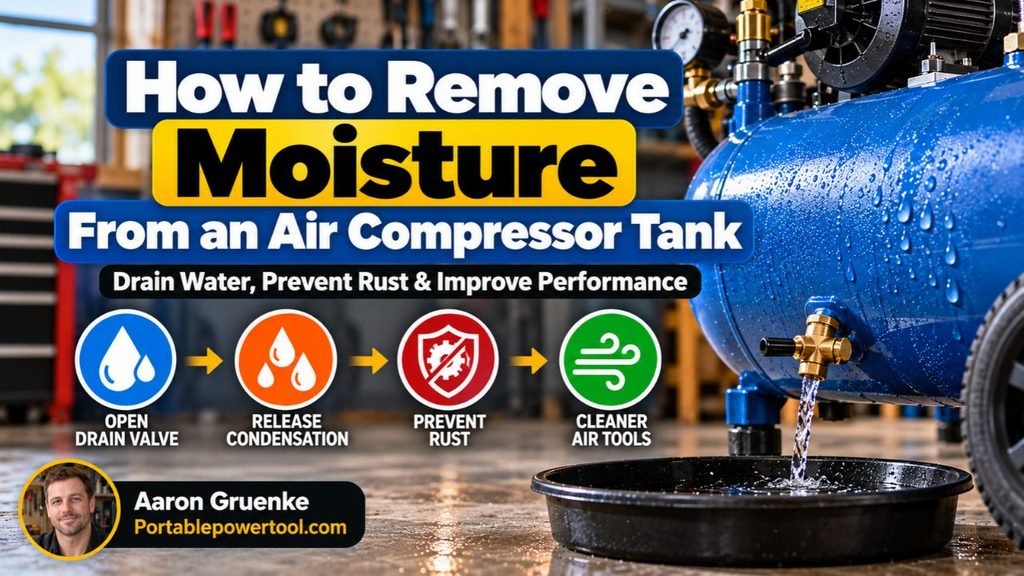
A careful draining routine helps remove more water and reduces mess.
Turn the Compressor Off
Allow the compressor to stop running.
For maintenance, disconnecting power can prevent an unexpected restart.
If the compressor is hardwired or part of a large shop system, follow the proper shutdown and isolation procedure.
Let Hot Components Cool
Compressor heads and discharge tubes can become very hot.
You usually do not need to touch these components to drain the receiver, but allowing the compressor to cool reduces the risk of accidental burns.
Reduce Receiver Pressure
Use a connected air tool, blow gun where appropriate, or another approved method to reduce pressure.
Watch the pressure gauge.
Stop at the pressure specified for draining in your owner’s manual.
Locate the Lowest Drain Point
Water settles at the bottom of the receiver.
Find the drain valve underneath the tank.
Portable compressors may require you to reach under the receiver, so make sure the unit is stable before doing so.
Prepare for Dirty Water
Compressor condensate may contain:
- Rust
- Dirt
- Oil residue
- Other contaminants
Place a container beneath the drain when appropriate.
Avoid spraying the condensate onto your clothing, walls, electrical equipment, or finished surfaces.
Open the Drain Slowly
Turn or operate the valve gradually.
You will normally hear compressed air escaping.
Water may initially:
- Spray
- Drip
- Mist
- Flow in a small stream
How much comes out depends on how long it has been since the tank was last drained.
Allow the Water to Exit
Keep the valve open until liquid water stops flowing.
If only air is coming out consistently, most accumulated liquid has likely been removed.
Reposition the Compressor if Necessary
Some portable compressors may trap a small amount of water because the drain is not perfectly at the lowest point when the machine is sitting normally.
If the manufacturer’s instructions permit it, gently tilting the tank can help move remaining water toward the drain.
Do not tip a compressor in a way that could:
- Make it unstable
- Spill pump oil
- Damage components
Oil-lubricated compressors deserve particular caution because excessive tilting can move crankcase oil where it should not go.
Close the Drain Valve
Once drainage is complete, close the valve securely.
It should be snug enough to seal but not overtightened.
Small drain fittings can be damaged if excessive force is used.
How Often Should You Drain Water From an Air Compressor?
There is no universal schedule that works for every compressor.
The proper frequency depends on:
- Humidity
- Compressor usage
- Tank size
- Duty cycle
- Ambient temperature
- Manufacturer instructions
For compressors used regularly, checking and draining the receiver after each work session is a common maintenance practice.
In humid environments or during heavy continuous use, the tank may need draining more frequently.
If only a tiny amount of moisture appears after several checks, you can develop a maintenance routine appropriate for your usage while still following manufacturer recommendations.
The important point is not to allow water to accumulate for long periods.
What Happens if You Do Not Drain the Air Compressor?
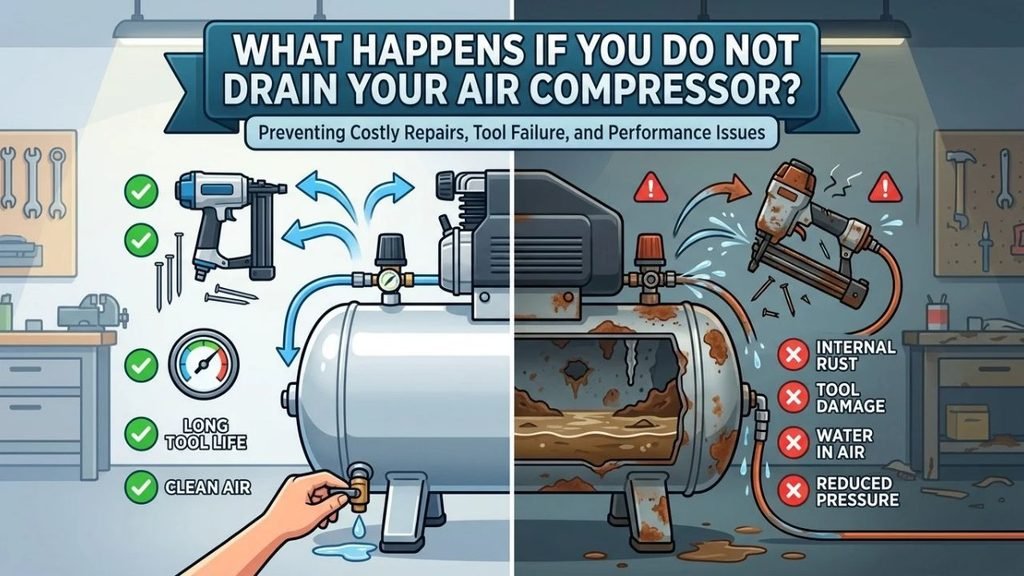
Skipping tank drainage can cause several problems.
Internal Tank Corrosion
Water sitting against bare steel can promote rust.
Because corrosion occurs inside the tank, you may not see it easily from the outside.
Receiver corrosion is a serious reason to follow tank inspection and replacement guidance from the manufacturer.
Water in Air Lines
Once enough water accumulates, moisture can be carried out of the tank and into hoses.
This may affect:
- Pneumatic tools
- Spray guns
- Tire equipment
- Air lines
Poor Paint Finish
Water contamination is particularly troublesome when using compressed air for:
- Automotive painting
- Clear coating
- Wood finishing
- Powder coating preparation
Moisture reaching the spray gun can contribute to defects in the finish.
Corrosion in Pneumatic Equipment
Moisture passing through air tools can contribute to internal rust if lubrication and moisture control are poor.
Reduced Air Quality
Applications that require dry, clean compressed air may become unreliable when moisture is allowed to travel downstream.
Can Water Inside an Air Compressor Tank Cause Rust?
Yes.
Internal corrosion is one of the main reasons regular tank draining matters.
Compressed-air receivers are designed to withstand significant internal pressure, so maintaining the integrity of the tank is important.
Never ignore signs such as:
- Serious external corrosion
- Deep pitting
- Bulging
- Tank damage
- Leaking through the tank wall
Do not attempt to repair a pressure receiver casually by welding or patching it unless the work is performed under applicable pressure-vessel procedures by qualified professionals.
A compromised tank may need replacement.
Why Is So Much Water Coming Out of My Compressor?
A large amount of condensate does not necessarily mean something is wrong.
You may simply be operating in:
- Hot weather
- High humidity
- Long compressor cycles
- High air-demand conditions
The more atmospheric air the compressor processes, the more moisture it can bring into the system.
If you live in a humid part of the United States, draining a noticeable amount of water after heavy use can be normal.
However, unusually heavy downstream water may indicate that your moisture-control system is inadequate for your application.
Draining the Tank Does Not Completely Dry Compressed Air
This distinction matters.
Opening the receiver drain removes liquid condensate that has collected inside the tank.
It does not remove all water vapor from the compressed air.
Compressed air leaving the receiver may still contain substantial moisture.
If your work requires dry air, you may need additional moisture-control equipment.
How to Remove More Moisture From Compressed Air
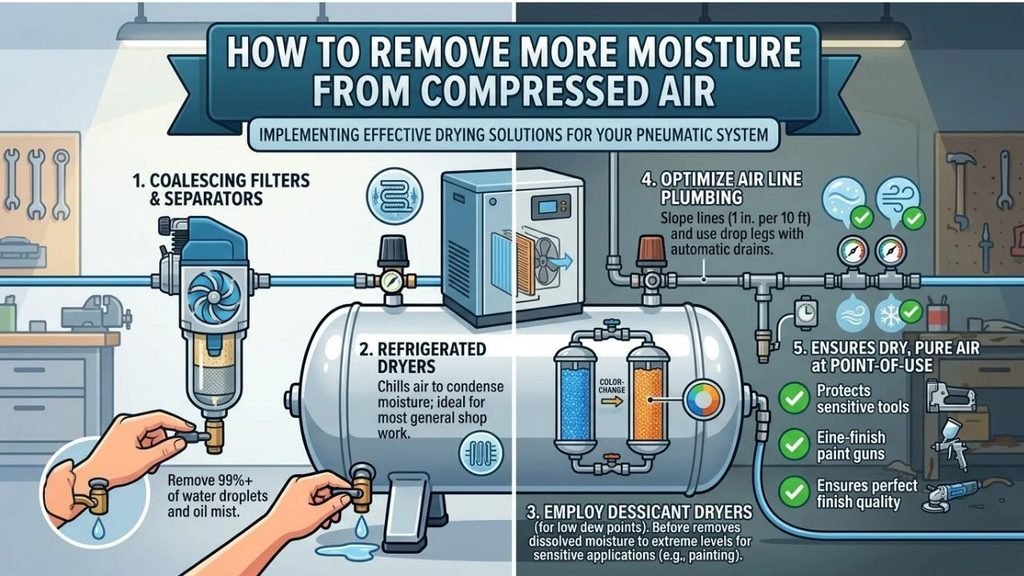
For basic shop use, regular tank draining may be enough.
For more demanding applications, several devices can remove additional moisture.
Moisture Separator
A moisture separator helps remove liquid water droplets carried through the compressed-air line.
It is often installed downstream of the compressor.
Separators need regular draining unless they have an automatic drain.
Aftercooler
Compressed air leaves the pump hot.
An aftercooler cools that compressed air before it travels farther into the system.
Cooling causes more water vapor to condense into liquid, which can then be separated and drained.
Refrigerated Air Dryer
A refrigerated dryer cools compressed air enough to condense a large amount of moisture.
The liquid is then removed from the system.
These dryers are common in workshops and industrial systems where consistently drier air is required.
Desiccant Dryer
A desiccant air dryer uses moisture-absorbing material to produce very dry compressed air.
It may be useful for:
- Certain painting processes
- Instrument air
- Sensitive pneumatic applications
- Extremely dry air requirements
Desiccant systems require proper maintenance or replacement/regeneration of the drying material.
Where Should a Moisture Separator Be Installed?
A separator generally works better after compressed air has had some opportunity to cool.
If it is mounted immediately next to the compressor outlet, much of the moisture may still exist as hot vapor rather than liquid droplets.
A properly designed air system may use:
Compressor → aftercooling/piping → receiver → separator/filter → dryer if required → point of use
The exact layout depends on the compressor and application.
For a small garage compressor, even allowing air to cool through properly arranged piping before a separator can improve water removal.
How to Keep Moisture Out of Air Compressor Lines
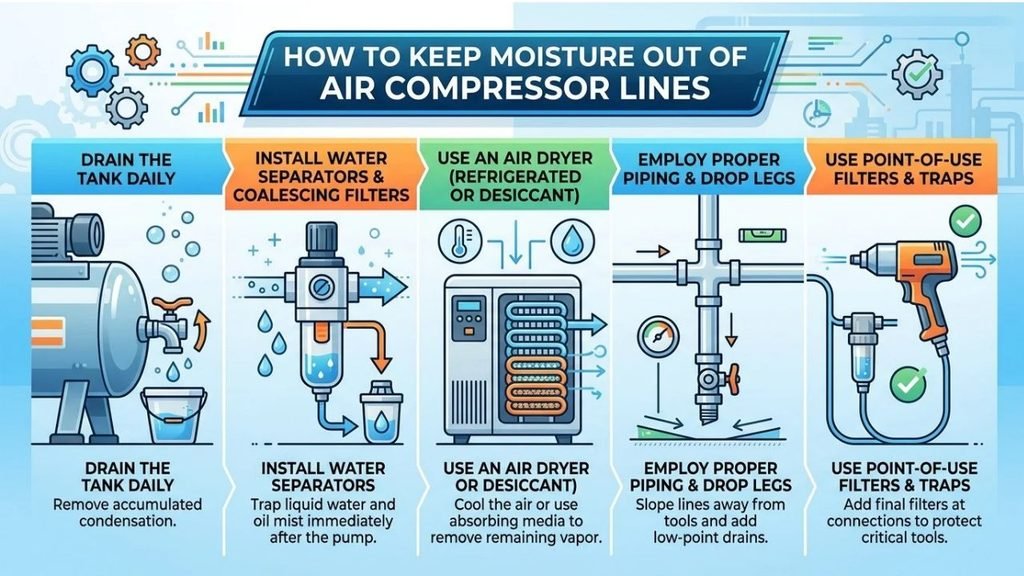
You cannot prevent the compressor from drawing humidity from the surrounding air, but you can reduce how much liquid water reaches your tools.
Helpful practices include:
- Drain the receiver regularly.
- Install a water separator.
- Use properly designed air piping.
- Slope main air lines toward drain points.
- Install drip legs where appropriate.
- Drain filters and separators.
- Keep the compressor in a reasonably dry, ventilated environment.
- Use an air dryer when the application requires very dry air.
Long horizontal lines can also allow compressed air to cool, causing additional moisture to condense downstream. This is why properly placed drain points remain important even when the main tank is drained regularly.
How to Remove Water From Air Compressor Lines
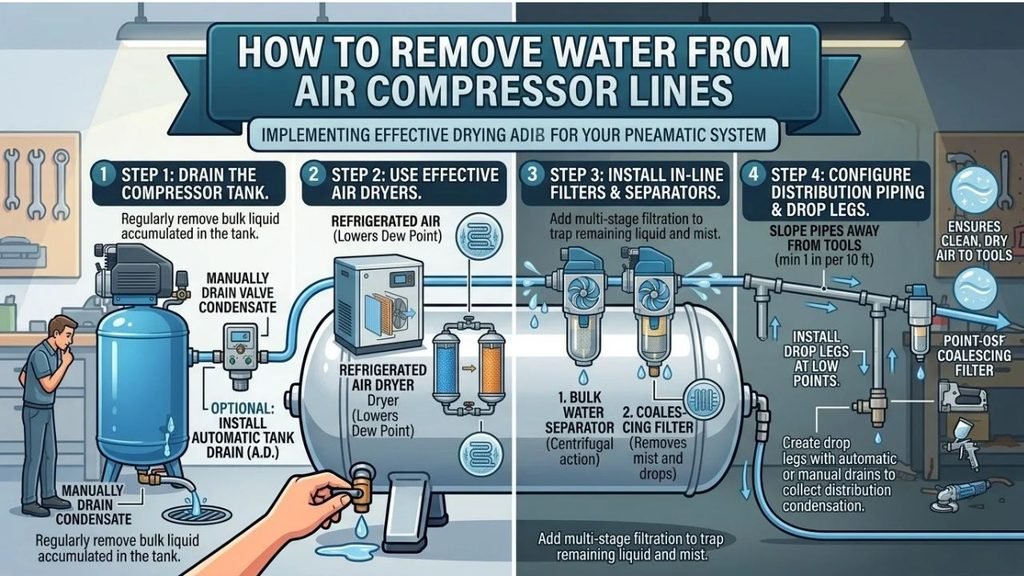
If water has reached the piping or hose system, draining only the receiver may not remove all of it.
Check for:
- Filter bowls
- Water separators
- Drip legs
- Low points in piping
- Secondary receiver tanks
Drain these locations using their intended valves.
A poorly designed air system can collect water at low points where no drain exists.
For permanent shop piping, correct slope and drain placement make moisture management much easier.
What Is an Automatic Drain Valve?
An automatic drain releases accumulated condensate without requiring you to manually open the receiver valve every time.
Common designs include:
- Timed electronic drains
- Float-operated drains
- Zero-loss drains
Automatic drains can be useful on compressors that:
- Run frequently
- Are difficult to access
- Serve commercial shops
- Produce significant condensate
However, an automatic drain still requires maintenance.
If it becomes clogged or fails, water may begin accumulating in the receiver.
Periodically verify that it is actually working.
Is an Automatic Drain Better Than a Manual Drain?
It can be more convenient, but neither system is automatically better for every situation.
A manual drain is:
- Simple
- Inexpensive
- Easy to inspect
Its main weakness is that someone has to remember to use it.
An automatic drain reduces dependence on memory but adds another component that can fail.
For busy shops, the convenience can be worthwhile.
For a small home compressor, regular manual drainage may be entirely adequate.
What if the Air Compressor Drain Valve Is Clogged?
Rust flakes, dirt, and other debris can restrict a drain.
Signs include:
- Little or no water comes out despite known moisture
- Only a tiny amount of air escapes
- Drain valve will not turn
- Valve leaks after being closed
Do not poke metal objects deeply into a pressurized tank drain.
Before servicing or replacing the valve:
- Shut the compressor off.
- Disconnect power.
- Completely depressurize the receiver.
- Verify the tank pressure gauge reads zero.
- Follow the manufacturer’s valve-removal procedure.
A fitting connected to a pressurized receiver should never be removed.
If the valve is heavily corroded or the tank itself appears compromised, professional inspection may be appropriate.
Why Does the Drain Valve Leak After Draining?
A drain valve may leak because of:
- Dirt on the sealing surface
- Rust particles
- Worn threads
- Damaged seal
- Worn valve
- Improper closing
Sometimes opening and closing the valve after the receiver has been safely depressurized can dislodge a small contaminant.
If it continues leaking, replace or service the drain according to the compressor manufacturer’s instructions.
Do not overtighten a delicate petcock in an attempt to stop leakage.
Should You Leave the Drain Valve Open During Storage?
Some compressor manufacturers recommend leaving the drain valve open during extended storage so remaining moisture can escape and the tank cannot accidentally retain pressure.
However, storage instructions vary.
Follow your model’s manual.
Before putting the compressor back into service, make sure the drain valve is closed and properly sealed.
Is Compressor Tank Water Dangerous?
The condensate is not necessarily clean water.
It can contain:
- Rust
- Lubricating oil
- Compressor residue
- Dirt
- Other contaminants
Avoid drinking it or using it as household water.
Environmental disposal requirements vary, particularly when compressor condensate contains significant oil.
Commercial facilities may need specific oil-water separation or disposal procedures.
Can You Use the Compressor’s Safety Valve to Drain Water?
No.
The pressure relief valve is a safety device designed to protect the receiver from excessive pressure.
It is not the normal water drain.
Use the dedicated drain valve at the bottom of the tank.
Repeatedly using the safety valve as a moisture drain can wear or contaminate the valve and may compromise its ability to seal correctly.
Should You Drain an Oil-Free Compressor Too?
Yes.
“Oil-free” describes the pump’s lubrication design. It does not mean the compressed air contains no moisture.
An oil-free compressor still pulls humid atmospheric air into the system, so condensation can still collect in its receiver tank.
Oil-free compressor tanks therefore still need regular draining.
Should You Drain a Portable Compressor After Every Use?
For frequently used portable compressors, draining accumulated condensate after the work session is a sensible routine, especially in humid conditions.
Portable pancake and hot-dog compressors can collect moisture even during relatively short periods of use.
Because their receiver tanks are relatively small, accumulated water can occupy a noticeable portion of the tank more quickly than many users expect.
Always follow the manufacturer’s maintenance schedule.
Should a 60-Gallon Compressor Be Drained Differently?
The basic principle is the same.
A 60-gallon stationary compressor normally has a drain at the lowest point of its receiver.
Because large compressors may process significantly more air, moisture accumulation can also be substantial.
An automatic tank drain is particularly convenient for heavily used large compressors.
Stationary systems may also have:
- Aftercoolers
- Multiple filters
- Drip legs
- Refrigerated dryers
Each moisture collection point must be maintained separately.
How to Tell if Your Compressed Air Has Too Much Moisture

Possible signs include:
- Water spraying from air tools
- Water inside hose couplers
- Moisture collecting in filter bowls
- Rust in pneumatic equipment
- Paint defects
- Water dripping from air lines
If you regularly drain the receiver but still see significant downstream moisture, adding better separation or drying equipment may be necessary.
Common Mistakes When Removing Moisture From an Air Compressor
Never Draining the Tank
This allows condensate to remain against the internal tank surface.
Opening the Drain Carelessly at Full Pressure
High-pressure air can spray dirty water forcefully.
Use the manufacturer’s procedure.
Assuming a Separator Replaces Tank Draining
The receiver can still accumulate condensate even when a separator is installed.
Assuming an Oil-Free Compressor Makes Dry Air
Oil-free compressors can still produce significant water condensation.
Ignoring Downstream Drains
Filters, separators, and piping low points may each collect water.
Forgetting an Automatic Drain Needs Maintenance
Automatic components can clog or fail.
Using the Safety Relief Valve as a Tank Drain
Use the proper receiver drain valve instead.
FAQs About How to Drain Water From Air Compressor
How often should you drain water from an air compressor?
Drain frequency depends on humidity, usage, and manufacturer recommendations.
For regularly used compressors, checking the receiver after each work session is a practical routine. Heavy use or high humidity may require more frequent draining.
Do I need to drain my air compressor after every use?
It is often a good practice, especially for portable compressors and machines operating in humid environments.
The owner’s manual should provide the specific maintenance recommendation for your compressor.
Why does my air compressor have so much water in it?
Atmospheric humidity enters with the intake air. Compression heats the air, and subsequent cooling causes moisture to condense into liquid.
Hot, humid weather and heavy compressor use generally increase condensation.
How do you remove moisture from an air compressor tank?
Open the dedicated tank drain according to the manufacturer’s procedure and allow the accumulated condensate to escape.
For moisture remaining in the compressed airflow, use separators or an air dryer where necessary.
Can I run my compressor with water in the tank?
A small amount of condensation may exist between normal draining intervals, but deliberately allowing large quantities of water to remain in the receiver is poor maintenance.
Regular drainage helps reduce corrosion and downstream water problems.
Does draining an air compressor remove all moisture?
No.
It removes liquid water that has accumulated inside the receiver.
Water vapor may still remain in the compressed air, which is why filters, separators, aftercoolers, or dryers may be required for dry-air applications.
What happens if the air compressor drain valve will not open?
Do not force or remove the valve while the tank is pressurized.
Shut down the compressor, disconnect power, fully depressurize the receiver, and then inspect or replace the drain according to the manufacturer’s instructions.
How can I keep water out of my air tools?
Drain the receiver regularly and use an appropriate moisture separator near the point of use.
For applications requiring very dry air, adding an air dryer and properly designed piping can further reduce moisture.
Conclusion
Learning how to drain water from air compressor tanks is simple, but it is one of the most valuable maintenance habits you can develop. Moisture is an unavoidable result of compressing humid atmospheric air, so even a perfectly functioning compressor can accumulate water in its receiver.
The practical solution is to drain the receiver regularly through its dedicated bottom drain, using the pressure and procedure specified by the manufacturer. This removes standing condensate, reduces the opportunity for internal tank corrosion, and helps keep liquid water from being carried into hoses and pneumatic tools.
If your goal is to remove moisture from an air compressor system more completely, tank draining is only the first step. Moisture separators, correctly designed piping, aftercoolers, drip legs, and refrigerated or desiccant dryers can remove additional water from the compressed-air stream when the job requires cleaner and drier air.
The overall verdict is straightforward: do not wait until water starts spraying from your air tools before maintaining the system. Drain the compressor tank routinely, inspect the drain valve, maintain downstream moisture-control equipment, and increase your draining frequency during humid weather or heavy compressor use. Those simple steps provide the most reliable way to drain water out of an air compressor, remove moisture from the air compressor tank, and protect the entire compressed-air system over the long term.